
Expanding a successful franchise into Israel is a compelling prospect for any global brand. However, understanding the requirements of a franchise agreement in Israel is crucial, as this dynamic market presents a unique legal landscape. It can easily ensnare unwary franchisors.
Unlike jurisdictions with specific, rigid franchise laws, Israel operates differently. This apparent lack of regulation often signals an easy market entry. Yet, this perception is dangerously misleading. Consequently, your brand’s protection hinges on navigating the unseen complexities.
This initial sense of freedom is deceptive. A franchise agreement in Israel is not governed by a singular “Franchise Act.” Instead, it is subject to the full weight of general commercial, contract, and competition laws. This framework is laden with hidden legal risks for those unprepared to protect their brand.
Navigating Israel’s Unregulated Franchise Market
Israel lacks a formal franchise statute. There is no Franchise Disclosure Document (FDD) system like in the United States. This absence frequently lulls international brands into a false sense of security. The assumption is simple: without a specific rulebook, the game is easier. However, this is a critical miscalculation. It is often costly.
In reality, any franchise agreement in Israel will be interpreted through a complex web of statutes. These laws were not written exclusively for franchises. Nevertheless, they carry immense power. They can expose an unprepared franchisor to significant legal and financial jeopardy. Therefore, this guide serves as a strategic map. It will help you fortify your brand and secure your intellectual property in this distinctive environment.
The True Legal Framework
There is no single law to follow. Instead, a successful franchisor must comprehend several distinct areas of Israeli law. These distinct areas interact to govern the relationship. Mastering this multi-layered environment is the foundational step. It is essential for building a solid, defensible agreement designed for brand protection.
Here are the key legal pillars that will shape your agreement:
-
Contract Law: Core principles of good faith and fairness are not mere suggestions. On the contrary, they are paramount and aggressively enforced by Israeli courts.
-
Competition Law: Proceed with caution. Clauses concerning pricing and territory can be invalidated. Specifically, they may be seen as restrictive arrangements under antitrust regulations.
-
Intellectual Property Law: Protecting your trademarks is not automatic. Rather, it demands proactive registration and meticulously drafted licensing clauses.
-
Tort Law: You could be held liable for a franchisee’s actions. For example, if your agreement inadvertently creates an agency relationship.
Navigating Israel’s Unregulated Franchise Market
The absence of a formal franchise statute, such as the Franchise Disclosure Document (FDD) system in the United States, frequently lulls international brands into a false sense of security. The assumption is that without a specific rulebook, the game is simpler. This is a critical, and often costly, miscalculation.
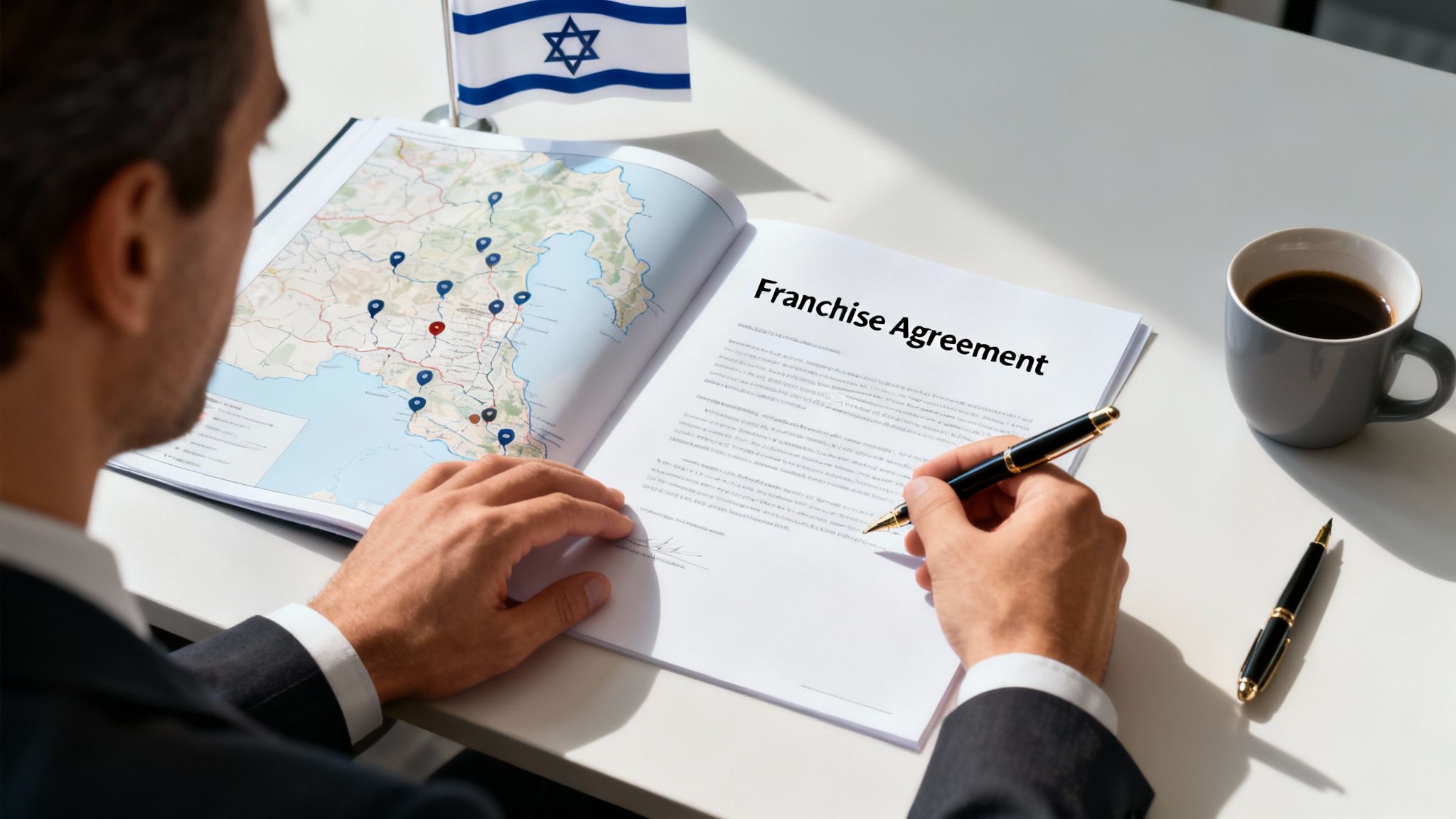
In reality, any franchise agreement in Israel will be interpreted through a complex web of existing Israeli statutes. These laws, though not written exclusively for franchises, carry immense power and can expose an unprepared franchisor to significant legal and financial jeopardy. This guide serves as a strategic map to fortify your brand and secure your intellectual property in this distinctive environment.
The Legal Framework for a Franchise Agreement in Israel
Instead of one law, a successful franchisor must comprehend how several distinct areas of Israeli law interact to govern the franchisor-franchisee relationship. Mastering this multi-layered legal environment is the foundational step toward building a solid, defensible agreement designed for brand protection.
Here are the key legal pillars that will shape your franchise agreement:
- Contract Law: Core principles of good faith, fair dealing, and reasonableness are not mere suggestions; they are paramount and aggressively enforced by Israeli courts.
- Competition Law: Proceed with caution. Clauses concerning pricing, territory, and supply chains can be invalidated as restrictive arrangements under antitrust regulations.
- Intellectual Property Law: Protecting your trademarks and trade secrets is not automatic. It demands proactive registration and meticulously drafted licensing clauses that leave no room for ambiguity.
- Tort Law: You could be held liable for a franchisee’s actions if your agreement inadvertently creates an agency relationship.
To succeed in Israel, a shift in mindset is required. You are not entering a regulatory vacuum but a sophisticated legal environment that values substance over form. Your agreement must do more than outline commercial terms; it must be engineered from the ground up to withstand judicial scrutiny under these powerful, established legal doctrines.
This guide will deconstruct the critical pitfalls you must avoid, offering real-world strategies to build a resilient and profitable franchise network. The cross-border expertise of RNC Group is tailored to navigate these complexities, ensuring your business is structured for success from day one. We will delve into the specifics of implied disclosure, non-compete clauses, and IP protection, providing a clear path to safeguarding your brand.
The Hidden Dangers of Implied Disclosure Obligations
The single greatest mistake a foreign franchisor can make in Israel is assuming that no specific franchise law equates to no disclosure requirements. This is a critical and often profoundly expensive misunderstanding. While Israel lacks a rigid, U.S.-style Franchise Disclosure Document (FDD), its legal system imposes a powerful pre-contractual duty that can be far more treacherous due to its ambiguity.
At the heart of Israeli contract law lies the principle of “good faith and fair dealing” (tom lev ve’derech mekubeket). This is not an ethical guideline but a binding legal duty that activates the moment negotiations commence. Israeli courts consistently interpret this to mean that a franchisor must provide a prospective franchisee with all material information a reasonable businessperson would require to make an informed decision. This creates a de facto disclosure standard that is dangerously vague for those accustomed to clear-cut rules.

Unpacking the “Good Faith” Obligation
What does this “good faith” duty actually demand? While no official checklist exists, Israeli case law provides strong indicators of where transparency is non-negotiable. Failure to disclose key information in these areas can lead to the voiding of your franchise agreement in Israel or expose your brand to costly misrepresentation claims.
Franchisors must be prepared to proactively share details concerning:
- The Basis of Financial Projections: If you provide any earnings claims or forecasts, you must also reveal the underlying assumptions, data, and methodologies. Presenting best-case scenarios without factual support is a direct path to a legal dispute.
- Known Operational Risks: Are there specific supply chain vulnerabilities, known market challenges, or regulatory hurdles that have impacted other franchisees? Concealing these known issues is a classic breach of good faith.
- Litigation History: A history of significant legal disputes with other franchisees, particularly concerning the business model’s viability, is considered material information.
- The True Costs of Operation: You must go far beyond the initial franchise fee. A transparent and realistic picture of all anticipated costs—from marketing fund contributions to mandatory technology upgrades—is essential.
The real risk is not what you are legally required to put in a specific document. It is what a judge, with the benefit of hindsight, will decide you should have shared. This retroactive scrutiny makes a proactive, thorough disclosure package not merely good practice, but a vital risk management tool in Israel.
How This Differs From Formal FDD Regimes
The Israeli approach is worlds apart from the structured FDD process in jurisdictions like the U.S. Understanding this distinction is fundamental to building a defensive legal strategy. The lack of a specific statute has not hindered Israel’s franchise market from attracting top global brands. Instead, agreements are governed by general commercial laws, with a watchful eye from the Israel Competition Authority to ensure they do not become ‘restrictive arrangements’—another layer of complexity demanding expert guidance. You can explore more data on franchise market growth to see how different regulatory environments shape expansion.
The fundamental difference lies in predictability. In the U.S., a franchisor knows precisely what the 23 items of the FDD demand. In Israel, the “reasonableness” standard is determined on a case-by-case basis, making the system far more subjective and perilous for the unprepared.
Disclosure Obligations: A Comparison of Israeli and U.S. Standards
This table highlights the stark contrast between the formal, checklist-driven requirements in the United States and the more ambiguous, principle-based obligations found in Israel.
| Legal Aspect | United States (Federal Trade Commission Rule) | Israel (General Contract Law) |
|---|---|---|
| Governing Framework | Formal, regulated system with a mandatory Franchise Disclosure Document (FDD). | Implied obligations derived from the duty of “good faith and fair dealing” in contract law. |
| Disclosure Content | Highly specific and standardized, covering 23 distinct items from fees to litigation history. | Fluid and non-specific; defined by what a “reasonable person” would consider material to their decision. |
| Legal Risk | Non-compliance with specific FDD rules, leading to clear statutory penalties. | Ambiguity and unpredictability; risk of litigation for misrepresentation or breach of good faith, judged retroactively. |
| Franchisor Strategy | Compliance-focused; meticulously completing a standardized document. | Risk-mitigation focused; creating a custom, voluntary disclosure package to preempt future claims. |
Ultimately, a franchisor’s best defense is not found in exploiting the absence of a formal law, but by proactively exceeding the Israeli courts’ expectations. When you construct a voluntary, robust, and transparent disclosure package, you are not just acting ethically—you are building a powerful shield against future legal challenges. This protective posture is absolutely essential for long-term success and brand preservation in the Israeli market.
Protecting Your Business After a Franchise Ends
When a franchise relationship concludes, the last thing a franchisor needs is for their former partner to become their newest, most informed competitor. You have invested years training them, granting them access to your proprietary playbook, customer data, and operational know-how. An ex-franchisee armed with such insider knowledge poses a serious threat to your brand. This is precisely why a post-termination non-compete clause is not mere legal boilerplate; it is a critical shield for your business.
However, this is where many foreign franchisors err in Israel. You cannot simply insert a standard, aggressive non-compete clause into your agreement and expect it to be upheld. Israeli courts hold the fundamental right to freedom of occupation in high regard. They will not rubber-stamp a restrictive covenant but will instead perform a delicate balancing act, weighing your legitimate business interests against the former franchisee’s right to earn a living. If your clause is deemed overly broad or punitive, it will be struck down, leaving your brand completely exposed.

The Three Pillars of Enforceability
For a non-compete to survive a legal challenge in Israel, it must be “reasonable.” The courts scrutinize this concept through three specific lenses. Your clause must be tightly tailored across all three to have any real force.
- Duration: How long are you attempting to restrict competition? A lifelong ban is unenforceable. Israeli courts tend to look favorably on restrictions lasting from six to 24 months, with the acceptable duration depending heavily on the industry and the sensitivity of your proprietary information.
- Geographic Scope: Where does the restriction apply? A blanket nationwide ban is almost certain to be invalidated. The restricted area must be directly tied to the franchisee’s former territory—the specific area where they operated and where your brand has a vested goodwill to protect.
- Scope of Activity: What exactly are you prohibiting? Banning them from working in the entire industry is far too broad. The clause must be specific, restricting only those activities that would place them in direct competition with your specific franchise model.
The secret to drafting an enforceable non-compete in Israel is precision. The goal is not to prevent a former franchisee from earning a living, but to prevent them from unfairly leveraging your confidential information and goodwill against you for a limited and reasonable period.
Linking Non-Competes to Confidential Information and Know-How
The single most compelling argument for enforcing a non-compete is its direct link to the protection of your trade secrets and proprietary know-how. This is the absolute cornerstone of a defensible post-termination strategy.
Israeli courts are far more inclined to enforce a restriction when its clear purpose is to safeguard the proprietary knowledge to which the franchisee was granted access. This includes your operations manual, customer data, pricing strategies, and unique marketing techniques—the very essence of your business.
Your franchise agreement must explicitly state that the non-compete’s purpose is to prevent the exploitation of this confidential information. This simple step reframes the clause from a punitive restriction on an individual’s career to a necessary measure to protect your legitimate intellectual property. Without this explicit link, a court is likely to view it as a blunt attempt to stifle fair competition, a position it will not uphold.
Proactive Strategies for Drafting a Strong Clause
To craft a non-compete that provides genuine protection without being dismissed by a court, a strategic and protective mindset is required.
Consider these practical steps:
- Define Confidentiality Broadly: Do not be vague. Clearly define “confidential information,” “trade secrets,” and “know-how” within the agreement, using specific examples relevant to your business.
- Justify the Restrictions: Use the text of the agreement to explain why the specific time and geographic limits are necessary to protect your legitimate business interests and goodwill.
- Use a Stepped Approach: Consider clauses that become less restrictive over time. For instance, a strict non-compete within the franchisee’s direct former territory for 12 months, followed by a less restrictive non-solicitation clause for another 12 months.
- Offer Consideration: While not always mandatory, offering some form of payment or benefit in exchange for agreeing to post-termination restrictions can strengthen your case by demonstrating an element of fairness.
By focusing on reasonableness and the clear objective of protecting your core assets, you can transform your non-compete clause from a legal gamble into a reliable shield. This foresight is vital for safeguarding your brand’s future in the Israeli market long after a particular franchise agreement concludes.
Safeguarding Your Intellectual Property and Know-How
When you franchise your business, you are not merely selling a product; you are licensing the very essence of your brand. Your intellectual property (IP)—the unique synthesis of your name, logo, operational methods, and accumulated goodwill—is your most valuable asset. Its protection is not just a clause in a contract; it is the absolute cornerstone of a successful franchise agreement in Israel. Protecting this IP and the operational know-how is paramount.
Your first, non-negotiable step is to register your trademarks with the Israeli Patent Office before you begin drafting a franchise agreement. Entering the Israeli market without a registered trademark is tantamount to leaving your vault unlocked. You risk losing control over your brand identity before your operations have even begun.

However, trademark registration is only the beginning. Much of what makes your business unique is your unregistered IP—the proprietary “know-how” that ensures its success. This includes your operations manuals, secret recipes, unique business processes, and customer management techniques. These are the crown jewels, and they demand a more nuanced, surgical approach embedded directly within your contractual framework.
Fortifying Your Unregistered IP and Know-How
To shield your operational secrets, your franchise agreement must contain ironclad confidentiality and non-disclosure clauses. These are not boilerplate text; they are your primary legal defense against a franchisee absconding with your playbook. They must be crystal clear, precisely defining what constitutes “confidential information” and “know-how,” and stating that its use is strictly limited to operating the franchise.
The agreement must explicitly detail the franchisee’s duties, including:
- Implementing specific security measures to protect both physical and digital copies of your manuals and data.
- Ensuring only employees with a direct need-to-know can access sensitive information.
- Immediately returning all proprietary materials upon the agreement’s termination.
These clauses legally transform your valuable know-how from mere business practices into protected assets. Without them, you have minimal recourse if a former franchisee launches a copycat business using your system under a new brand.
Structuring Airtight Licensing Terms
A common pitfall is drafting licensing terms that are vague or overly permissive. Your agreement must state, without a shadow of a doubt, that you are granting a limited, revocable license—not transferring any ownership. The franchisee is a temporary steward of your IP, not its co-owner. This distinction must be reinforced throughout the contract.
The core principle is control. Every clause related to your brand, from the use of logos on social media to store layout, must affirm your ultimate authority. The agreement should leave zero room for interpretation regarding who owns the IP and who has the final say on its use.
This is especially critical in Israel. With approximately 300 brands operating under franchise-like commercial agreements, the landscape is primarily governed by the Economic Competition Law. Since there are no specific franchise laws, this framework offers block exemptions for agreements that grant registered rights, like trademarks. An agreement lacking this clarity could be deemed ‘restrictive’ and necessitate a review by the Israel Competition Authority.
Defining Permitted Use and Consequences of Breach
Consider your franchise agreement a detailed user manual for your brand. It must specify exactly how your IP can be used—and just as importantly, how it cannot.
Be painstakingly clear on key areas:
- Brand Standards: Define the exact colors, fonts, and placement for all branding materials.
- Marketing and Advertising: Mandate a pre-approval process for all local marketing campaigns to maintain brand consistency.
- Online Presence: Establish firm rules for websites, social media accounts, and online ordering platforms.
A major part of this is comprehensive online brand protection to combat digital counterfeiting and fraud.
Equally crucial are the consequences for violating these rules. The agreement must state that any unauthorized use of your IP constitutes a material breach that can trigger immediate termination. This provides the leverage to act decisively. It should also grant you the right to seek injunctive relief—a court order compelling the franchisee to cease the infringing activity immediately, without the need to prove damages in a lengthy court battle. This is a powerful tool for stopping IP misuse in its tracks and preventing permanent damage to your brand.
Planning Your Endgame: Termination and Dispute Resolution
Every business partnership has a lifecycle, and franchising is no exception. How you plan for the end of the relationship can be the difference between a clean break and a messy, expensive legal battle. Building a robust exit strategy into your franchise agreement in Israel isn’t being pessimistic; it’s smart, strategic planning. This means carefully thinking through your termination and dispute resolution clauses to ensure they’re not just protective, but actually enforceable under Israeli law.
It all starts with defining what counts as a valid reason for termination. Obvious material breaches—like a franchisee not paying royalties or misusing your brand—are one thing. But franchisors need to be careful. Israeli courts lean heavily on the concept of “reasonableness” and will take a hard look at any termination that feels arbitrary or unfair, regardless of what the contract says. Trying to terminate the agreement over a minor issue without giving proper warning could easily be challenged and thrown out.
What Constitutes Solid Grounds for Termination?
Your agreement has to be crystal clear about what triggers a termination. Simply including a generic “termination for convenience” clause is a gamble, as Israeli courts will always test its use against the principle of good faith.
To make your termination clause hold up, it needs to include:
- Material Breaches: Spell out the serious offenses. This includes things like failing to meet brand standards, becoming insolvent, or engaging in criminal activity.
- Cure Periods: For less severe issues, you must provide a fair window of time for the franchisee to fix the problem—say, 30 days. This shows you’re acting reasonably and makes your position much stronger if things escalate.
- Immediate Termination Events: Save the instant termination for the absolute worst-case scenarios, like fraud or any action that causes severe, immediate damage to your brand’s reputation.
The recent case where McDonald’s bought back all 225 of its franchised restaurants in Israel from a long-time franchisee is a powerful reminder of how complicated these situations can get. While external pressures were a major factor, the event shows that without specific franchise laws, these disputes often get tangled up in Israel’s Economic Competition Law. This law forces courts to consider the length of the relationship, the franchisee’s investment, and their role in establishing the brand in the market. As a foreign franchisor, you have to be ready for complex negotiations, disputes, or even strategic buybacks. You can read more about how major brands handle franchise buybacks to understand the stakes.
Arbitration vs. Israeli Courts: A Critical Choice
When a dispute is unavoidable, where you resolve it is a huge strategic decision. The default is the Israeli court system, but for many international brands, international arbitration is a much more predictable and controlled environment.
Each option comes with its own set of pros and cons that you need to weigh carefully.
| Feature | Israeli Courts | International Arbitration |
|---|---|---|
| Confidentiality | Proceedings are usually public, putting your brand’s reputation at risk. | Private and confidential, keeping sensitive business matters out of the public eye. |
| Enforcement | Judgments are directly enforceable in Israel. | Awards are enforceable in over 170 countries thanks to the New York Convention. |
| Decision-Maker | A judge who may not have deep experience in franchising or commercial law. | An arbitrator (or panel) chosen by the parties, often a recognized expert in the field. |
| Procedure | Formal, rigid rules with the potential for long, drawn-out appeals. | A more flexible and streamlined process with very limited grounds for appeal. |
| Cost | Can be unpredictable, with costs spiraling due to extensive discovery and appeals. | Costs can be more predictable, though the initial setup might be higher. |
Choosing between litigation and arbitration isn’t just a procedural box to tick; it’s a core risk management decision. For a franchisor operating across borders, the certainty, confidentiality, and global reach of an arbitration award often deliver a decisive edge in protecting the brand.
For your arbitration clause to be worth the paper it’s written on, it has to be drafted with surgical precision. It needs to name the seat of arbitration (like London or Geneva), the governing rules (such as ICC or LCIA), and the language of the proceedings. Any ambiguity is your enemy. A sloppy clause can be challenged, dragging you right back into the very local court system you wanted to avoid. Getting expert legal help to craft this endgame plan ensures your brand stays protected, no matter how the partnership concludes.
Crafting a Bulletproof Franchise Agreement in Israel
Many foreign franchisors look at Israel and see a landscape without a specific, dedicated “franchise law.” This can create a dangerous illusion of simplicity. The reality is that succeeding here isn’t about finding regulatory loopholes; it’s about building a sophisticated and proactive legal fortress from day one.
While you won’t find a single franchise statute, a powerful combination of contract, competition, and intellectual property law governs these relationships. This creates a surprisingly complex environment for those who arrive unprepared. Think of it less as an empty field and more as a minefield of interconnected legal principles.
The most common traps for the unwary include implied disclosure duties under the broad principle of “good faith,” narrowly interpreted non-compete clauses that courts often dislike, and weak IP safeguards that fail to stand up to scrutiny. Each of these represents a critical point of failure that can lead to expensive litigation, serious brand damage, and a complete loss of your competitive edge. Your only real defense is a meticulously drafted franchise agreement in Israel that anticipates and neutralizes these challenges before they arise.
Your Brand’s Best Shield
This agreement is far more than a standard commercial contract; it is your brand’s most critical shield in the Israeli market. By proactively building in robust protections, crystal-clear definitions, and enforceable clauses specifically tailored to Israeli judicial standards, you transform your agreement from a potential liability into a strategic asset. As you navigate the intricate process of drafting and reviewing these agreements, leveraging specialized legal document processing solutions can significantly improve both efficiency and accuracy.
The ultimate takeaway is simple: a forward-thinking, defensively structured agreement empowers your brand, minimizes risk, and builds the foundation for a resilient and profitable franchise network in Israel. Confronting these legal realities before you enter the market is the absolute key to long-term success.
Got Questions About Israeli Franchise Agreements? We Have Answers.
If you’re bringing a foreign brand to Israel, you’re bound to have questions. The legal landscape here can be surprising, especially since Israel doesn’t have a dedicated, all-in-one franchise law like many other countries. This often trips people up. Let’s clear the air on some of the most common concerns we hear from international franchisors.
Do I Have to Register My Franchise Agreement in Israel?
Simply put, no. There’s no government registry or official filing process for franchise agreements in Israel. While that sounds straightforward, don’t mistake procedural simplicity for a lack of oversight. The real issue isn’t registration; it’s competition law.
The key piece of legislation to watch is Israel’s Economic Competition Law. If your franchise agreement in Israel includes clauses that could be seen as a ‘restrictive arrangement’—think price-fixing or rigid territorial exclusivity—you might need a green light from the Israel Competition Authority. This is a nuanced area, and getting an expert legal opinion is crucial to determine if your agreement falls under a block exemption or requires formal approval.
How Are Franchisee Rights Here Different from the EU?
The difference is night and day, and it all comes down to the source of legal protection. Most EU nations have specific laws that spell out the rights and responsibilities of franchisors and franchisees. Israel doesn’t.
Instead, franchisee rights are built on general principles of contract law, with one concept reigning supreme: ‘good faith’ (known in Hebrew as Tohm Lev). Israeli courts take this principle very seriously. They will look beyond the black-and-white text of your agreement and scrutinize the fairness of the entire relationship. This means things like providing reasonable notice before termination or ensuring a franchisee is fairly compensated for their investments if you part ways become critically important. It’s a system based more on judicial interpretation than rigid statutes.
In Israel, the spirit of an agreement is often judged as harshly as the letter of the law. Your conduct and commitment to fair dealing are constantly under a microscope, creating a legal environment that is far more fluid than the strict statutory frameworks common in the EU.
What’s the Tax Situation for Royalties from an Israeli Franchisee?
This is a critical point for your financial projections. Royalties paid by an Israeli franchisee to a foreign franchisor are typically hit with a withholding tax right here in Israel. In practice, this means your franchisee must deduct a percentage of their royalty payment and send it directly to the Israeli Tax Authority before the rest hits your account.
But the rate isn’t fixed. The final tax bill can often be substantially lowered thanks to double taxation treaties between Israel and the franchisor’s home country. Unlocking the most favorable rate involves navigating these complex treaties, making expert tax and legal advice not just a good idea, but essential for protecting your bottom line.
Bringing a franchise to Israel is a major undertaking, and success depends on getting the legal foundation right from day one. RNC Group combines deep local knowledge with international legal expertise to protect your brand, secure your investment, and help you build a resilient franchise network. Contact our team to ensure your market entry is built to last.
This article does not constitute legal advice and is not a substitute for consulting with a qualified attorney. Do not rely on the contents of this article for taking or refraining from taking any action.