
When operating in a region known for its geopolitical volatility, a force majeure clause transcends boilerplate language; it becomes a critical line of defense against sudden, crippling disruptions. For corporate entities and international businesses in Israel, mastering the nuances of local force majeure interpretation is not merely advisable—it is essential. A standard, off-the-shelf “Act of God” provision can leave a company dangerously exposed when a true crisis unfolds. This guide offers a realistic perspective on navigating unforeseen events. It covers everything from the stringent Israeli doctrine of frustration to the strategic necessity of custom-drafted “War Clauses.”
The Unique Landscape of Contractual Risk in Israel
Navigating commercial agreements in Israel demands a heightened awareness of risk, particularly for unforeseen events that can halt operations overnight. The instinct for many international executives during a disruption is to invoke the force majeure clause, believing their non-performance is excused.
However, the application of force majeure in Israel differs significantly from many Western jurisdictions. The legal system, shaped by a history of conflict, has cultivated a pragmatic and often stringent view of what constitutes a genuinely unforeseeable event. As a result, this reality presents numerous pitfalls for the unprepared.
Israel’s Doctrine of Frustration: Section 18
In the absence of a specific force majeure clause, Israeli law provides a default mechanism: the doctrine of frustration (Sikul), codified in Section 18 of the Contracts Law (General Part), 1973. This doctrine can discharge a contract if performance becomes impossible. Alternatively, it applies if performance becomes so fundamentally different from the original intent that enforcing it would be unjust.
Relying on Sikul is a high-stakes gamble. The burden of proof is exceptionally high. It requires the party to convince a court that the disruptive event was not something that could have been reasonably anticipated at the time of signing.
“The core idea behind frustration is that the event must so fundamentally change the contract’s nature that it would be unjust to hold the parties to their original promises. The new circumstances must be something they couldn’t have possibly contemplated when they signed.”
This standard sets the stage for a critical reality check: what feels entirely unforeseeable in London or New York may be deemed foreseeable in Tel Aviv.
The Foreseeability Hurdle: Why War is Rarely a Default Excuse
This is the concept that often surprises foreign entities. Israeli courts have a long-standing precedent of viewing the outbreak of war or military operations as a foreseeable risk of conducting business in Israel.
This judicial perspective means that simply citing “war” as a force majeure event is almost certain to fail. Courts expect sophisticated commercial parties to understand the regional context and to proactively plan for such contingencies within their agreements. Therefore, this realistic stance underscores several vital points for business clients:
- Standard Clauses Are Insufficient: Generic, boilerplate force majeure language offers unreliable protection.
- Specificity Is Paramount: True protection is not found in statutory defaults but in meticulously drafted, bespoke contract terms.
- Proactive Drafting Is Non-Negotiable: Clauses must be tailored to address specific regional risks, explicitly defining trigger events.
For our foreign clients engaged in commercial law, litigation, and crisis management, a standard agreement is inadequate. The contract must feature a specific and robust “War Clause” that eliminates ambiguity. It should clearly define the rights and obligations of each party during a security crisis. Without this foresight, the business assumes an unacceptable level of legal and financial risk.
The High Bar of Israel’s Frustration Doctrine
If your contract lacks a force majeure clause, Israeli law offers a statutory fallback: the doctrine of “frustration,” known locally as Sikul. Codified in Section 18 of the Contracts Law (General Part), 1973, it can, in theory, excuse a party from its obligations when an unforeseen event renders performance impossible.

In practice, relying on Sikul is a perilous strategy. Israeli courts have established an exceptionally high threshold for its application. It is less a safety net and more a last-resort legal argument. To succeed, a party must satisfy a demanding, three-part test.
This is not about mere inconvenience or increased costs. It requires an event that shatters the very foundation upon which the agreement was built.
The Three Pillars of Frustration
To successfully invoke the doctrine of frustration in Israel, a party must prove all three of the following conditions. Failure to meet even one will cause the entire claim to collapse.
- Unforeseeability of the Event: The disruptive event must have been something the parties did not—and could not have reasonably—foreseen when the contract was signed.
- Impossibility of Prevention: The party must demonstrate that it had no means to prevent the circumstances that impeded performance.
- Fundamental Destruction of Purpose: The event must have made performing the contract impossible or so radically different from the original intent that it destroys the agreement’s commercial purpose.
Falling short on any of these points can result in a finding of breach of contract. This can expose the party to significant damages. It underscores the critical importance of proactive and precise contract drafting.
Why Foreseeability Is the Greatest Challenge
Of the three conditions, foreseeability is by far the most difficult to meet in the context of force majeure in Israel. The Israeli Supreme Court has consistently held that, given the nation’s history, the possibility of armed conflict and security disruptions is often a foreseeable business risk.
An event that might be considered a classic “Act of God” in another country could easily be classified by an Israeli court as a known, albeit infrequent, operational risk in the region. This judicial mindset effectively bars the use of frustration as an easy exit during times of conflict.
This strict interpretation places an immense burden on the party seeking relief. It is not enough to point to a crisis; one must prove that this specific crisis was so different in nature and scale from past events that it was truly unforeseeable. This is an argument that rarely succeeds in court without overwhelming and highly specific evidence.
Israeli Frustration vs. Common Law Impracticability
It is crucial for international businesses to recognize how Israel’s standard diverges from what they may be accustomed to. For example, the more flexible doctrine of “impracticability” in common law jurisdictions like the United States sets a different expectation.
| Legal Principle | Israeli Doctrine of Frustration (Sikul) | US Common Law Doctrine of Impracticability |
|---|---|---|
| Threshold | Impossibility: Performance must be physically impossible or the core purpose utterly destroyed. | Impracticability: Performance must be made excessively burdensome, difficult, or expensive by an unforeseen event. |
| Foreseeability | Extremely Strict: In Israel’s geopolitical context, events like war or security threats are often deemed foreseeable. | More Flexible: The event must be something that was not a basic assumption of the contract. Courts are more open to arguments of unforeseeability. |
| Economic Hardship | Generally Not a Defense: Increased costs or lost profits are almost never enough to justify a frustration claim. | Can Be a Defense: A severe and unreasonable increase in costs can sometimes be sufficient to invoke the doctrine. |
| Judicial Approach | Very Narrow Interpretation: Israeli courts are highly reluctant to let parties out of their contractual obligations. | More Balanced Approach: Courts weigh the equities and fairness to both parties more openly. |
The key takeaway is that the statutory safety nets expected under common law do not exist in the same form under Israeli law. Ultimately, the doctrine of frustration is more of a theoretical backstop than a practical tool. Its application is narrow and fraught with risk. This leads to the most important lesson for any foreign company operating in Israel. You cannot rely on statutory defaults. The only reliable safeguard is a meticulously negotiated force majeure clause tailored to the specific risks of the Israeli commercial and geopolitical landscape.
Why War Is Not an Automatic Escape Clause
For many international executives, the eruption of war seems to be the quintessential force majeure event—an unforeseeable disaster that should automatically excuse contractual performance. However, this assumption is a critical and potentially costly mistake when doing business in Israel. The legal reality here is shaped by a history that compels courts to view conflict not as a shocking, once-in-a-lifetime event, but as a recurring, and therefore often foreseeable, business risk.
This judicial realism establishes a high bar for any company seeking relief. Since a landmark 1979 Supreme Court ruling described Israel as a ‘constant war-threat nation,’ this principle has continued to influence commercial disputes. Consequently, one cannot simply declare a “state of war” and expect to be released from contractual obligations.
The core question an Israeli court will ask is not whether a war occurred, but whether the conflict directly and unavoidably rendered performance impossible. Mere difficulty, increased cost, or logistical challenges are almost never sufficient grounds.
This distinction is paramount. Israeli courts adeptly separate genuine impossibility from what they perceive as economic hardship. A war may make raw materials more expensive or shipping routes less direct. However, these are typically considered commercial risks a business must bear. The law demands an unbreakable chain of causation between a specific wartime event and the inability to perform.
The Critical Link: From Event to Impossibility
To build a credible force majeure claim in Israel, specificity is key. Vague assertions about “the war” are inadequate. The burden of proof rests entirely on the claimant and requires hard evidence linking a specific action or consequence of the war to non-performance.
Consider the “Swords of Iron” war, which began on October 7, 2023. This event triggered the mobilization of over 300,000 reservists, creating widespread disruption. Yet, even these significant impacts do not grant an automatic release from contractual duties. You can explore more insights into the war’s effect on international business in this detailed analysis.
A successful claim requires direct, documented proof of impact, such as:
- Key Personnel Mobilized: Demonstrating that specific engineers or project managers essential to fulfilling the contract were called up for reserve duty, with no viable replacements available.
- Government-Ordered Shutdown: Presenting an official military or government decree that mandated the closure of the exact factory, facility, or access route required for performance.
- Supply Chain Severance: Documenting that a sole-source supplier’s facility was physically destroyed or rendered inaccessible by direct military action, not merely that supplies were delayed.
Without this type of specific, documented proof, a court will likely conclude that performance was merely more difficult or expensive, not truly impossible, leaving the party in breach of contract.
Drafting Beyond Generic Clauses: The “War Clause”
A standard-issue force majeure clause that simply lists “war” or “hostilities” is dangerously insufficient in the Israeli legal environment. An effective contract anticipates the court’s stringent tests and addresses them in advance. This is where a meticulously drafted, Israel-specific “War Clause” becomes an invaluable strategic tool for foreign clients.
By defining specific trigger events—such as a government declaration of a “special situation on the home front” (הכרזה על מצב מיוחד בעורף) or the mass mobilization of reservists—you replace legal ambiguity with contractual certainty.
This proactive drafting shifts the entire dynamic. The issue is no longer a high-stakes legal debate about foreseeability but a straightforward factual verification: did a contractually defined event occur? This allows both parties to agree, in advance, on precisely which wartime events will excuse performance, suspend obligations, or grant the right to terminate. For any foreign company operating in Israel, this is not just best practice. In fact, it is essential risk management.
Drafting an Ironclad War Clause for Your Contract
In Israel’s commercial environment, relying on statutory safety nets like “frustration of contract” is a precarious strategy, especially during a conflict. The courts’ consistent view of war as a foreseeable business risk means that statutory relief is rarely granted. Your most potent, and often only, reliable shield is the one you construct yourself within the four corners of your commercial agreement. A meticulously drafted, Israel-specific force majeure provision—often termed a "War Clause"—is not legal boilerplate. Rather, it is a critical risk management instrument.

A well-crafted clause transforms the legal calculus. Instead of a contentious courtroom debate over “foreseeability,” the question becomes a simple factual inquiry: did a pre-defined event occur? An affirmative answer triggers the pre-agreed consequences. This approach delivers the certainty and predictability that international businesses require to operate with confidence.
Moving Beyond Generic Templates
A generic clause that vaguely mentions “war” or “hostilities” is dangerously inadequate. It invites judicial interpretation—the very outcome you seek to avoid. Your clause must be tailored to the specific operational realities of Israel. Additionally, while focusing on the War Clause, it is also prudent to review the fundamentals of drafting contracts that protect your business. A strong contract functions as a cohesive whole.
A resilient War Clause for the Israeli market must contain three core components: explicit trigger events, clearly defined consequences, and unambiguous procedural rules.
Essential Component 1: Specific Trigger Events
This is the heart of your clause. Vague terms must be replaced with specific, verifiable events that activate the force majeure provisions. This shifts the focus from subjective legal interpretation to objective fact.
Consider including triggers such as:
- Official Government Declarations: The declaration of a “special situation on the home front” (Matzav Miyuchad Ba’Oref) or a formal state of emergency by the Israeli government.
- Military Mobilization: A widespread call-up of military reservists (e.g., exceeding a specified number of employees or a percentage of the local workforce).
- Disruption to Critical Infrastructure: The closure of major ports (like Ashdod or Haifa), airports, or key highways by government or military order for a specified duration.
- Direct Physical Impact: Documented missile or rocket attacks within a specified radius of key operational facilities, such as factories, data centers, or warehouses.
By detailing such events, you create undeniable tripwires that remove ambiguity.
Essential Component 2: Defined Consequences
When a trigger event occurs, the contract must explicitly state the consequences to prevent disputes over the scope of relief. A robust clause outlines a clear, multi-stage response plan rather than merely excusing performance.
A sophisticated War Clause anticipates the full lifecycle of a crisis. It should provide for an initial suspension of obligations, allowing the situation to stabilize, followed by clear termination rights if the disruption becomes prolonged. This prevents parties from being locked into an unworkable agreement indefinitely.
Key consequences to define include:
- Suspension of Obligations: An initial “breathing room” period (e.g., 60-90 days) where contractual duties are paused without penalty.
- Termination Rights: If the force majeure event continues beyond the suspension period, one or both parties should have the explicit right to terminate the contract with written notice.
- Payment Obligations: Clearly specify the status of payments for work already completed or goods delivered before the event.
Essential Component 3: Clear Procedural Rules
Finally, your clause must establish a clear process for its invocation. Procedural errors can invalidate an otherwise perfect claim. Ambiguity here is as damaging as a poorly defined trigger.
Your clause needs a clear, step-by-step process:
- Formal Notice Requirement: The affected party must provide prompt written notice to the other party, typically within a short, defined timeframe (e.g., 7-14 days) of the event’s onset.
- Duty to Mitigate: The clause should reinforce the invoking party’s legal duty to take all reasonable steps to mitigate the impact of the event and minimize damages.
- Information Sharing: Require the affected party to provide regular updates and evidence regarding the disruption and their efforts to overcome it.
Checklist for a Resilient War Clause in Israeli Contracts
| Clause Component | Objective | Example Language Snippet |
|---|---|---|
| Specific Triggers | Remove ambiguity and tie activation to objective, verifiable events specific to Israel. | “A force majeure event shall be deemed to have occurred upon… the official declaration of a ‘Special Situation on the Home Front’ by the Israeli Minister of Defense.” |
| Causation Link | Ensure the clause requires a direct link between the event and the inability to perform. | “…provided that such event directly prevents, hinders, or delays the affected party from performing its obligations under this Agreement.” |
| Suspension Period | Define a clear initial period for suspending obligations without penalty. | “Upon the occurrence of a force majeure event, the affected party’s obligations shall be suspended for an initial period of 60 days.” |
| Termination Rights | Grant a clear exit strategy if the disruption is prolonged. | “If the force majeure event continues for a period exceeding 90 consecutive days, either party may terminate this Agreement upon 30 days‘ written notice.” |
| Notice Procedure | Mandate a strict, time-bound process for invoking the clause. | “The affected party must provide written notice… within 14 days of the commencement of the force majeure event, detailing the nature of the event and its expected impact.” |
| Mitigation Duty | Reinforce the legal requirement to minimize the impact of the disruption. | “The party invoking this clause shall use all commercially reasonable efforts to mitigate the effects of the force majeure event.” |
By integrating these three pillars—specific triggers, defined consequences, and clear procedures—into your contract, you replace legal uncertainty with commercial clarity. This proactive approach is the most effective way to safeguard operations and transform a potential contract breach into a managed, predictable outcome.
How to Strategically Invoke a Force Majeure Clause
Declaring force majeure is not a mere procedural step; it is a high-stakes strategic decision that can redefine business relationships. When a crisis prevents performance, a methodical plan is essential. This roadmap outlines how to invoke a clause under Israeli law, ensuring your actions are defensible while preserving long-term commercial interests.
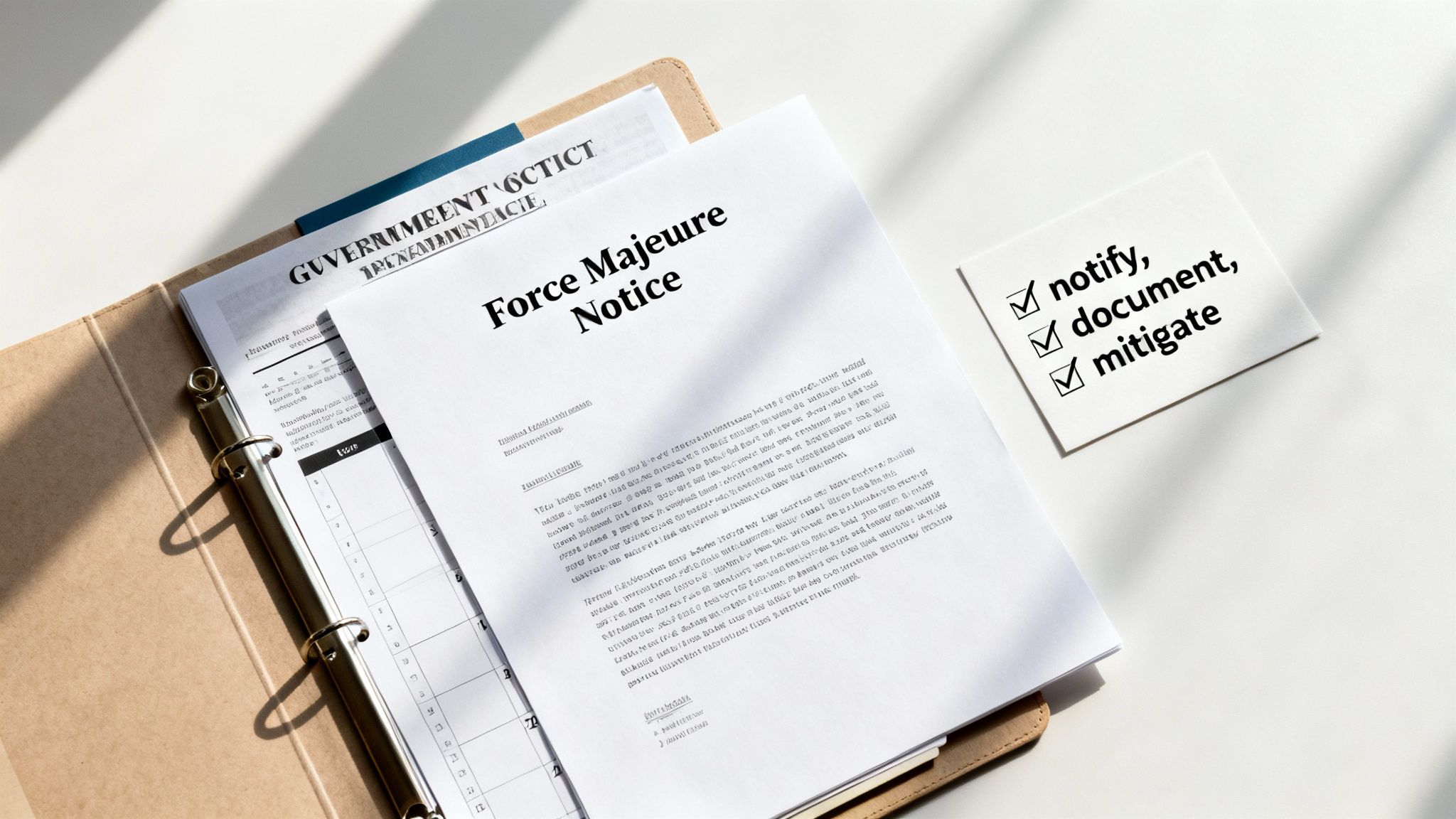
Once a force majeure event occurs, time is of the essence. Your first action must be to provide immediate, formal, and written notification to the other party. Delay can be detrimental, as many contracts specify a narrow window for notice. Missing this deadline may be interpreted as a waiver of your rights. This could potentially leave you in breach of contract.
This initial notice must be substantive. It should clearly state that you are invoking the force majeure clause. It should also describe the specific event and explain precisely how it renders performance impossible.
Building an Unassailable Evidentiary Record
A declaration without proof is insufficient. To withstand legal challenges, you must meticulously document every aspect of the disruption. The objective is to build an undeniable record that establishes a direct causal link from the event to your non-performance. This paper trail is your most powerful asset in any subsequent negotiation or litigation.
Your evidence portfolio should be ironclad and include:
- Official Decrees: Copies of government orders, military directives, or declarations of a “special situation” that directly impact your operations.
- Logistical Proof: Notices from port authorities regarding closures, communications from shipping companies confirming canceled routes, or official announcements of road blockades.
- Personnel Records: Official mobilization orders (Tzav 8) for key employees whose absence critically impairs your ability to operate.
- Third-Party Communications: Written confirmation from sole-source suppliers or critical vendors explaining their inability to deliver due to the same event.
This level of detailed proof is mandatory. A classic case following the 1973 Yom Kippur War saw a seller’s force majeure claim fail because they could only demonstrate hardship, not absolute impossibility. Unlike the more lenient ‘impracticability’ standard in U.S. law, Israeli courts demand rigorous proof. In-depth legal precedent can be explored in this analysis of international commercial arbitration.
Fulfilling the Duty to Mitigate
Invoking force majeure does not absolve you of all responsibility. Israeli law, like most jurisdictions, imposes a duty to mitigate. This requires you to take every commercially reasonable step to lessen the impact on your counterparty. Failure to do so can weaken or even invalidate your entire claim.
This is an active obligation that could involve:
- Sourcing materials from an alternative supplier, even at a higher cost.
- Identifying alternative shipping routes to bypass a blockade.
- Reassigning remaining staff to cover the most critical duties of mobilized employees.
Document every attempt to mitigate, including unsuccessful ones. This demonstrates good faith and responsible action, which significantly strengthens your legal position.
Preserving the Relationship Through Strategic Communication
Finally, how you communicate is as crucial as what you do. An adversarial approach can quickly lead to burned bridges and costly litigation. A more effective strategy is to frame the situation as a shared problem requiring a collaborative solution.
By providing regular, transparent updates and detailing your mitigation efforts, you can guide the conversation toward a constructive outcome. Propose alternatives such as a temporary suspension of the contract, a renegotiation of timelines, or a partial delivery schedule. This strategic communication can transform a potential legal battle into a managed crisis. It preserves value far more effectively than any courtroom victory.
Common Questions About Force Majeure in Israel
Navigating a commercial dispute in a foreign legal system presents significant challenges. When a crisis impacts operations in Israel, urgent questions arise, and the stakes are high. The following are answers to the most pressing questions international clients face. They are based on extensive experience in Israeli commercial law and cross-border crisis management.
Does a Government Lockdown Qualify as Force Majeure?
The answer depends entirely on the specific language of your contract. If your force majeure clause explicitly lists triggers like “government action,” “epidemic,” “pandemic,” or “official decrees restricting movement,” your position is strong. Such clear language can transform a complex legal argument into a more straightforward contractual issue.
If your contract is silent, you must rely on the statutory doctrine of frustration (Sikul), which presents a much higher hurdle. To succeed, you must prove the lockdown made performance physically or legally impossible—not merely more expensive or difficult. For example, a government order padlocking your factory is powerful evidence of impossibility. In contrast, a general travel restriction that complicates logistics but does not halt them is a much weaker argument and unlikely to meet the high bar set by Israeli courts.
What Is the Difference Between Suspending and Terminating a Contract?
A well-drafted force majeure clause is not a simple on/off switch but a multi-stage process designed to manage a crisis over time. It provides both stability and a clear exit strategy.
Typically, the process includes two distinct phases:
- Suspension: The occurrence of a defined force majeure event triggers a temporary suspension of contractual obligations. This creates a contractually sanctioned “pause,” often for a set period like 60 to 90 days. During this window, neither party can sue for breach, allowing both sides to assess the disruption’s duration and impact.
- Termination: If the force majeure event continues beyond the initial suspension period, the clause should grant one or both parties the right to terminate the agreement without penalty. This is an essential escape hatch, preventing parties from being trapped indefinitely in a commercially unviable contract.
For this mechanism to be effective, every detail—from the suspension period’s length to the notice required for termination—must be unambiguously defined.
What Are My Rights If My Israeli Supplier Declares Force Majeure?
When you receive a force majeure notice, a swift and methodical response is crucial. Do not accept it at face value. Your first step should be to demand a formal written notice that provides a detailed explanation and, most importantly, concrete proof linking their failure to a specific force majeure event.
A vague claim of “disruption due to the war” is insufficient. Scrutinize your contract and demand hard evidence, such as:
- Official government orders shutting down their facility.
- Documented proof of key employee mobilization.
- Confirmation from port authorities that their specific shipment was halted.
Next, review the force majeure clause in your agreement. Does their justification align with the contractually defined events? Did they provide notice within the required timeframe? Did they fulfill their duty to mitigate the damage? If their claim is weak or unsupported by evidence, you may have strong grounds to reject it and pursue a claim for breach of contract.
Can I Claim Force Majeure if War Makes My Contract Unprofitable?
The answer is almost universally “no.” Israeli law draws a sharp distinction between impossibility of performance and economic hardship. A sudden spike in raw material costs, adverse currency fluctuations, or soaring shipping insurance premiums—even if directly caused by a war—are typically considered standard business risks.
Neither the doctrine of frustration nor a standard force majeure clause is intended to protect against a deal that has become unprofitable. The event must render performance impossible or so radically alter the contract’s nature that its original purpose is destroyed. Increased cost, however severe, almost never meets this stringent test. Attempting to invoke force majeure on these grounds is highly likely to fail and could result in liability for breach of contract.
This article does not constitute legal advice and is not a substitute for consulting with a qualified attorney. Do not rely on the contents of this article for taking or refraining from taking any action.