
For corporate entities and international businesses operating in Israel, a pivotal question consistently arises: are electronic signatures legally binding on commercial contracts? The answer is an unequivocal yes. Israel’s legal framework not only permits the use of an e-signature in Israel but accords electronic agreements the same legal weight as traditional pen-and-ink signatures. This, in turn, facilitates efficient and secure cross-border transactions.
Navigating Digital Transactions in Israel
As a global technology hub, Israel’s high rate of digital adoption provides fertile ground for paperless commerce. For corporate entities engaged in commercial law, litigation, or crisis management, a sophisticated understanding of digital agreement compliance is not merely beneficial. On the contrary, it is essential for operational success and risk mitigation.
The nation’s digital-first approach has positioned it as a leader in e-signature adoption, a significant advantage for international businesses. Consider that by late 2025, Israel is projected to have 10.4 million active cellular connections—109% of its population. This pervasive connectivity streamlines the electronic execution of agreements. The COVID-19 pandemic stress-tested this digital readiness. Furthermore, it cemented e-signatures as the standard. This mirrors a global market trend that saw a leap from USD 4.9 billion in 2022 to a projected USD 15.5 billion by 2026. You can explore Israel’s digital capabilities in greater detail in this comprehensive report.

Core Principles for Cross-Border Commerce
This guide is engineered to demystify the legal landscape, beginning with the core pillars that uphold digital contracts in Israel. It serves as a foundational resource for understanding both the viability and the critical nuances of the system. For any foreign entity, several key principles are paramount:
- Legal Equivalence: Israeli law treats electronic signatures as legally identical to their handwritten counterparts, ensuring the enforceability of your contracts.
- Tiered Security Levels: The legal system is not monolithic. It recognizes distinct types of e-signatures, each carrying a different level of security and evidentiary weight.
- Transaction-Specific Rules: For high-stakes transactions such as mergers, acquisitions, or certain governmental filings, a standard e-signature is insufficient. A specific, more secure class of signature is often mandated by law.
By mastering these foundational concepts, your organization can execute agreements with confidence, accelerate deal closures, and significantly mitigate legal risk within the Israeli market. The core of digital compliance lies in aligning the signing methodology with the transaction’s specific legal and commercial demands.
In the sections that follow, we will delve into the technical distinctions between these e-signature tiers and their implications for your high-value commercial activities. We will deconstruct the legal classifications, clarify when a more secure signature becomes mandatory, and identify which documents remain excluded from digital execution. This knowledge is fundamental to maintaining compliance and ensuring your contracts are legally unassailable.
Understanding the Israeli Electronic Signature Law
The legal bedrock for any e-signature transaction in Israel is the Electronic Signature Law, 2001. This legislation is the definitive framework that grants electronic signatures the same legal status as traditional handwritten signatures. The law strategically establishes a tiered system based on security protocols and the evidentiary strength behind the signature, ensuring that the level of authentication is commensurate with the importance of the transaction.
This tiered system can be analogized to the methods for delivering a critical document. A standard “Electronic Signature” is akin to standard mail—perfectly valid and sufficient for most routine commercial agreements where the intent to sign is evident.
Ascending to a higher level of security, a “Secured Electronic Signature” is comparable to certified mail. It provides cryptographic verification that links the signature uniquely to the signatory. Additionally, it confirms that the document has not been altered post-signing.
The highest tier, a “Certified Electronic Signature,” is the digital equivalent of a notarized document. It carries the strongest possible legal presumption of validity because it is issued and verified by a trusted, government-recognized certification authority.
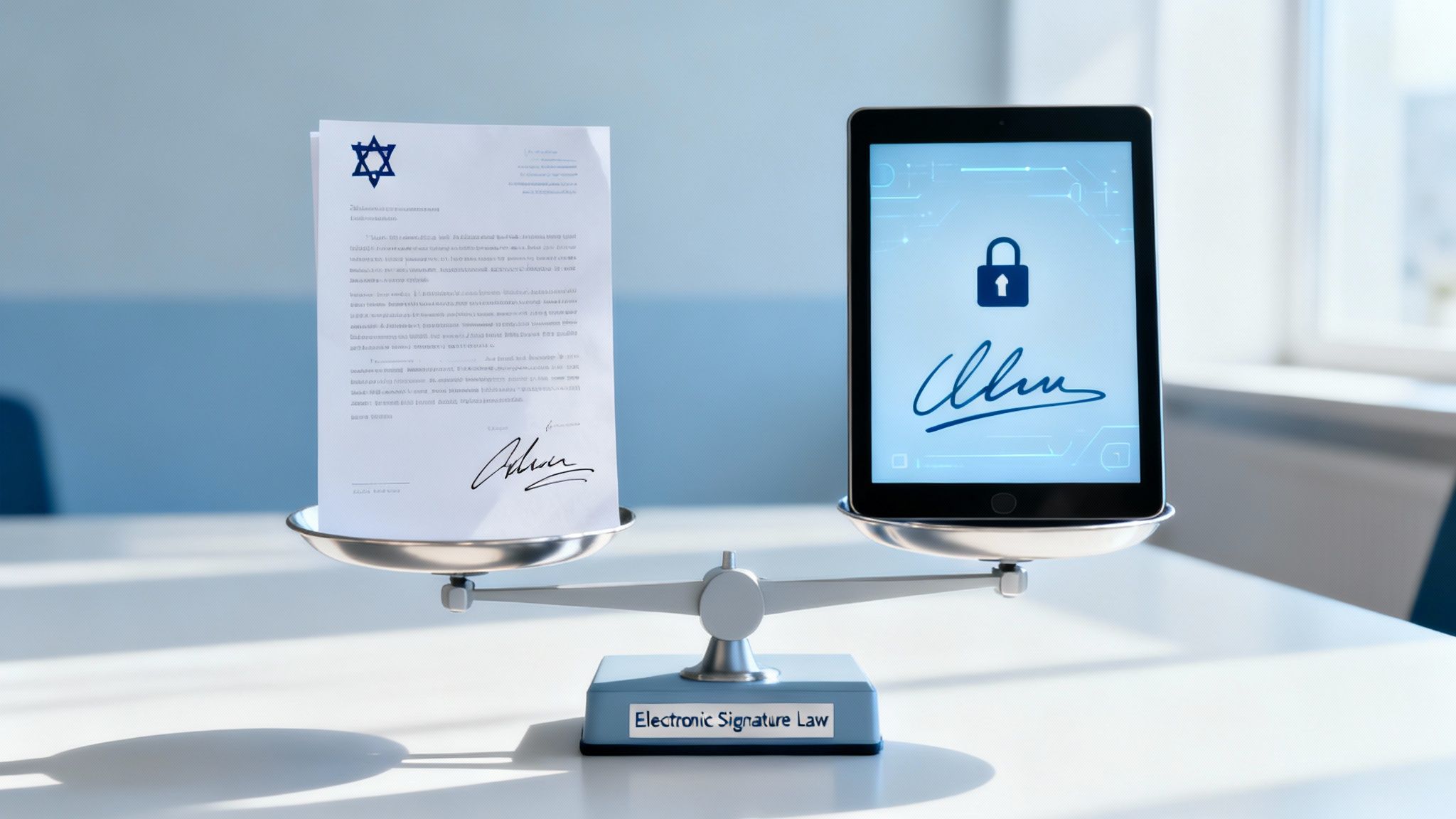
The Three Tiers of Israeli E-Signatures
For any international corporation operating in Israel, a precise understanding of these tiers is not merely academic—it is a matter of critical compliance. Each classification carries a distinct legal weight. This fact becomes paramount should a high-stakes commercial dispute proceed to litigation. Utilizing an incorrect signature type can render a contract unenforceable. Moreover, it can expose your business to significant financial and legal risk.
The law was designed with technological neutrality in mind, focusing on the outcome—reliability and authenticity—rather than the specific software used. This forward-thinking approach ensures the legal framework’s enduring relevance. The pivotal distinction between the tiers lies in the burden of proof. As a result, higher-tier signatures invert this burden. They require the party challenging the signature to prove its invalidity, instead of compelling you to prove its authenticity.
For our corporate clientele, selecting the appropriate signature tier is a strategic imperative. A standard e-signature is highly effective for streamlining routine contracts like non-disclosure agreements or basic service agreements. However, for a multi-million-dollar M&A transaction or a sensitive intellectual property licensing agreement, a secured signature provides an indispensable layer of legal defense.
Let us now examine the technical and practical distinctions of these tiers. This will provide the foundational knowledge required to ensure your digital agreements are ironclad under Israeli law.
Classifications of Electronic Signatures Under Israeli Law
The table below provides a comparative analysis of the three signature types recognized by the Electronic Signature Law, 2001. It serves as a practical guide to their technical requirements, legal standing, and common business applications.
| Signature Type | Definition & Requirements | Legal Presumption | Common Use Case |
|---|---|---|---|
| Electronic Signature | Any electronic data logically attached to other electronic data, used by the signatory to indicate intent to sign. This includes a typed name, a scanned signature image, or a “click-to-accept” action. | Admissible in court, but the party relying on the signature bears the burden of proving its validity and the signatory’s intent. | Everyday commercial contracts, sales orders, HR onboarding forms, and standard service agreements where risk is low. |
| Secured Electronic Signature | Must be uniquely linked to the signatory and capable of identifying them. It must be created using means under the signatory’s sole control (e.g., a private key) and linked to the data in such a way that any subsequent change is detectable. | Carries significantly higher evidentiary value. The signature is presumed to be valid, shifting the burden of proof to the challenging party. | High-value corporate contracts, major financial agreements, and transactions with government bodies where non-repudiation is critical. |
| Certified Electronic Signature | A “Secured Electronic Signature” that has been verified and issued by a Certification Authority officially recognized by the Israeli government. It is accompanied by a formal digital certificate. | Possesses the highest legal weight, legally equivalent to a handwritten signature. It is presumed authentic and valid by law, making it exceptionally difficult to challenge. | Official filings with government bodies such as the Israeli Tax Authority or the Companies Registrar, and other submissions where explicitly required by law. |
Mastering these distinctions is a practical necessity for compliance and risk management. For instance, employing a simple electronic signature for a transaction that legally mandates a “Secured” one could render the agreement void. This is a frequent pitfall for foreign companies accustomed to different regulatory frameworks, such as the EU’s eIDAS regulation, which has its own unique classifications. It is precisely in navigating these subtle yet critical differences that RNC Group’s cross-border expertise proves invaluable. This ensures your digital processes are fully compliant from the outset.
When a Secured E-Signature Is Mandatory
While a standard electronic signature is sufficient for most commercial dealings, Israeli law establishes a clear demarcation for high-stakes and official transactions. The legal system mandates a higher standard of proof when the consequences are significant, particularly in interactions with government authorities. These situations require incontrovertible proof of the signatory’s identity and assurance that the document’s integrity has been maintained post-signing. This is where the Electronic Signature Law, 2001 specifically mandates a Secured Electronic Signature or a Certified Electronic Signature.
High-Stakes Government Interactions
The most frequent scenario requiring a mandatory secured signature is interaction with Israeli state authorities. These institutions will not accept a simple e-signature due to its lack of cryptographic assurance of the signer’s identity. Attempting to submit official documents with an inadequate signature type will result in rejection, operational delays, and significant administrative burdens.
A Secured or Certified e-signature becomes non-negotiable in these key scenarios:
- Official Filings with the Israeli Tax Authority: Submissions of annual reports, formal tax documents, and asset declarations require a signature that meets stringent verification standards.
- Submissions to the Companies Registrar: Critical corporate actions—such as filing for incorporation, amending company bylaws, or registering director changes—all demand the heightened security of a certified signature.
- Interactions with other Government Ministries: Many other governmental submissions, particularly in regulated industries or for public tenders, explicitly require a secured signature to ensure authenticity and prevent fraud.
The governing principle is straightforward: when the counterparty is a government body and the transaction holds legal weight, the law elevates the standard for digital proof. A Secured Electronic Signature establishes a robust, cryptographically verifiable link between the individual and the document, rendering it nearly impossible to repudiate.
Why This Evidentiary Standard Matters in Practice
Adherence to this standard is fundamental to digital compliance and risk management. The primary objective is to achieve non-repudiation—making it impossible for a signatory to later disavow their action. A Secured or Certified signature accomplishes this by embedding a digital certificate uniquely tied to the individual, creating an immutable and verifiable audit trail.
For global corporations, this detail is critical. The digital signature market, valued at USD 5.57 billion in 2024, is projected to surge to USD 150.69 billion by 2034. Businesses are driving 76.8% of this growth with precisely this type of PKI-secured signature technology. With 42% of companies now prioritizing audit trails to combat contract fraud, Israel’s focus on verifiable identity offers a level of trust. This, in turn, directly supports RNC Group’s strategies for preemptive dispute resolution. For deeper insights into these trends, consult this market research report.
The consequences of using an improper signature type are severe, potentially invalidating government filings, rendering agreements unenforceable, and creating substantial legal exposure. For any company navigating commercial law and litigation, ensuring every digital signature meets the required legal threshold is a core pillar of effective corporate governance.
Key Documents You Cannot Sign Electronically
While Israel’s e-signature framework facilitates broad commercial application, it is not without limitations. Israeli law deliberately excludes certain high-stakes documents from digital execution, mandating traditional, physical signatures where security, deliberation, and ceremonial gravity are paramount. For foreign entities and investors, understanding these statutory exceptions is fundamental to maintaining compliance.
These exclusions are not arbitrary; they are designed to prevent fraud and undue influence in situations involving profound personal and financial consequences. The law recognizes that for certain instruments, classic formalities—such as signing in the physical presence of a witness or a notary public—provide an indispensable layer of protection. Attempting to execute these documents digitally will not only fail. It will also render them legally invalid. This is a costly and entirely avoidable error.
The following categories of documents are generally excluded from Israel’s Electronic Signature Law and require a physical, wet-ink signature:
- Wills and Testamentary Documents: To ensure authenticity and prevent coercion, documents related to inheritance, such as last wills and testaments, typically require physical signatures and often witness attestations as prescribed by succession law.
- Certain Real Estate Deeds: While preliminary real estate agreements may be signed electronically, final deeds and other instruments requiring registration with the Israel Land Registry (Tabu) must be physically signed, often in the presence of a real estate attorney.
- Documents Requiring Notarization: This is a definitive rule. If Israeli law mandates notarization for a document, it must be signed in the physical presence of a notary public. Digital execution is not a permissible substitute.
This legal distinction is a deliberate safeguard. Requiring a physical signature in these contexts compels deliberation, verifies identity beyond digital doubt, and creates an unambiguous record for transactions that are often irreversible.
The Critical Real Estate Exception
Israel’s dynamic real estate market has digitized many aspects of the transaction process, benefiting foreign investors. However, a critical exception frequently surprises those accustomed to different jurisdictions.
Globally, real estate is a significant driver of e-signature adoption, accounting for 76.8% of enterprise use. While preliminary agreements in Israel can often be signed digitally, the final deeds requiring registration with the Land Registry Office (Tabu) still mandate physical signatures.
This detail is absolutely vital. The Middle East’s digital signature market is projected to grow from USD 170.79 million in 2022 to USD 1.49 billion by 2030, as detailed in this detailed industry report. A misunderstanding on this point could easily invalidate a major property transaction.
Navigating these exceptions demands precise legal guidance. For international investors, assuming universal applicability of electronic execution is a serious compliance risk. With extensive experience guiding non-residents through Israeli real estate transactions, our firm is positioned to manage these complexities, ensuring every document meets its specific legal requirements.
Best Practices for International Commercial Agreements
While understanding the legal theory behind Israel’s e-signature framework is essential, translating that knowledge into a tangible business advantage requires practical application. For international corporations seeking to leverage the efficiency of digital signing for Israeli operations—be it for supply chain contracts, SaaS agreements, or complex M&A deals—success depends on embedding key practices into every cross-border agreement.
These practices are not merely procedural suggestions; they are foundational elements for constructing legally resilient contracts designed to withstand scrutiny in an Israeli court. The objective is to eliminate ambiguity. Moreover, you want to establish a fortress of enforceability around your digital agreements.

Fortify Your Contracts with Explicit Clauses
The first line of defense is to leave no room for doubt. Although an e-signature in Israel is legally valid by default, your contracts should explicitly state that all parties intend to be bound by signing digitally. This simple measure preempts any future claim that a party did not comprehend the legal gravity of their electronic signature.
A well-drafted clause should accomplish three objectives:
- Consent to Electronic Execution: A clear statement that all parties agree to conduct the transaction electronically and accept that a digital signature carries the same legal weight as a handwritten one.
- Governing Law and Jurisdiction: Unambiguously designate the laws of the State of Israel as governing the agreement and specify Israeli courts as the exclusive jurisdiction for dispute resolution. This creates legal certainty.
- Platform Acknowledgment: While not strictly required, identifying the secure e-signature platform used in the agreement adds another layer of evidence demonstrating clear intent and a structured signing protocol.
Consider this proactive clause your primary defense in a potential dispute. It transforms the implicit acceptance of an e-signature into an explicit, undeniable contractual term, making it exceptionally difficult to challenge later.
Maintain an Impeccable Digital Audit Trail
One of the most powerful evidentiary tools at your disposal is the automatically generated audit trail from modern e-signature platforms. This digital record serves as your key witness if a signature’s validity is ever questioned. It provides a detailed, time-stamped log of the entire signing event.
A robust audit trail meticulously records:
- Signatory Information: The full names and email addresses of all signatories.
- Authentication Records: Proof of how each signatory’s identity was verified (e.g., email link authentication, SMS code verification).
- Timestamps: The precise date and time of every action, from document opening to final signature.
- IP Addresses: The IP address of the device used for signing, providing crucial geographic context.
- Document Integrity: A cryptographic hash or similar verification method to prove the document was not altered after the final signature was applied.
This is not merely a technical feature; it is a legal safeguard that provides strong, admissible evidence.
Integrate with Broader Contract Management Protocols
Securing the signature is only one part of a comprehensive strategy. To truly protect your interests, e-signing must be integrated into a larger system. Understanding effective contract management is essential for creating streamlined, compliant digital workflows. This means your signing process should feed into a contract lifecycle management (CLM) system. It needs to track how contracts are created, stored, monitored, and eventually renewed or terminated.
By treating e-signatures as one component of a holistic contract strategy, you build a more efficient and legally secure operation. This ensures every digitally signed agreement is not only enforceable but also properly managed throughout its entire lifespan. As a result, you minimize risk and maximize the commercial value of the deal.
Israeli E-Signature Law: Your Questions Answered
For global businesses, navigating the legal intricacies of a new jurisdiction can be complex. For international executives and corporate legal teams, mastering Israel’s e-signature regulations is a matter of both compliance and strategic risk management. Here are direct answers to the questions we most frequently address for our clients.
Are Platforms Like DocuSign and Adobe Sign Valid in Israel?
Absolutely. For the vast majority of commercial agreements, signatures executed via internationally recognized platforms like DocuSign or Adobe Sign are legally valid and enforceable in Israel. The foundational test under Israel’s Electronic Signature Law, 2001, is whether the signature reliably demonstrates the person’s intent to be bound by the agreement. For everyday business contracts—such as service agreements, NDAs, and sales orders—these platforms are sufficient.
The requirements change, however, when a higher security standard is mandated by law. For specific transactions, particularly those involving government agencies, a “Secured Electronic Signature” or a “Certified Electronic Signature” is required. These demand specific cryptographic and identity verification protocols. Often, this necessitates the use of a locally certified Israeli provider for full compliance.
How Is an E-Signature Proven in an Israeli Court?
In litigation, the method for proving an e-signature’s validity depends entirely on its classification. This distinction is critical, as it determines the burden of proof and shapes legal strategy.
-
Standard Electronic Signature: The party seeking to enforce the contract bears the burden of proving its validity. This is typically accomplished by presenting the platform’s digital audit trail—a detailed log showing who signed, when they signed, and from what IP address.
-
Secured or Certified Electronic Signature: These classifications carry a significant legal advantage: they are presumed authentic. The digital certificate itself serves as prima facie evidence, inverting the burden of proof. It becomes the responsibility of the party challenging the signature to prove its invalidity—a much higher evidentiary hurdle. This makes secured signatures exceptionally robust for high-stakes litigation.
Can We Use E-Signatures for Employment Contracts?
Generally, yes. Standard e-signatures are widely accepted for most hiring and HR documents in Israel, including job offers, employment contracts, and acknowledgments of company policies. For international companies hiring Israeli talent, this provides a significant operational advantage by accelerating the onboarding process.
However, caution is warranted. Israeli labor law imposes specific requirements for certain documents. For example, formal notices related to termination or material changes to employment terms may have unique delivery and acknowledgment protocols that an e-signature alone cannot satisfy. Seeking specialized legal counsel is prudent to ensure comprehensive compliance.
A common error is to treat all business documents uniformly. Context is paramount. A routine sales agreement is legally distinct from a sensitive termination notice, and the law treats them accordingly.
What if Someone Signs a Document Electronically by Mistake?
The fundamental principles of contract law remain applicable in the digital realm. If a party can genuinely prove they signed a document by mistake—and that the other party knew or should have known about the error—an Israeli court could potentially void the contract.
However, claiming “I clicked by accident” is a difficult argument to sustain. E-signature platforms generate detailed audit trails that create a time-stamped, step-by-step record of the signing process. This log documents every user action, from opening the email to clicking the final “sign” button. It builds a strong evidentiary case for intentional action. Accordingly, this serves as a powerful reminder to review all documents carefully before signing. After all, the digital footprint of intent is typically unambiguous.
Your Partner in Israeli Digital Commerce and Law
To summarize, the e-signature in Israel is a robust and legally sanctioned tool essential for modern business. However, ensuring its enforceability requires more than a simple click; it demands a sophisticated understanding of Israel’s tiered legal system and a keen awareness of its critical exceptions. For international corporations, these nuances are not mere legal technicalities. Instead, they are pivotal risk factors in all commercial dealings.
From Digital Signatures to Bulletproof Strategy
At RNC Group, we view digital transactions not as isolated events, but as integral components of your entire operational framework. Our role extends beyond ensuring legal compliance. In addition, we engineer your digital processes to be airtight under Israeli law. This transforms a potential liability into a strategic asset.
Effective compliance management is about constructing a resilient operational model from the ground up. This proactive approach is key to preempting disputes before they can materialize. By partnering with us, you gain a strategic ally dedicated to securing your digital footprint and protecting your investments in Israel. We translate legal complexities into clear, actionable business practices.
For an international company, the distinction between a standard e-signature and a “Secured” one can mean the difference between a binding agreement and a void contract. This is especially true in M&A, high-value contracts, and official government filings where the standard of proof is absolute.
Do not allow legal hurdles to impede your commercial objectives. To ensure your digital agreements are fully compliant and engineered to withstand scrutiny, contact RNC Group for a consultation on your cross-border legal needs.
This article does not constitute legal advice and is not a substitute for consulting with a qualified attorney. Do not rely on the contents of this article for taking or refraining from taking any action.