
For corporate entities and businesses with interests in Israel, understanding the country’s statute of limitations is not a mere legal formality—it is a cornerstone of effective risk management. These laws, often referred to as time bars, dictate the precise window within which you can enforce your legal rights. Moreover, miscalculate this timeframe, and a perfectly valid claim can be rendered permanently unenforceable.
At first glance, the framework appears straightforward. The standard limitation period for most civil claims, such as breach of contract or commercial torts, is a significant seven years. However, this simplicity is deceptive. Israeli law is layered with critical exceptions and nuances. In particular, real estate and the “Discovery Rule” can fundamentally alter the strategic landscape for corporate and business clients.
Decoding Israel’s Legal Timelines
Israel’s statute of limitations functions as a definitive legal countdown. Once this clock expires, the right to initiate a lawsuit is almost certainly extinguished, irrespective of the claim’s underlying merit. This is not a procedural technicality; it is a foundational principle designed to promote legal certainty and prevent the indefinite threat of litigation. Therefore, for any corporate entity, mastering these timelines is essential for protecting investments, managing disputes strategically, and making incisive, informed decisions in the Israeli market.
While many jurisdictions feature a complex patchwork of shorter deadlines, Israeli law establishes a few core periods that every business leader should commit to memory. The general seven-year rule is the bedrock, but it is only the starting point. In practice, the actual limitation period is determined entirely by the nature of the claim. This creates a complex map of legal deadlines that demands careful navigation.

Key Limitation Periods at a Glance
The primary rule when navigating Israeli limitation periods is that a single timeframe does not fit all scenarios. The legal clock can accelerate or decelerate dramatically based on the subject of the dispute—a critical distinction for companies with diverse commercial operations.
Here are the main timelines your business must know:
- Standard Civil & Commercial Claims: A seven-year period is the default for most business disputes. This covers a wide spectrum of actions, from breach of contract to professional negligence.
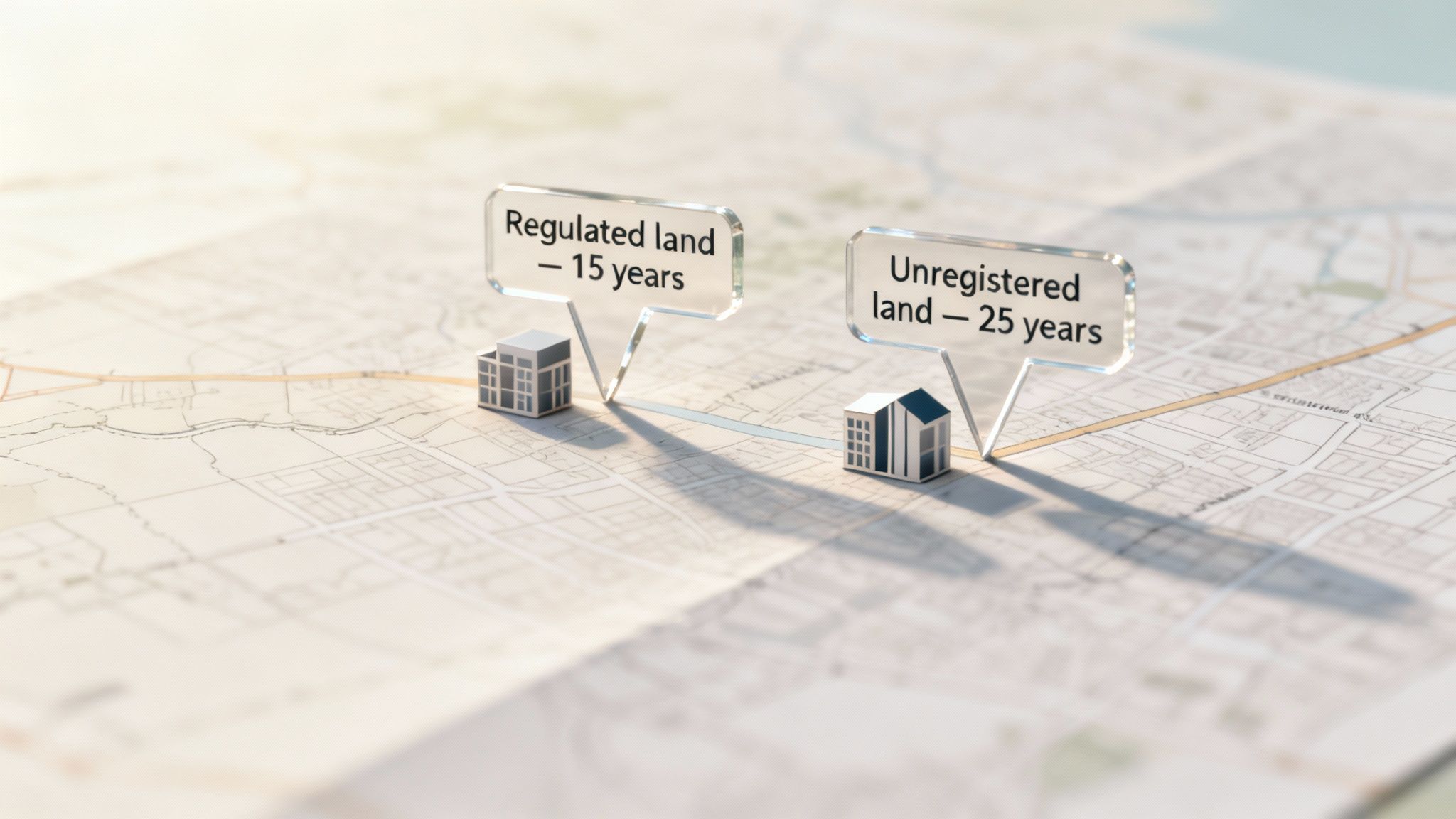
- Real Estate Claims: When property rights are at stake, the timeline extends considerably. The period is 15 years for land registered with the Land Registry (Tabu) and a substantial 25 years for unregistered land.
This stark contrast underscores how vital it is to correctly classify a potential claim from its inception. A miscalculation at this stage could result in the forfeiture of significant legal rights and financial claims.
The Crucial “Discovery Rule”
The most complex aspect is determining when the limitation clock actually starts ticking. The trigger is not always the date a contract was breached or an incident occurred.
Israeli law employs the “Discovery Rule,” a principle stating that the limitation period commences not when the wrongful act occurred, but when the claimant discovered—or, with reasonable diligence, should have discovered—the essential facts forming the basis of their claim.
Consider a sophisticated case of concealed corporate fraud. While the deceptive act may have occurred years prior, the seven-year countdown only begins the moment the fraud is uncovered. This rule balances fairness to victims who were unaware of their injury with the need for eventual legal finality. For corporate entities, it introduces a critical layer of strategic analysis to every potential dispute.
The Seven-Year Standard for Civil Claims
In the realm of civil litigation in Israel, a foundational principle every business client must recognize is the seven-year statute of limitations that governs the vast majority of civil and commercial claims. This rule, enshrined in Israel’s Prescription Law of 1958, serves as the primary legal metronome for actions ranging from breach of contract to professional negligence and a host of business torts.
For companies accustomed to the shorter, often fragmented, limitation periods in jurisdictions like the United States or the United Kingdom, this extended timeframe presents a dual-edged sword. On one hand, it provides a generous window to gather evidence, assess damages meticulously, and formulate a robust litigation strategy. On the other, it means potential liability persists for a much longer duration. This demands immaculate record-keeping and a proactive approach to long-term risk management.

This seven-year standard establishes a default timeline upon which businesses can generally rely. The critical challenge, however, lies not merely in knowing the number, but in precisely identifying when that seven-year clock begins to run.
Pinpointing the Cause of Action
The trigger for the seven-year countdown is the “cause of action” (‘ilat hatvi’a’). This is not an abstract concept but the exact moment a set of facts materializes that grants the legal right to sue. In commercial terms, it is the day the damage occurred or the agreement was breached.
Consider a classic commercial scenario:
- A corporate entity signs a distribution agreement with an Israeli partner.
- The contract stipulates that payment for a shipment is due on June 1st.
- The Israeli partner fails to meet the payment deadline.
Here, the cause of action crystallizes on June 1st—the day the contract was formally breached. From that date, the seven-year limitation clock commences. The company has until May 31st seven years later to file a lawsuit to recover the funds.
Key Takeaway: The cause of action is a specific, identifiable date, not an estimation. Miscalculating this date is a critical error, as it can result in a claim being permanently barred by the statute of limitations in Israel.
The Broad Scope of the Seven-Year Rule
This seven-year period is the default for an exceptionally wide array of commercial disputes that international businesses encounter. Understanding its application is crucial for managing legal risks and ensuring preparedness.
The rule typically covers claims such as:
- Breach of Contract: Encompassing failure to deliver goods, non-payment for services, and violations of shareholder agreements.
- Business Torts: This includes professional negligence, misrepresentation, and tortious interference with contractual relations.
- Debt Collection: Any action to recover unpaid invoices, loans, or other outstanding financial obligations.
This consistency provides a solid degree of predictability. Nevertheless, understanding the nuances of different civil claims is vital. For instance, reviewing specific product liability case examples can reveal how legal precedents shape these timelines and underscore the necessity for prompt action. If a party fails to act within this seven-year window, the defendant gains a decisive procedural defense—that the claim is time-barred—which Israeli courts will uphold. This makes obtaining proactive legal counsel not merely advisable, but an absolute necessity for protecting your company’s interests.
Critical Exceptions for Real Estate and Property Claims
While the seven-year benchmark governs most commercial disputes, the rules for the statute of limitations in Israel are transformed when land is involved. For corporate property investors, companies managing real estate portfolios, or entities engaged in development, these are not minor details; they are fundamental principles that dictate long-term strategy and risk.
The Israeli Prescription Law deliberately establishes much longer timelines for land-related claims, reflecting the unique and enduring value of property rights within the legal system. This is one of the most critical distinctions in Israeli civil law, impacting everything from due diligence on acquisitions to the resolution of decades-old ownership disputes. For business clients accustomed to more uniform time limits, grasping this specific framework is essential to protecting high-value assets.
The Crucial Distinction: Registered vs. Unregistered Land
The limitation period for a real estate claim in Israel hinges on a single pivotal factor: the official registration status of the land. The law draws a sharp line between property that has undergone a formal settlement of title procedure and property that has not. This classification dictates whether a 15-year or a 25-year limitation period applies.
-
Registered Land (Mekarke’in Musdarim): This refers to property where ownership rights have been officially investigated, settled, and recorded in the Land Registry (Tabu). For these properties, the statute of limitations to file a claim is 15 years.
-
Unregistered Land (Mekarke’in She’Einam Musdarim): This category includes land that has not yet undergone the official settlement of title process. Due to the greater potential for uncertainty regarding historical ownership, the law provides a significantly longer window. The statute of limitations for claims involving unregistered land is a full 25 years.
This substantial extension for unregistered land is a legal safeguard, acknowledging that discovering and proving older claims can be far more complex. For any business considering land acquisition for development, determining its registration status is not merely a procedural step in due diligence—it is the action that defines the scope of potential legacy risk.
Legislative Shifts and Modern Investment Strategy
The legal landscape governing Israeli property is not static. Legislative updates can profoundly impact long-term investment calculations for corporate entities. For example, the 2026 Arrangements Law introduced significant changes affecting property tax and limitation periods. A key provision established that property tax returns would apply after 25 years on vacant land, a shift that reshaped real estate investment timelines, particularly for those holding undeveloped properties. For a deeper dive into how legislative changes affect legal expectations, you can explore further analysis on Israeli limitation laws.
The disparity between the 15-year and 25-year periods signals the exceptional weight the Israeli legal system places on property rights. This reality demands meticulous, expert-led due diligence, especially in cross-border transactions where historical claims can lie dormant for decades.
Navigating these timelines requires a proactive strategy. Whether addressing an inheritance dispute that surfaces twenty years later or assessing the risk of a historical boundary claim on a development site, the land’s registration status is always the starting point. This makes a deep, practical understanding of the Israeli Land Registry and its procedures a non-negotiable asset for any serious international investor.
For our corporate clients, these extended periods mean that records tied to property acquisitions, transfers, and development must be preserved for decades. A claim that would be long expired in another jurisdiction could still be viable in Israel. It’s a reality that RNC Group’s cross-border expertise helps clients manage effectively. We turn this complex legal knowledge into a strategic advantage and ensure long-term investments are built on a rock-solid legal foundation.
When Does the Clock Actually Start Ticking?
Knowing the length of the limitation period is only half the battle. The most frequently litigated issue is determining the precise moment the legal countdown begins. Israeli law addresses this with the “Discovery Rule” (klal ha’gilui), a critical principle that can completely alter the timeline for filing a claim.
This rule dictates that the clock—whether for the standard seven-year period or a longer real estate term—does not automatically start when the wrongful act occurred. Instead, it begins on the day the claimant first became aware of the essential facts giving rise to their cause of action. Crucially, it also commences the moment they reasonably should have become aware of those facts through proper diligence.

This distinction is fundamental. It is designed to protect victims of harms that are not immediately apparent—such as latent construction defects, carefully concealed fraud, or professional malpractice that only manifests years later. As a result, the Discovery Rule ensures a right to sue is not extinguished before the injured party even knows a claim exists.
The Objective Test of “Reasonable Discovery”
The core of the Discovery Rule is its objective test. A court does not merely ask, “When did you actually discover the issue?” It probes further, asking, “When should a prudent person or business in your position have identified it?” This prevents a party from turning a blind eye to red flags to artificially extend the time to sue.
Israeli courts hold sophisticated corporate clients and international businesses to a higher standard. A multinational corporation is expected to have internal controls, conduct regular audits, and possess the commercial acumen to detect irregularities that an ordinary individual might miss.
Consider this scenario:
- An international investment fund acquires a stake in an Israeli technology company in Year 1.
- The company’s executives have been subtly inflating revenue figures in internal financial reports.
- In Year 5, a routine but thorough due diligence audit for a new funding round uncovers the fraud.
Under the Discovery Rule, the seven-year statute of limitations did not begin in Year 1 when the fraudulent activity commenced. The clock most likely started ticking in Year 5, the moment the investor discovered—or reasonably could have discovered—the misrepresentation.
Balancing Fairness with Finality
While the Discovery Rule provides crucial protection, it also creates the potential for indefinite liability. The legal system requires finality. Therefore, to strike this balance, Israeli law imposes an absolute backstop.
The Prescription Law establishes a final, absolute time limit of ten years from the date of the event itself, even if the damage was not and could not have been discovered. This creates a hard ceiling, providing legal certainty and preventing claims from lurking in the shadows indefinitely.
This ten-year longstop is a critical component of the statute of limitations in Israel. It means that even in cases of perfectly concealed fraud or a hidden building defect that no one could find, the right to file a claim will expire ten years after the fraudulent act or the building’s completion, regardless of when it was discovered.
This dual system—a subjective discovery trigger tempered by an objective ten-year cap—is central to Israeli procedural law. For our international clients, this is where specialized cross-border expertise becomes indispensable. We analyze the specific facts of a dispute to pinpoint precisely when that clock started ticking. In many cases, this strategic assessment is the difference between a viable, high-value claim and a right that has been lost to time.
Navigating this terrain demands a proactive approach, highlighting the importance of diligent oversight, meticulous record-keeping, and seeking legal counsel the moment an issue is suspected—not just when its full, damaging impact is felt.
Navigating Regulatory Claims and Data Privacy
While the classic rules for contracts and real estate form the bedrock of commercial law, the modern business environment is layered with far greater complexity. Companies must now contend with a maze of regulatory statutes, each with its own limitation period and compliance framework. For any international firm handling the data of Israeli customers, one area towers above the rest in terms of risk: data privacy.
This is not a static field of law; it is constantly evolving to counter new technological threats and align with global standards. Failure to keep pace can lead to severe consequences, as both regulators and private citizens are being armed with stronger tools and longer timelines to take action. The statute of limitations in Israel for these modern claims demands constant vigilance.
The Game-Changing Shift in Data Privacy Liability
The most significant development in this area was a landmark reform to Israel’s Privacy Protection Law. For years, the statute of limitations for civil claims related to data privacy violations was a mere two years. Therefore, this short window made it exceedingly difficult for individuals or businesses to take legal action after discovering their personal information had been breached or misused.
Recognizing the need for stronger consumer protection and alignment with international standards, the law was fundamentally overhauled. Amendment No. 13, enacted on August 5, 2024, was the most sweeping reform to Israel’s Privacy Protection Law since 1996. It dramatically extended the limitation period from two years to a full seven years, bringing Israel’s data protection rules much closer to the standards seen in major economies like the European Union under GDPR. For a deep dive into the legislation, you can learn more about the comprehensive amendment to the Privacy protection Law.
This shift from two to seven years is not a minor adjustment; it represents a 250% increase in the potential liability period for corporations. This completely changes the risk calculation for any company that processes the data of Israeli citizens.
What This Means for International Companies
This seven-year window for data privacy claims carries massive strategic implications. It means a data breach or compliance failure from half a decade ago can suddenly escalate into a major legal and financial crisis, long after the issue was believed to be resolved. In light of this, for international companies, this heightened exposure makes robust, long-term data governance protocols non-negotiable.
Here’s how this extended liability period directly impacts your business:
- Greater Litigation Risk: A longer clock provides potential plaintiffs significantly more time to organize, collect evidence, and launch damaging class-action lawsuits.
- Prolonged Reputational Harm: The threat of litigation can loom over a company for years, eroding public trust and damaging its brand long after the initial incident.
- Mandatory Long-Term Record Keeping: You must now preserve data processing records, consent forms, and breach response documents for a much longer period to defend against claims that could surface years later.
While understanding legal deadlines is vital, the most effective defense is a proactive offense. Implementing robust data security and compliance measures is the only way to meaningfully mitigate the risk of facing these claims. Proactive data management is no longer a “best practice”—it is an essential shield against a legal threat that now has a much longer memory.
At RNC Group, our expertise in cross-border regulatory minefields helps clients build the frameworks they need to manage this heightened and extended exposure. We ensure your operations are not only compliant today but are built to be resilient against the legal challenges of tomorrow.
Turning Knowledge into a Fortress: Proactive Strategies for Global Businesses
Understanding Israel’s legal timelines is one thing; building a corporate strategy around them is what truly insulates a global business from unforeseen liabilities. For any international company operating in Israel, managing the statute of limitations is not merely a defensive legal tactic; it is a core pillar of sophisticated corporate governance and risk management. It involves shifting from a reactive posture to an assertive, forward-thinking approach that anticipates disputes before they materialize.
Ultimately, this strategy is about control. By implementing robust internal systems, you control the documentary evidence and, most critically, the clock. In turn, this ensures your company always acts from a position of strength, whether defending against a legacy claim or initiating necessary legal action.
Meticulous Record-Keeping: Your First and Strongest Line of Defense
Your most powerful weapon is meticulous, long-term record-keeping. In a jurisdiction where claims can arise seven, fifteen, or even twenty-five years after an event, comprehensive documentation is not an administrative chore—it is your corporate memory and your most valuable evidence. As a result, vague contracts, verbal agreements, and incomplete email chains are vulnerabilities that an opponent can exploit years later.
To fortify your position, your documentation protocol must be airtight:
- Centralized Contract Management: Every signed agreement, amendment, and related correspondence should reside in a single, secure, and accessible digital repository.
- Deep Financial Archives: Maintain pristine records of all transactions, invoices, and payment confirmations. Think in terms of decades, not just standard accounting periods.
- Document Key Decisions: Memorializing the rationale behind major business decisions in meeting minutes can be invaluable when reconstructing events and demonstrating intent years after the fact.
Due Diligence Isn’t Enough—You Need Forensic Due Diligence
For companies considering mergers, acquisitions, or significant investments in Israel, standard due diligence can be insufficient. The long limitation periods, especially in real estate, mean that substantial liabilities can lie dormant for a generation, waiting for a new owner to sue. As a result, a deep, forensic approach is required to unearth these hidden risks before a transaction closes.
This entails moving beyond typical financial audits to conduct a thorough legal and historical deep-dive into assets, contracts, and potential dispute histories. Uncovering a potential claim before an acquisition allows you to negotiate powerful indemnities, adjust the valuation, or walk away from a deal laden with unacceptable legacy risk.
A proactive legal strategy transforms the statute of limitations from a potential threat into a tool for corporate certainty. It allows your business to operate with confidence, knowing that time is your ally, not your enemy.
Mastering the Art of the Tolling Agreement
When a dispute begins to emerge, strategic tools are needed to create breathing room. A tolling agreement is a sophisticated legal instrument where both parties agree to “pause” the statute of limitations clock while they attempt to negotiate a settlement.
This is incredibly valuable in complex commercial disputes where preserving business relationships is a priority. Instead of being forced into litigation merely to beat a deadline, a tolling agreement provides the necessary space for good-faith negotiations without the imminent threat of a lawsuit. It is an intelligent, out-of-court maneuver that signals a genuine desire for resolution. At the same time, it unequivocally preserves your right to sue if discussions fail. These are the proactive steps that convert legal knowledge into a tangible competitive advantage.
Frequently Asked Questions
When dealing with Israel’s legal system, especially from abroad, a few key questions always come up. Here are the straight answers to some of the most common queries we handle, designed to cut through the complexity.
Can The Statute Of Limitations Period Be Extended?
Yes, but only in very specific situations. Think of the limitation period as a countdown clock. That clock can be paused, or “tolled,” if a defendant is physically outside of Israel and can’t be properly served with legal documents. The parties can also mutually agree to hit the pause button, usually by signing a formal agreement, which often happens during settlement talks to give negotiations a chance.
More dramatically, the clock can be reset entirely. If a defendant formally acknowledges the debt or the right you’re claiming, the standard seven-year clock restarts from the date of that acknowledgment. These aren’t simple moves; they require precise legal execution to ensure your rights are actually preserved.
Does Israeli Law Apply If My Contract Is Governed By Foreign Law?
This is a classic cross-border trap that catches many international businesses off guard. Israeli courts almost always treat the statute of limitations as a procedural issue, not a substantive one. In legal terms, this means it’s governed by the law of the court hearing the case (the lex fori), which would be Israeli law.
So, even if your contract is rock-solid and explicitly states it’s governed by New York or English law, if you file a lawsuit in an Israeli court, Israel’s statute of limitations will apply. It’s a critical detail to factor in when you’re drafting dispute resolution clauses for any international agreement involving an Israeli party.
What Is The Time Limit For Enforcing A Foreign Judgment?
Bringing a court victory from another country and making it stick in Israel operates on a much tighter schedule. The Foreign Judgments Enforcement Law sets a separate, shorter deadline: you typically have just five years from the date the original judgment was handed down to file an action to enforce it in Israel.
This compressed timeline means you can’t afford to rest on your laurels after winning a case abroad. You have to move quickly to turn that international legal win into a real, enforceable asset inside Israel.
Successfully managing these timelines isn’t about luck; it’s about foresight and having the right legal strategy from day one. If your business is navigating a potential dispute or needs to secure its legal rights in Israel, RNC Group has the cross-border expertise to protect your position. Contact our team of international commercial law experts and ensure your interests aren’t left to chance.
This article does not constitute legal advice and is not a substitute for consulting with a qualified attorney. Do not rely on the contents of this article for taking or refraining from taking any action.