
When you’re weighing LLC vs. private ownership for real estate in Israel, it boils down to one fundamental question. Do you prioritize a powerful liability shield and long-term flexibility, or are simplicity and lower upfront costs your main concern? An LLC separates your personal assets from business debts, while private ownership is straightforward and cheaper to set up. Your answer will steer your entire investment strategy.
Understanding Your Israeli Real Estate Ownership Structure
For international investors, deciding how to hold property in Israel is a critical strategic choice, not just a legal formality. This decision goes to the very core of your investment, shaping everything from your tax obligations and liability exposure to your long-term wealth management in the unique Israeli market.
This guide will unpack the real-world differences between these two paths. We’ll give you clear, actionable insights into Israel’s legal and tax landscape, helping you make a decision that truly aligns with your financial goals. We’ll dig into corporate tax structures versus individual tax rates, evaluate the real asset protection an LLC provides, and analyze how each choice impacts your estate planning down the road. Getting this right is the first step in any successful Buying Property in Israel Guide.

Key Differences at a Glance
Before we dive deep, here’s a high-level look at the trade-offs. Each structure caters to different investor profiles and objectives, and seeing them side-by-side makes the core distinctions clear.
| Feature | LLC / Corporate Ownership | Private (Individual) Ownership |
|---|---|---|
| Asset Protection | High: Creates a legal barrier between business liabilities and your personal assets. | Low: Your personal assets are directly exposed to any legal or financial claims against the property. |
| Tax Complexity | Higher: Involves corporate tax on profits, plus a potential dividend tax when you take money out. | Lower: Rental income is simply taxed at progressive individual rates. |
| Initial Setup | More Complex: Requires formal company registration, a process our firm handles through our Setting Up a Company in Israel services. | Simpler: Involves a direct purchase in your name, often using a Real Estate Power of Attorney if you are abroad. |
| Anonymity | Higher: The company name appears on the title, offering a layer of privacy. | Lower: Your name is publicly registered on the property title for all to see. |
| Estate Planning | Flexible: Company shares can be transferred to heirs, which can dramatically simplify succession. | More Formal: The property deed itself must be transferred through Israeli inheritance or probate processes. |
| Administrative Burden | Higher: Requires annual reporting, separate bank accounts, and ongoing accounting fees. | Lower: Simpler record-keeping focused on your personal tax filings. |
Tax Burdens and Asset Protection: The Core Trade-Off
When you’re deciding between an LLC and private ownership, it really boils down to two critical questions: How much tax will you end up paying, and how safe are your other assets if something goes wrong? These two factors are the heart of the debate and will directly shape your financial reality as a foreign investor in Israel. Each path has serious implications, so understanding them is non-negotiable.

The fundamental split is how Israel views a corporation versus an individual. An LLC is its own legal entity, separate from you. Private ownership, on the other hand, means the property is just an extension of your personal finances. This single distinction changes everything for both your tax bill and your exposure to risk.
The Double Taxation Model of an LLC
Holding your property within an Israeli company (the equivalent of an LLC) means navigating a two-layered tax system. While this structure is built for protection, it definitely adds a layer of tax complexity you need to be ready for.
First, the company itself pays a flat corporate tax on any net rental income. As of 2024, that rate is a straightforward 23%. This tax is paid before you, the owner, ever see a shekel of profit.
Then comes the second layer. When you decide to pull those profits out of the company to put them in your own pocket, you’ll pay a dividend tax. For most foreign investors, this hits at 30% of the amount you distribute. This is the classic “double taxation” model—the profit is taxed once at the corporate level, and again when it’s paid out to you.
The Simpler Path of Individual Taxation
Holding the property in your own name is much more direct. As an individual landlord, your rental income is simply added to your other personal income and taxed at progressive rates. You can see exactly how these brackets work in our detailed guide on the Taxation on Apartment Rentals.
This route completely sidesteps the corporate tax layer. However, keep in mind that the initial purchase is subject to Israel’s progressive purchase tax, which can be quite steep for non-residents. You can see the numbers using our Purchase Tax Calculator & Rates. While an LLC also pays purchase tax, the individual structure often feels simpler for investors with just one or two properties.
Crucial Misconception: I get asked this all the time: can you recover VAT on a residential property purchase? In Israel, the answer is a hard no. It doesn’t matter if you buy through an LLC or as an individual—the 17% VAT paid on a new apartment from a developer is a sunk cost. You cannot reclaim it.
Asset Protection: The Great Divide
Beyond the tax math, asset protection is probably the single most compelling reason investors opt for an LLC. Think of an LLC as a legal firewall, creating a clean break between the property’s liabilities and your personal wealth.
- LLC Ownership: If a tenant gets injured and sues, or the property business racks up debt, the lawsuit is against the LLC’s assets—meaning, the property itself. Your personal bank accounts, your home back abroad, and other investments are kept safely out of reach.
- Private Ownership: In that same scenario, there is no firewall. A lawsuit can come after all your personal assets. There’s no legal distinction between your investment property and your personal finances, putting everything you own on the line.
This legal separation is an incredibly powerful tool, especially for high-net-worth individuals or those scaling up a portfolio. The trend is obvious in high-value markets. In Manhattan, for example, LLC ownership jumps to 37% of all properties, which is more than five times the state average. Elite investors favor this structure because it effectively shields them from creditors; any lawsuit has to target the entity, not the individual’s global assets.
Comparing the Core Financial and Legal Trade-Offs
To really make the right call, it helps to see these competing factors laid out side-by-side. Your decision will ultimately hang on whether you prioritize tax simplicity upfront or long-term liability protection.
Here’s a look at how the two structures stack up for foreign investors looking at the Israeli market.
Comparing LLC vs Private Ownership for Israeli Real Estate
| Consideration | LLC / Corporate Ownership | Private (Individual) Ownership |
|---|---|---|
| Primary Tax Structure | Double Taxation: 23% corporate tax on profits, then 30% dividend tax on distributions. | Single Taxation: Rental income is taxed at progressive individual rates. |
| Asset Liability | Segregated: Your personal assets are legally shielded from business debts and lawsuits. | Direct: Your personal assets are fully exposed to any claims related to the property. |
| VAT Recovery | Not Possible for residential property. | Not Possible for residential property. |
| Best For | Investors prioritizing asset protection, managing multiple properties, or planning complex estate transfers. | Single-property investors, buyers focused on simplicity, and those with a lower risk tolerance for tax complexity. |
At the end of the day, this decision forces you to make a strategic choice. Are you willing to deal with a more complex tax structure to gain an ironclad liability shield? Or does the straightforward nature of individual ownership outweigh the potential risks of personal exposure? The answer will form the very foundation of your investment strategy in Israel.
Simplifying Estate Planning and Succession
Beyond the immediate headaches of taxes and liability, your ownership choice casts a long shadow over your estate plan. When you’re weighing “llc vs private ownership real estate” from thousands of miles away, the corporate route offers a much cleaner path for passing assets to the next generation. For international investors, this isn’t just a convenience; it’s a game-changer.
Holding your Israeli property in an LLC can allow your heirs to sidestep the labyrinth of Israeli inheritance proceedings entirely. What could be a complex, cross-border legal mess becomes a simple corporate transaction.

Transferring Shares Versus Transferring Deeds
The crucial difference is what your heirs actually inherit. Through an LLC, they aren’t inheriting a physical property in a foreign land; they’re inheriting shares in a company you control.
- LLC Share Transfer: The process is as straightforward as transferring ownership of the company’s shares. This is handled internally, typically governed by the company’s operating agreement or your will, keeping it far away from the complexities of international probate law.
- Private Deed Transfer: This is the bureaucratic route. Transferring a property deed directly means diving into the Israeli inheritance system. Your heirs will need to secure an inheritance order from an Israeli court—a formal process that can be painfully slow, public, and expensive for beneficiaries living abroad.
This isn’t just about paperwork. It’s about saving your family significant time, trimming legal fees, and giving them a predictable, clear path to taking control of the asset you left them.
Enhancing Privacy and Discretion
For many high-net-worth investors, privacy is paramount. Here, an LLC provides a valuable shield of discretion that’s simply impossible with direct ownership.
When you buy property in your own name, that information is publicly recorded in the land registry (the “Tabu”). An LLC, however, puts the company’s name on the title, keeping the ultimate owners out of the public record. This layer of confidentiality is a major advantage for anyone who prefers to keep their financial affairs private.
This is a well-established strategy. In urban areas of the U.S., for example, corporations (often small LLCs) own 8.9% of residential parcels. Investors favor this structure precisely because it obscures the true owners, adding a buffer that protects personal assets from any business-related legal issues.
Built-In Flexibility for Future Growth
Investment strategies are not static. Down the road, you might decide to bring in a partner, add family members as co-investors, or sell a percentage of your stake. An LLC is a flexible vehicle designed for exactly these kinds of changes.
Bringing on a partner can be as simple as issuing new shares and updating the company’s operating agreement—a process we handle routinely through services for Founders’ Agreements. In stark contrast, trying to add a co-owner to a property deed is a far messier affair, often triggering tax consequences and requiring formal, registered changes to the title.
An LLC treats your real estate investment like a dynamic business, not a static asset. It lets you pivot and adapt—whether that means raising capital or planning for succession—without getting tangled in the red tape of traditional property law.
To truly streamline your estate plan while protecting your assets, it’s wise to consult a High Net Worth Estate Planning Guide to understand all the implications. The savvy investor always looks beyond the purchase and plans for the asset’s entire lifecycle, especially its eventual transfer. This is where an LLC truly proves its worth, offering a superior tool for long-term protection and seamless wealth transfer across generations.
Navigating Financing and Administrative Hurdles
Beyond the big-picture questions of tax and liability, we need to talk about the practical, day-to-day realities of your investment structure. Choosing between an LLC and private ownership has a direct impact on how you get a mortgage and the amount of paperwork you’ll be dealing with to stay compliant. These operational factors are just as crucial as the strategic legal benefits.
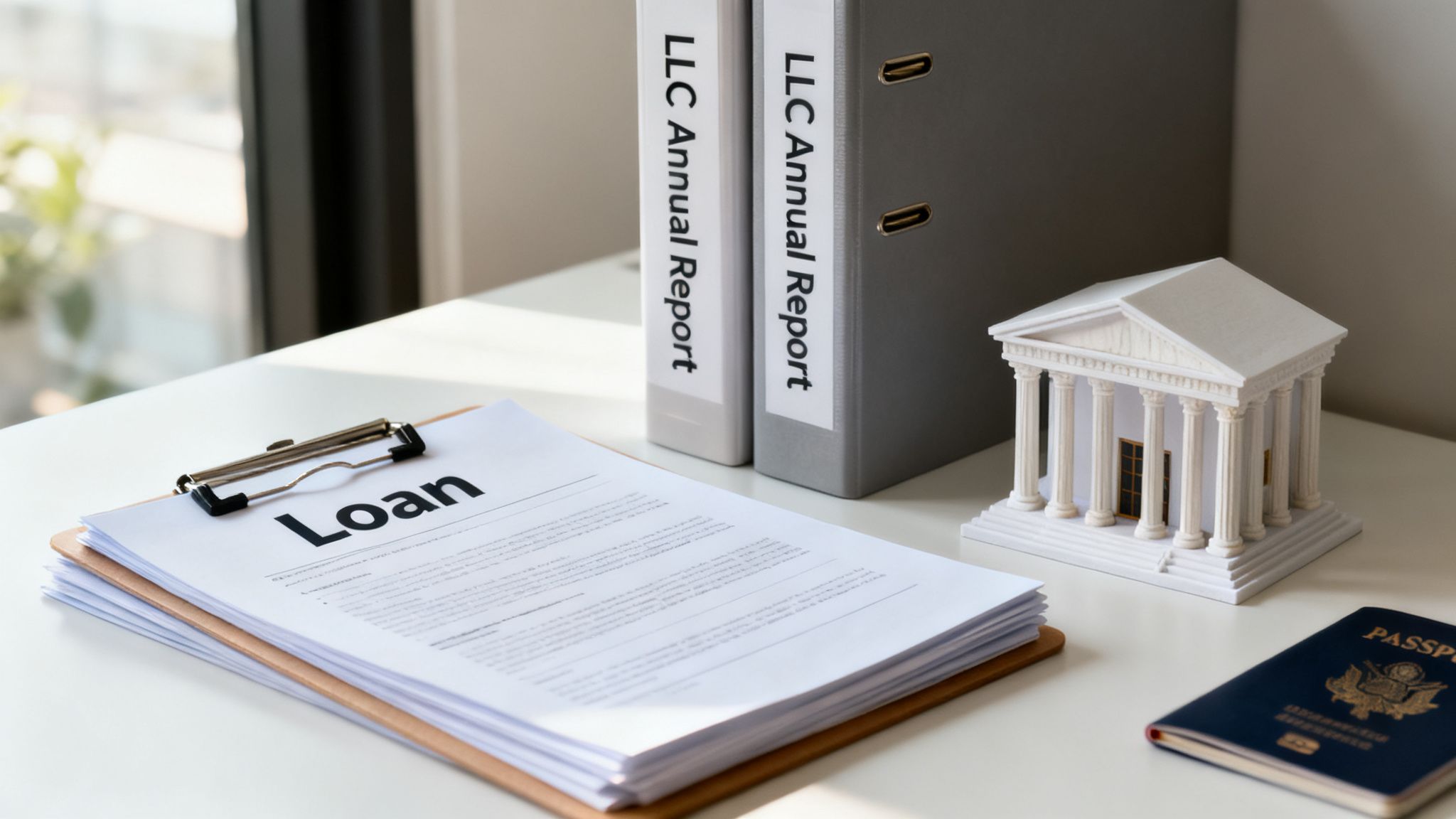
While the asset protection an LLC offers is a huge draw, it doesn’t come for free. It brings a new layer of complexity to the table. This trade-off is at the very heart of the “llc vs private ownership real estate” decision.
Securing a Mortgage in Israel
Let’s be clear: Israeli banks look at financing for foreign entities with an extremely meticulous eye. They are all about managing risk, and their approach changes dramatically depending on whether you’re applying as an individual or a corporate entity.
As a non-resident individual, getting a mortgage is a known quantity. Assuming you have a solid credit history and prove your income, the path is relatively well-trodden. But the moment you apply for that same loan through a foreign-owned LLC, the game changes. Banks immediately shift into a higher gear of scrutiny.
Lenders will perform extensive due diligence on the company itself, its shareholders, and where its funds are coming from. This is all to comply with strict anti-money laundering (AML) regulations. In practical terms, this means you need to brace yourself for a longer, more document-heavy approval process. The bank must be absolutely confident in your corporate structure’s transparency before it will even consider extending credit.
The Ongoing Administrative Burden of an LLC
The liability shield you get with an LLC has a price tag: ongoing administrative duties and costs. Owning property in your own name is simple; it requires little more than your personal tax filings. An LLC, on the other hand, is a formal legal entity that demands consistent maintenance to preserve its legal standing and, most importantly, its protections.
This isn’t just an Israeli phenomenon. In the U.S., while huge institutions own a mere 3% of single-family rentals, smaller investors—many of whom use LLCs—own a staggering 85% of all investor-owned properties. They do it for the blend of protection and relative simplicity compared to a full corporation. You can learn more about how private equity firms are involved in real estate.
For an LLC in Israel, here’s a taste of what you’ll be managing:
- Annual Reporting: Filing annual reports with the Israeli Corporations Authority is not optional.
- Separate Finances: You absolutely must maintain a separate bank account for the LLC. Never, ever commingle personal and business funds.
- Accounting and Bookkeeping: Proper financial records are a must. This usually means hiring a local accountant, which becomes another line item in your operational budget.
- Corporate Governance: You have to follow corporate formalities, like recording major decisions. This is what keeps the legal wall between you and the company standing strong.
Neglecting these administrative duties can be catastrophic. If a court finds that you failed to treat the LLC as a truly separate entity, it can “pierce the corporate veil.” This action makes your personal assets completely vulnerable to business lawsuits—and defeats the entire purpose of setting up the LLC in the first place.
This increased operational workload is a major factor to consider. You have to honestly weigh whether the powerful asset protection and estate planning advantages of an LLC are worth the added costs and administrative headaches that are part of the deal.
Which Ownership Structure Fits Your Investment Goals?
Figuring out whether to use an LLC or hold property in your own name isn’t just a box-ticking exercise. The right answer is tied directly to your specific goals, how much risk you’re comfortable with, and what you see for the investment down the road. To make this less abstract, let’s walk through a few common investor profiles.
By looking at these real-world scenarios, you can start to see where your own plans fit in. The “LLC vs. private ownership” debate isn’t about which is universally better; it’s about which is strategically better for you.
Profile 1: The Single-Property Personal Use Investor
Let’s imagine Sarah, a foreign investor buying a single apartment in Tel Aviv. Her main goal is simple: have a second home for family vacations. She might rent it out here and there to cover some maintenance costs, but she has no plans to build a large portfolio. For her, simplicity is everything.
For Sarah, private ownership is the clear winner. The hassle and ongoing expense of setting up and maintaining an Israeli company just wouldn’t make sense.
- Rationale: The administrative load—annual corporate filings, separate accounting, and potential financing headaches—far outweighs any potential benefit for a single, low-risk property.
- Recommendation: Owning the property directly keeps the entire process clean and simple. Her tax situation will be more straightforward, focusing on individual Taxation on Apartment Rentals rules. The purchase itself is also less complicated, especially if she’s abroad and uses a Real Estate Power of Attorney to get things done. The minimal liability risk here simply doesn’t justify a corporate shield.
Profile 2: The Multi-Partner Investment Syndicate
Now, let’s picture a totally different situation. A group of three international partners are pooling their capital to buy a portfolio of five rental units across Jerusalem and Haifa. Their goals are clear: generate serious rental income, shield their personal assets from any trouble, and have a rock-solid framework for managing the whole operation.
For this syndicate, an LLC isn’t just a good idea; it’s essential.
An LLC provides the legal architecture needed to manage a multi-partner investment. It establishes clear rules for profit distribution, decision-making, and exit strategies, preventing the kinds of disputes that can destroy a partnership.
The corporate structure is tailor-made for their level of complexity.
- Rationale: The LLC’s liability shield is paramount here. It protects each partner’s global assets from lawsuits or debts connected to the properties. Operationally, the company structure centralizes all the finances and management, making everything cleaner. A well-drafted Founders’ Agreement within that LLC framework will govern their relationship and head off future conflicts.
- Recommendation: Setting up an Israeli company gives them the asset protection and operational clarity they need. It also creates a much simpler way to bring in new partners or let existing ones exit—they just transfer shares, rather than trying to untangle multiple property deeds.
Profile 3: The High-Net-Worth Legacy Builder
Finally, meet David, a high-net-worth individual buying a luxury property. He sees this not just as an investment, but as a long-term family asset. His absolute top priorities are insulating his significant personal wealth from any potential lawsuits and ensuring the property can pass to his children smoothly and privately.
For David, an LLC is the superior strategic vehicle. The advantages go way beyond liability protection and into sophisticated estate planning.
- Rationale: David’s first concern is protecting the wealth he already has. For an investor at his level, the LLC’s legal firewall is non-negotiable. But the real game-changer is what happens during inheritance. Instead of his heirs getting bogged down in Israeli probate court trying to transfer a foreign property deed, they simply inherit shares in a company. This is a far more private, efficient, and predictable process.
- Recommendation: The LLC structure hits both of his key objectives: robust asset protection and simplified succession planning. The extra administrative costs are a tiny price to pay for the powerful legal shield and the streamlined wealth transfer it enables.
As these profiles show, there’s no single right answer. Your choice has to be a deliberate one, based on a clear-eyed look at the scale of your investment, your partnership structure, and your long-term legacy plans.
Don’t navigate the Israeli legal system alone. Schedule a consultation regarding your specific case.
Finalizing Your Investment Strategy
So, where do we land? After weighing the pros and cons, it’s clear the “LLC vs. private ownership” question doesn’t have a one-size-fits-all answer for real estate in Israel. The right path hinges entirely on you: the size of your investment, how you feel about risk, and what you envision for this property down the road.
A single investor grabbing a holiday flat in Tel Aviv has a completely different set of needs than a syndicate managing a portfolio or a high-net-worth family thinking about the next generation. For the first, the simplicity and lower overhead of private ownership might be a perfect fit. For the others, the bulletproof liability shield and estate planning power of an LLC are probably non-negotiable.
Making a Deliberate and Informed Decision
Your final choice is a strategic one, a careful balancing act. On one side, you have the straightforward tax and administrative lane of individual ownership. On the other, the powerful asset protection and succession advantages that a corporate structure brings to the table. This decision will be the legal and financial bedrock of your investment for years.
To get this right, you need to be honest with yourself about a few things:
- Asset Protection: How vital is it to build a legal firewall between this property’s liabilities and your other personal assets?
- Estate Planning: Is your main goal a smooth, private transfer of the property to your heirs, sidestepping the headaches of international probate?
- Operational Complexity: Are you truly ready for the ongoing administrative legwork and costs that come with keeping a formal legal entity alive and well?
- Future Flexibility: Can you see yourself bringing in partners, selling off shares, or growing this into a larger portfolio?
The single biggest mistake a foreign investor can make is to assume the rules that work back home apply here. A structure that’s perfect in your country can trigger unforeseen tax liabilities or legal knots in Israel.
This isn’t a decision to make in a vacuum. The maze of cross-border real estate investing demands specialized know-how. Getting professional legal and tax advisors who live and breathe Israeli real estate law isn’t just a good idea—it’s essential to protect your investment. Expert guidance ensures your ownership structure is not only compliant but perfectly dialed into your financial goals, saving you from disastrously expensive mistakes. Doing your homework now is critical, a point we drive home in our guide to Due Diligence Essentials.
Don’t navigate the Israeli legal system alone. Schedule a consultation regarding your specific case.
Common Questions Answered
When you’re weighing an LLC against private ownership for Israeli real estate, some key questions always come up. Getting stuck on these points can bring your investment plans to a halt. Here are the direct, no-nonsense answers to the questions we hear most often from foreign investors.
Can I Just Transfer My Property To An LLC Later On?
While you technically can move a property from your personal name into an LLC down the road, it’s rarely a good idea. The Israeli Tax Authority doesn’t see this as a simple administrative change; they treat it as a brand-new sale.
What does that mean for you? It means the transfer will almost certainly trigger a purchase tax bill, forcing you to pay up as if you were buying the property all over again. Considering the steep rates (which you can see on our Purchase Tax Calculator & Rates guide), this can be a shockingly expensive mistake. It’s almost always smarter and cheaper to get the structure right before you sign the purchase contract.
What Are The Real Annual Costs of Maintaining An LLC In Israel?
Running an Israeli company comes with ongoing costs that simply don’t exist with private ownership. The exact numbers will fluctuate, but you should absolutely budget for a few key expenses:
- Accountant Fees: This will be your biggest recurring cost. A certified accountant is non-negotiable for handling bookkeeping, preparing financial statements, and filing the company’s annual tax returns.
- Annual Corporate Levy (Agra): This is a mandatory government fee paid to the Israeli Corporations Authority. Paying it keeps your company active and in good standing.
- Registered Address Fees: Unless you have a physical office in Israel, you’ll need to pay a nominal fee for a registered address service, which is a legal requirement.
Think of these costs as the price of maintaining the corporate veil that shields your personal assets.
Does Holding Property in an LLC Make Getting a Mortgage Harder?
It definitely adds a layer of complexity, but it’s not a deal-breaker. Israeli banks put corporate borrowers under a much stronger microscope, especially when foreign nationals are involved. This is driven by strict anti-money laundering (AML) regulations they are legally required to follow.
Lenders will perform extensive due diligence on your LLC’s ownership structure, its shareholders, and the origin of the funds. Expect a longer approval timeline and a much heavier paperwork burden than if you were applying as an individual. It’s a hurdle, but with a transparent and well-documented corporate setup, securing financing is entirely achievable. The whole process can even be handled from overseas with a correctly drafted Real Estate Power of Attorney.
Are There Any Real Alternatives To An LLC For Holding Property?
For the vast majority of foreign investors who need liability protection and a clear succession plan, an Israeli limited company (our version of an LLC) is the go-to vehicle. It’s the most effective and battle-tested structure.
That said, depending on your specific circumstances, other options might come into play. Trusts can be powerful for estate planning, but they bring their own labyrinth of tax laws and compliance rules. For a simple venture between a few partners, a partnership agreement might seem sufficient, but it usually fails to provide the same ironclad liability shield as a company.
At the end of the day, for the unique blend of asset protection, operational clarity, and estate planning needed for real estate, the LLC model remains the primary and most recommended choice. If you do go with a partnership, make sure it’s governed by a rock-solid agreement, much like the ones we draft for tech Founders’ Agreements.
Don’t navigate the Israeli legal system alone. Schedule a consultation regarding your specific case.
Disclaimer: The information provided in this article is for general informational purposes only and does not constitute binding legal advice. Each legal case is unique and requires specific examination by a qualified attorney. Reliance on the information contained herein is at the reader’s sole responsibility.