
For international investors, Israel’s short-term rental market, especially in tourism hotspots like Tel Aviv and Jerusalem, looks like a golden ticket. But that high-return potential comes with a catch: a complex and constantly shifting legal landscape that can turn a profitable venture into a legal nightmare. Understanding Airbnb laws in Israel is essential, because for investors operating from overseas, ignoring these rules isn’t just risky—it’s a direct threat to your capital.
The High Stakes of Israel’s Short-Term Rental Market
From a distance, the appeal of Israel’s vibrant tourism sector makes short-term rentals seem like a straightforward path to high yields. The reality on the ground, however, is a minefield of regulatory, financial, and even social risks that can vaporize profits and create staggering legal exposure.
The days of quietly running an Airbnb under the radar are long gone. Israeli authorities, at both the city and national levels, are now proactively hunting for non-compliance. This guide is built for the serious investor who needs to understand the severe risks involved and navigate these challenges, not ignore them.

Key Risks for Investors
Operating a short-term rental is far more than just managing bookings. It’s about managing a multi-layered legal framework where one misstep can cascade into a disaster. Foreign investors need to be laser-focused on three main areas of risk:
- Aggressive Municipal Restrictions: Cities, with Tel Aviv leading the charge, have rolled out tough local bylaws. They are reclassifying short-term rental properties from residential to commercial, which instantly triggers a much higher municipal tax, known as Arnona. This single change can completely destroy your investment’s financial model.
- Mandatory Income Tax Reporting: Let’s be clear: income from an Airbnb is business income, period. It is not considered passive rental income and does not qualify for the common residential rental tax exemptions. Our detailed guide on the Taxation on Apartment Rentals digs into this critical distinction. The Israeli Tax Authority now mandates that platforms report host earnings directly, making tax evasion a thing of the past.
- Nuisance Claims and Building Bans: This is the risk everyone underestimates until it’s too late. Nuisance claims from neighbors and building management committees (the Va’ad HaBayit) over noise, security concerns, and wear-and-tear on common areas can quickly escalate into legal action. More importantly, a building’s internal bylaws (its Takanon) can flat-out prohibit short-term rentals, giving neighbors all the legal ammunition they need to shut you down.
A proactive legal strategy isn’t just a good idea—it’s essential for survival in this market. Without it, you’re not just risking fines; you are putting your entire investment on the line.
Any serious Buying Property in Israel Guide must start with a thorough due diligence of these specific risks before a single shekel is committed. We’ll now unpack these critical challenges to give you the clarity needed to make sharp, informed decisions and shield your investment from these hidden liabilities.
Tel Aviv’s Municipal Crackdown Explained
If you’re looking at Israel for a short-term rental investment, all eyes are on Tel Aviv. The city is the undisputed epicenter of this market, and what happens here often sets the tone for the rest of the country. For years, the Airbnb space was a bit of a gray area, but those days are long gone. The municipality has taken a decisive—and financially aggressive—stance, turning what was once an easy side hustle into a heavily scrutinized business.
While many foreign investors get caught up in national tax laws, the real, immediate threat to your bottom line often comes from the local level. The city’s weapon of choice isn’t an outright ban. It’s something far more subtle and powerful: Arnona, the municipal property tax. This is where a seemingly profitable Airbnb can quickly turn into a financial nightmare.
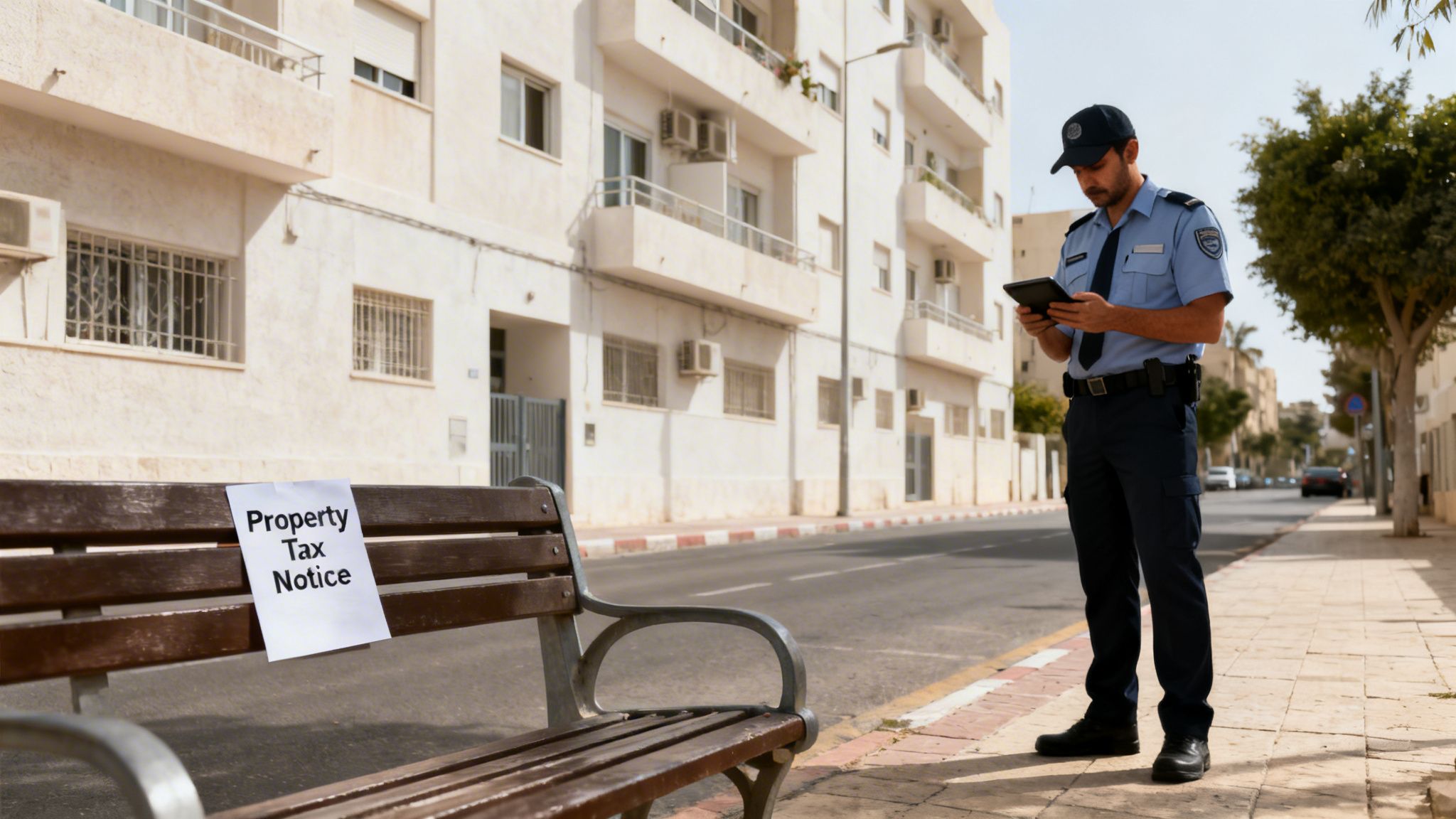
The Arnona Reclassification Trap
In a normal long-term lease, your apartment is taxed at a standard “residential” rate for Arnona. But the moment you start renting it out on platforms like Airbnb, the Tel Aviv municipality sees it differently. They argue it’s no longer a home; it’s a commercial operation, essentially a hotel room operating inside a residential building.
This triggers a reclassification of your property’s tax status from residential to commercial. The financial fallout is immediate and severe. The commercial Arnona rate in Tel Aviv can be two to three times higher than the residential one. This isn’t a small fee; it’s a massive spike in your fixed operating costs that can single-handedly wipe out your entire profit margin.
It’s a silent risk that’s completely invisible during a standard property purchase. This is precisely why any serious investor must conduct comprehensive Due Diligence Essentials that specifically probe local rental policies before signing any contract.
To put it in perspective, let’s break down the tangible differences in your legal and financial duties when you pivot from a standard tenant to short-term guests.
Residential vs Short-Term Rental Obligations in Tel Aviv
| Obligation | Standard Residential Rental | Short-Term Rental (Airbnb) |
|---|---|---|
| Arnona (Property Tax) | Standard residential rate. | Reclassified to a commercial rate, 2-3x higher. |
| Business License | Not required. | Potentially required, depending on the scale of operation. |
| VAT Liability | Not applicable on rental income. | 17% VAT is typically required on rental income. |
| Income Tax | Lower tax brackets, potential exemptions up to a certain threshold. | Taxed as business income, often at higher rates. |
| Municipal Oversight | Minimal, unless there are neighbor complaints. | Proactive monitoring, data scraping, and on-site inspections. |
| Zoning Compliance | Assumed to comply with residential zoning. | Scrutinized for compliance; may violate bylaws in certain zones. |
As the table shows, the moment you list on Airbnb, you’re stepping into an entirely different regulatory world. The obligations multiply, and the financial stakes get much higher.
Proactive and Sophisticated Enforcement
Thinking you can just fly under the radar is a dangerously outdated mindset. The Tel Aviv municipality has become incredibly savvy. They aren’t just sitting back and waiting for angry neighbors to call.
The city now actively hunts for undeclared short-term rentals using a multi-pronged approach:
- Data Scraping: Municipal agents methodically scan Airbnb, Booking.com, and other platforms. They cross-reference listings with official property records to pinpoint exactly who is running an undeclared business.
- On-Site Inspections: Inspectors are regularly sent to buildings with a known concentration of Airbnbs to verify how the apartments are being used. They’ll talk to neighbors and look for the classic signs of high guest turnover.
- Utility Monitoring: A sudden, sustained spike in water and electricity usage in a residential-zoned apartment is a major red flag. It suggests commercial-level activity and can trigger an official review.
Once your property is flagged, the game changes. The burden of proof is now on you to prove it’s not being run as a business. For investors trying to manage this from overseas, it’s a bureaucratic nightmare. This is where a Real Estate Power of Attorney becomes mission-critical, giving local legal counsel the authority to fight these disputes on your behalf.
The core takeaway for investors is this: The Tel Aviv municipality views short-term rentals as a commercial activity that must be taxed accordingly. Ignoring this reality is a direct path to unexpected tax bills and legal penalties.
The Long-Term Vision and Zoning Restrictions
This municipal crackdown isn’t just a cash grab. It’s rooted in a larger urban planning strategy. Officials are deeply concerned that the explosion of Airbnbs is shrinking the available housing stock for actual residents, which in turn drives up long-term rental prices and fundamentally changes the character of neighborhoods.
Because of this, the city is actively discussing future zoning restrictions. This could mean anything from new limits on the number of days you can rent per year to outright bans on short-term rentals in specific residential buildings or zones.
While these rules aren’t yet universally in place, the writing is on the wall. An investment that looks profitable today could become illegal or financially unviable tomorrow if the local regulations shift. This is why a deep understanding of the local airbnb laws israel is so crucial. A property’s current performance doesn’t guarantee its future success in such a dynamic environment. Any investor’s Buying Property in Israel Guide must account for this regulatory risk.
Understanding Your National Tax Obligations
While wrestling with municipal rules like Tel Aviv’s Arnona feels like a major hurdle, it’s only half the story. The other, equally critical piece of the puzzle is national tax law. For any international investor, getting these rules wrong with the Israeli Tax Authority isn’t just an option—it’s a fast track to severe financial penalties and legal headaches.
Perhaps the single most dangerous assumption investors make is thinking the tax rules for short-term lets are the same as for traditional, long-term residential leases. They are fundamentally different, and this misunderstanding is where immense financial risk lies.

Short-Term Rentals Are a Business, Not a Tenancy
Here’s the core distinction you must understand: In Israel, income from a standard long-term rental might get certain tax breaks or a flat 10% tax rate, assuming it’s below a certain threshold. But short-term rentals on platforms like Airbnb? The Tax Authority sees that as an active business operation.
This isn’t just semantics; it changes everything.
- No Tax Exemption: Forget about the popular residential rental tax exemption. It simply doesn’t apply.
- Business Income Rates: Your earnings are taxed as business income. This means you’re subject to progressive tax brackets that climb much higher.
- VAT Liability: This is the big one. If your annual revenue from short-term rentals crosses the designated threshold (around NIS 120,000 for 2024), you must register as a VAT dealer (Osek Murshe). From that point, you have to collect and pay 17% VAT on all your earnings.
Failing to grasp this reclassification from passive income to active business is the biggest tax mistake you can make. A solid grasp of rental income and taxes is non-negotiable for any serious investor, and our firm’s guide to Taxation on Apartment Rentals dives even deeper into these crucial Israeli specifics.
The End of the Shadow Rental Era
For years, the system was leaky. It relied on hosts to self-report their income, which led to widespread non-compliance. Well, that loophole has been slammed shut. New legislation has created a reality where tax evasion is almost impossible, placing the reporting burden squarely on the shoulders of the big platforms.
A landmark law set to take effect with the 2026 budget will effectively kill the “shadow rental” market. The Knesset has pushed forward legislation that forces platforms like Airbnb and Booking.com to automatically hand over host data directly to the Israeli Tax Authority. This isn’t just a name and number; we’re talking host IDs, property addresses, every transaction, and total income. You can read more about this game-changing legislation and its effect on the Israeli rental market.
This new reporting mandate changes the entire game. The question is no longer if the tax authority will know about your rental income, but when. Proactive, professional compliance is your only real defense.
Meticulous Bookkeeping Is Non-Negotiable
Because your short-term rental is legally a business, you have to act like one. That means meticulous record-keeping isn’t just good practice—it’s a legal requirement. It’s also the only way you can properly calculate your tax liability and, just as importantly, claim legitimate business expenses to lower your taxable income.
To stay compliant and ready for any scrutiny, you must track everything:
- All Income: Every single payment from every guest, across every platform you use.
- Deductible Expenses: Costs directly tied to running your rental business. This includes cleaning fees, maintenance, utilities, management fees, and yes, those commercial Arnona payments.
- VAT Records: If you’re a registered VAT dealer, you need detailed records of the VAT you’ve collected from guests and the VAT you’ve paid on your business expenses.
For a foreign investor managing property from thousands of miles away, this level of detail can feel overwhelming. This is often the point where Setting Up a Company in Israel becomes a smart strategic move. It allows you to properly structure the investment, manage these finances professionally, and turn a potential compliance nightmare into a well-oiled asset.
How Neighbor Disputes Can Shut Down Your Airbnb
Beyond the reach of municipal inspectors and national tax authorities lies a powerful—and often completely underestimated—risk to your Airbnb investment: your neighbors. Many investors get laser-focused on official regulations but completely miss the immense legal power held by the building’s homeowners’ committee (Va’ad HaBayit).
It’s a common story. A profitable short-term rental operation isn’t shut down by the government, but by the very people living next door. This threat is real, immediate, and rooted in the day-to-day realities of running a rental business in a residential building.

Common Nuisance Claims and Legal Challenges
Complaints from long-term residents aren’t just minor annoyances; they’re the foundation of a formal legal challenge. These claims often revolve around the concept of a “legal nuisance,” where your rental operation is seen as fundamentally disrupting their right to peacefully enjoy their own homes.
What kinds of complaints escalate to legal action?
- Persistent Noise: The constant coming and going of tourists, luggage being rolled through hallways at all hours, and loud conversations or late-night parties are classic sources of friction.
- Security Concerns: A steady stream of unknown, unvetted guests can make permanent residents feel unsafe, raising alarms about who has access to common areas.
- Excessive Use of Common Facilities: More people means more wear and tear. Increased traffic in elevators, lobbies, and swimming pools means higher maintenance costs—and the long-term residents are the ones footing the bill.
These aren’t just social gripes; under Israeli law, they are legitimate grievances. If a Va’ad HaBayit can document a pattern of such disturbances, they have solid grounds to seek a court-ordered injunction to halt your business. This kind of legal battle is costly and draining, a reality we cover in detail in our guide to Commercial Litigation in Israel.
The Power of the Building’s Articles of Association
The single most potent weapon your neighbors have is the building’s articles of association, known as the Takanon. Think of this as the building’s constitution—a legal document that governs life within the property and is binding on every single apartment owner.
Crucially, a building’s Takanon can include clauses that explicitly prohibit or severely restrict short-term rentals. If it forbids using apartments for commercial purposes or specifically bans lets under a certain duration (like 30 days), your Airbnb operation is in direct violation from day one. This gives the homeowners’ committee a clean, straightforward legal basis to shut you down.
Ignoring a building’s Takanon is a critical error. It is the internal law of the property, and an Israeli court will almost always side with the homeowners’ committee if a clear violation is proven.
This highlights a fatal flaw we see in many investors’ purchasing processes. They focus on the apartment but fail to scrutinize the legal framework of the building it sits in. A thorough review of the Takanon is absolutely non-negotiable. It’s a core component of our firm’s approach to Due Diligence Essentials, designed to uncover these hidden but potentially catastrophic risks before you ever commit to a purchase.
Proactive Steps to Mitigate Neighbor-Related Risks
Given these dangers, you need a proactive strategy. Before you even think about making an offer, you must investigate the building’s internal politics and legal standing. This means not only obtaining and translating the Takanon but also getting a feel for the residents’ general attitude toward short-term rentals.
For investors operating from abroad, this kind of on-the-ground investigation is nearly impossible to do alone. It requires local expertise and the finesse to navigate complex interpersonal and legal dynamics. This is a key reason why many foreign investors rely on a Real Estate Power of Attorney, empowering local counsel to conduct this deep-level due diligence.
Ultimately, understanding and respecting the community you are investing in is just as important as complying with official airbnb laws israel.
Your Compliance Checklist: From Foreign Investor to Local Pro
Jumping into Israel’s short-term rental market with just a checkbook is a recipe for disaster. It takes more than capital; it requires a disciplined, step-by-step approach to compliance. Think of this checklist as your roadmap for turning the risks we’ve talked about into a series of manageable, concrete actions.
Don’t treat this as a list of friendly suggestions—it’s a mandatory process. Every single step is designed to get ahead of a specific problem, whether it’s a municipal tax surprise or a feud with the neighbors’ committee that could sink your entire investment. Following this plan is the single best way to protect your capital and build a rental business in Israel that actually lasts.
Pre-Purchase Due Diligence
Before you even think about making an offer, you need to go deep on the property’s regulatory standing. This is where the game is won or lost. Mistakes made at this stage are always the most expensive and painful to fix down the line, so your investigation has to be relentless.
-
Confirm Municipal Zoning and Arnona Classification: Get on the phone with the local municipality (the Iriya) for the exact property you’re eyeing. Ask them point-blank how they classify short-term rentals and what the commercial Arnona rate is. Never take the seller’s word for it or assume the current tax bill is what you’ll pay. You need official confirmation, in writing if possible.
-
Scrutinize the Building’s Takanon: Get a copy of the building’s articles of association (Takanon). This isn’t something to skim. Pay for a professional translation and have your lawyer review it line by line. You’re hunting for any clause that even hints at prohibiting commercial activity, subletting, or rentals below a certain length (like 30 days). This document alone can give your neighbors the legal ammunition to shut you down.
-
Gauge the Va’ad HaBayit’s Attitude: Try to get a feel for the homeowners’ committee’s (Va’ad HaBayit) general stance on Airbnbs. Are there others in the building? Have there been fights about it before? A hostile building is a massive red flag, and no amount of potential profit is worth that headache.
Structuring Your Investment
Okay, so you found a property that passes the initial checks. Now, how are you going to buy it? The structure of your investment has huge consequences for your liability, taxes, and day-to-day operations. Just buying it in your personal name is rarely the smartest play for a commercial venture.
Choosing the right legal structure isn’t just paperwork. It’s a strategic move that builds a firewall between your personal wealth and your business risks, while also making your tax situation much cleaner. It elevates your investment from a personal asset to a professional, compliant business.
Talk these options over with your legal and financial advisors:
-
Set Up the Right Legal Entity: For most serious investors, Setting Up a Company in Israel is the way to go. An Israeli limited liability company can own the property, which cleanly separates your personal assets from the business. This structure makes accounting a breeze, contains any potential liability, and gives you a professional framework for managing everything from bookings to tax payments.
-
Open a Dedicated Israeli Bank Account: This is non-negotiable. Don’t even think about mixing your rental income with personal funds. A separate business bank account in Israel is critical for clean bookkeeping, paying local bills like Arnona and Va’ad fees, and keeping a transparent financial record for the Israeli Tax Authority.
Operational and Legal Formalities
With the property deed in hand and the company set up, the last piece of the puzzle is establishing the on-the-ground operational framework. This is especially vital if you’re managing the property from overseas.
If you aren’t living in Israel, giving a trusted local representative the power to act on your behalf isn’t a luxury—it’s a necessity. This is how legal notices get received, how disputes get handled, and how contracts get signed without you having to book a flight for every minor issue. A Real Estate Power of Attorney is the formal legal tool that makes this happen, creating the critical link between you and your investment.
By methodically working through this checklist, you shift from being a passive buyer to an active, informed investor who is fully prepared for the unique realities of the Israeli market.
Don’t navigate the Israeli legal system alone. Schedule a consultation regarding your specific case.
Protecting Your Investment in a High-Stakes Market
Let’s be clear: Israel’s short-term rental market can be incredibly rewarding, but it’s anything but a passive investment. We’ve laid out the primary risks you’ll face, and they aren’t trivial. Success here demands more than just capital; it requires meticulous due diligence, sharp strategic planning, and constant legal and financial oversight to navigate the intricate web of Airbnb laws in Israel.
From Tel Aviv’s aggressive municipal enforcement to new national tax reporting that has closed old loopholes for good, the landscape is littered with challenges. And that’s before we even get to the often-underestimated power of neighbors to tie you up in legal knots. In this environment, proactive compliance isn’t just good practice—it’s the only way to shield your investment and keep your venture profitable.
Understanding the Market’s True Potential
Despite these hurdles, the market is buzzing with activity. Israel currently boasts around 35,000 active short-term rental listings, and hosts in the major hubs are seeing impressive returns. Take Tel Aviv, where hosts average $15,842 annually, or Jerusalem, where that figure jumps to about $17,323 per year.
Crucially, unlike many European hotspots that impose strict 90-day caps, Israel has no national minimum-stay rules or annual night caps. This key difference keeps the market uniquely attractive for serious investors. You can dive deeper into the numbers by exploring Israel’s short-term rental market performance.
This blend of high potential and high risk means that a solid legal strategy isn’t a luxury—it’s your foundation. For foreign investors, Managing Property from Overseas adds a whole other layer of complexity, making local, on-the-ground expertise absolutely indispensable.
The Blueprint for a Secure and Profitable Venture
To truly succeed, you need to stop thinking like a casual host and start operating like a professional business. This shift in mindset involves a few non-negotiable steps:
- Go Deep on Due Diligence: Before you even think about signing a purchase agreement, you need to conduct exhaustive Due Diligence Essentials. This means digging into every detail of municipal zoning, Arnona tax rates, and specific building bylaws. Leave no stone unturned.
- Build the Right Legal Structure: Don’t just buy the property in your name. Consider Setting Up a Company in Israel to hold the asset. This simple move can significantly limit your personal liability and streamline tax compliance down the road.
- Maintain Professional Oversight: The rules are constantly changing. Retaining expert legal and financial counsel isn’t a one-time thing; it’s an ongoing necessity to stay ahead of regulatory shifts and ensure you’re always in full compliance.
By taking these steps, you transform a field of potential liabilities into a well-managed, profitable, and secure asset.
Got Questions About Israel’s Airbnb Rules? We’ve Got Answers.
The world of short-term rentals in Israel can feel like a maze, especially for investors trying to navigate the rules from overseas. Let’s cut through the confusion with clear answers to the questions we hear most often.
Can I Just Use the Standard Residential Tax Exemption for My Airbnb?
Absolutely not. This is probably the single most common—and costly—mistake foreign investors make. That standard tax break you hear about for long-term residential leases? It does not apply to short-term lets. Period.
The Israel Tax Authority views Airbnb income as what it is: a business. That means it’s classified as business income, needs to be reported as such, and is taxed at standard income tax rates. For a full breakdown of the numbers, check out our guide on the Taxation on Apartment Rentals.
What Exactly Is Arnona and How Big a Deal Is It?
Arnona is Israel’s municipal property tax, and it’s a very big deal for your bottom line. Every city has its own rates, and here’s the trap: once you start operating an Airbnb, the municipality (especially in a city like Tel Aviv) can reclassify your property. It stops being “residential” and becomes “commercial.”
This isn’t just a small fee increase. The commercial Arnona rate can easily be two to three times higher than what you’d pay for a residential property. If you haven’t factored that massive jump in operating costs into your financial model before buying, you’re in for a nasty surprise.
Can My Neighbors Actually Shut Down My Airbnb?
Yes, and you’d be surprised how often it happens. The building’s official articles of association, known as the Takanon, are legally binding. If that document prohibits any commercial activity, the homeowners’ committee has every right to seek a court injunction to stop you.
And even if there isn’t a direct ban in the Takanon, you’re not automatically in the clear. If guests are causing a ruckus, creating security concerns, or just generally being a nuisance, your neighbors can take legal action to shut your operation down on the grounds that it’s a legal nuisance. This is precisely why having a Real Estate Power of Attorney is so critical for managing these kinds of disputes when you’re not in the country.
Don’t navigate the Israeli legal system alone. Schedule a consultation regarding your specific case.