
Could a profitable cross-border contract disappear on notice, even when performance is strong and no breach exists? In 2026, that question is no longer theoretical for companies operating across the United States, Israel, and Europe.
A termination for convenience clause example often looks harmless in a template. In practice, it can reallocate negotiating power, cash flow, inventory risk, and litigation exposure in a single paragraph. The legal result also changes sharply by governing law, forum, and contract type.
Companies with strong legal oversight should stop treating this clause as boilerplate. The clause is an exit device, a pricing issue, a dispute trigger, and sometimes a hidden transfer of commercial risk.
The Exit Clause You Cannot Ignore in 2026
Most executives still ask the wrong question. They ask whether a termination for convenience clause allows exit without cause. The harder question is whether the clause lets the other party destroy the economic value of the deal while staying technically inside the contract.
That distinction matters because the clause usually works exactly as written, until a court decides it does not. In some systems, the express wording carries enormous weight. In others, good faith obligations narrow the right even when the text looks absolute.
Why the clause changed from boilerplate to board issue
A termination for convenience clause gives one party an agreed contractual off-ramp. The terminating party does not need to prove breach, default, or fault. For buyers, that flexibility can be rational. For suppliers, franchisees, service providers, and post-acquisition integration teams, it can be destabilizing.
Cross-border businesses face a second layer of risk. The same clause may be read differently under U.S. common law, Israeli contract principles, or EU-influenced commercial norms. As a result, a clause that appears standard in a U.S. template may create avoidable exposure in an Israel-linked transaction.
What experienced parties miss
The danger rarely sits in the headline phrase alone. It sits in the surrounding mechanics.
- Notice: A short notice period shifts working capital pressure to the performing party.
- Compensation: Payment for accepted work may not cover tooling, hiring, stock commitments, or internal ramp-up.
- Process: Silence on consultation, transition, and document delivery creates dispute room.
- Timing: A right that can be used immediately after award can wipe out deal economics.
A weak termination clause does not only define how a contract ends. It often decides who absorbs sunk costs when priorities change.
A prudent legal review should treat the clause as a pricing term, not just a remedy term. If the clause gives one side unilateral flexibility, the other side should receive time protection, compensation protection, or both. Without that balance, the contract may remain enforceable yet commercially dangerous.
Understanding the Core Mechanism
A termination for convenience clause is a contractual exit right. It lets a party end the agreement without proving the other side failed.

How it works in business terms
The simplest analogy is a business subscription with a negotiated cancellation rule. One side can stop the relationship early, but only if it follows the contract’s exit procedure. That usually means written notice and payment for what the other side has already done.
This differs from termination for cause. In a for-cause termination, the terminating party must point to breach, default, insolvency, or another contractually defined failure. In a convenience termination, the right exists even when performance is compliant.
The practical components
Most clauses turn on a small set of moving parts:
- Who may terminate: One party only, or both parties.
- How notice must be given: Written notice, formal delivery method, and effective date.
- What gets paid: Accepted work, work in progress, approved expenses, and wind-down items.
- What stops immediately: Future performance, procurement, staffing, or manufacturing.
- What survives: Confidentiality, payment duties, intellectual property rules, and dispute clauses.
A clause can look simple and still create serious exposure. A buyer-friendly draft may say only that notice is required and payment covers delivered work. That wording can leave unresolved questions about inventory, subcontractor commitments, software handover, and employee demobilization.
Where power sits
The power dynamic depends on the business model. In a recurring service deal, the main issue is usually revenue interruption. In a supply contract, inventory and raw material commitments become central. In software or M&A support arrangements, transition obligations and intellectual property access matter more.
The clause also affects behavior before any termination occurs. A party holding an unrestricted exit right can pressure price reductions, scope changes, or timeline concessions. Therefore, when reviewing a termination for convenience clause example, the right question is not whether termination is possible. The right question is what influence the clause creates during performance.
Strong drafting gives both sides predictability. Weak drafting gives one side optionality and leaves the other side arguing about cleanup.
Practical Termination for Convenience Clause Examples
A useful termination for convenience clause example should be read in context. The words change because the underlying risk changes.
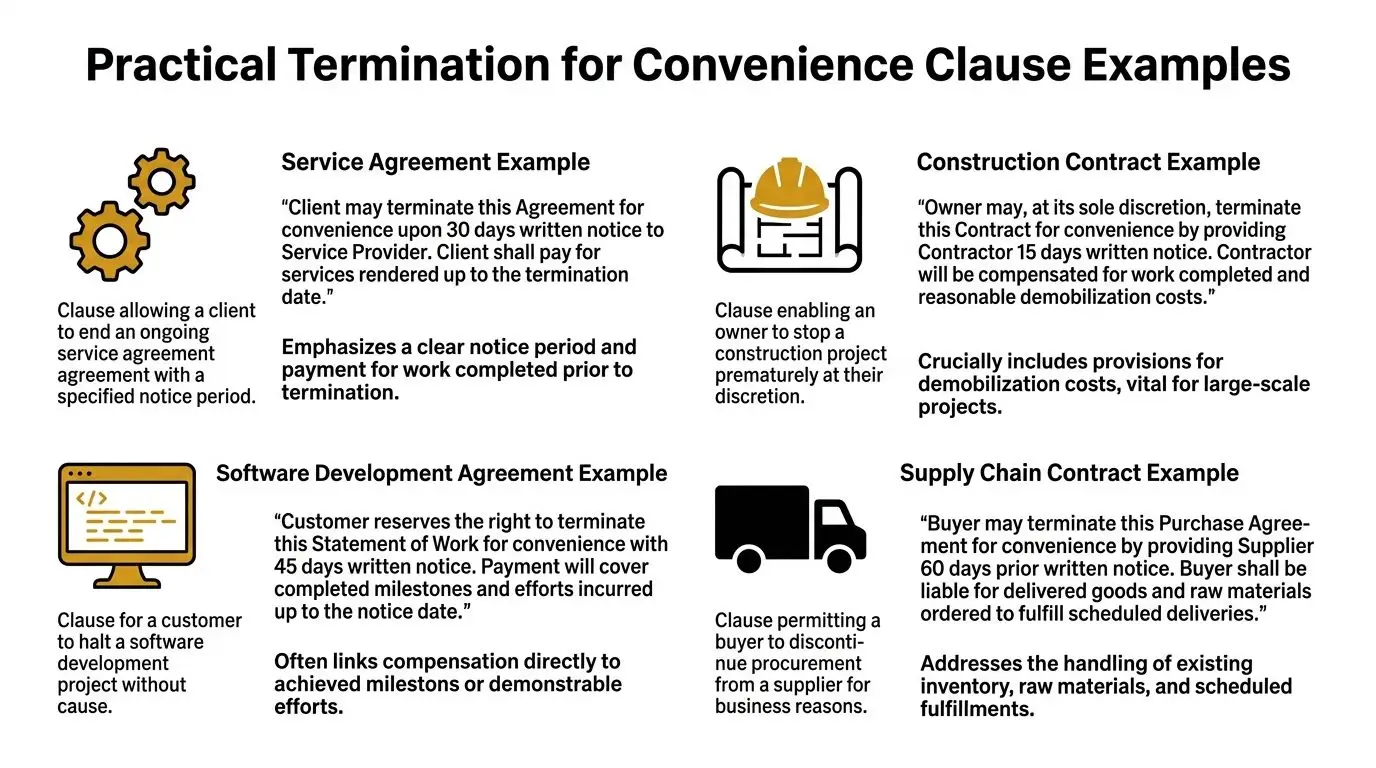
Service agreement example
“Client may terminate this Agreement for convenience upon 30 days written notice to Service Provider. Client shall pay for services rendered up to the termination date.”
This is the classic light commercial form. It is short, clear, and dangerous for any provider that invests early in onboarding, staffing, or training.
The strength is clarity. The weakness is what it omits. It says nothing about non-cancellable commitments, staff reassignment costs, knowledge transfer time, or prepaid third-party tools. If the provider prices the deal on a long relationship, the clause can erase expected margin quickly.
This format works best when the provider has low setup costs and a diversified client base. It works poorly where the provider builds a dedicated team or accepts reduced early pricing in exchange for future term.
Cross-border supply contract example
“Buyer may terminate this Purchase Agreement for convenience by providing Supplier 60 days prior written notice. Buyer shall be liable for delivered goods and raw materials ordered to fulfill scheduled deliveries.”
This wording fits procurement relationships better because it addresses the supply chain tail. Raw materials, scheduled deliveries, and committed production create losses that a bare service clause would ignore.
The strategic issue lies in the phrase “ordered to fulfill scheduled deliveries.” Buyers will often argue for a narrow reading. Suppliers should define what counts as committed inventory, approved forecasts, long-lead inputs, and packaging specific to the buyer.
In cross-border deals, this clause also needs customs, storage, and local disposal language. Otherwise, the parties may fight over stranded goods in the wrong jurisdiction.
Franchise agreement example
“Franchisor may terminate this Agreement for convenience upon written notice where continued operation under this Agreement no longer aligns with system strategy, subject to payment of accrued contractual sums and completion of an orderly de-branding and transition process.”
This wording shows a different commercial purpose. The franchisor is protecting brand architecture, market strategy, and network control.
A franchisee should focus less on the label “for convenience” and more on the transition burden. De-branding, customer notices, return of manuals, platform access, and local employee liabilities all create friction. If the agreement allows strategic exit, it should also define the franchisee’s runway and post-termination obligations with precision.
This style of clause often triggers good faith arguments. If a franchisor invokes convenience while informally preparing to replace the operator, the dispute will often move beyond plain text into conduct and motive.
Post-merger integration services example
“Either party may terminate a Transition Services Schedule for convenience upon written notice, provided that the terminating party shall cooperate in an orderly transfer of the affected services, continue critical services during the agreed transition period, and pay all undisputed charges accrued through final cutover.”
This is the most operationally sensitive example. In post-merger transactions, a termination right can disrupt finance, payroll, IT, compliance support, or customer interfaces.
The key phrase is orderly transfer. That phrase should never stand alone. It needs detail. Which systems remain available. Who owns migration responsibility. What data formats must be delivered. Which personnel remain available during handoff. How long critical services continue after notice.
Without those details, the parties may both accept the concept and still litigate the execution.
What these examples show
The wording should reflect the business reality, not a borrowed template. The same clause architecture does not fit all contracts.
| Agreement type | Main protected interest | Main drafting risk |
|---|---|---|
| Service agreement | Payment for performed work | Unpaid setup and ramp-down costs |
| Supply contract | Inventory and production commitments | Undefined raw materials and forecast liability |
| Franchise agreement | Brand control and network reshaping | Bad faith allegations and transition chaos |
| M&A transition services | Continuity of critical operations | Vague cutover and cooperation duties |
A sound review asks three questions.
- What costs arise before delivery? Those costs need express protection.
- What must continue after notice? The contract should name the transition duties.
- What behavior would look abusive? The clause should narrow that conduct in advance.
Assessing Your Financial and Operational Risks
The commercial harm from convenience termination rarely stops at lost revenue. The primary impact often appears in the cost categories that the contract fails to mention.

The losses that most contracts leave exposed
A company may recover payment for accepted work and still suffer serious damage. Setup costs, dedicated hiring, specialized inventory, internal management time, and foregone opportunities can remain unrecovered. That is why legal teams should model the downside before signing, not after a notice arrives.
The operational effect can be wider than the direct contract value. One terminated relationship may leave unused stock, idle staff, and pressure from subcontractors. It may also force a rapid redesign of forecasts and cash planning.
A disciplined review should sit inside broader enterprise risk management strategies. The clause belongs on the risk register because it can trigger legal, financial, operational, and reputational consequences at once.
Good faith is the hidden limiter
Many parties assume that an express termination right is absolute. That assumption fails in a growing number of disputes. Maryland case law, discussed in the ConsensusDocs analysis on the good faith limits of termination for convenience clauses, states that a party exercising discretion must “refrain from doing anything that will have the effect of frustrating the right of the other party to receive the fruits of the contract between them.”
That principle matters in international business. Israeli and many civil law systems treat good faith as a stronger operating rule than parties from strict common law backgrounds often expect. Conduct can therefore matter as much as clause wording.
Risk map for management teams
- Sunk investment risk: Front-loaded costs become vulnerable if the clause allows early exit.
- Dependency risk: A major customer can use the clause to exert pressure during repricing.
- Downstream risk: Subcontractor commitments may survive even when the prime contract ends.
- Dispute risk: The right may exist, yet the exercise may still be challenged as abusive.
A company should not ask only, “Can the other side terminate?” It should ask, “What remains unpaid, untransferred, and unprotected the day after notice?”
A useful internal test is simple. If notice arrived tomorrow, management should already know which costs stop, which continue, which records support recovery, and which obligations survive. If that answer is unclear, the clause remains a live business risk.
How to Draft and Negotiate a Balanced Clause
A balanced clause does not eliminate exit rights. It makes them predictable.

Termination for convenience clauses appear in 75% of cross-border supply contracts and typically allow exit with 30-90 days’ notice. Their enforceability depends on good faith under principles such as UNIDROIT Art. 1.7, and drafting with procedural safeguards such as consultation periods has been shown to cut litigation by 40%, according to the analysis at fynk on termination for convenience clauses.
Drafting points that change outcomes
The first lever is timing. A notice period should match the commercial setup of the deal. Commodity supply can support one model. Dedicated manufacturing, regulated services, and integration work need more runway.
The second lever is compensation. Payment for accepted work is not enough where the performing party carries termination-specific burdens. The better approach is a defined formula for work performed, approved commitments, and wind-down costs.
The same source notes that optimal drafting often uses tiered compensation, including full payment for accepted work plus a 10-20% termination fee benchmarked to wind-down costs. That approach is not mandatory in every deal, but it is a useful benchmark where the supplier bears real exit friction.
A negotiation checklist
- Limit early use: Add a blackout period after signing or after launch.
- Define notice mechanics: State delivery method, effective date, and required content.
- Create a consultation step: Require a short business review before notice becomes final.
- State compensation clearly: Cover accepted work, committed costs, and termination expenses.
- Address inventory: Define custom stock, long-lead materials, and disposal responsibility.
- Protect transition: Require cooperation, data delivery, and system access where relevant.
- Control conduct: Prohibit replacement sourcing before notice where that behavior would suggest bad faith.
Language that works better than templates
Weak language says the buyer may terminate on notice and pay for work completed. Stronger language specifies categories and process.
A practical structure often includes these features:
| Clause component | Weak version | Better version |
|---|---|---|
| Notice | “on written notice” | written notice, effective date, recipient, cure of delivery defects |
| Compensation | “pay for work completed” | accepted work, approved WIP, committed third-party costs, wind-down costs |
| Timing | immediate right | no use during launch, implementation, or recovery period |
| Process | none | consultation period, transition plan, final accounting timetable |
Drafting should force the parties to answer the uncomfortable questions before a dispute exists. That is cheaper than litigating what “reasonable” meant later.
Negotiation posture matters
Sellers often ask to delete the clause entirely and lose credibility. Buyers often insist on an unrestricted right and create avoidable dispute risk. A better negotiation position ties flexibility to procedure and compensation.
The recommended strategic path is to trade optionality for certainty. If one party wants broad exit rights, the other party should secure stronger economics, stronger notice, or stronger process. Balanced clauses survive pressure better because they give decision-makers a clear landing path when conditions change.
Navigating Cross-Border Contract Enforcement
A termination right does not travel cleanly across legal systems. The same words can produce different outcomes depending on the governing law and forum.
The U.S. federal model
In U.S. federal procurement, the clause sits on unusually strong footing. Under FAR 52.249-2, the government has unilateral authority to terminate fixed-price contracts in whole or in part when the Contracting Officer decides that termination serves the government’s interest. That power was used in over 90% of federal contract terminations from 2018-2023, and contractor recovery is generally limited to work performed and settlement costs, excluding anticipatory profits, as outlined in this discussion of FAR termination for convenience practice.
That structure reflects public procurement policy, not ordinary commercial bargaining. It favors state flexibility over the contractor’s expectation of full contract value. Companies entering U.S.-linked public contracts should not assume that their commercial instincts will map neatly onto the federal regime.
The same source also notes that misuse for bad faith reasons can be challenged, with courts overturning about 15% of contested terminations under precedents such as Kolar Inc. v. United States. That is an important safeguard, but it is not a substitute for careful contract administration and evidence preservation.
The Israeli and EU commercial position
Israeli and many EU-influenced systems place more visible weight on good faith in performance and enforcement. In those environments, a convenience termination may remain valid in principle while the key point of contention is the manner of exercise.
That changes contract strategy. Parties should spend less time debating whether the clause may exist and more time defining how it may be used. Notice periods, consultation duties, prohibited pre-termination conduct, and transition cooperation become central because courts may examine behavior closely.
What cross-border parties should do
The governing law clause should never be treated as background text. It changes the practical meaning of the exit right.
A cross-border contract should answer these questions:
- Which law governs the clause? Common law and civil law systems frame discretion differently.
- Where will disputes be heard? Forum affects urgency, cost, and interim relief.
- What language controls? Dual-language drafting can create ambiguity in notice and compensation.
- How do subcontracts align? Downstream contracts should mirror the prime contract’s termination logic.
A U.S. buyer may expect wide discretion. An Israeli counterparty may expect the court to police opportunistic conduct more aggressively. Neither assumption is safe without careful drafting.
In cross-border contracts, the termination clause is not self-contained. Governing law, dispute forum, and post-termination obligations decide how much power the text really gives.
Beyond the Clause Mitigating Termination Risk
Some contracts will not yield on the clause. When that happens, the response should move beyond markup strategy.
Contractual alternatives
A company can sometimes replace an unrestricted convenience right with a narrower mechanism. Examples include termination for material change in circumstances, mandatory renegotiation after defined events, or staged exit rights tied to milestones.
These structures do not remove flexibility. They make the trigger more objective. That reduces the likelihood that one side uses termination as a pricing weapon.
Operational buffers
The stronger protection often sits outside the contract itself. Management should reduce the damage a single termination can cause.
- Diversify revenue exposure: Avoid dependence on one contract where possible.
- Phase delivery and payment: Separate projects into milestones with paid acceptance points.
- Limit irreversible spend: Delay dedicated procurement until clear approvals exist.
- Mirror downstream terms: Push equivalent exit rights and notice rules into subcontracting layers.
Prepare the paper trail before conflict
When termination happens, documentation quality quickly becomes outcome quality. The business should be ready to show what work was completed, what commitments were unavoidable, and what steps reduced further loss.
For teams that need a practical reference on exit communications, this guide on how to write a contractor termination letter that reduces your risk is useful because it focuses on clarity, record creation, and controlled wording. Those points matter on either side of the notice.
The recommended strategic path is resilience by design. A company should negotiate the best clause available, then structure the transaction so that an unfavorable exercise does not threaten the wider business.
Frequently Asked Questions
Can a termination for convenience clause apply only to part of a contract
Yes. Parties can draft the clause to allow partial termination or full termination. Partial termination is often useful where product lines, service towers, territories, or transition schedules can be separated.
The contract should define the consequences of a partial exit. It should state what pricing changes, what minimum volumes survive, and whether shared costs must be reallocated.
What happens to intellectual property after termination
The answer depends on the ownership and license structure. The termination clause alone usually does not decide the full IP position.
A strong contract should state which IP rights survive, which licenses end, what source materials or know-how must be returned, and what transitional use remains allowed. In software, R&D, franchising, and post-acquisition services, this issue often matters more than the termination notice itself.
Can a convenience termination be challenged in court
Yes, but the argument usually focuses on exercise, not only existence. The challenge may allege bad faith, abuse of discretion, failure to follow notice mechanics, or non-payment of contractually required compensation.
The quality of evidence matters. Internal emails, replacement-vendor discussions, inconsistent reasons, and defective notice practices can all shape the dispute. Companies should assume that conduct before and after termination will be examined closely if litigation follows. Contact RNC group to find out how to do this right.
Disclaimer: The following analysis and the provided termination for convenience clause examples are intended for educational and strategic briefing purposes only. Contractual interpretation varies significantly across jurisdictions, including the specific nuances of U.S. Federal Acquisition Regulations (FAR), Israeli contract law, and European Union commercial directives. The exercise of a termination right involves high-stakes financial and operational risks, including potential allegations of bad faith or breach of implied duties. This content does not constitute legal advice or the formation of an attorney-client relationship. All stakeholders must engage qualified legal counsel to review specific contract language and ensure alignment with governing law and enterprise risk mitigation protocols before executing or modifying any legal instrument.