
A company can register every mark it owns and still lose control of its intellectual property abroad. That sounds counterintuitive. It isn’t.
International IP failure usually starts before infringement. It starts with incomplete ownership records, weak contracts, careless disclosure, and no response plan when a dispute spills into banking, customs, or reputation risk.
Israeli companies entering the US, EU, China, Japan, or regional franchise markets need a different posture in 2026. They need to treat IP as a live commercial asset and a crisis-management function at the same time. That is the only serious way to answer the question of how to protect intellectual property internationally.
Your 2026 IP Strategy Is Already Obsolete
Many boards still treat IP as a filing exercise. That model is outdated.
International protection now sits at the intersection of expansion, enforcement, and operational resilience. If a business files late, discloses too much, or signs the wrong cross-border agreement, the legal problem quickly becomes a commercial problem.

The old assumption was simple. Register patents and trademarks, then enforce them if trouble appears. That approach overlooks critical vulnerabilities. Competitors move faster, distributors become adverse parties, former partners reuse know-how, and digital copying turns one leak into a multi-market event.
Registration alone won’t save the business
A registration is evidence of rights. It is not a business continuity plan.
Companies that expand internationally need a phased model. First, they identify what matters. Then they file selectively, lock down confidential assets, hardwire ownership into contracts, and prepare escalation paths before the first conflict arrives.
Practical rule: If an IP dispute can disrupt sales, funding, supply, or banking, it belongs in the company’s crisis framework, not only in its legal folder.
That point matters more for Israeli businesses. They often operate across multiple jurisdictions, use multilingual contracts, and depend on distributors, developers, manufacturers, and local partners. Each one can become a weak link.
The strategic shift that matters
The correct lens is defensive and offensive at once. IP should protect market access, support valuation, strengthen licensing power, and reduce exposure during disputes.
That also changes what “good protection” looks like. It isn’t just broad coverage. It’s coverage tied to revenue markets, manufacturing locations, future licensing, M&A due diligence, and enforcement practicality.
A serious international strategy asks harder questions:
- Where will infringement hurt first: Sales market, factory location, app store, distributor network, or customs channel.
- Which asset provides an advantage: Patent, brand, design, source code, database, formula, or process know-how.
- What fails under pressure: Ownership chain, inventor assignment, NDA language, or governing law.
- Who acts in the first week of a dispute: Management, local counsel, customs agent, bank liaison, or litigation team.
Most companies already have more exposure than they think. The right response isn’t panic. It’s structure.
Phase One Conduct a Strategic Asset Inventory
Your filing plan is only as strong as the asset map under it. If the company cannot identify what it owns, who controls it, and where the exposure sits, international protection breaks down before the first application is filed.
Start with an audit that treats IP as a crisis-risk issue, not a clerical task. An analysis from AnalystIP notes that companies often miss trade secrets in early-stage reviews and that filing strategy should match current and planned sales markets. That point matters for Israeli companies. A missing assignment, a loosely managed reseller, or code developed outside a clean employment framework can turn into a cross-border dispute, delayed funding, blocked distribution, or reputational pressure at the worst possible time.
What the inventory must capture
List the registered rights first. Patents, patent applications, trademarks, designs, copyrights, domain names, and marketplace handles should all be visible in one place.
Then identify the assets that usually create the harder disputes. Source code. Product architecture. datasets and data structures. Manufacturing tolerances. Pricing logic. Training materials. formulas. Testing protocols. Internal playbooks. Customer-facing content adapted for foreign markets.
The inventory should answer five direct questions:
- What exists: Every asset, registered or unregistered.
- Who owns it: The company, a founder, an employee, a contractor, a university, or a foreign affiliate.
- How it was created: Employment, commissioned development, acquisition, joint venture, or license.
- Where it matters: Revenue markets, production sites, cloud locations, app stores, customs touchpoints, and litigation-sensitive jurisdictions.
- What fails under pressure: Expired rights, missing assignments, public disclosure, open access, reseller misuse, or conflicting local registrations.
An incomplete inventory does not stay a legal problem. It becomes a financing problem, an enforcement problem, and often a management problem.
Ownership is usually weaker than management assumes
I see the same pattern repeatedly. The company believes it owns the code, but a founder built the core module before incorporation. The company uses a house mark worldwide, but the first filings sit in a distributor’s name. Marketing rolls out translated packaging in Europe or Latin America, but no one checked who owns the adapted content or whether local use created new exposure.
Israeli companies are especially vulnerable to this gap because they scale fast, build through mixed teams, and enter foreign markets early. That speed creates value. It also creates record-keeping defects, fragmented chains of title, and local practices that do not match headquarters assumptions.
A serious inventory collects documents, not just labels on a spreadsheet.
The practical audit file
The working file should be usable by legal, finance, operations, and management under time pressure. If a dispute starts in Germany, the UAE, or the United States, the company should not need two weeks to locate the ownership record.
| Asset class | Key documents | Main risk |
|---|---|---|
| Patents and applications | Filing records, inventor assignments, prosecution status | Chain-of-title defects |
| Trademarks and brands | Registration certificates, use evidence, coexistence terms | Use by unauthorized distributors or local registrants |
| Copyright assets | Creation records, work-for-hire terms, assignment documents | Contractor or founder ownership claims |
| Trade secrets | Access controls, internal policies, NDA records, storage map | Loss of secrecy through internal leakage or partner misuse |
| Designs and packaging | Registrations, launch materials, supplier approvals | Copying by manufacturers, resellers, or parallel traders |
Audit for business reality
A legal register is not enough. The audit has to follow the asset into the field.
Review how the company sells, licenses, manufactures, hosts, and markets the product. Check Amazon listings, software repositories, reseller portals, franchise materials, OEM relationships, packaging approvals, and distributor-created content. Many international disputes start because commercial use drifted away from legal ownership, then no one corrected the gap before expansion.
For Israeli businesses, this is the first escalation point in the wider crisis framework. Identify the assets tied to revenue. Flag the markets where a dispute could freeze sales, trigger payment holds, disrupt banking reviews, or damage investor confidence. Separate defects that can wait from defects that must be repaired before filing, fundraising, licensing, or enforcement.
The output should be blunt. Which assets drive enterprise value. Which rights are exposed. Which documents are missing. Which foreign relationships create immediate risk. That clarity is what turns an inventory into an operating tool, rather than another legal memo no one reads.
Phase Two Select Global Filing Routes
After the inventory is complete, the company faces a real strategic choice. File country by country, or use international systems to control timing, cost, and reach.
That decision depends on asset type, target markets, speed, and budget. It also depends on whether the business needs optionality for investment, licensing, or a near-term sale.
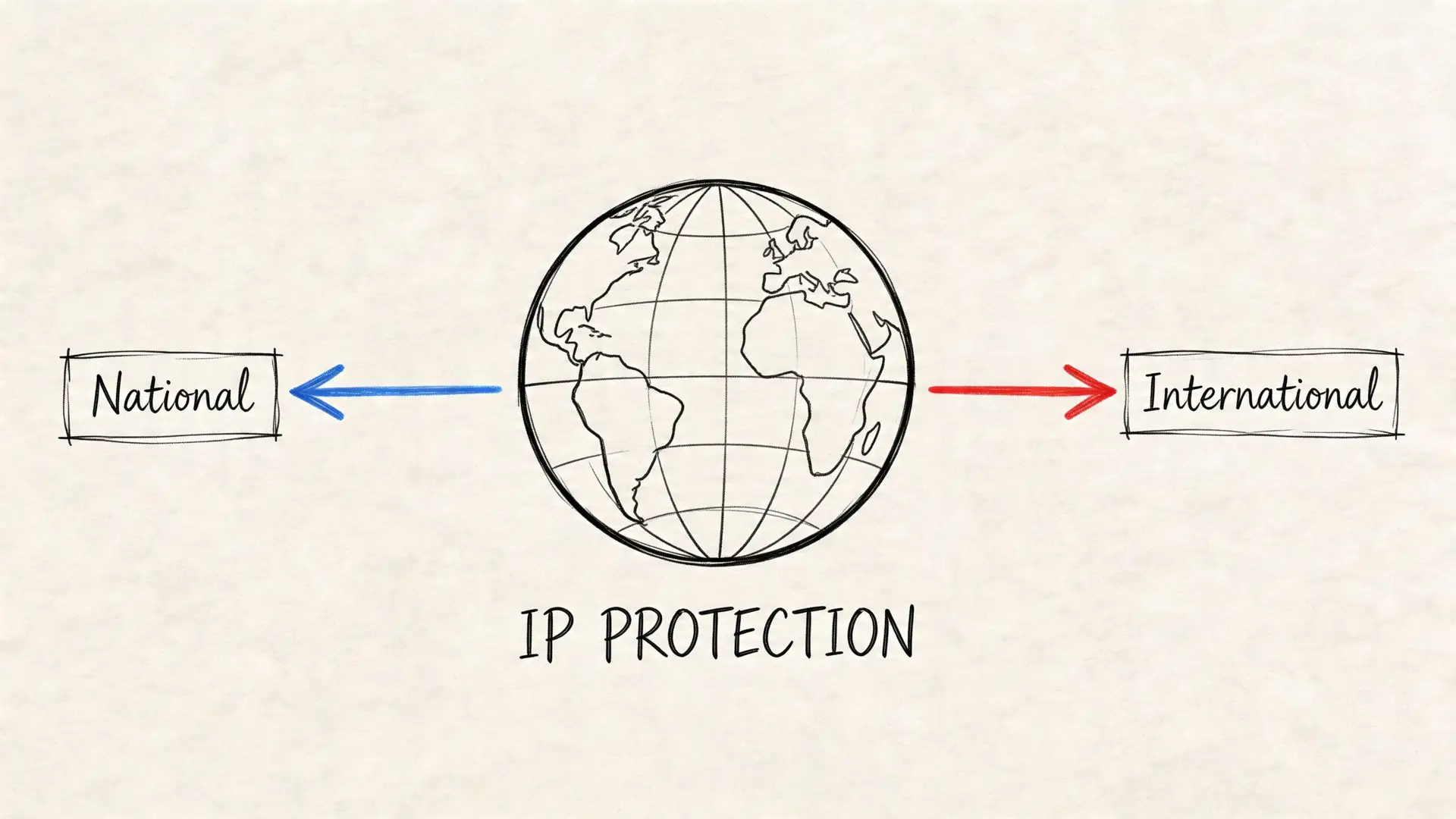
Trademarks require a portfolio view
For brands, the Madrid Protocol remains the core international mechanism. According to this discussion of international IP mechanisms, it allows a single application to seek coverage in over 130 countries and contracting parties, covering about 80% of world trade. The same source states that the system can reduce initial filing fees by up to 90% compared with separate national filings, and WIPO has recorded over 1.3 million international registrations.
That does not mean Madrid is always enough. It means Madrid is often the starting route for a brand with broad geographic ambition.
A practical trademark filing analysis should compare:
- Core sales markets: Where customers buy now.
- Expansion markets: Where the company expects to launch next.
- Manufacturing and sourcing points: Where counterfeit or parallel use may begin.
- Defensive markets: Where bad-faith filings are common or where distributors may try to register the mark first.
Patents are about timing as much as scope
Patents follow a different logic. The Patent Cooperation Treaty is less about obtaining a global patent and more about preserving international options while delaying fragmented national filing pressure. The USPTO IP toolkit explains that the PCT allows a single application to defer national phase entry in up to 143 countries, representing over 90% of global GDP. The same source states that inventors generally gain 30-31 months to evaluate commercial viability, and that the system has processed over 3.5 million applications historically, with over 300,000 filings annually in recent years.
For an Israeli technology company, that window matters. Management may still be testing market fit, negotiating investment, or deciding whether the US, Europe, and Asia all justify full patent spend.
File patents for strategic flexibility, not for vanity. A large filing footprint without a market case becomes dead weight.
Direct filings still have a place
International systems are powerful, but they aren’t automatic answers. Some businesses should file directly in one or two critical jurisdictions before broadening the portfolio.
That is common when a company has a narrow export map, a short launch cycle, or a known enforcement target. A premium consumer brand may need immediate action in a specific market. A life sciences company may need tight coordination with disclosure rules and licensing negotiations. A design-heavy business may prefer a mixed route that combines direct filings with international design coverage where relevant.
A simple decision frame
| Asset | Best first route in many cases | Why |
|---|---|---|
| Trademark | Madrid Protocol | Broad reach and centralized administration |
| Patent | PCT | Defers national decisions while preserving options |
| Design | Hague or targeted filings | Useful where product appearance drives value |
| Copyright-heavy product | Contractual and evidentiary planning | Registration alone won’t solve copying risk |
| Trade secret-driven model | Internal controls and NDAs first | Filing may disclose too much |
The strongest portfolios usually use a hybrid model. Register where exclusivity matters. Delay where commercial facts are still forming. Avoid broad filing for assets that should remain secret.
That’s the operational answer to how to protect intellectual property internationally. Pick routes that serve the business, not just the filing calendar.
Phase Three Fortify Digital Assets and Trade Secrets
Some of the most valuable IP cannot be sensibly patented. Once disclosed, it may lose the advantage that made it valuable in the first place.
That is why trade secrets, internal systems, source code, algorithms, formulas, customer intelligence, and operational know-how need a separate protection model. The law will not treat something as a trade secret if the business itself handled it casually.

Weak enforcement markets require layered protection
In high-risk jurisdictions, relying on patents alone is often a poor bet. As explained in this analysis of weak patent enforcement markets, over 80% of IP disputes in such jurisdictions involve unenforced patents. The same source notes that a layered strategy based on trade secrets, strict NDAs, and defensive trademark registrations can reduce costs by 40-60%.
That is the right mindset. Use patents where they provide strategic advantage. Use trade secret controls where disclosure would create vulnerability. Use trademarks defensively because brands are often easier to police than embedded know-how.
Secrecy must be engineered
A court will ask simple questions. Who had access. Why did they have access. What restrictions applied. What records exist.
Trade secret protection should therefore include:
- Access segmentation: Staff, contractors, and partners should see only what they need.
- Clean labeling: Confidential materials should be clearly designated and stored in controlled systems.
- Exit discipline: Departing personnel should return devices, credentials, and repositories, and reaffirm confidentiality.
- Vendor control: Manufacturers, developers, and external labs should receive only scoped disclosures.
- Proof trails: The business should preserve records showing who received what, and under which obligations.
The secret is not the document alone. The secret is the system around the document.
Contracts must match operational reality
Many companies use NDAs that are too thin to support real enforcement. They define confidential information poorly, ignore onward disclosure, and fail to align with cross-border dispute mechanics.
A practical starting point can be a structured NDA template, but the final document should reflect the transaction, the jurisdiction, the disclosure path, and the actual asset class involved. A software access agreement needs different language from a manufacturing transfer. A due diligence NDA needs different language from a reseller onboarding file.
A strong confidentiality framework should also distinguish between material that may be inspected, material that may be copied, and material that may never leave a secure environment.
Digital assets need evidence, not assumptions
Software and data disputes often turn on proof. The company must show authorship, version history, access logs, and contractual restrictions. If the business cannot show when code was created, who contributed to it, and under what assignment terms, enforcement becomes harder.
The same applies to AI-adjacent workflows, internal datasets, and technical configurations. If the company expects to enforce rights later, it should preserve creation records now. That is especially important in joint development, outsourced engineering, and cross-border product teams.
Phase Four Deploy Contractual Armor and Licensing
Cross-border IP losses often start in the contract set, not at the registry. The filing proves ownership. The agreement decides who can access the asset, where they can use it, what they can build around it, and how fast you can shut misuse down. For Israeli companies expanding under pressure, that difference is not academic. It determines whether an IP dispute stays contained or turns into a cash-flow, supply-chain, and reputation event.
The clauses that stop disputes before they become claims
Ownership language must be exact. If a distributor adapts packaging, a development partner improves code, or a manufacturer changes a process, the agreement must say who owns the result, who may use it, and whether that right survives termination.
Confidentiality is only one layer. Key protection resides in the operating clauses: purpose limits, named user groups, subcontractor restrictions, storage rules, deletion duties, inspection rights, governing law, forum, and emergency relief. If those provisions are vague, enforcement becomes slower and more expensive at the worst possible moment.
Licenses need even tighter control. The document should define exclusivity, territory, field of use, performance thresholds, reporting duties, sublicensing limits, quality standards, infringement notice obligations, audit rights, treatment of improvements, and post-termination wind-down. Each item affects commercial control. Each item also affects the evidence file if the relationship breaks.
For franchise and distribution models, trademark control is a front-line issue. Weak quality controls can damage the mark itself. In some jurisdictions, that failure also weakens the owner’s position in later enforcement.
Multilingual drafting can create or destroy your enforcement position
Many international disputes are won or lost on text that looked harmless at signing. One version says assignment. Another suggests a license. One version permits affiliate use. Another does not. By the time the mismatch surfaces, the counterparty is already relying on the broader reading.
Israeli groups working through local entities, foreign subsidiaries, resellers, and outsourced teams should test three points before signature:
- Language alignment: Every version must allocate ownership, use rights, and termination effects in identical terms.
- Dispute mechanics: Governing law, jurisdiction, notice, and interim relief must work where the counterparty and assets are located.
- Crisis usability: The agreement should support injunction papers, payment holds, platform notices, and internal escalation if misuse appears.
Many founder, affiliate, and local partner arrangements frequently encounter failure points. The commercial relationship moves fast. The paper trails behind. Then a market entry stalls because ownership is disputed, royalty flows are blocked, or a former partner starts using the brand as if the rights were shared.
Licensing should preserve control under stress
The common drafting error is simple. The grant is broader than the business deal.
A better structure gives the counterparty only what it needs to perform. Nothing more. That often means limiting the field of use, requiring approval for marketing and local adaptations, restricting reverse engineering, controlling source code access, defining who owns derivative works, and giving the licensor suspension rights after breach or payment default.
A strong contract does not just describe cooperation. It gives the rights holder power when cooperation ends.
That point matters in crisis management. In a live dispute, the fastest pressure point is often contractual. Suspension rights can freeze misuse before a court order arrives. Audit rights can expose hidden channels. Quality-control clauses can support trademark action. Payment and reporting provisions can help trace diversion, quantify exposure, and justify escalation.
Contracts do not replace registration. They turn registered rights into tools you can use.
Phase Five Execute International Enforcement and Crisis Response
Your filing strategy means little if the company freezes in the first 72 hours of a live cross-border dispute.
International IP enforcement is a crisis function. For Israeli companies, it can escalate fast from infringement into customs holds, marketplace removals, payment delays, distributor conflict, and reputational damage in export markets. The legal claim is only one front. The business must stay operational while pressure builds.
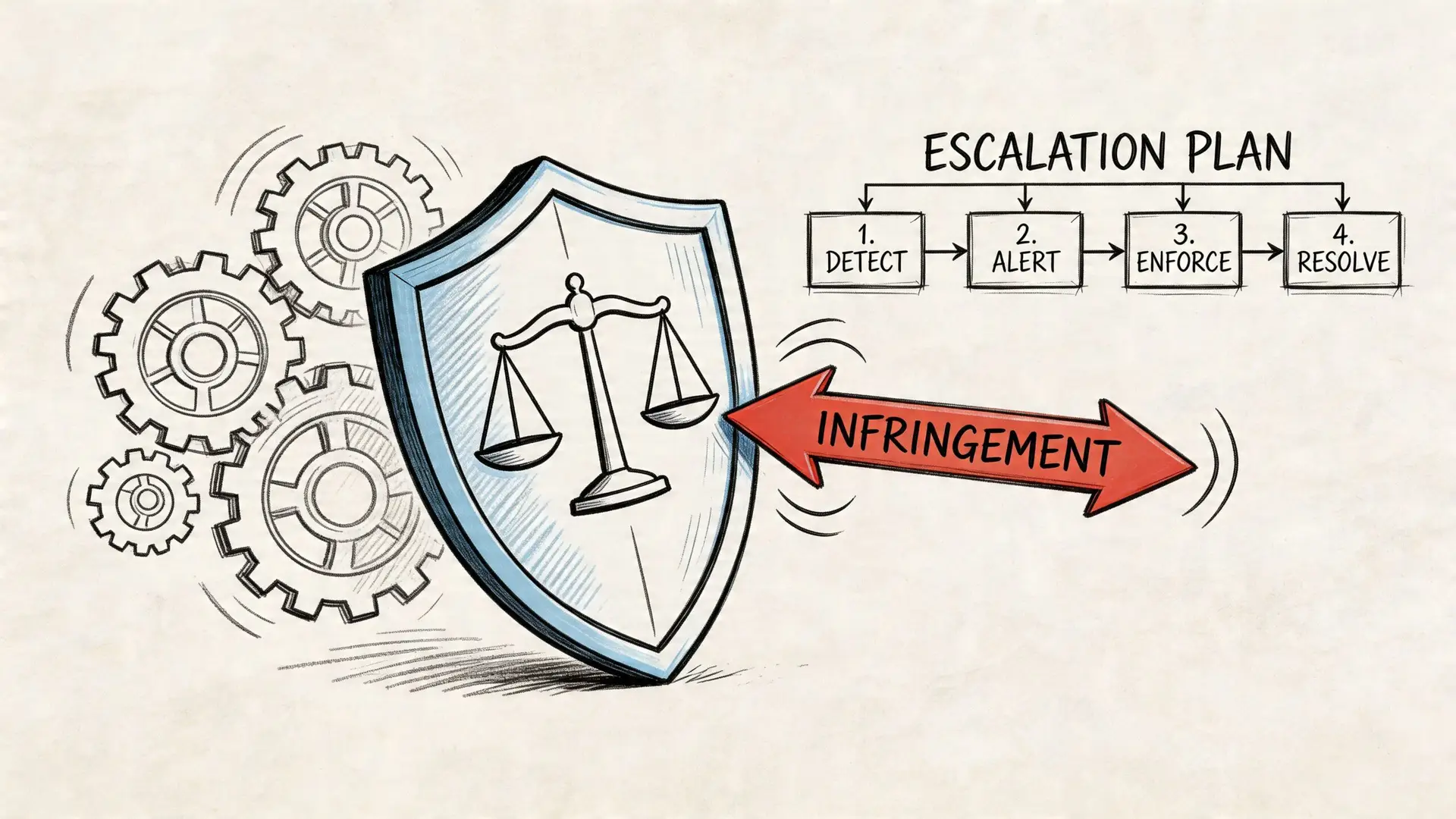
Build enforcement as a phased response
The first mistake is emotional escalation. The second is delay.
A disciplined response starts with control. Preserve evidence. Stop internal leakage. Confirm who owns the right being asserted, in which jurisdiction, and against which party. Then choose the first move based on business exposure, not outrage. A cease-and-desist letter may be enough. In other matters, early notice only gives the counterparty time to move stock, scrub accounts, or shift operations.
According to this discussion of phased IP development and enforcement, many disputes are resolved before court through early assertion and structured follow-up. The same source also warns that weak claims and poor timing can damage later opposition or enforcement efforts.
The first week decides your options
Treat the first week as evidence and pressure design.
A workable sequence usually looks like this:
- Confirm the right. Verify registrations, chain of title, scope, and any local recording requirements.
- Lock the record. Capture listings, packaging, domain data, ads, correspondence, source files, and access logs in a form counsel can use later.
- Map the commercial route. Identify where goods are made, stored, sold, paid for, and shipped.
- Select the pressure point. Use the forum that creates immediate business friction, such as customs, a marketplace, a local court, or a contractual suspension right.
- Run settlement and litigation in parallel. Prepare the commercial exit before the first formal notice goes out.
That sequence reduces two common enforcement failures. One is filing in the wrong forum because the legal team reacts before the business map is clear. The other is sending a letter that sounds forceful but creates no practical pressure.
Cross-border disputes often become operational crises
Many management teams still separate IP enforcement from crisis response. That is a mistake.
As noted in this trade guidance on IP considerations, IP disputes can affect market access, counterparties, and commercial continuity across borders. For an Israeli company selling through distributors, payment processors, cloud platforms, or global marketplaces, an infringement allegation can trigger problems far beyond the right itself. Funds may be delayed. Inventory may be held. A local partner may stop performing. A platform may act before a court does.
That is why enforcement planning must sit inside a broader escalation framework. Legal, finance, operations, communications, and regional management need assigned roles before the dispute starts. If a bank asks questions, a marketplace suspends listings, or a distributor claims competing rights, the company should already know who approves statements, who handles regulators, who contacts foreign counsel, and who protects revenue flow.
Litigation must serve a commercial end state
Court action is sometimes the correct first move. Often it is not.
The stronger position is the one that combines enforceable rights, clean evidence, local procedure, and a defined commercial objective. That objective may be an injunction. It may be a negotiated exit, a stock surrender, a license conversion, or a settlement that shuts down repeat misuse in multiple markets. Good enforcement strategy chooses the remedy that changes conduct fastest at an acceptable cost.
I have seen international matters deteriorate because management treated the case as a legal contest instead of a containment exercise. The better files are calmer and harder. They show ownership clearly, preserve evidence early, coordinate messages across jurisdictions, and escalate in phases. That is how rights protection supports expansion instead of disrupting it.
The Playbook Summary and Strategic Imperatives
A 2026 international IP plan fails fast if it sits outside crisis control.
The companies that hold value across borders treat IP as an operating discipline tied to expansion, disputes, payments, counterparties, and reputation. For Israeli businesses, that point is sharper. Cross-border pressure rarely stays inside one legal file. A trademark conflict can trigger customs delays. A trade secret leak can affect financing, channel stability, and public messaging in several markets at once.
The five-phase playbook works only if management treats it as a standing system, not a one-time filing exercise. Asset mapping must support enforcement. Filing choices must match revenue exposure and manufacturing risk. Digital protection must prevent real loss, not satisfy policy language. Contracts must hold under stress. Enforcement planning must connect legal action to cash preservation, operational continuity, and message control.
The checklist that deserves board attention
Use this standard:
- Know what the business owns: Confirm registered rights, unregistered rights, source code, data rights, domain control, and key know-how.
- Fix ownership before expansion: Clean up founder transfers, employee invention terms, contractor assignments, and affiliate gaps.
- File where loss would hurt: Prioritize jurisdictions tied to sales, production, strategic partnerships, copycat risk, and enforcement practicality.
- Protect confidential value in practice: Restrict access, document controls, segment sensitive information, and track disclosure.
- Write agreements for failure scenarios: Set audit rights, use restrictions, termination mechanics, post-termination obligations, dispute forums, and interim relief options clearly.
- Assign escalation roles early: Legal, finance, operations, communications, and regional teams should know who acts when a platform suspends listings, a bank raises questions, or a distributor asserts competing rights.
Boards should ask one question. If a core IP asset is attacked next quarter in two foreign markets, who owns the response by hour, by day, and by week?
What usually goes wrong
Many companies still separate filing strategy from crisis planning. That mistake is expensive.
They register rights in the right classes, then leave commercial use uncontrolled. They disclose sensitive know-how through demos, integration work, or reseller support without proving secrecy discipline later. They sign distribution or license agreements that help market entry but fail under termination, insolvency, or hostile local conduct. By the time the dispute surfaces, the legal position is narrower than management assumed.
The stronger model is selective and hard-edged. Protect the assets that drive enterprise value. Match each right to a market, a revenue stream, or a strategic dependency. Build proof early. Control counterparties before conflict starts. If enforcement becomes necessary, escalate in phases that contain legal exposure and business disruption at the same time.
A company asking how to protect intellectual property internationally should ask three harder questions. Where does value sit. Where can control break. How fast can the business contain cross-border damage when it does.
Address exposure before it turns into blocked revenue, trapped inventory, platform action, or a public dispute. The right course is early review, ownership repair, contract correction, and a phased protection plan built with counsel experienced in international escalation.
This article provides general information only. It does not constitute legal advice, does not create an attorney-client relationship, and should not replace advice suited for specific facts, jurisdictions, contracts, or disputes.