
A management buyout looks simple from the outside. The managers know the business, the seller knows the managers, and the asset already has an operating team. Yet cross-border deals involving Israeli entities often break on issues that generic MBO guides barely mention. These issues include tax leakage, regulatory friction, currency exposure, and governance failures after closing.
That gap matters in 2026. Management buyout transactions now account for almost half of all M&A transactions in recent decades, according to Menke’s management buyout and ESOP analysis. For Israeli groups and foreign investors, the issue isn’t whether an MBO can work. Instead, the issue is how to structure a management buyout. The goal is to ensure the deal remains financeable, enforceable, and stable after signing.
The Strategic Case for a Management Buyout in 2026
Control is the primary reason to pursue an MBO in 2026. Price matters, but the winning structure is the one that keeps the business financeable, keeps management aligned, and keeps cross-border risk from eroding value after closing.

That is why astute sellers now treat an MBO as a serious control transaction, not a fallback for a failed auction. A management team starts with an advantage an outside bidder does not have. It already knows where margin is stable and which contracts are fragile. The team also knows which employees carry operational dependency and where integration risk would destroy value. For some businesses, especially founder-led groups and regulated operating companies, that continuity can justify choosing management over a higher but less certain headline bid.
The advantage is real, but it is easy to overstate. Managers know the business as operators. However, they do not always know it as buyers carrying acquisition debt, covenant pressure, minority investor rights, and post-closing governance constraints. I see this mistake often in cross-border deals. The team assumes familiarity with the asset is enough. It is not. In addition, the buyer group needs discipline on price, authority lines, information flow, and downside planning. This needs to be addressed before the seller, the lender group, or the tax authorities expose the gaps.
Why boards and owners still choose the MBO route
Boards usually choose the MBO route for one of three reasons. Continuity protects value. Confidentiality is easier to preserve. Execution can be faster than a broad sale process if the team is credible. Additionally, execution is quicker if financing is realistic.
That matters in businesses where customer relationships, licensing status, technical knowledge, or founder transition risk sit at the core of enterprise value. An external acquirer may pay more on paper and still deliver a worse outcome. This happens if customers leave or if regulators ask harder questions. Key employees may also treat the sale as a trigger to exit.
Sellers also get more room to shape the exit. They can negotiate deferred consideration, rollover equity, consulting arrangements, transition services, and tighter conduct covenants. The reason is, they are dealing with a known management group rather than an unfamiliar strategic buyer. The trade-off is obvious. In particular, familiarity can soften challenge where challenge is needed. This happens especially on valuation, warranties, and post-signing conduct.
Practical rule: The best MBOs are built around cash generation, control rights, and management credibility under lender scrutiny.
The Israeli cross-border angle changes the analysis
This point is often missed in generic MBO guides. If an Israeli company is the target, or an Israeli management team is acquiring through a foreign vehicle, the strategic case changes immediately.
The question is no longer just whether management is the natural buyer. Now, the question is whether the structure can carry Israeli tax, foreign tax, withholding, intercompany cash movement, exchange control considerations in relevant jurisdictions, local corporate approvals, and regulator expectations on beneficial ownership and funding sources. A deal that looks efficient in a UK or US template can fail quickly. This happens once Israeli law, foreign holding structures, and cross-border debt service are layered in.
For Israeli groups, structure and strategy are inseparable. Dividend capacity may not match acquisition debt timing. A foreign bidco may create tax friction that reduces distributable cash. Equity incentives that work well for domestic management can produce adverse tax outcomes. This might happen if they are rolled or reset without planning. RepaymentIn addition, repayment flows, transfer pricing, and management service arrangements also need to stand up to scrutiny after closing, not just at signing.
Cash flow analysis matters here in a very practical way. Teams that cannot isolate what the business will contribute to acquisition debt, after tax leakage and structural friction, tend to overpay. A useful starting point is disciplined modeling of operating cash generation and debt capacity. Mastering Incremental Cash Flow is a helpful primer on that lens. This is especially important when management is testing whether projected gains are genuine acquisition returns or accounting optimism.
A sensible MBO case in 2026 is therefore narrower than many teams expect. It works best where the company has durable cash flow and a management bench that can operate under shareholder oversight. Also, it works where a structure has been designed for the jurisdictions involved rather than copied from a domestic precedent. For Israeli and cross-border transactions, that design work is not a technical side issue. Instead, it is what determines whether the MBO remains executable once diligence, financing, and tax implementation begin.
Establishing Valuation and a Bankable Business Plan
Most failed MBOs don’t fail in the documents. They fail earlier, when the team agrees on a number that the business can’t carry.
A lender doesn’t finance ambition. A lender finances a repayment case. That means valuation and the business plan must align from the start.
Start with a range, not a slogan
Management teams often begin with a seller’s asking price or a rough sector multiple. That’s too loose for an MBO. The right approach is to build a defensible range using more than one method. Then test whether the resulting structure leaves enough room for debt service, working capital, and post-closing surprises.
In practice, two methods dominate:
- Earnings multiple analysis: This asks what multiple a rational buyer can support on the company’s operating earnings.
- Discounted cash flow analysis: This asks what the future cash generation is worth today under realistic assumptions.
The multiple method is usually the first filter because it is easy to communicate to lenders and sellers. The DCF matters because it forces the team to confront timing, margin pressure, and capital expenditure. If both methods point in roughly the same direction, the deal may be bankable. If they diverge sharply, one of the assumptions is probably too generous.
Build the business plan like a credit memo
A bankable plan doesn’t read like a sales deck. Instead, it reads like a risk memo with numbers attached.
The plan should address four questions.
-
What drives revenue
Separate recurring business from opportunistic wins. If revenue depends on a few major customers, say so and model downside cases.
-
What pressures margins
Input costs, employee retention, pricing power, and contract renewal risk all matter more after debt is introduced.
-
What cash must stay in the business
Debt service comes after payroll, inventory, tax, compliance, and customer delivery.
-
What changes under management ownership
Identify actual operational gains. Don’t fill the model with vague efficiency claims.
A credible MBO model shows how the business survives a bad quarter, not just how it performs in a good year.
A practical valuation example
Assume a management team in an Israeli industrial business wants to acquire the company from a founding shareholder. The team believes growth will continue because customer churn is low and management already handles operations. That may be true. It still doesn’t answer the central financing question.
The team must test whether the proposed purchase price survives under conservative assumptions. If one customer renews late, if a shekel or dollar move affects procurement, or if a planned product line takes longer to launch, can the business still meet debt obligations and covenant tests? If the answer is unclear, the valuation isn’t ready.
That is why line-by-line cash analysis matters. Teams that need a sharper framework for operating assumptions often find Mastering Incremental Cash Flow useful. It forces focus on what changes with the transaction, rather than what management hopes will happen.
What sellers and lenders each want to see
Sellers want a price narrative. Lenders want a repayment narrative. Equity partners want an upside narrative. A serious MBO structure addresses all three, but the lender’s question controls timing. This is because no financing means no closing.
Use this checklist before circulating numbers:
- Normalize earnings carefully: Strip out one-off items, but don’t over-clean the accounts.
- Model management costs accurately: Owners often understate the true cost of replacing founder functions.
- Stress test cash: Add downside cases for customer concentration, margin compression, and delayed collections.
- Separate essential from non-essential assets: Buyers often miss how disposals or retained assets affect price and funding.
- Tie the model to diligence: Every major assumption must be verifiable in contracts, records, and management reporting.
A valuation becomes persuasive when the numbers, legal structure, and financing story all point the same way. Anything less creates a gap. As a result, someone will price against you.
Assembling the MBO Financing Stack
No complex MBO is funded from one cheque. It is built from layers, and each layer changes control, cost, and enforcement risk.
For larger transactions, the financing menu expands quickly. Deals exceeding $5 million typically access senior debt, subordinated mezzanine debt, and private equity contributions, while MBOs are rarely financed from a single source, according to Wall Street Prep’s management buyout overview. In practice, the art lies in choosing a stack the business can live with after closing.
The logic of the capital stack
Senior lenders want first claim on value and strong visibility on repayment. Mezzanine providers accept more risk but demand a higher return and tighter negotiation on defaults, information rights, and exit terms. Private equity can solve funding gaps, but it changes governance. Seller financing often saves the deal because it aligns price with performance and reduces cash strain at completion.
For smaller transactions, the mix tends to be more personal and less institutional. The management team may combine personal funds, family loans, small business borrowing, and seller notes. As transaction size increases, the structure becomes more formal and document-heavy.
MBO financing sources compared
| Financing Source | Typical Cost | Risk Profile | Impact on Control |
|---|---|---|---|
| Senior debt | Lower relative cost than junior capital | Lower for lender, stricter covenants for borrower | Usually limited direct equity control, but strong covenant control |
| Mezzanine financing | Higher than senior debt | Higher repayment pressure and intercreditor complexity | May include rights that restrict flexibility |
| Private equity | No scheduled debt service, but high economic cost | Lower immediate cash strain, greater governance pressure | Significant dilution and board influence |
| Seller financing | Often commercially flexible | Depends on seller relationship and subordination terms | Usually less day-to-day control impact, but can shape enforcement rights |
| Management equity | Highest personal exposure for managers | Concentrates risk on the team | Preserves control if dilution stays limited |
What works and what usually doesn’t
The strongest stacks share three features.
- Senior debt supports, rather than suffocates, operations: If normal trading volatility could trigger a breach, the debt is too tight.
- Seller financing bridges valuation gaps: It works especially well when the seller believes in the business but wants a controlled exit.
- Equity holders align on authority early: If management and financial sponsors disagree on hiring, budget approval, or exit timing, the structure will destabilize fast.
What usually doesn’t work is a stack assembled backward. For example, teams sometimes start with the seller’s target price, then pile on debt until the numbers seem to fit. That approach creates a legal problem disguised as a financing solution. As a result, the documents then become a battlefield over defaults, information rights, and cash traps.
Senior debt versus mezzanine versus private equity
A simple comparison helps.
Senior debt is the cheapest money in the structure, but it is also the most disciplined. Banks will ask hard questions about reporting, concentration risk, and collateral. That’s good. It forces realism.
Mezzanine financing is useful when the business has strength but lacks enough senior debt capacity to close the gap. However, the legal complexity rises sharply. Intercreditor terms, cure rights, standstill periods, and payment blocks must be negotiated with precision.
Private equity is often necessary, especially when management lacks substantial personal capital. Yet equity isn’t passive in a stressed situation. If the documents are loose, sponsor influence can expand quickly through reserved matters, board controls, anti-dilution provisions, or drag rights. Therefore, clients should review these terms with the same intensity they apply to price.
The cheapest capital on signing day can become the most expensive capital once covenants tighten and optionality disappears.
For broader transaction context, readers dealing with sponsor-backed acquisitions often review RNC’s analysis of M&A and private equity transactions. This is particularly relevant when financing terms begin to dictate governance.
The control question sits behind every funding choice
Management teams often say they want to “keep control.” That phrase has no legal meaning until the documents define it. Control can sit in share ownership, board composition, veto rights, covenant packages, security enforcement, or transfer restrictions.
Use this lens when selecting financing:
- If preserving strategic autonomy matters most, avoid overreliance on sponsor equity without a strong shareholders’ framework.
- If certainty of closing matters most, seller financing and committed equity often provide more flexibility than a pure bank solution.
- If cross-border approval risk exists, a cleaner debt-plus-seller-note approach may avoid delays tied to external investors.
- If post-closing growth needs capital, leave headroom rather than maximizing debt at completion.
A sustainable financing stack doesn’t merely close the acquisition. It leaves the business governable on an ordinary Monday morning.
Structuring the Transaction and Key Legal Documents
The legal structure decides where liabilities sit, how tax leaks out, and who can force what after signing. That is why an MBO should never begin with the SPA. It begins with the acquisition architecture.
Asset deal or share deal
A share purchase usually preserves operational continuity. Contracts, permits, staff arrangements, and customer relationships often stay where they are, subject to change-of-control clauses and specific regulatory approvals. The buyer also inherits the target’s history, known and unknown, unless the documents carve risk back to the seller.
An asset purchase offers more flexibility in ring-fencing liabilities and selecting what the buyer wants. It can, however, create friction around employee transfer, contract novation, tax treatment, licensing, and business continuity. In regulated or relationship-heavy sectors, that friction can undermine the very value the MBO seeks to preserve.
The right answer depends on the business. If continuity and financing certainty matter most, a share purchase often wins. However, if legacy exposure is severe, an asset deal may justify the extra complexity.
Why Newco often matters
Many MBOs use a newly formed acquisition vehicle. The purpose is straightforward. The vehicle acts as the buyer, receives the financing, and holds the target after completion.
That can simplify ownership allocation among managers and investors. It also helps isolate transaction debt and governance rights at the holding level. For practical comparison, teams considering the corporate mechanics sometimes use resources on LLC formation. This is especially important when they need a clean acquisition vehicle with a clear cap table from day one.
Deal discipline: If the ownership and financing rights aren’t clean at HoldCo level, they won’t become cleaner after closing.
The documents that carry the real risk
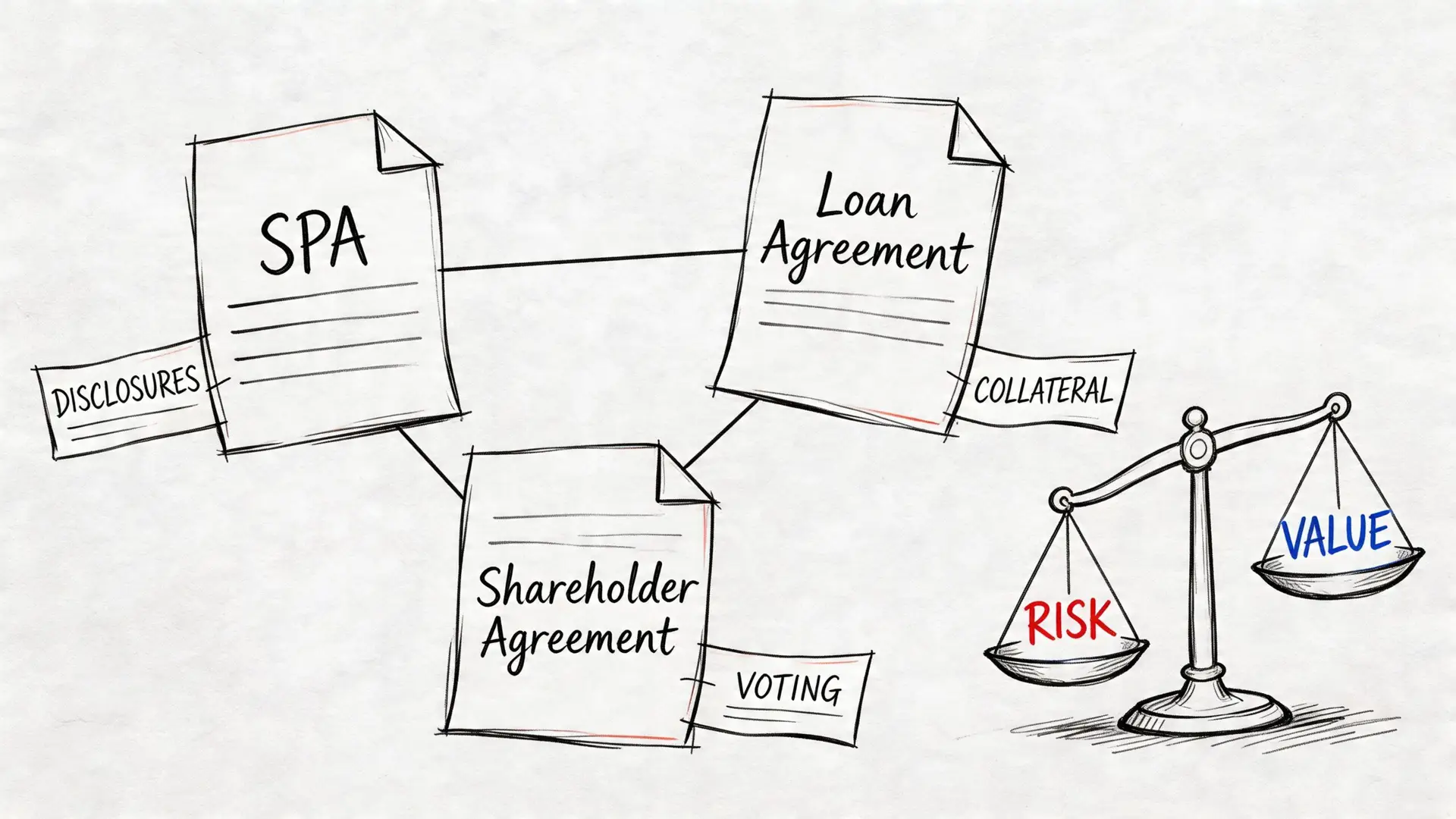
The Share Purchase Agreement is the central risk-allocation document. Price mechanics, locked box or completion accounts, warranties, indemnities, disclosure, restrictive covenants, and claims procedures all sit here. In an MBO, the seller often assumes management knows the business already. Buyers should resist any attempt to use that familiarity to dilute warranty protection on matters they could not reasonably verify from inside the company.
The Shareholders’ Agreement matters just as much, sometimes more. It governs board composition, reserved matters, transfer restrictions, default consequences, leaver provisions, deadlock, information rights, and exit routes. Most post-closing fights are not valuation disputes. Rather, they are governance disputes.
That is why a serious MBO treats the shareholders’ agreement as a constitutional document, not an appendix. Readers focused on internal control and founder-style governance often examine RNC’s discussion of partnership and founders’ agreements. Many of the same fault lines appear in management-led acquisitions.
Completion mechanics and escrow
Completion must account for uncertainty. In practice, that means cash flow timing, debt draw conditions, third-party consents, and post-closing true-up mechanics should all align.
Escrow can solve several problems at once:
- Claims protection: It provides a practical fund for warranty or indemnity claims.
- Price adjustment support: It reduces immediate conflict over completion accounts.
- Cross-border comfort: It gives parties neutral ground where trust is limited.
- Political or market uncertainty: It can support phased release triggers if timing risk is unusual.
A weak completion structure creates preventable disputes. A strong one lets the parties focus on operating the business rather than litigating the handover.
The negotiation point that teams often miss
Managers negotiating with a current owner often blur personal loyalty with acquisition bargaining power. That is dangerous. Once the transaction moves from employment to ownership, every verbal assurance should migrate into enforceable text.
Use this short document checklist before signing heads of terms:
- Acquisition structure paper: Confirm buyer vehicle, debt location, security path, and tax assumptions.
- Heads of terms: Define price logic, exclusivity, confidentiality, and key conditionality.
- SPA term sheet: Resolve warranties, indemnities, and completion mechanics early.
- Shareholders’ term sheet: Fix governance before financing pressure reduces flexibility.
- Service and transition documents: Clarify the founder’s post-closing role, if any.
The legal structure should produce one result above all others. It should make control clear before pressure arrives.
Navigating Cross-Border Complexities and Due Diligence
Cross-border MBOs involving Israel fail on structure more often than on price. A buyer can agree valuation, line up financing, and still create a deal that traps cash, triggers tax leakage, or becomes difficult to enforce once interests diverge.

Israeli-linked MBOs require closer scrutiny than generic guides suggest. The friction points are usually cross-border cash extraction, withholding tax, transfer pricing, foreign exchange exposure, sector regulation, and the practical enforceability of security and judgments. Those issues affect whether the management team can service acquisition debt and retain control after closing.
Where generic MBO advice stops being useful
A standard MBO checklist assumes one tax system, one lender base, and one familiar court process. However, that assumption breaks down quickly if the target is Israeli, the acquisition vehicle sits elsewhere, or part of the financing comes from foreign lenders or seller paper.
Focus early on five structural questions:
- How cash leaves the group: dividends, interest, management fees, and sale proceeds do not receive the same tax treatment.
- Where acquisition debt sits: debt at the wrong level can create trapped interest deductions or block upstreaming.
- Whether the holding structure has substance: an intermediary company may help on tax or lender familiarity, but weak substance creates audit and treaty risk.
- Which approvals are needed: foreign investment review, regulated-sector consents, and local filings can affect signing and closing strategy.
- How enforcement works in practice: governing law clauses are only useful if security, interim relief, and judgments can be executed where assets and people are located.
These are not edge issues. They change the economics of the deal.
Due diligence should test cash movement, not just business quality
Management usually knows the business better than any outside bidder. That creates a different diligence risk. Familiarity can hide structural problems because the team assumes current operating patterns will survive a change in ownership, financing, and tax residence.
In Israeli cross-border MBOs, diligence should concentrate on points that can break repayment or block distributions:
-
Revenue durability
Review key customer contracts, change-of-control clauses, termination rights, pricing reset mechanisms, and customer concentration. -
Regulatory continuity
Confirm whether the transaction affects licences, data use rights, government contracts, export controls, or sector-specific approvals. -
Tax leakage and repatriation
Map withholding tax, historical assessments, transfer pricing positions, VAT exposure, and the route for moving cash from operating entities to the acquisition vehicle. -
Currency exposure
Test whether the business earns in shekels, dollars, euros, or a mix, and whether debt service follows the same profile. -
Disputes and contingent liabilities
Review litigation, threatened claims, compliance history, employee matters, and indemnities that can survive closing.
One question should govern the entire exercise. Can the structure move cash to the debt stack without creating avoidable tax cost, regulatory delay, or shareholder dispute?
Holding companies and escrow need a specific rationale
Intermediary holding companies can be useful in Israeli deals, particularly where lenders want a familiar borrower jurisdiction or where the parties are assessing treaty access, tax efficiency, and enforcement mechanics. Jurisdictions such as the Netherlands or Cyprus often enter the analysis. However, they are not automatic solutions. If the structure lacks commercial substance, the tax case weakens. In addition, the optics worsen with lenders, tax authorities, and counterparties.
The same discipline applies to escrow. In a domestic deal, escrow often covers warranty exposure and completion adjustments. In an Israeli cross-border MBO, it may also help manage signing-to-closing volatility, sanctions sensitivity, banking delays, or concern about rapid market deterioration. A phased release structure can reduce pressure. This is especially important where parties need neutral control over part of the consideration, as noted earlier in Zachary Scott’s analysis of management buyout structuring.
Dispute planning belongs in the core structure work
Cross-border MBOs often devote too much time to price mechanics and too little to forum, interim remedies, and enforcement strategy. That is a mistake. If relations break down after signing or after closing, procedural advantage can matter as much as the underlying legal claim.
The dispute framework should match the rest of the deal. The SPA, finance documents, security package, escrow arrangements, and shareholders’ agreement should not send the parties to incompatible courts or arbitral seats. Pay close attention to service of process, language, emergency relief, recognition of judgments, and enforcement against shares, bank accounts, and local assets. For parties assessing these issues in Israeli and international matters, RNC’s work on international commercial litigation is a useful reference point.
A disciplined diligence process does more than find problems. It identifies which risks can be priced, which must be restructured, and which should stop the deal before management signs up to debt it cannot safely control.
Executing the MBO and Mitigating Common Pitfalls
Signing isn’t success. Closing isn’t success either. The critical phase starts when the managers must perform as owners with significant borrowed capital, reporting pressure, and altered internal relationships.
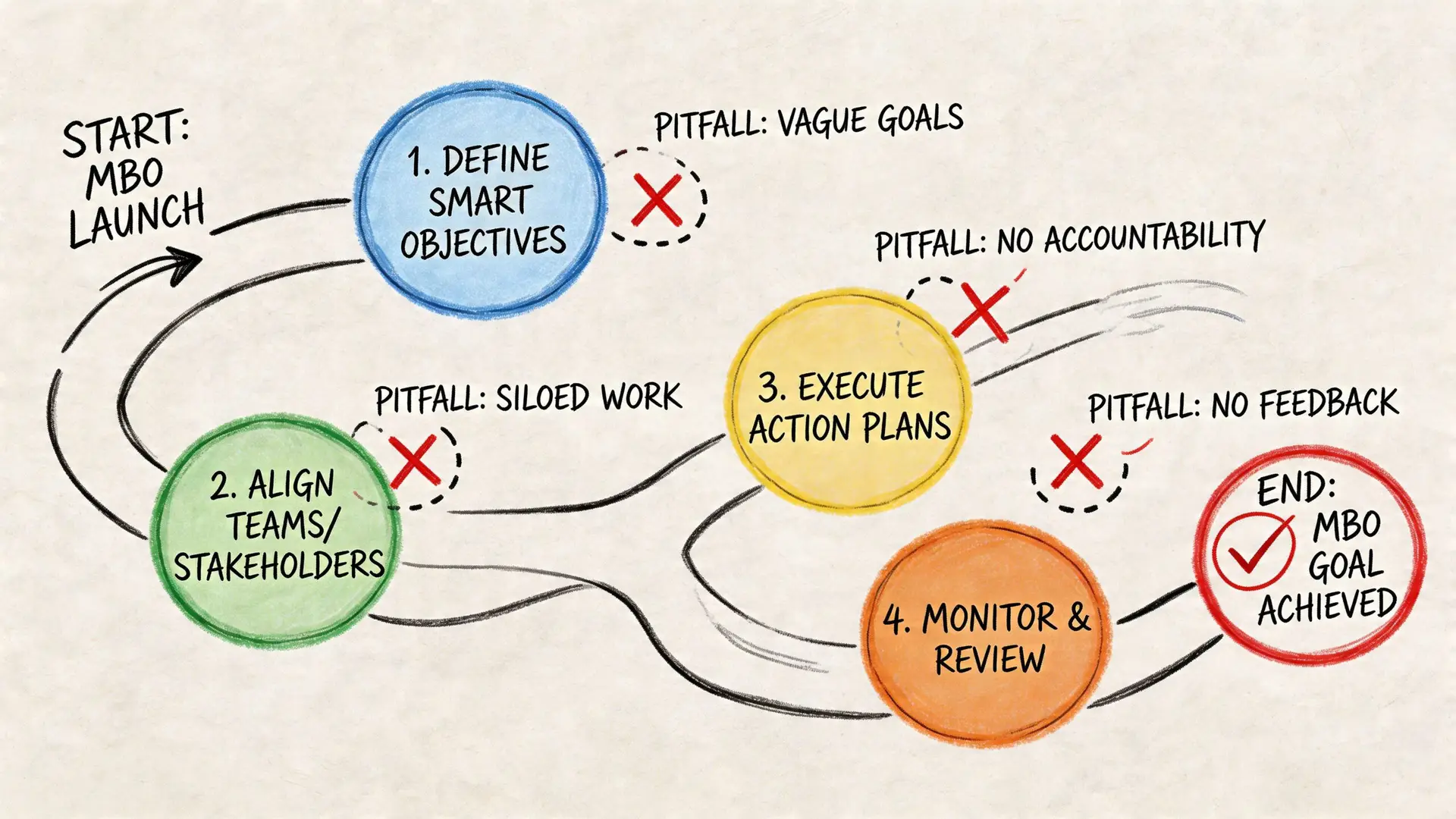
The people risk is often underestimated. Post-MBO management team dynamics and leadership transitions lead to a 30% failure rate within 2 years per a 2025 Harvard study, and equal equity splits among 3 to 5 executives yield 22% higher IRR but increase disputes by 35% without strong founders’ agreements, according to WGU’s discussion of the management buyout model. The same source points to phased vesting, such as 40% upfront and 60% tied to performance, as a practical mitigation tool.
The execution sequence that reduces friction
A disciplined MBO rollout usually follows this order:
- Operational transition first: Management should already control critical functions before closing where possible.
- Authority mapping next: One leader needs clear executive authority. Committees don’t run stressed businesses well.
- Reporting cadence immediately after closing: Lenders, investors, and management need one reporting language.
- Incentive alignment early: Equity, vesting, leaver rules, and non-compete terms should be settled before resentment builds.
Many teams fail. They negotiate financing in detail but leave internal authority vague because the group has worked together for years. Familiarity does not replace governance.
The most common post-closing mistakes
Excess debt remains a classic problem. If the margin for error is too thin, ordinary volatility becomes a covenant event and then a control event.
Leadership ambiguity is the second problem. A team of capable executives can still fail if nobody has final authority on hiring, capital allocation, or lender negotiations.
The third problem is emotional carryover from the pre-deal relationship. A former employee can become a co-owner overnight, but the psychological shift often lags behind the legal one.
Strong MBOs separate friendship from governance. They document power before they need to exercise it.
What the management team must do
Use this checklist during the first phase after closing:
- Confirm decision rights: Board powers, CEO powers, and reserved matters should be operational, not theoretical.
- Document vesting and leaver rules: Equity should reward contribution and protect continuity.
- Revisit banking covenants regularly: Problems are easier to solve before a breach.
- Preserve escalation paths: Internal deadlock and external disputes need pre-agreed procedures.
- Review crisis clauses: Cross-border deals should have usable response mechanisms if markets, counterparties, or politics shift.
Where conflict risk already exists, parties often benefit from reviewing structured legal escalation frameworks such as RNC’s crisis management approach in commercial disputes. The point isn’t aggression. In contrast, the point is preserving bargaining power and preventing drift.
A well-structured MBO does four things at once. It buys at a defensible price, funds the acquisition with realistic obligations, allocates legal risk clearly, and prevents post-closing governance decay. If any one of those elements is missing, the deal may still sign. However, it won’t be stable.
Avoid costly mistakes in a cross-border management buyout by getting the structure right before negotiations harden. For specialized guidance on Israeli and international deal architecture, governance, and risk control, contact RNC Group through its contact page.
Disclaimer: This article provides general information for educational purposes only. It does not constitute legal advice and should not be relied upon as such. Every transaction is unique, and you should consult with a qualified professional for advice specific to your situation. RNC Group expressly disclaims all liability in respect to actions taken or not taken based on any or all the contents of this article.