
If your Israeli matter turns hostile in 2026, will your counsel control the timeline, the evidence, and the pressure points, or react to them?
That question exposes a significant gap in the market. Many multinationals still hire an israel law firm the way they hire a local filing agent. That approach fails when the problem involves frozen banking access, multilingual evidence, counterparties in several jurisdictions, or a dispute that can damage both operations and reputation at once.
Engaging an Israel Law Firm for Global Operations

The market looks broader than it did a few years ago. An estimated 160 law firms operated Israel Desks in 2023 to 2024, reflecting a 20% increase from 2019 levels, according to the Israel Desks ranking page. However, more firms in the market doesn’t mean more firms can run a high-stakes cross-border file correctly.
A global client usually needs more than Israeli law advice. The file often requires document control, translation discipline, cross-border privilege management, financial forensics, and a strategy for counterparties who may use delay as an advantage. Therefore, the wrong hire creates operational risk before the first pleading goes out.
Why market growth creates selection risk
A larger field creates noise. Some firms are excellent at routine company work but thin on crisis execution. Others handle transactions well, yet they struggle when banking friction, reputational sensitivity, or emergency applications appear at the same time.
That distinction matters because international clients don’t experience Israeli legal issues in isolation. They see one commercial problem that touches contracts, banking, internal reporting, and board oversight. An israel law firm must be able to manage the full engagement lifecycle, not just one narrow legal task.
Practical rule: Hire for stress performance, not brochure breadth.
Generic selection methods miss the real issue
Directories and rankings help, but they rarely test how a firm behaves under pressure. They don’t show how the team triages a blocked account, how it coordinates foreign counsel, or how it decides whether a demand letter should stay private or create calibrated external pressure.
Even document handling can become a hidden risk. Multinationals often underestimate how translation choices affect negotiation posture, evidentiary coherence, and timing. For that reason, in-house teams should apply the same rigor they use for counsel selection to how to select legal translation providers, especially when documents will move between Hebrew and English.
A strategic engagement starts with one assumption. The legal process is only one tool. Control comes from selecting counsel that can connect legal analysis to commercial outcomes, then move early before the other side shapes the record.
Evaluating a Firm’s True Specialization

A firm’s website tells you what it wants to sell. Its institutional footprint tells you what it can carry. That difference becomes visible when you test relationships, methods, and staffing discipline.
One useful signal comes from the financial sector. Bank Hapoalim worked with 23 law firms across multiple practice areas as of 2021, according to the Nishlis legal sector analysis. That fact doesn’t prove that every bank panel firm fits your matter. It does show that serious institutions spread work based on specialization, not slogans.
Questions that expose real capability
A General Counsel should ask direct questions and resist generic answers. The point isn’t politeness. The point is to identify whether the firm has a working method.
- Ask for the firm’s decision model: How does it decide between a negotiated approach, targeted court action, and a broader escalation path?
- Test banking familiarity: Has the team handled files that required direct engagement with banks, regulators, and foreign compliance actors at the same time?
- Probe multilingual execution: Who controls translated drafts, affidavit consistency, and terminology drift across Hebrew and English records?
- Check partner involvement: Which partner owns strategy, and which lawyer manages daily execution?
- Demand file architecture: How are facts, documents, and legal theories organized in the first week?
Strong firms answer with process. Weak firms answer with general confidence.
What a sophisticated buyer should look for
The best due diligence often sounds operational, not legalistic. Ask who drafts the first demand letter. Ask who attends urgent hearings. Ask how the firm handles decision-making when your U.S., EU, and Israeli stakeholders disagree on tone or risk.
A useful comparison appears below.
| Issue to test | Strong answer | Red flag |
|---|---|---|
| Team structure | Named partner, named manager, clear escalation path | “Our team will handle it” |
| Banking exposure | Specific method for bank contact and evidence review | “We litigate if needed” |
| Cross-border coordination | Defined protocol with foreign counsel and client legal ops | Ad hoc coordination |
| Early-stage strategy | Phased options with commercial off-ramps | One default path |
The right israel law firm should be able to explain its method in plain English before it asks for trust.
Marketing claims that deserve skepticism
Be cautious when a firm lists every practice area under the sun. Breadth can help, but only if the team can show how those practices connect on one file. In difficult matters, integration matters more than inventory.
Also watch for firms that discuss only court wins or only deal closings. Multinational files often live in the middle ground. The decisive work may happen in document preservation, pre-suit influence, bank-facing correspondence, or the sequencing of parallel actions in more than one jurisdiction.
Strategic Analysis Navigating Bank Account Restrictions

What happens if your Israeli operating account is restricted on a Thursday afternoon and payroll is due on Sunday?
At that point, the legal question is only one part of the problem. Treasury, local management, foreign parent approvals, vendor continuity, and board reporting all start moving at once. A disciplined israel law firm treats the matter as an escalation event with legal, banking, and operational tracks running in parallel.
Under Israel’s Checks Without Cover Law, 5741-1981, repeated returned checks can trigger restrictions recorded through the Bank of Israel system. As explained in the restricted bank accounts guide published by RNC Group, the immediate consequences can include limits on opening new checking accounts or serving as an authorized signatory in shekel accounts. That changes the company’s options fast, especially where the Israeli entity is tied into a wider regional cash-management structure.
Start with classification and control
The core issue is not whether the bank is being difficult. It is whether counsel has correctly classified the restriction and set the right objective for the first seventy-two hours.
I have seen multinationals lose time by arguing the merits before anyone has sorted the file into the correct category. A returned-check restriction may sit alongside a lien, an insolvency measure, a sanctions review, or an internal corporate authority defect. Each path calls for a different response, a different decision-maker, and often a different timetable.
That is why the first work product should be a diagnosis memo, not a protest letter.
At minimum, counsel should review the transaction history, the sequence of bank notices, available balances at the relevant moments, account mandates, board authorities, and any communications that explain why the checks were returned. If key records sit with finance teams in London, New York, or Singapore, someone has to control collection immediately. Delay at this stage usually shows up later as a weak filing, inconsistent facts, or an avoidable dispute over authority.
For legal and finance teams already handling AML and suspicious-activity reviews across multiple jurisdictions, external compliance discipline can improve evidence preparation. Resources on data-driven BSA strategies can help align document collection and internal escalation before Israeli counsel approaches the bank or the court.
Map the remedy before you spend political capital
Once the restriction is classified, the next task is case mapping. That means identifying the legal route, the operational objective, and the pressure points that matter to the bank.
A generic appeal is rarely enough in a high-stakes matter. Counsel should define the exact fact pattern, test the likely judicial objections, and decide whether the business needs full release, partial access, corrected reporting, or a negotiated interim arrangement. Those are different outcomes. They also justify different fee structures and staffing models. A file aimed at a narrow interim remedy should not be staffed or billed like a full merits battle unless the facts require it.
A working case map usually includes:
- Event chronology: returned checks, notice dates, balances, and corrective actions
- Authority review: signatories, board approvals, delegated powers, and any gaps in corporate authorization
- Restriction analysis: whether the issue is a returned-check restriction, lien, insolvency matter, sanctions concern, or a hybrid file
- Business priority: payroll, tax payments, regulated customer obligations, or supplier continuity
- Escalation path: bank contacts, litigation trigger, executive reporting line, and cross-border decision authority
This is also where multinational clients should force clarity on coordination. If Israeli counsel cannot explain who speaks to the bank, who manages foreign counsel, who approves filings, and how privileged material will be handled across jurisdictions, the engagement is not ready for pressure.
Use filings, negotiation, and fee design together
Bank restriction matters are often mishandled because clients are pushed into a false choice between immediate litigation and informal negotiation. Strong counsel usually prepares both tracks and controls the sequence.
A filing may be needed to preserve rights or create urgency. Negotiation may still be the faster route to practical relief, especially where the company needs limited access for salaries, tax remittances, or customer refunds while the broader dispute is being resolved. The strategy should be built around business continuity, not courtroom theater.
Fee structure matters here. In volatile matters, the billing model is part of risk control. A phased scope can separate emergency diagnosis, bank engagement, interim relief work, and full litigation. That gives the General Counsel room to release budget in stages, test the firm’s judgment early, and avoid paying full-crisis rates for work that may never be required. On cross-border files, it also helps align Israeli counsel with foreign firms and internal legal ops teams that need clear approval gates.
RNC Group describes a model that combines legal action with financial analysis and international coordination. That matters because a restricted account rarely stays a local banking issue for long. It can become a reporting issue for the parent company, a covenant issue for lenders, and a control issue for the board.
Speed matters. So does structure. The companies that regain control fastest are usually the ones that classify the problem correctly, gather evidence before positions harden, and run legal pressure, bank communication, and internal escalation as one managed engagement.
A Checklist for Your Initial Consultation
The first meeting should feel like an operational briefing, not a beauty contest. If the discussion stays abstract, the firm probably doesn’t own a repeatable method. A multinational client needs enough detail to judge execution quality before the engagement begins.
Questions that should be asked directly
Use the consultation to test how the firm thinks under constraint.
- Who will run the file day to day? A strong answer names the partner, the senior associate, and the handoff protocol. A weak answer stays vague about who does the work after signing.
- How do you structure fees for volatile matters? Good answers may include phased budgets, blended staffing, or outcome-linked components where appropriate. Red flags appear when the firm refuses to discuss cost control mechanics at all.
- What is your communication protocol across time zones? Look for a set cadence, emergency contacts, and a rule for same-day reporting after material developments.
- How do you coordinate with foreign counsel and internal legal teams? The answer should cover privilege, version control, and decision authority.
- What happens in the first seventy-two hours? You want a concrete list of actions, documents, and decisions.
Answers that usually signal trouble
Certain replies almost always predict friction later.
| Question area | Useful answer | Problem answer |
|---|---|---|
| Staffing | Named people and roles | “Our department will assist” |
| Fees | Scope by phase with assumptions | Open-ended hourly estimate only |
| Urgency | Defined first-step actions | “We’ll review and revert” |
| Coordination | One reporting channel and document control rule | Multiple informal channels |
Board-level test: If you can’t explain the firm’s first-week plan to your CFO in one minute, the plan isn’t ready.
What to bring to the meeting
Bring the documents that let counsel evaluate strategic advantage, not just liability.
- Corporate records: Signatory authority, board approvals, shareholder arrangements.
- Commercial paper: Contracts, amendments, demand letters, and key correspondence.
- Banking material: Notices, account statements, compliance requests, and payment failures.
- Internal chronology: A short timeline prepared by the business team.
- Risk priorities: State what must be protected first, such as liquidity, reputation, or customer continuity.
A strong consultation leaves the client with a decision map. A weak one leaves only reassurance.
Understanding the Engagement Timeline and Documentation
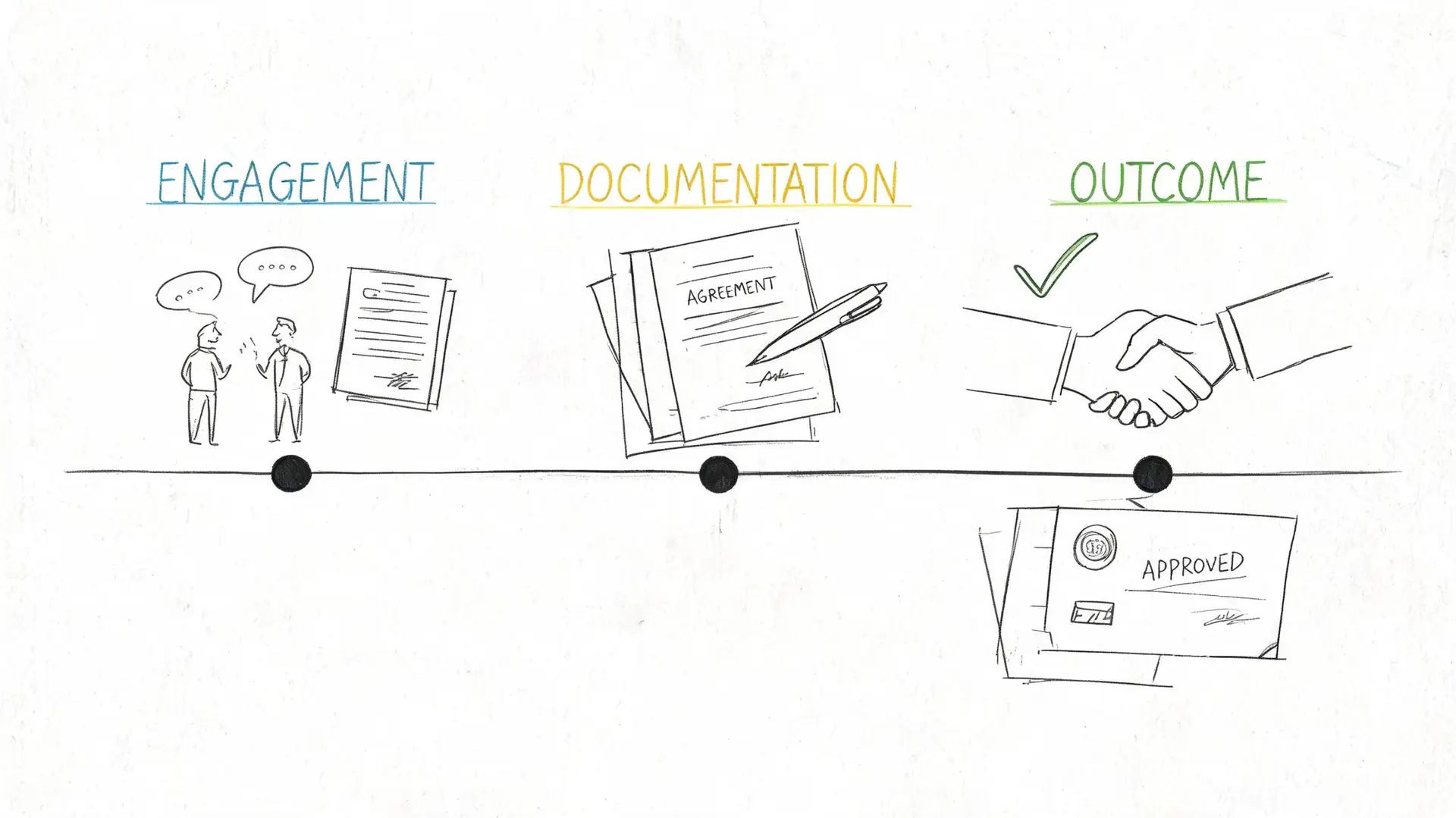
How quickly can outside counsel get from intake to a controlled first move?
That question matters more than the headline hourly rate. In high-stakes Israeli matters, the engagement letter sets the operating model for the file. It should allocate scope, approval rights, confidentiality rules, reporting lines, and escalation triggers across the client, local counsel, and any foreign advisers. If those points stay vague, costs drift, communications split, and early advantage is forfeited.
The same discipline applies to the opening document set. Strong teams do not ask for paper merely to open a file. They build an evidentiary record that supports immediate decisions, preserves privilege where possible, and lets the business choose between pressure, containment, or negotiated resolution with a clear view of risk.
Timeline should match the decision path
An effective engagement timeline is phased because the client rarely needs every tool at once. Phase-based planning gives the General Counsel control over spend, keeps options open across jurisdictions, and creates defined moments to escalate or stop.
As RNC Group’s crisis management note states, “For international executives and investors, navigating this minefield requires more than standard legal defense. Instead, it demands an advanced strategy. Legal action and reputation management must be fused into a single, powerful weapon.” In practice, that means the timeline is not administrative. It is part of the pressure strategy, especially where court filings, banking friction, counterparties, and reputational exposure may interact.
A phased model that works in live matters
Most multinational clients benefit from a three-phase structure, adjusted for urgency and cross-border dependencies.
Phase 1 focuses on closed-record analysis and controlled outreach
Counsel tests the facts, identifies pressure points, checks what can be proved quickly, and maps who makes decisions on the other side. The first external step is often a targeted letter, a without-prejudice approach where appropriate, or a quiet factual request. The aim is to create movement without committing the client to allegations or remedies that narrow later options.
Phase 2 uses limited court action to change leverage
If private pressure fails, counsel may recommend interim relief, a narrow application, or another procedural step that changes incentives fast. This stage works best when the filing objective is specific. Preserve funds, stop dissipation, compel a response, or secure a position before parallel action abroad. Broad claims filed too early often increase cost before they improve outcome.
Phase 3 expands into full dispute execution
At this point, pleadings, evidence collection, witness preparation, expert input, and communications planning have to run on one track. A fragmented structure becomes expensive here. One team drafts for court, another speaks to stakeholders, a third handles offshore consequences, and contradictions appear. Good engagement terms reduce that risk by assigning one decision channel and clear approval thresholds from the start.
Each phase should contain an off-ramp, a budget assumption, and a defined trigger for the next step.
Documentation should be ranked, not just collected
The first document request should separate what is immediately decision-critical from what can wait. That is how counsel shortens the path to action and avoids billing the client to review low-value material.
Priority usually goes to:
- Authority records showing who could bind the company and approve the next move.
- Banking and payment documents that establish what transpired in operations.
- Final contract sets with amendments, side letters, and signature pages aligned.
- Notices, message logs, and key correspondence that fix timing, knowledge, and default positions.
- Controlled translations where Hebrew and English versions may be read differently by different audiences.
Fee structure belongs in the same discussion. For sensitive matters, I usually want fees broken by phase, assumptions stated in writing, and urgent applications priced separately where possible. That gives the client a real management tool. It also shows whether the firm understands the matter as a sequence of strategic decisions, not a stream of open-ended time entries.
An israel law firm that asks for authority, chronology, and proof before drafting usually understands where cases are won. The file gets shaped early, and the client keeps control of both pace and spend.
Frequently Asked Questions About Engaging Israeli Counsel
Do Israeli fee structures differ from U.S. or EU practice
Often, yes. The differences usually appear in staffing assumptions, litigation pacing, and how firms treat urgent applications. Therefore, the client should ask for phase-based budgeting and written assumptions, not just hourly rates.
How should a multinational handle confidentiality in cross-border matters
It should define one document channel, one client-side decision owner, and one privilege protocol from the start. If data will move across jurisdictions, counsel should also identify which documents can circulate freely and which require restricted handling.
Does global network access matter
Yes, when the dispute touches assets, counterparties, or evidence outside Israel. A network matters most when Israeli strategy depends on coordinated steps abroad, such as parallel demand letters, local enforcement checks, or collection of foreign banking records.
Should the first move always be litigation
No. In many commercial files, the first move should be a controlled factual build, followed by calibrated correspondence. Litigation should support a position of advantage, not replace strategy.
What makes an israel law firm useful to a General Counsel
Clarity under pressure. The firm should reduce ambiguity, assign responsibility, protect evidence, and give the business a sequence of decisions. That is more useful than broad assurances about experience.
Conclusion Choosing a Strategic Partner Not Just a Legal Provider
An israel law firm shouldn’t be judged only by prestige, size, or the length of its practice list. The true test is whether it can control a difficult file from intake through resolution, while coordinating legal, operational, and reputational considerations without drift.
That means asking harder questions at the start. How does the firm classify the problem. Who owns strategy. What happens in the first days. Where are the off-ramps. How will fees support outcomes instead of rewarding delay.
For a multinational business, those aren’t administrative details. They are risk controls. The right counsel doesn’t just process Israeli legal work. It creates advantage, protects management attention, and preserves room to solve the problem before it expands.
To avoid costly mistakes and secure a strategic legal partner for your Israeli interests, contact our firm now.
Disclaimer: The information provided in this article is for general informational purposes only and does not constitute legal advice. No attorney-client relationship is formed by reading this article. You should not act or refrain from acting based on this information without seeking professional legal counsel specific to your situation. RNC Group expressly disclaims all liability with respect to actions taken or not taken based on any or all the contents of this article.
Avoid costly mistakes by engaging counsel that treats Israeli legal work as a strategic campaign, not a paperwork exercise. For confidential guidance on cross-border disputes, banking restrictions, commercial agreements, and crisis-driven execution, contact RNC Group.