
Your 2026 contract is either controlling the relationship, or exposing it. There’s rarely a middle ground. If your company is entering Israel, expanding through Israeli partners, or relying on Israeli suppliers, distributors, franchisees, or licensees, weak contract management can trigger a commercial crisis long before anyone files a claim.
Most contracts don’t fail because counsel forgot a boilerplate clause. They fail because nobody controlled the living process around the document. A team signed the wrong version. A renewal rolled over without review. A local business unit accepted a change by email. Finance tracked payments, but nobody tracked service credits, reporting duties, audit rights, or governing law deviations.
That exposure gets worse in cross-border business. Israeli entities often operate fast, negotiate hard, and execute across multiple languages, time zones, and legal cultures. Therefore, non-Israeli companies need more than clean drafting. They need disciplined systems, clear authority, and escalation rules that work when pressure rises.
The strongest best practices for contract management treat the contract as an operating system for the deal. They centralize control, measure performance, and force business and legal teams to work from the same record. That approach matters because poor contract management can erode about 9% of annual contract value on average, according to the 2024 WorldCC global benchmark referenced in the verified guidance above.
For companies dealing with Israel, the strategic path is clear. Build a controlled contract function before the first dispute, missed renewal, or enforcement problem forces the issue.
1. Centralized Contract Repository and Version Control
Scattered contracts create avoidable disputes. Email chains, local hard drives, and shared folders guarantee confusion when a disagreement starts. A multinational entering Israel needs one controlled repository that holds the signed contract, every amendment, approval records, and the full version history.
Independent CLM guidance consistently treats centralized repositories with full metadata and audit-ready version control as core controls in high-performing contract programs. That standard matters even more in cross-border matters, where teams need to search by party, jurisdiction, renewal date, governing law, and clause deviations without delay.
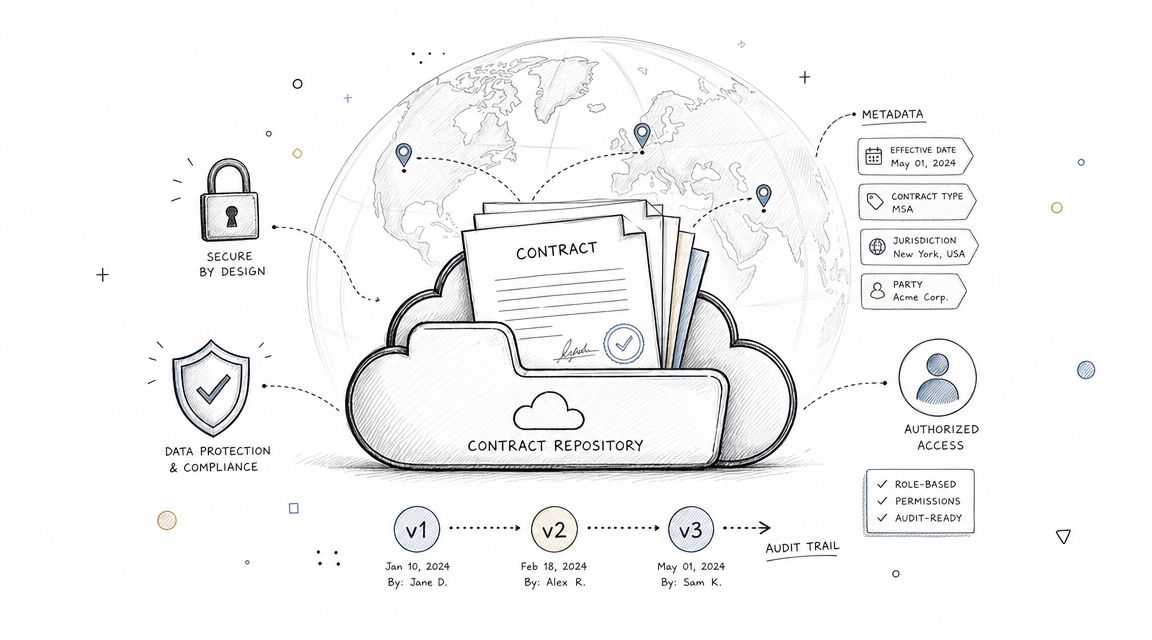
A repository only works if the company imposes structure. Microsoft SharePoint, Ironclad, Icertis, and DocuSign CLM can all function as a single source of truth when legal controls naming, permissions, and metadata rules. Without those controls, the software becomes a digital attic.
What the repository must contain
- Authoritative record: Store the executed agreement, schedules, exhibits, side letters, and all later amendments in one file structure.
- Searchable metadata: Tag contracts by counterparty, country, business unit, governing law, dispute forum, renewal date, and risk tier.
- Locked version trail: Preserve every draft and approval path so the company can prove who changed what and when.
Practical rule: If a contract can’t be retrieved in minutes with its latest binding version, the company doesn’t control that contract.
For Israel-related deals, index local law issues separately. Flag Hebrew-language exhibits, Israeli court jurisdiction clauses, arbitration provisions, and local regulatory attachments. If a dispute escalates, those tags save time and reduce interpretive fights.
Companies that still rely on folders and ad hoc permissions should review a broader cloud based document management systems guide to understand the operational baseline. However, legal leadership still needs to define the rules. Technology won’t solve a governance failure.
Cross-border counterparties also need one internal owner per contract record. When nobody owns the file, local teams start keeping private copies. That is how conflicting versions enter negotiations, claims, and court filings.
2. Automated Obligation and Renewal Tracking Systems
A signed contract starts the risk period. Many companies negotiate carefully, sign confidently, and then stop watching the obligations that matter. That is where value leaks, defaults form, and disputes harden.
Ironclad notes that contract value can erode during execution when obligations aren’t tracked, estimating an average 11% loss of contract value through invisible revenue leakage and unnecessary costs. That figure alone justifies post-signature control. In Israel-facing commercial relationships, the pressure is sharper because supply, licensing, distribution, and service arrangements often depend on tightly timed notices and performance steps.

A proper system tracks more than expiration dates. It must capture payment milestones, reporting duties, audit windows, price review dates, insurance renewals, cure periods, exclusivity triggers, and auto-renewal cutoffs. Icertis, Gatekeeper, and Sirion all support this type of lifecycle tracking when configured correctly.
What to automate immediately
- Renewal alerts: Trigger review well before expiration, especially for auto-renewing Israeli distribution, reseller, and supply agreements.
- Obligation ownership: Assign each duty to finance, operations, procurement, compliance, or legal, not to a generic inbox.
- Escalation logic: Send missed milestones to the responsible business lead and legal at the same time.
A practical enhancement is contract text extraction and alerting through AI-enabled workflow tools. Teams exploring that layer should first delve into NLP’s function because extraction quality depends on clause clarity, formatting, and language consistency.
For non-Israeli clients, one rule matters. Never let an Israeli contract auto-renew without a tracked commercial review. Market conditions shift, service failures accumulate, and local compliance expectations change. If the alert comes too late, the advantage is lost.
3. Risk-Based Contract Prioritization and Classification
Not every contract deserves the same level of scrutiny. Treating every agreement as equally important wastes resources and blinds management to the documents that can damage the business. High-stakes contracts need high-touch oversight.
Risk classification should start before drafting. A company should rank each contract by strategic value, operational dependency, regulatory exposure, enforcement difficulty, and deviation from approved language. Then it should route each tier through different review, approval, and monitoring rules.
This is especially important for non-Israeli companies dealing with Israel through local distributors, franchise operators, technology partners, or founders. One contract may control market access, customer data, local IP use, exclusivity rights, and payment flows at the same time. Another may be routine and disposable. Those documents should never move through the same process.
A workable tiering model
- Tier 1 critical contracts: Market entry, exclusive distribution, core supply, strategic licensing, joint venture, and high-dispute counterparties.
- Tier 2 important contracts: Recurring commercial relationships with moderate financial or operational exposure.
- Tier 3 standard contracts: Low-risk templates with limited deviations and low business dependency.
The classification has to affect action. Tier 1 contracts should receive senior legal review, business-lead sign-off, tighter amendment controls, and frequent post-signature monitoring. Tier 3 contracts should rely on approved templates and controlled self-service.
A strong risk model also looks beyond legal text. It should factor in the counterparty’s payment behavior, internal dependence on the relationship, history of informal change requests, and the practical difficulty of enforcing remedies in the relevant jurisdiction.
For Israeli matters, governing law and forum should weigh heavily. A contract that places enforcement abroad may be less risky for one company and more risky for another. The classification should reflect where the company can move fastest if the relationship breaks down.
Contracts don’t become dangerous because they’re long. They become dangerous because the company misjudged their commercial leverage and enforcement reality.
4. Cross-Border Jurisdictional Analysis and Conflict-of-Laws Documentation
International contracts often collapse at the enforcement stage, not at signature. A polished commercial deal means little if the parties can’t determine governing law, valid service, forum, language hierarchy, and the path to relief when performance fails.
That issue matters immediately for foreign companies working in Israel. The contract should document more than the governing law clause. It should align the dispute forum, notice mechanics, execution language, and local enforceability assumptions across the full document set.
A company that signs an English master agreement, a Hebrew order form, and email-based changes without a language priority clause is inviting a later fight. The same is true when parties choose a court or arbitration seat without checking how interim relief, injunctions, or collection will work in practice.
Jurisdiction clauses need supporting architecture
- Language control: State which language prevails if schedules, correspondence, or local appendices diverge.
- Forum consistency: Match governing law, dispute forum, service provisions, and interim relief language.
- Enforcement planning: Assess where assets sit, where evidence sits, and where a judgment or award will need recognition.
For cross-border businesses, this analysis should start during term sheet review, not after the first draft. If the counterparty’s assets, personnel, and operational base sit in Israel, the dispute design should reflect that reality. If the operational base sits abroad, the drafting strategy changes.
Foreign companies evaluating Israeli commercial structures should also compare how dispute exposure changes across deal types. That is particularly relevant when structuring collaborations, licensing, or operational control. A broader legal view appears in RNC’s analysis of commercial agreements in Israel, which helps frame how contract architecture affects downstream enforcement.
The key principle is simple. Conflict-of-laws issues should never remain implicit. They need written answers before the relationship becomes adversarial.
5. Proactive Contract Performance Monitoring and KPI Integration
A foreign company signs an Israeli distributor, books the revenue forecast, and moves on. Three months later, the rebates were triggered too early, acceptance was never documented, payment timing slipped, and the local team waived defects by email without legal review. The contract did not fail at signature. It failed in performance.
That is why contract management must continue after execution with disciplined monitoring tied to business KPIs. For non-Israeli entities entering the Israeli market, this is a control system, not an admin exercise. It gives management early visibility into slippage, local practice drift, and the first signs of a dispute.
Track two things at the same time. First, whether the counterparty is performing. Second, whether your own teams are preserving contractual rights. If you only measure commercial output, you miss waiver risk, notice failures, undocumented concessions, and renewal drift.
KPIs that expose real risk
- Operational performance: Delivery timing, service-level compliance, acceptance milestones, defect remediation, audit response, and support obligations.
- Commercial performance: Revenue against commitment, rebate triggers, volume thresholds, payment timing, credit exposure, and price adjustment events.
- Control performance: Missed notices, unapproved deviations, undocumented change requests, open defaults, waiver activity, and contracts approaching renewal without review.
- Process performance: Draft-to-signature cycle time, approval delays, exception rates, and redline patterns that show where the business keeps conceding ground.
Set these indicators during negotiation, then write them into the contract and the reporting process. If the agreement is vague about acceptance, cure periods, reporting duties, or ownership of performance data, the KPI framework collapses under pressure. Each side starts applying its own standard. That is the start of a preventable dispute.
RNC’s approach is systematic and staged. Classify the contract by exposure, assign review frequency based on that exposure, and escalate in phases. High-risk contracts need monthly review with legal, finance, and operations in the room. Lower-risk agreements can sit on a quarterly cycle. The rule is simple. Every exception needs an owner, a cure deadline, and a decision on whether the issue stays operational or moves to legal escalation.
Keep the reporting tight. One dashboard. Clear thresholds. Written exception logs.
In cross-border work involving Israel, this discipline matters because informal commercial accommodations happen fast and are often poorly documented. If sales extends timing, operations accepts partial performance, or finance tolerates chronic delay without a reservation of rights strategy, your contract position weakens long before anyone says the word “breach.” Monitoring closes that gap and turns contract management into crisis prevention.
6. Contract Negotiation Playbook and Redline Standards
Your Israel sales lead marks up a draft at midnight. Local counsel for the counterparty accepts two points, rewrites three, and slips in a broad indemnity, a weak limitation of liability clause, and a dispute forum that pulls you into an unfamiliar venue. By morning, your commercial team calls it progress. It is not progress if control has already shifted.
A negotiation playbook stops that drift. It gives legal and business teams one operating position on risk, authority, and acceptable concessions. Without it, every new draft becomes a fresh argument about points that should already be settled inside your organization.
The playbook must do more than store sample clauses. It should tell the team which template applies, which clauses are required, which fallbacks are approved, which deviations trigger escalation, and who has authority to approve movement on price, liability, IP, data, exclusivity, and dispute terms. That is how you shorten negotiation cycles without giving away core protections.
For non-Israeli companies entering the Israeli market, this discipline matters because speed often gets mistaken for alignment. Drafts move fast. Commercial pressure builds fast. Informal assurances appear before legal review is finished. If your redline standards are weak, the counterparty learns your pressure points before your own team does.
What belongs in the playbook
- Approved templates by deal type: Separate standards for supply, distribution, SaaS, licensing, services, channel, and strategic partnership contracts.
- Clause hierarchy: Required language, preferred language, acceptable fallback language, and prohibited language.
- Risk approval matrix: Clear thresholds for who can approve deviations based on contract value, regulatory exposure, operational dependency, and dispute risk.
- Cross-border control points: Governing law, jurisdiction, service of process, language priority, currency, tax allocation, sanctions, data transfer, and local compliance terms.
- Redline rules: Which clauses legal owns, which business teams may discuss commercially, and which issues must stop the deal until escalated.
One standard does not fit every contract. A reseller agreement raises channel conflict and payment collection issues. A software license shifts the focus to IP scope, uptime commitments, data handling, and limits on downstream use. An equity-linked commercial arrangement raises control, deadlock, transfer rights, and decision authority issues that can turn into full disputes if the drafting is loose.
RNC’s method is systematic and phased. Start with the base position. Allow movement only within pre-approved fallback bands. Escalate departures in stages based on legal exposure and business significance. That structure matters in cross-border deals involving Israel because local deal momentum can push teams to accept wording that looks commercially harmless but changes enforcement, evidence, or control in a dispute.
Set one hard rule and enforce it. No business unit sends “final comments” unless those comments match the approved playbook and the approval matrix. If that rule is loose, the contract stops being governed by policy and starts being governed by whoever answered the email fastest.
7. Amendment and Change Order Management Protocols
Many contracts die by informal modification. A sales lead agrees to a delivery change by email. A local manager accepts expanded services in a meeting. Procurement approves a workaround that nobody documents. Later, both sides swear the other accepted the change.
That pattern is common in long-term supply, software implementation, managed services, construction, franchise, and licensing relationships. It becomes even more dangerous when one side operates in Israel and the other side coordinates from abroad. Time pressure encourages shortcuts. Those shortcuts rewrite the deal without legal control.
The remedy is a formal amendment protocol. Every contract should state that modifications require written approval by authorized signatories. Every business team should understand that operational cooperation does not equal legal consent.
Tighten the change process
- No oral modification rule: Require signed written amendments for any change affecting scope, price, timing, risk, or governance.
- Approval channels: Route material changes through legal, finance, and the accountable business owner.
- Amendment register: Record every executed change in the repository with an effective date and a linked rationale.
This rule is especially important when change requests touch local compliance or market practice. A foreign company might accept a commercially convenient Israeli workaround without realizing it affects exclusivity, tax allocation, data use, or service obligations.
A disciplined amendment path also helps preserve evidence. If a dispute later turns on who approved a revised obligation, the company needs more than scattered messages. It needs a clean record that ties the request, review, approval, and final text together.
RNC’s analysis of management agreements in Israel is useful here because these arrangements often drift operationally unless the parties lock down authority and change approval from the outset.
8. Stakeholder Communication and Legal-Business Alignment
Contracts fail when legal knows the paper, but operations runs the relationship. They also fail when finance sees the money, but nobody sees the obligations tied to it. Alignment isn’t a soft issue. It is a control issue.
The strongest contract programs force legal, sales, procurement, finance, compliance, and operations to work from the same assumptions. They also document who owns each commercial promise after signature. Without that alignment, the company will miss notices, under-document breaches, and waive rights by conduct.
This point matters in Israel-related business because local execution often moves faster than head-office review. A country manager may accept practical adjustments to keep the relationship alive. Meanwhile, headquarters still thinks the written contract governs cleanly. That disconnect creates exposure on both sides.
The communication structure should be simple
- One owner per contract: Assign a named business lead responsible for operational performance and escalations.
- One-page obligation summary: Translate dense legal text into business instructions for the teams that must perform it.
- Scheduled alignment reviews: Bring legal, finance, and operations together for critical contracts at fixed intervals.
A strong summary should identify payment mechanics, notice rules, renewal triggers, performance milestones, audit rights, data restrictions, and cure periods. The point is not to replace the contract. The point is to make sure the people running the deal can comply with it.
Internal communication also needs language discipline. If the contract is in English, but the operating team uses Hebrew internally, the company should decide who controls final interpretation of technical terms, notices, and milestone definitions. Otherwise, ambiguity starts inside the company before it starts with the counterparty.
9. Dispute Prevention and Early Warning Systems
Your Israeli distributor misses two reporting deadlines, asks for a pricing exception by phone, and goes silent after a quality complaint. If your team waits for a lawyer’s letter, you are already managing a dispute, not preventing one.
Early warning systems belong at the center of contract management for foreign companies entering Israel. They give headquarters control before local friction turns into waived rights, payment fights, supply disruption, or a forum battle across borders. This is not administration. It is crisis prevention.
The system should detect pressure before a formal breach notice becomes necessary. Track late payments, recurring service failures, repeated requests to work outside contract terms, missed forecasts, unexplained shipment delays, unusual discount pressure, and changes in who is making decisions on the other side. In Israel-related deals, those signals matter because commercial relationships often continue under practical workarounds long before anyone admits the contract is off course.
Remove guesswork. Build phased escalation into both the contract and the operating process.
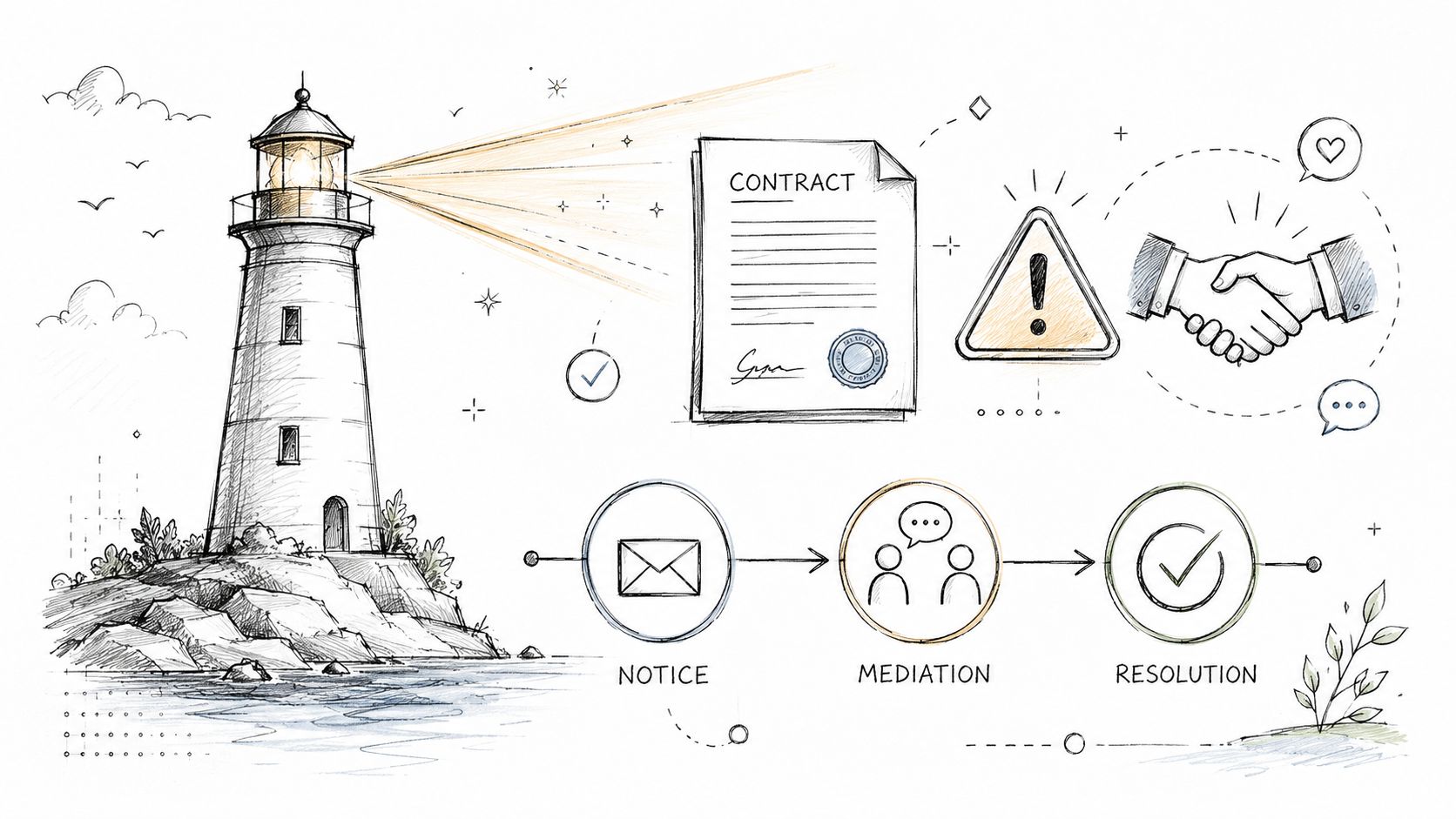
Build the escalation ladder into the contract and the workflow
- Trigger events: Define the failures that require review, such as payment slippage, KPI misses, reporting gaps, unauthorized scope changes, and repeated informal deviations.
- Escalation path: Set a fixed sequence. Operational review, management escalation, reservation-of-rights communication, then formal legal notice if the issue continues.
- Response deadlines: Assign internal deadlines that are shorter than the contract’s notice and cure periods. That preserves room to act.
- Evidence discipline: Preserve emails, meeting notes, delivery records, approvals, complaints, and internal decisions from the first warning sign.
- Decision authority: Name who can grant temporary exceptions, who can approve a cure plan, and who must approve any position that could affect waiver, termination, or jurisdiction.
Automation helps, but only if it serves control. Use contract systems to flag missed milestones, renewal windows, and deviation patterns. Then require human review for legal significance, commercial tradeoffs, and escalation timing. The point is simple. Surface friction early, document it fast, and decide from a position of strength.
Cross-border disputes involving Israel punish delay. Time zones slow response. Language differences distort informal discussions. Local teams often try to preserve the relationship with operational concessions that later weaken the legal record. A disciplined warning system stops that drift. It gives the business a repeatable path from issue detection to documented intervention before the counterparty hardens its position.
Raise the issue while performance can still be corrected. Once the file turns into litigation strategy, your options narrow and your costs rise.
10. Compliance, Regulatory, and Data Protection Integration
A contract can be commercially sound and still fail because it ignores regulation. That risk rises sharply when the deal crosses borders, transfers data, touches sanctions controls, or operates in a regulated sector.
Compliance review should sit inside contract management, not beside it. The drafting process should identify data-sharing terms, retention duties, export limitations, sector rules, audit access, and counterparty representations before the contract reaches signature. Then the post-signature workflow should monitor whether those obligations remain accurate as laws, business models, and territories change.
This is essential for foreign companies entering Israel through technology, finance, healthcare, defense-adjacent supply, or regulated service relationships. A local commercial team may focus on closing the deal. Legal has to test whether the contract structure supports lawful performance.
Compliance controls that belong in the lifecycle
- Jurisdiction-aware templates: Use contract language that reflects the relevant regulatory regime for the territory and industry.
- Counterparty diligence hooks: Insert representations, update duties, and termination rights tied to compliance failures.
- Ongoing review triggers: Revisit key clauses when the business expands scope, changes data flows, or adds subcontractors.
Independent WorldCC and practitioner guidance also shows that high-performing contract programs combine centralized repositories, automated routing tied to risk thresholds, and audit-ready version control. Those controls matter for compliance because they let the company prove what was approved, by whom, and under which policy.
For non-Israeli clients, one point deserves emphasis. If the contract touches personal data, financial controls, or regulated goods or services, local legal review shouldn’t be optional. Compliance mistakes often begin as drafting shortcuts and end as enforcement or banking problems.
10-Point Contract Management Best Practices Comparison
| Item | Implementation Complexity 🔄 | Resource Requirements ⚡ | Expected Outcomes ⭐ | Ideal Use Cases 📊 | Key Advantages 💡 |
|---|---|---|---|---|---|
| Centralized Contract Repository and Version Control | High, platform setup, integration, governance | High, cloud platform, IT, ongoing maintenance | High, single source of truth, audit trails, faster due diligence | Multinational portfolios, M&A, cross-border compliance | Eliminates version ambiguity; improves retrieval and compliance |
| Automated Obligation and Renewal Tracking Systems | Medium, NLP/config, workflow setup | Medium, integrations (calendars, finance), data hygiene | High, prevents missed renewals/defaults; proactive alerts | SaaS/subscriptions, franchises, payment-heavy contracts | Alerts stakeholders early; supports proactive renegotiation |
| Risk-Based Contract Prioritization and Classification | Medium, scoring model and policy design | Low–Medium, analytics, periodic reviews | High, focuses resources on highest-impact contracts | Large contract inventories, M&A target screening | Efficient resource allocation; strategic prioritization |
| Cross-Border Jurisdictional Analysis & Conflict-of-Laws | High, jurisdictional research and mapping | High, expert legal input across jurisdictions | High, clarity on enforceability and forum selection | International licensing, enforcement planning, arbitration | Enables strategic dispute forum choice and enforcement planning |
| Proactive Contract Performance Monitoring & KPI Integration | Medium–High, systems and KPI alignment across teams | Medium, dashboards, data pipelines, ops integration | High, early detection of performance degradation | SLAs, supply chain, franchise compliance monitoring | Detects issues early; provides evidence for remediation |
| Contract Negotiation Playbook and Redline Standards | Low–Medium, template creation and approval flows | Low, legal templates, training, periodic updates | High, faster negotiations; consistent risk posture | M&A, procurement, SaaS and repeat transactions | Standardizes positions; reduces negotiation time and errors |
| Amendment and Change Order Management Protocols | Low–Medium, workflow and approval hierarchy | Low, logs, approval tools, repository links | High, prevents scope creep; preserves contract accuracy | Construction, software dev, franchise local changes | Controls informal changes; ensures documented amendments |
| Stakeholder Communication & Legal-Business Alignment | Medium, governance, scheduled reviews, summaries | Medium, stakeholder time, summaries, committees | High, fewer misunderstandings; earlier issue detection | Post-merger integration, major partnerships, operational contracts | Bridges legal/ops gap; improves compliance and response time |
| Dispute Prevention and Early Warning Systems | Medium, trigger definitions and ADR protocols | Medium, monitoring, mediation resources, training | High, more disputes resolved pre-litigation; lower costs | Long-term partnerships, construction, franchise networks | Preserves relationships; reduces escalation to litigation |
| Compliance, Regulatory & Data Protection Integration | High, continuous regulatory tracking and clause drafting | High, compliance teams, screening tools, audits | High, reduced regulatory and sanction risk; stronger defenses | Regulated industries, GDPR transfers, cross-border M&A | Prevents fines/sanctions; demonstrates due diligence and readiness |
From Risk to Control Your Actionable Path Forward
The best practices for contract management are not administrative hygiene. They are commercial defense systems. A company that centralizes contracts, classifies risk, controls amendments, monitors obligations, and escalates problems early retains influence when the relationship comes under pressure.
That matters even more in Israel-facing business. Cross-border deals involving Israeli entities often move quickly, involve several internal stakeholders, and depend on operational flexibility. Those strengths can support growth. They can also conceal weak approvals, undocumented changes, and enforcement blind spots. The contract function must therefore act as a control center, not an archive.
The practical sequence is straightforward. First, create one controlled repository with version history and searchable metadata. Second, automate obligation, notice, and renewal tracking. Third, classify contracts by risk and route them through different review and monitoring paths. Fourth, align governing law, forum, language, and enforcement assumptions before signature. Fifth, turn key obligations into measurable business metrics. Sixth, force negotiations through a documented playbook. Seventh, lock down amendment approval. Eighth, align legal, finance, and operations around one performance record. Ninth, build an early warning and escalation ladder. Tenth, integrate compliance review into the lifecycle itself.
Foreign companies shouldn’t wait for a failed renewal, payment dispute, or local injunction problem to start this work. By then, their negotiation power is already damaged. The disciplined path is to build the control structure before conflict begins, then use it to prevent disputes, preserve evidence, and strengthen negotiation power if a dispute still emerges.
For companies engaging with Israeli counterparties, this type of structured analysis often determines whether a disagreement stays manageable or turns into a multi-jurisdiction fight. The recommended next step is to pressure-test the current contract estate, identify where control has already slipped, and fix those weaknesses before the next major negotiation or renewal cycle. To avoid costly mistakes and implement an effective contract management strategy, contact the firm now through RNC Group’s contact page.
Disclaimer: The articles and information provided in this publication are for informational and educational purposes only and do not constitute legal advice. Reading this article does not create an attorney-client relationship. Readers should consult a qualified attorney for advice on any specific legal matter.
RNC Group advises corporations, founders, investors, and international businesses on Israeli commercial contracts, cross-border disputes, and high-stakes risk management. Companies that want to avoid preventable contract failures, enforcement surprises, and costly escalation should contact the firm now for a disciplined strategic review.