
If your company enters a major Israeli commercial dispute in 2026, will leadership still treat litigation as a surprise event?
That assumption already fails in cross-border business. Most high-value disputes leave signals long before a statement of claim arrives. Contract drift appears in delivery data. Payment stress appears in invoice behavior. Escalation appears in internal communications, counterpart conduct, and regulator-facing friction.
International companies often lose control before they lose a case. They react too late, preserve evidence too late, and frame the dispute too late. In Israel, that delay can reshape influence across urgent injunctions, banking exposure, shareholder pressure, and settlement posture.
The Future of Litigation Is Already Here
Boards still ask whether a dispute is likely. The stronger question is narrower and harder. Which facts already show that a dispute is forming, and what should management do before the other side moves first?
That is where risk management predictive analytics matters. In a commercial litigation context, it is not a gadget and not a dashboard for its own sake. It is a control system for identifying patterns that usually precede breach, fraud, deadlock, regulatory attention, or document warfare.
Why the old method breaks down
Traditional legal risk review looks backward. Counsel reads the contract, reviews the latest correspondence, and assesses exposure after a problem becomes visible. That approach still matters, but it rarely gives executives enough time to shape the battlefield.
Cross-border disputes involving Israel add pressure because facts move across languages, entities, and jurisdictions. A missed notice clause, a translated payment commitment, or a local compliance issue can become the trigger for a broader commercial fight.
Practical rule: In high-stakes disputes, the first strategic failure is usually informational, not legal.
A business that maps leading indicators early can preserve optionality. It can renegotiate before default hardens, secure evidence before deletion, isolate a rogue distributor before brand damage spreads, and prepare a cleaner record before hostile allegations land.
What strategic control looks like
Predictive analysis in this setting does not mean promising certainty. It means assigning probability, priority, and sequence. Management needs to know which counterparty, business unit, or transaction deserves immediate intervention.
For international companies, that discipline matters especially when Israeli jurisdiction sits inside a broader regional operation. The dispute may start in a local supply, licensing, or partnership relationship, yet the consequences can reach group reporting, financing covenants, or parent-level governance.
Several RNC publications address adjacent pressure points that often sit behind litigation risk, including commercial contracts in Israel, complex commercial litigation strategy, debt collection in Israel, and multilingual legal correspondence. Read together, they show a consistent commercial truth. Disputes rarely erupt from nowhere. They build.
Understanding Predictive Analytics in Risk Management
A useful way to understand risk management predictive analytics is to compare it with driving. Traditional risk management is the rearview mirror. It tells the company what already happened. Predictive analytics is the navigation layer that uses past routes plus live conditions to estimate what is likely to happen next.
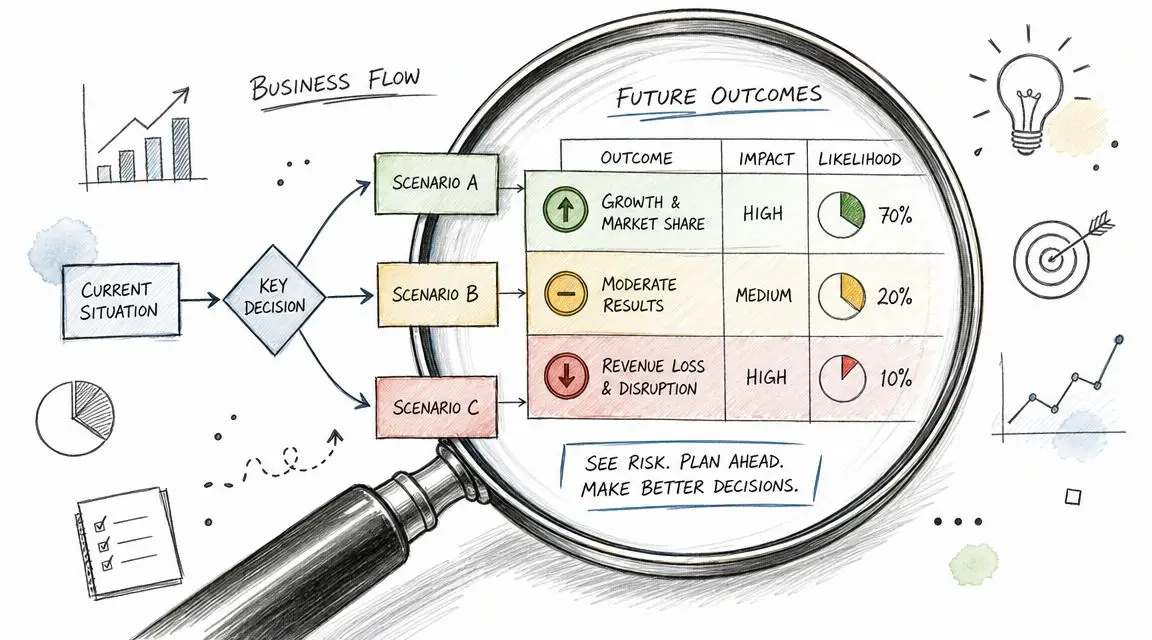
That distinction changes legal strategy. A reactive system waits for breach notices, chargebacks, regulator letters, or emergency board meetings. A predictive system scans historical and current signals, then estimates where pressure is building before loss becomes formal.
What it actually does
In practice, predictive analytics turns data into probability scores. The data can include payment patterns, delivery delays, service failures, contract deviations, audit findings, transaction anomalies, and communication trends. The output is not magic. It is a structured forecast that helps management rank threats by likely impact and timing.
IBM describes predictive analytics as a branch of advanced analytics that uses historical data, statistical modeling, data mining, and machine learning to predict future outcomes and help companies identify risks and optimize opportunities. IBM also notes a project-risk study in which a Gradient Boosting Machine achieved 85% accuracy and 82% precision, while the same study reported a 10% project cost reduction through predictive methods, as explained in IBM’s overview of predictive analytics in business risk forecasting.
For executives, the key point isn’t the model name. The point is operational. Management can intervene earlier when a system identifies likely dispute conditions instead of waiting for a legal event.
Why legal teams should care
A legal department usually inherits risk after another function has already normalized it. Sales stretches a pricing clause. Procurement tolerates repeated supplier variance. Finance accepts unusual payment sequencing. By the time counsel sees the file, the record may already favor the other side.
A strong predictive system doesn’t replace legal judgment. It improves timing, triage, and escalation.
For a clean non-technical explainer, DataTeams’ predictive analytics guide gives useful background on how businesses convert data patterns into forward-looking decisions. That framing helps non-legal leadership understand why predictive tools belong in dispute prevention, not only in operations.
Common Predictive Models and Data Sources
Not every model serves the same business purpose. Some classify risk into likely or unlikely buckets. Others rank severity. Others detect anomalies that deserve human review. The legal value comes from choosing the model that fits the decision.
Which model does what
A simple baseline model can help a team estimate whether a counterparty is moving toward default or whether a claim is likely to escalate. More advanced machine learning models can capture more complex patterns across many variables. That difference matters.
One project-risk benchmark summarized by Milvus found that the best-performing Gradient Boosting Machine reached 85% accuracy, while logistic regression reached 71% accuracy. Milvus also notes that support vector machines reached 83% accuracy, which shows why model choice can directly affect decision support in risk settings, as discussed in this overview of predictive analytics for risk management systems.
| Model Type | Primary Use Case | Example Application | Relative Complexity |
|---|---|---|---|
| Logistic regression | Binary classification | Estimate whether a payment dispute is likely to become formal litigation | Lower |
| Decision tree | Rule-based classification | Flag agreements with combinations of clauses that often correlate with later conflict | Moderate |
| Gradient Boosting Machine | Higher-precision pattern detection | Rank counterparties by litigation risk using many interacting variables | Higher |
| Anomaly detection | Outlier review | Surface unusual transactions, document changes, or claims activity | Moderate to higher |
The data that actually matters
Legal teams often focus on documents alone. That is too narrow. Useful prediction usually depends on mixed data, not a single file set.
Relevant inputs may include:
- Contract data: Renewal language, service levels, exclusivity terms, notice clauses, and change-order patterns.
- Operational data: Delivery failures, support tickets, refund requests, stock interruptions, and unresolved exceptions.
- Financial data: Aging invoices, credit holds, unusual payment sequencing, and repeated partial payments.
- External context: Market pressure, public filings, sanctions screening, adverse media, and regulatory developments.
- Communications evidence: Escalation language, silence after key requests, or sudden shifts in approval chains.
Better data usually beats a more fashionable model.
For commercial disputes, internal email volume alone is rarely useful. Internal email tied to missed milestones, disputed invoices, and last-minute contractual deviations can be highly useful. Context creates signal.
Forecasting High-Stakes Commercial Litigation
A lawsuit is often the end of a pattern, not the beginning. The practical question is which pattern legal and executive teams should detect first.
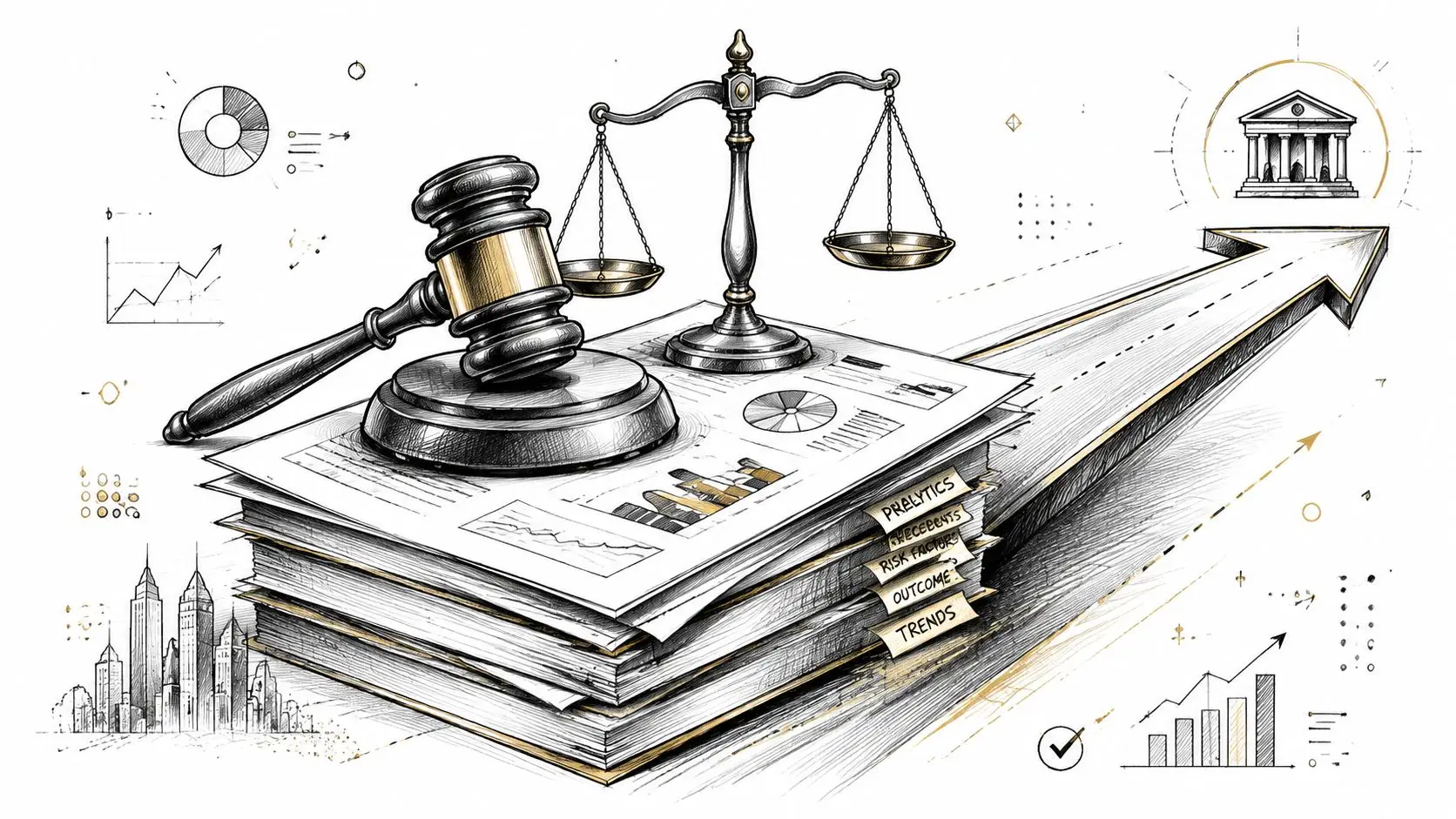
The strongest predictive systems combine heterogeneous data sources, including historical events, market signals, and internal operational data. They detect leading indicators before those indicators become realized losses, and they act as decision engines that continuously update risk probabilities, as described in Riskonnect’s analysis of prescriptive and predictive analytics in risk management.
Contract breach before the breach notice
Consider a distributor relationship governed by Israeli law. The contract still looks intact. However, the operational record shows repeated shipment variance, disputed rebates, and mounting deviations from approval workflow. At the same time, local managers stop confirming verbal accommodations in writing.
No single fact proves breach. Together, they show a rising probability of a payment and performance fight. That forecast lets management freeze informal concessions, preserve records, and reset communications before the distributor frames the dispute first.
Compliance friction before regulator contact
A second scenario appears in regulated sectors. A company sees recurring exceptions in onboarding, inconsistent customer classification, and local staff workarounds to keep deals moving. The legal issue may not surface immediately. The exposure grows anyway.
Predictive review helps legal and compliance teams identify clusters of conduct that tend to produce complaints, internal whistleblowing, or inquiries. That matters because once external scrutiny begins, the business no longer controls timing or narrative.
Fraud indicators before financial loss turns into claims
Fraud-related disputes rarely start with a final loss event. They start with fragmented indicators, such as unusual approval behavior, timing mismatches, transaction anomalies, and unexplained vendor changes. Businesses that already study operational anomaly patterns often use adjacent technical approaches similar to those outlined in this discussion of real-time fraud detection.
That does not make every anomaly a fraud case. It does mean legal teams should treat anomaly clusters as pre-litigation intelligence, especially when insurance notice obligations, fiduciary duties, or banking relationships are involved.
The company that sees the pattern first usually shapes the remedy first.
M&A diligence and hidden dispute exposure
In acquisitions, predictive logic helps buyers look beyond disclosed litigation. A target may report no major disputes while still carrying unstable commercial relationships. If the data shows repeated claims settlements, volatile collections behavior, concentrated customer friction, or unresolved IP complaints, a buyer may be inheriting tomorrow’s litigation.
That insight changes more than diligence memoranda. It affects price adjustment, indemnity structure, post-closing controls, and whether the deal should proceed at all.
Navigating Legal and Governance Implications
Prediction creates power, but it also creates its own risk. A company that uses a model to influence legal or operational decisions must be ready to defend the model’s logic, data discipline, and human controls.
Why black-box decisions create legal exposure
Privacy, bias, and trust remain persistent concerns in predictive systems. The more serious issue for commercial disputes is evidentiary defensibility. If a company deprioritizes a counterparty, escalates monitoring, or alters contractual treatment because a model flagged risk, that decision can become part of the litigation record.
Insightsoftware notes that the central question is no longer whether predictive analytics works. The harder question is how to prove that it is fair, explainable, and defensible when major legal and operational decisions depend on it, as discussed in this article on the benefits, challenges, and risks of predictive analytics.
Governance rules that matter in practice
A usable governance framework should answer several business questions before deployment:
- Who owns the model outcome: Legal, compliance, finance, procurement, or a shared escalation committee.
- What triggers human review: Not every high-risk score should trigger automatic action.
- Which data stays out: Sensitive or irrelevant data can contaminate both fairness and legality.
- How decisions are recorded: The business needs a clear explanation for why people acted on a model output.
- When recalibration occurs: Market conditions, regulation, and business structure change.
A model becomes dangerous when people treat its output as self-authenticating.
International companies with Israeli exposure should be especially careful where local privacy law, internal investigations, employment sensitivity, and cross-border data transfers intersect. A predictive tool can help the company avoid disputes. It can also generate a new dispute if no one governs data access, override authority, and explanation standards.
Human override is not optional
Senior management should resist the urge to automate decisive legal steps. Models can rank, flag, and prioritize. People still need to decide whether to issue a demand, suspend a relationship, disclose a problem, or preserve evidence.
That is not a weakness in the system. It is the control that makes the system defensible.
A Roadmap for Implementation
Most implementations fail because management buys software before defining the risk question. A legal team doesn’t need a broad AI program to start. It needs a disciplined method for one high-value threat.
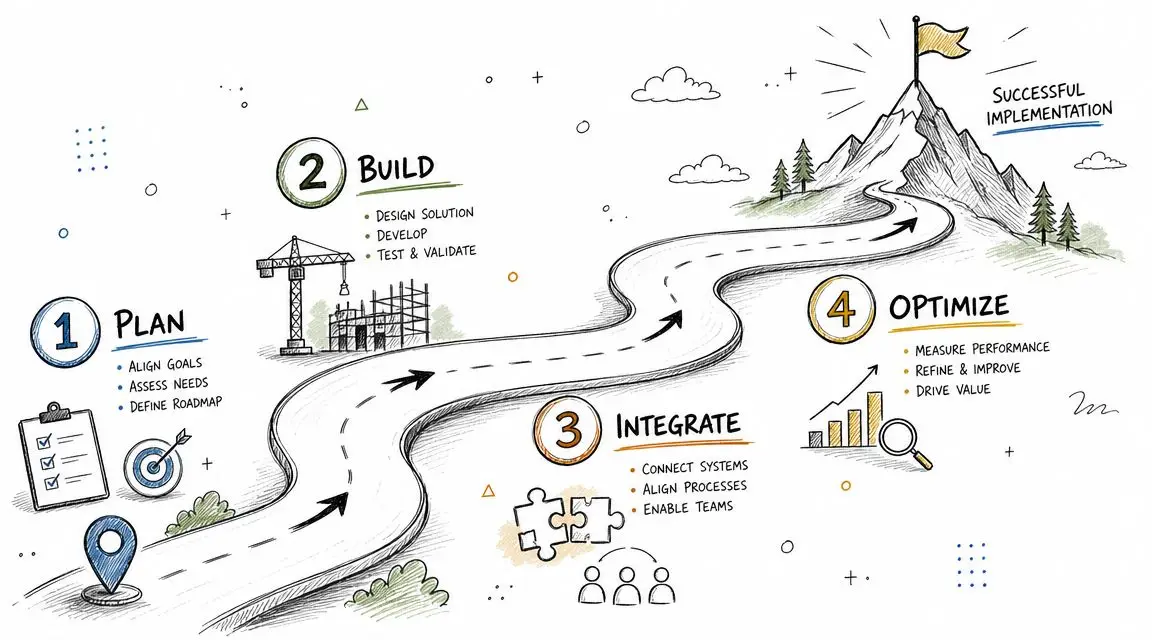
Meegle emphasizes that implementation quality depends more on data engineering than on model choice alone. Source data must be cleaned, deduplicated, and validated because missing values and inconsistent records directly degrade forecast reliability, as explained in this guide to predictive analytics in risk analytics systems and tools.
Stage one defines the threat
Start with one precise business problem. “Reduce litigation risk” is too vague. “Identify distributor relationships likely to become payment and performance disputes” is much better.
The narrower framing forces clearer inputs. It also helps leadership decide what action should follow a high-risk score. If the action is unclear, the model will produce noise.
Stage two fixes the data
This stage usually takes longer than management expects. Legal documents often sit in one system, invoice histories in another, and operational complaints in a third. Different business units name the same counterparty in different ways. Dates don’t align. Core records contain duplicates or gaps.
A practical readiness review should include:
- Entity mapping: Confirm that each contract, invoice stream, and business unit points to the same legal counterparty.
- Document normalization: Standardize amendments, notices, side letters, and translated versions.
- Event tagging: Mark disputes, defaults, service failures, refund events, and remediation efforts in a consistent format.
- Access controls: Limit who can see sensitive records and who can change labels.
Stage three tests the model against business reality
The right question is not “Is the model advanced?” The right question is “Does it correctly flag the situations that matter, and can people understand why?”
Teams should compare outputs against known historical events. They should test false positives, false negatives, and edge cases. They should also ask whether local legal and commercial teams would trust the result enough to act.
Board-level point: If the output cannot be explained to a judge, regulator, or audit committee, it is not ready for serious use.
Stage four builds governance and escalation
Implementation only becomes useful when it enters a real workflow. That means defined ownership, review thresholds, evidence preservation rules, and a documented override path. In legal risk settings, deployment without escalation logic creates a polished but idle tool.
Executives should also align this work with communications, claims handling, and local external counsel strategy. Otherwise, prediction stays isolated from the actual dispute response.
Strategic Path Forward
The commercial value of predictive analytics is not limited to forecasting. Its real value lies in control. It helps leadership identify which relationships are destabilizing, which warning signs deserve intervention, and which risks can still be contained before they become formal disputes.
For international companies operating in or through Israel, that shift matters more than initially understood. Litigation risk often sits inside ordinary business data long before it reaches lawyers. Companies that organize that data early can maintain their standing, improve documentation, and make better decisions under pressure.
The larger lesson is strategic, not technical. Weak programs usually fail because they chase tools, ignore data discipline, or treat governance as an afterthought. Strong programs define a narrow legal threat, connect the right records, validate outputs against real events, and preserve human judgment at decisive moments.
Leaders evaluating broader change may also find value in Doczen’s discussion of AI transformation for enterprises, especially where the question is not whether to adopt AI, but how to integrate it into controlled decision systems. In the legal sphere, that same discipline separates useful intelligence from ungoverned risk.
A business that waits for the lawsuit usually inherits the other side’s timing. A business that detects the build-up can still choose its forum, sequence, message, and remedy.
Avoid costly mistakes in Israeli commercial disputes and cross-border risk planning. Contact RNC Group through its contact page to assess strategic exposure before a preventable conflict hardens into litigation.
This article provides general information only. It does not constitute legal advice, does not create an attorney-client relationship, and should not replace a fact-specific legal review of any Israeli or cross-border commercial matter.