
A failed vendor rarely looks dangerous at signing. The file is complete, the questionnaire is answered, and the commercial team wants speed. Yet in 2026, the essential question is sharper: when a critical cross-border vendor fails, will the diligence record protect the company, or prove that the warning signs sat in plain view?
For companies dealing with Israeli counterparties, vendor due diligence isn’t a clerical procurement exercise. It is a strategic control over legal exposure, operational continuity, reputational fallout, and advantage in disputes. In cross-border relationships, routine oversights can turn into multilingual enforcement problems, IP disputes, sanctions issues, and urgent board-level decisions.
Beyond the Checklist The True Goal of Due Diligence in 2026
What is a vendor due diligence file supposed to do when the relationship starts to fail?
In 2026, the right answer is not administrative completeness. The file must help the company act under pressure. It should show what was tested, what was missed, who approved the risk, and which contractual protections were put in place before money, data, or customer delivery depended on the vendor. Without that, due diligence becomes evidence against the buyer in a dispute, an investigation, or a board review.
That problem is sharper in cross-border relationships with Israeli vendors. Foreign companies often receive a polished set of documents and assume the legal work is largely done. It rarely is. Exposure often lies in translation gaps, affiliate structures, founder influence, inconsistent signing authority, export control touchpoints, and local business practices that make commercial sense in Israel but create legal or reputational risk elsewhere.
A well-built diligence record is an early warning system. It should identify where failure is likely to occur, how quickly the buyer can verify facts, and whether the contract matches the operational reality. I have seen companies discover too late that the Israeli entity signing the agreement did not own the relevant IP, the key service obligations were performed by an affiliate outside the contract, or the records needed for an audit were held in a different jurisdiction.
Practical rule: If the file cannot support escalation, remediation, suspension, or termination during a live incident, it was not ready for the risk the business accepted.
The danger is false comfort. A known brand, a complete questionnaire, or pressure from an internal sponsor can produce approval momentum long before legal, compliance, security, and operations have tested the same facts from different angles. That is how routine onboarding turns into a sanctions question, an evidence-preservation fight, or a public dispute over service failure and data handling.
Israel-facing transactions need a broader lens
Generic procurement forms rarely capture the points that matter most in Israel-facing transactions, especially for non-Israeli buyers with limited local context:
- Corporate authority: Verify who can bind the vendor and whether the contracting entity matches the entity that owns the assets, employs the personnel, or delivers the service.
- Regulatory exposure: Check whether the vendor’s activities create downstream obligations on privacy, cybersecurity, sector rules, export controls, or sanctions compliance for the foreign customer.
- Reputational exposure: Screen for adverse media, politically sensitive affiliations, founder-related controversies, and key-person issues that may be manageable locally but serious in another market.
- Dispute practicality: Test where documents are held, which language governs, what evidence can be obtained quickly, and whether interim relief or enforcement would be realistic if performance breaks down.
A checklist still has a place. It creates order and forces baseline collection. The primary goal, however, is crisis prevention. Proper due diligence assigns risk before the vendor has system access, before payments are difficult to unwind, and before a local problem in Israel becomes a cross-border legal and reputational event.
Defining Your Diligence Scope and Proportionality
The hardest question isn’t whether to investigate. It’s how much investigation is enough. Many companies still burden low-risk vendors with exhaustive forms, while strategic vendors pass with only superficial review. That is the wrong asymmetry.
A more defensible model starts with a full inventory of third parties, then classifies them by criticality and data access, followed by baseline legal, financial, and security evidence, sanctions and adverse media screening, policy and contract review, and continuous monitoring after onboarding. That sequencing appears in Mitratech’s vendor due diligence workflow, which also stresses that high-risk vendors require deeper evidence such as certifications, on-site audits, and more frequent reviews.

A practical tiering model
Most organizations don’t need a grand theory. They need a repeatable rule that procurement, legal, security, and business owners can apply.
-
Low-risk vendors
These vendors provide general services and don’t touch sensitive systems or meaningful business continuity functions. The minimum file usually includes identity, corporate status, basic contract review, payment integrity checks, and a short compliance screen. -
Moderate-risk vendors
These vendors affect workflows, handle limited business information, or support regulated functions indirectly. They usually justify deeper policy review, stronger contract controls, and targeted questions on subcontractors, resilience, and incident handling. -
High-risk or critical vendors
These vendors can disrupt operations, access sensitive data, or create direct legal exposure. They require extensive document review, objective security evidence, financial scrutiny, more senior approval, and a clear post-signing monitoring plan.
What proportionality actually means
Proportionality doesn’t mean relaxing standards. It means matching effort to exposure. A one-size-fits-all questionnaire creates fatigue, delay, and false equivalence between a low-impact office supplier and a vendor with system access or sensitive customer data.
The real failure isn’t always under-checking. Often, teams waste time on vendors that don’t materially increase exposure and miss the relationships that do.
A proportional system should answer four practical questions:
| Question | Why it matters |
|---|---|
| Does the vendor affect core operations? | Business interruption risk usually justifies deeper review. |
| Will the vendor access sensitive data or systems? | Data access changes both legal and cybersecurity exposure. |
| Can the vendor create reputational fallout? | Public controversy can spread across borders fast. |
| Would replacement be difficult during a dispute? | Dependency increases leverage risk and termination complexity. |
Building a defensible internal record
The discipline here is documentation. If the company later needs to explain why one vendor received a light review and another underwent extensive scrutiny, the file should show a rational methodology tied to impact, access, and substitutability.
That record matters for governance and for disputes. A buyer that can show deliberate tiering looks prudent. A buyer that treated every vendor the same often looks careless, even when it believed it was being thorough.
A Core Investigative Playbook for Global Companies
Once scope is set, the investigation has to move from broad categories to proof. That means testing what the vendor says against what the documents, systems, and people can support. For cross-border transactions, many diligence exercises become dangerously shallow at this stage.
Cybersecurity now drives much of this scrutiny. One vendor-risk source states that 74% of all cybersecurity breaches result from privilege misuse or human error, which is why current reviews place weight on employee practices, access controls, incident response plans, and breach-notification procedures, not only financial stability, according to BitSight’s five-step vendor due diligence checklist. The same guidance notes that due diligence frameworks increasingly expect objective technical evidence such as SOC 2 or ISO 27001 certifications.
Three domains decide most outcomes
The legal team should investigate beyond formal registration. It should ask whether the vendor can lawfully perform the work, sustain the relationship, and transfer the promised rights without creating hidden disputes.
| Domain | Key Focus Areas | Essential Evidence |
|---|---|---|
| Corporate and financial viability | Legal existence, ownership structure, authority to sign, financial resilience, concentration risk | Corporate registry extracts, constitutional documents, signatory authority records, financial reports, key commercial terms |
| Legal and regulatory compliance | Sanctions exposure, adverse media, sector obligations, privacy and security commitments, subcontracting limits | Screening results, policy documents, compliance statements, insurance records, contract templates, internal procedures |
| Intellectual property and technology rights | Ownership, licensing chain, open-source use, third-party dependencies, employee and contractor assignment risk | IP schedules, license agreements, development agreements, assignment clauses, repository policies, customer use rights |
Corporate reality often differs from the sales narrative
Many problems appear at the entity level. The negotiating party may not own the operating assets. The affiliate delivering services may sit outside the proposed contract. The individuals making representations may not have clean authority.
For Israeli-facing transactions, foreign companies should insist on matching the commercial promise to the actual legal structure. If the vendor group uses multiple entities for tax, employment, or IP holding purposes, the contract must identify exactly which entity owns what, performs what, and bears what liability.
A vendor that can’t clearly explain its legal structure during diligence rarely becomes easier to manage after signature.
Compliance review should focus on consequence, not form
Sanctions screening and adverse media review are no longer optional add-ons. They help detect legal restrictions, corruption concerns, politically sensitive ties, and conduct that could become a reputational issue once the relationship becomes public.
This review should also test the vendor’s internal discipline:
- Policies that matter in practice: Ask whether privacy, security, and incident response policies govern the services in scope, not just the business generally.
- Notification pathways: Confirm who escalates incidents, who approves disclosures, and how quickly the vendor can communicate across borders.
- Insurance alignment: Check whether the policy structure responds to the service risk and territorial footprint.
Intellectual property deserves its own diligence track
IP is where routine vendor engagements become expensive. A software vendor may have a valid business, a workable product, and an acceptable security posture, yet still lack clean rights to license what it is selling. That can happen through contractor-developed code, inherited repositories, open-source misuse, or group-company ownership splits.
In Israeli commercial practice, this issue becomes acute where innovation businesses grow fast and document discipline lags behind product maturity. A foreign customer should ask:
- Who owns the code, content, designs, or data outputs?
- Do employees and contractors assign rights properly?
- Does any third party retain approval, royalties, or termination rights?
- Which components are licensed in, and on what restrictions?
- Can the vendor grant the customer’s intended use in every relevant territory?
For healthcare, fintech, and other regulated sectors, technical verification should support the legal review. Teams assessing security controls in sensitive environments often benefit from external resources on Affordable Pentesting for healthcare, especially where technical assurance must complement contractual risk allocation.
Evidence beats assurances
The best diligence questions are designed to force documentary answers. If the vendor claims mature controls, the file should contain the document, certification, report, or log that supports the claim. If the vendor resists basic substantiation, that resistance is itself a finding.
Gathering Evidence and Fortifying Your Contracts
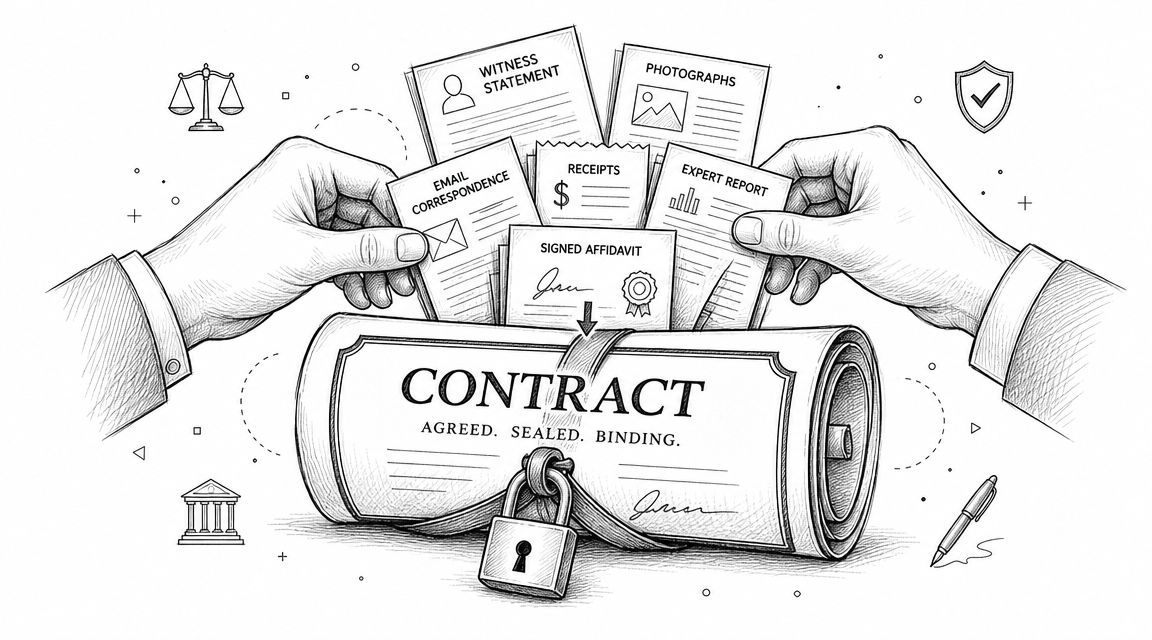
Due diligence achieves very little if the contract ignores what the investigation found. A vendor may disclose weak incident response, uncertain subcontracting, or incomplete IP assignments. If those points never become warranties, audit rights, remediation duties, and termination triggers, the diligence process records vulnerability without controlling it.
That is why the commercial agreement should function as the legal output of vendor due diligence. In Israeli and cross-border practice, businesses often spend substantial energy on the statement of work and pricing schedule, then leave the key risk provisions underdeveloped. The result is predictable. The deal signs quickly and becomes difficult to enforce precisely where it matters.
Questionnaires don’t prove control
Expert guidance warns that the due diligence questionnaire should not serve as the control itself, because questionnaires are time-consuming and become low-value when used alone. Organizations increasingly pair them with objective technical inputs such as security ratings, attack-surface review, and automated evidence collection, as discussed in Panorays’ analysis of vendor due diligence checklists.
That principle has direct contractual consequences. If a vendor’s representations rely only on self-reporting, the buyer has very little to enforce later. If the agreement requires ongoing evidence production, notices of material change, and audit cooperation, the buyer gains an advantage before a dispute matures.
Clauses that should reflect diligence findings
The contract should convert every serious diligence issue into an obligation, a remedy, or both.
- Representations and warranties: Tie these to sanctions status, legal compliance, ownership of deliverables, authority, data protection, and accuracy of diligence materials.
- Audit and evidence rights: Require access to updated certifications, policy changes, incident records, and relevant third-party assessments.
- Incident and breach provisions: Define notification mechanics clearly, including content, timing, preservation duties, and cooperation requirements.
- Subcontractor controls: Prevent silent outsourcing and require flow-down obligations where subcontractors affect data, security, or continuity.
- Termination triggers: Allow suspension or exit for compliance failures, material security deterioration, false statements, or unapproved structural changes.
For legal teams refining commercial frameworks, comparative material on understanding data protection strategies can help map governance concepts to operational controls. The point isn’t theory. The point is to ensure the contract requires proof, escalation, and correction.

The contract should preserve future options
A robust agreement also creates room to act before total failure. That means cure periods where remediation is realistic, immediate rights where the issue is existential, and evidence-preservation duties when misconduct or breach appears likely.
Contract drafting should answer one practical question: if the vendor’s assurances prove false, what can the buyer do on the next day, not after months of argument?
Cross-border parties should also address governing language, forum, records access, and service mechanics with care. Those points can look procedural at signing. In a crisis, they become decisive.
Handling Red Flags and Cross-Border Challenges
No serious diligence process ends with a perfect file. Real vendors present mixed records, incomplete systems, legacy documentation, and operational compromises. The strategic question isn’t whether a red flag exists. The question is how the company will classify it, escalate it, and decide whether remediation is acceptable.
One under-answered issue in vendor due diligence is proportionality. The sharper view is that the primary risk isn’t under-checking every vendor. It is misallocating diligence effort to vendors that do not materially increase exposure, as noted in SecurityScorecard’s vendor due diligence best practices. That principle should also govern red-flag response.

A useful escalation model
Consider three common scenarios.
A software vendor has strong functionality, but its IP assignments from outside developers are incomplete. That isn’t always a walk-away event. However, it does require documentary cure before signature, stronger indemnities, and perhaps escrow or staged payments.
A data-processing vendor provides polished policies, but resists giving objective security evidence and can’t explain its incident reporting chain. That usually points to a governance weakness, not just a document gap. In a regulated environment, many buyers should pause the process until the vendor can produce proof.
A logistics or operational vendor appears commercially sound, but adverse media reveals repeated allegations of misconduct involving senior personnel. Even where no formal finding exists, the reputational cost may outweigh the operational benefit. A board or regional leadership team may need to own that decision directly.
Remediate, restrict, or reject
A disciplined response usually falls into one of three paths:
- Remediate: Use when the issue is curable, documented, and time-bound.
- Restrict: Use when the relationship remains necessary, but scope, access, payment flow, or data exposure must narrow.
- Reject: Use when the issue strikes legality, trustworthiness, ownership, or enforceability at a fundamental level.
Some red flags don’t require immediate termination. They require the buyer to stop pretending that standard terms can absorb non-standard risk.
Cross-border friction changes the analysis
Foreign companies entering Israeli relationships face additional pressure points. Source documents may exist only in Hebrew. Internal approvals may move quickly on the vendor side while the foreign buyer still needs translated support. Local counterparties may assume Israeli jurisdiction or familiar market practice, while the foreign client expects broader warranties or different evidence standards.
These aren’t merely drafting irritations. They affect the ability to verify facts, interpret obligations, and enforce remedies. A translated summary can omit a qualification that changes liability. A forum clause can make emergency relief slower or more expensive than expected. A local operational norm can conflict with a global compliance rule.
This is why red-flag management needs a decision tree, not just a checklist. The company should define who can accept residual risk, which issues require business remediation, and which issues require legal redesign of the deal. Without that discipline, urgency will drive the result.
Conclusion From a One-Time Check to Ongoing Vigilance
What happens six months after signature, when the vendor changes ownership, shifts part of the work to an affiliate, or starts handling data from a new jurisdiction without telling you?
That is usually where risk begins. A clean diligence file at onboarding does not protect the company if the underlying facts change and nobody revisits them. In cross-border relationships, especially those involving Israeli vendors, distributors, service providers, or technology partners, those changes can alter regulatory exposure, enforcement options, sanctions analysis, data-transfer risk, and public fallout with very little warning.
The practical mistake is treating vendor due diligence as a gate instead of a monitoring discipline. Legal teams see the consequences later. The counterparty that looked acceptable at signing becomes harder to remove, harder to audit, and more expensive to confront once it is integrated into operations, customer delivery, or sensitive systems.
What ongoing vigilance looks like
A disciplined program keeps the relationship under review in ways that match the actual risk and business dependency:
- Re-test the risk rating: Update the vendor’s tier when services expand, data access increases, subcontractors appear, or the vendor becomes operationally difficult to replace.
- Refresh the evidence file: Request current corporate records, compliance confirmations, security materials, insurance support, and any change notices that affect ownership, control, or legal exposure.
- Align the contract with reality: Amend the agreement when the actual service model, territory, payment path, or data flow no longer matches the papered deal.
- Connect onboarding to monitoring: Use practical operating frameworks, including external references such as Doczen’s vendor onboarding strategies, so the review done at entry does not decay into stale assumptions.
Cadence matters, but judgment matters more. High-risk vendors should not wait for a calendar reminder if there is a control failure, a reputational incident, a financing shock, or a material change in beneficial ownership. Those events justify immediate review.
For non-Israeli companies, this point is sharper. A vendor relationship in Israel can look stable from abroad while local legal, political, tax, employment, or enforcement conditions shift underneath it. If the foreign client is relying on old translations, outdated officer certificates, or a contract built for a narrower scope, the business may discover the gap only when a dispute, regulator, journalist, or customer asks the wrong question.
Vendor due diligence works best as an early-warning system. Used properly, it reduces the chance that a routine supplier issue turns into a cross-border legal problem with reputational spillover. Used once and filed away, it gives comfort at exactly the moment caution is still required.
Avoid costly mistakes before they become cross-border disputes. For specific guidance on Israeli commercial risk, vendor contracting, and crisis prevention, contact RNC Group now.
This article provides general information only and does not constitute legal advice. Reliance on any part of it without a fact-specific legal review may create risk, especially in cross-border matters involving Israeli law, regulation, language, and enforcement.