
A business expansion strategy fails in Israel when management treats legal planning as paperwork instead of operational architecture. The decisive question for 2026 is simple. Can the business scale compliance fast enough to match commercial ambition without importing avoidable risk?
That question matters because static expansion plans break under live regulatory pressure. Recent data shows that 58% of small businesses expanding into emerging markets face unexpected regulatory penalties due to static compliance frameworks, while only 19% of expansion guides offer phased, jurisdiction-specific compliance escalation tactics according to Paro’s market expansion analysis. In practice, the gap usually appears in contracts, approvals, reporting lines, and crisis response.
Israel rewards prepared entrants. It also exposes generic templates very quickly. A sound market entry plan therefore has to integrate commercial contracts, regulatory sequencing, banking readiness, and dispute management from day one.
Entering the Israeli Market in 2026 Are You Prepared
Boards often ask the wrong opening question. They ask how fast they can enter, not how they will contain legal shock when counterparties, regulators, or payment systems stop behaving as forecast.
That mistake is expensive because Israel is a complex market with dense legal touchpoints. A business can secure a distributor, sign a licensing term sheet, and still remain structurally exposed if the contract stack, reporting chain, and escalation protocol don’t align.
The real exposure sits in static planning
The common checklist model looks tidy. It also assumes that the legal environment will stay stable long enough for execution to catch up. That assumption doesn’t hold in high-stakes cross-border work.
Practical rule: A business expansion strategy for Israel should treat compliance as a moving system, not a filing exercise.
The legal issue isn’t only whether entry is lawful on signing day. The issue is whether the structure can absorb friction after launch, when a local partner underperforms, a payment route tightens, or a regulator asks who bears responsibility inside Israel.
What a serious entry posture requires
A resilient entry plan usually includes several parallel workstreams:
- Entity and contract alignment: The operating model must match the documents. If the business enters through a distributor, the distribution agreement can’t allocate franchise-like obligations without corresponding controls.
- Jurisdiction-specific escalation: Management should decide in advance who handles notices, who approves concessions, and when external counsel enters the dispute stream.
- Commercial defensibility: Revenue assumptions must match practical enforceability. A strong spreadsheet doesn’t fix a weak termination clause.
- Operational continuity: Banking, invoicing, signatures, and data handling need local execution rules before launch.
A conventional expansion memo rarely goes that far. Yet that is where avoidable losses usually begin.
Generic expansion advice tells companies to define goals. Better advice tells them what to do when the Israeli counterparty misses milestones, withholds information, or uses delay as leverage.
Choosing Your Business Expansion Model
Not every market entry model creates the same legal burden. Some buy speed by giving up control. Others preserve control but demand deeper infrastructure, more diligence, and heavier execution.
The right choice depends on what management values most. Some clients want immediate market access. Others want direct control over pricing, compliance, and customer relationships. Those goals often conflict.
Comparison of Business Expansion Models
| Strategy | Initial Cost | Market Control | Operational Risk | Speed to Market |
|---|---|---|---|---|
| Exporting | Lower relative commitment | Lower control | Moderate, because local execution depends on intermediaries | Faster |
| Licensing | Lower upfront operational build | Limited control over day-to-day market conduct | Elevated brand and IP risk if drafting is weak | Faster |
| Franchising | Moderate to significant setup burden | Structured control if the agreement is disciplined | High if monitoring and brand standards are loose | Moderate |
| Joint venture | Shared investment burden | Shared control | High, because deadlock and governance disputes can emerge quickly | Moderate |
| Mergers and acquisitions | Higher transaction complexity | High control after closing, subject to deal structure | High during diligence, integration, and post-closing adjustment | Faster if the target is established |
| Greenfield investment | Highest internal build requirement | Highest direct control | High during setup, hiring, and infrastructure launch | Slower |
A table like this helps narrow options, but it doesn’t decide the answer. The legal implications differ sharply between models that appear commercially similar.
What works and what doesn’t
Exporting works when the business wants to test demand without building a full Israeli footprint. It doesn’t work well when after-sales obligations, local service standards, or regulatory exposure require direct supervision.
Licensing can be efficient where the core asset is intellectual property or know-how. It becomes dangerous when the licensor hasn’t defined quality control, territorial scope, audit rights, and post-termination restrictions with precision.
Franchising suits operators who need repeatable market rollout. It fails when parties use a loose distributorship form to disguise a franchise relationship while leaving training, brand standards, and default remedies underdeveloped.
Control usually costs more, but it also protects more
A joint venture can solve access problems quickly, especially where local networks matter. However, shared ownership without deadlock procedures, reserved matters, funding rules, and exit mechanics often creates a dispute machine.
An acquisition gives direct entry into contracts, staff, and customers. Yet it also imports legacy exposure. The buyer doesn’t purchase opportunity alone. It may also purchase unresolved liabilities, flawed permissions, and brittle governance.
A greenfield entry offers the cleanest control structure. It also demands patience, operational depth, and disciplined execution. If the internal team can’t carry compliance, hiring, finance, and vendor oversight together, greenfield expansion becomes a strain rather than an advantage.
A practical shortlisting lens
Use these questions before choosing the model:
- Where must control remain internal? Pricing, brand use, key accounts, or regulated processes may not be safely delegated.
- What can the business monitor in real time? If local conduct can’t be supervised, lighter-entry models become riskier.
- How painful would exit be? A fast entry model isn’t attractive if unwinding it becomes slow, public, or expensive.
- What dispute is most likely first? Misaligned incentives in a joint venture require one contract architecture. Quality drift under licensing requires another.
The Israeli Market Entry Decision Framework
The Israeli market rewards disciplined analysis before commitment. Intuition helps with commercial timing, but it doesn’t replace a structured legal and financial review.
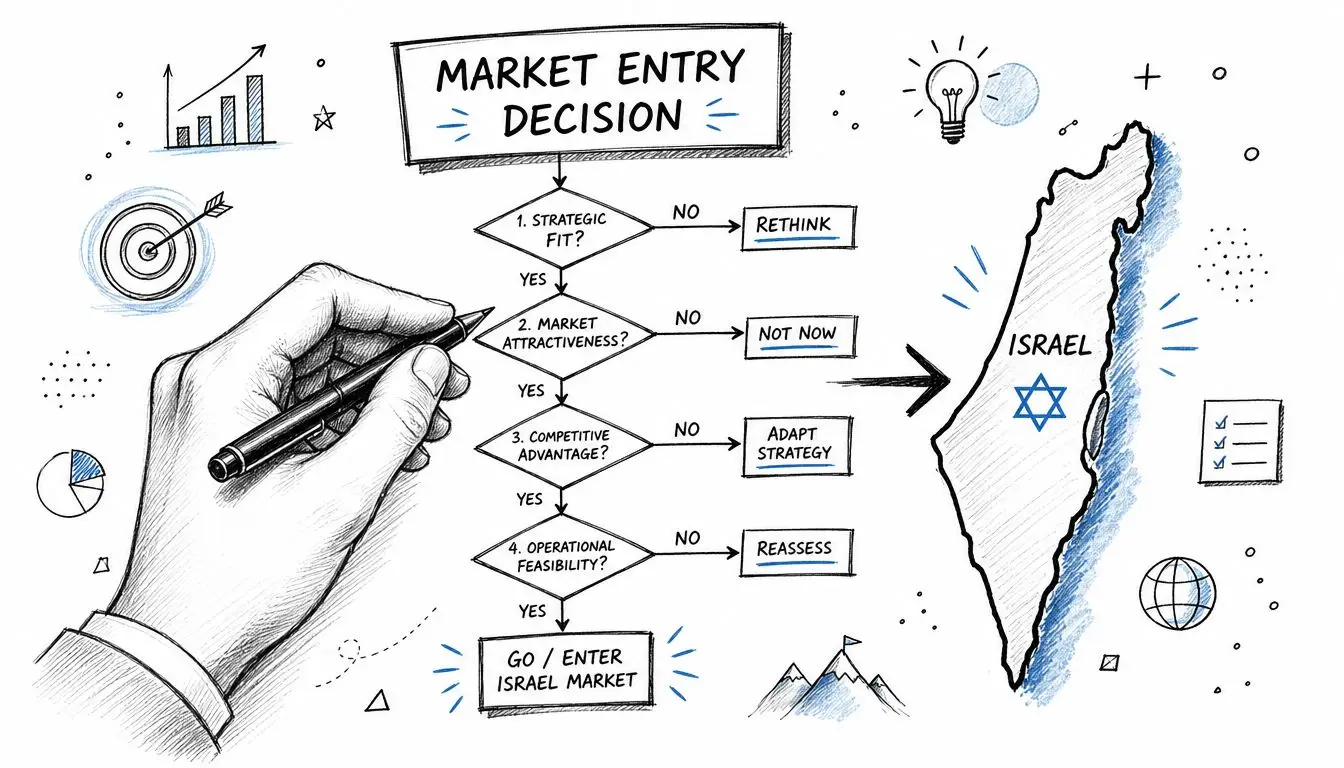
A serious framework starts with scenario testing, not enthusiasm. Successful market expansion strategies must include a thorough SWOT analysis to identify risk-benefit ratios for investment, followed by cost-benefit and growth forecasting that incorporates a buffer for unexpected costs, ensuring that financial viability is maintained according to Pipedrive’s business expansion guidance.
SWOT must reflect Israeli realities
A generic SWOT isn’t enough. The analysis should examine legal enforceability, local counterpart risk, payment reliability, market access channels, and how quickly management can intervene if the model slips.
- Strengths: Proprietary technology, disciplined pricing, strong contract management, or a portable operating model.
- Weaknesses: Dependence on one local partner, weak Hebrew-language execution, or limited monitoring capacity.
- Opportunities: Sector demand, strategic partnerships, or acquisition targets. Some teams also use a search tool for Israel investors to map financing and relationship contexts before entering.
- Threats: Regulatory friction, contract enforcement complexity, or governance tensions after rapid scale.
Competitor review should expose mistakes, not copy tactics
Competitor benchmarking matters, but imitation is usually lazy strategy. The better use of benchmarking is to identify where others overcommitted, delegated too much control, or entered through the wrong vehicle.
That matters particularly when management is debating whether acquisition is preferable to contract-based entry. A transaction can accelerate access, but it also changes the diligence burden, governance architecture, and post-closing risk map. Those issues become central when reviewing Israeli mergers and acquisitions considerations as part of an entry decision.
Businesses shouldn’t ask only whether a model can enter Israel. They should ask whether it can survive its first serious setback inside Israel.
Build the decision around reversibility
The strongest framework also tests how reversible each move is. A pilot distribution arrangement may be easier to correct than a poorly drafted joint venture or a rushed acquisition.
That is why the decision matrix should include legal exit cost, practical unwind difficulty, and who controls customer relationships if the relationship deteriorates. In cross-border work, reversibility is often the difference between a setback and a structural loss.
Strategic Analysis of Israeli Commercial Contracts
Commercial contracts in Israel shouldn’t be treated as memorials of business understanding. They are operating systems. If the system is vague, the dispute starts before performance does.

That is especially true in franchise agreements, licensing arrangements, partnerships, management services, and commercial collaborations. The business terms may look acceptable in principle. The legal risk sits in the machinery.
Clauses that carry disproportionate weight
Several clauses regularly determine whether a deal remains manageable:
- Scope and exclusivity: Territory, channels, customer classes, and reserved rights must be explicit.
- Performance obligations: Sales targets, reporting duties, audit access, training standards, and service levels should be measurable.
- IP control: Ownership, permitted use, infringement response, and post-termination treatment need exact drafting.
- Termination mechanics: Trigger events, cure periods, transition obligations, and restrictive covenants must support a clean exit.
- Dispute framework: Governing law, forum, interim relief, notice mechanics, and escalation stages should fit the commercial reality.
Weak drafting often appears in hybrid deals. A contract may be called a distributorship, but the actual obligations resemble franchising or agency. That mismatch creates avoidable ambiguity over control, liability, and remedies.
Why local deal knowledge changes outcomes
Israeli transactions can contain rules that foreign executives don’t expect. Under Israeli Companies Law in 2026, to acquire 100% of issued shares via a tender offer, shareholders holding at least 95% of the issued share capital must accept the offer, and no appraisal or dissenters’ rights are available in Israel for such transactions as noted in the Chambers comparison guide on Israeli Companies Law.
That rule matters beyond public M&A. It illustrates a larger point. Foreign clients often import assumptions from other jurisdictions into Israeli deal documents, then discover that the local legal framework distributes power differently.
For that reason, astute parties don’t rely on precedent alone. They adapt the contract to the Israeli enforcement environment, the sector, the counterparty profile, and the likely pressure points in a dispute. That is why careful review of commercial agreements under Israeli practice can materially change the quality of the transaction architecture.
A strong contract doesn’t eliminate conflict. It narrows the opponent’s room to create leverage.
What disciplined negotiation looks like
The best negotiations don’t fight over every clause equally. They identify where the business cannot afford uncertainty.
A licensor may tolerate pricing flexibility but not dilution of audit rights. A strategic investor may accept phased closing mechanics but not weak information covenants. A franchisor may compromise on territory calibration but not on brand standards or immediate injunctive protection for misuse.
That discipline is what turns a contract from a draft into a strategic asset.
Navigating Legal and Regulatory Checkpoints
Many foreign companies assume that commercial readiness and legal readiness develop at the same speed. They don’t. The commercial team can be prepared to launch while the legal structure still contains a hidden defect.

The practical fix is early due diligence across the full operating chain. That includes the entity structure, signing authority, IP position, labor exposure, privacy handling, tax-facing documentation, and tender eligibility where public business is relevant.
The non-obvious hurdles matter most
The visible requirements are rarely the ones that cause the most disruption. Problems usually arise from representation formalities, service of notices, local authority requirements, or gaps between the foreign parent and the Israeli operating footprint.
A clear example appears in public procurement. Under 2026 Israeli government tender regulations, foreign bidders must establish either an Israeli-registered branch or subsidiary with the Companies Registrar, or a nominated local representative with a verifiable Israeli address and documented authority via a signed representative agreement and power of attorney to accept legal notices according to Global Law Experts on Israeli government tenders in 2026.
That rule is easy to overlook because it sounds procedural. It isn’t. It determines whether the bidder can participate cleanly and receive notices in a legally dependable manner.
A practical checkpoint list
- Corporate authority: Confirm who can bind the foreign entity and whether local signatory arrangements are valid.
- IP positioning: Register or secure rights before market visibility rises and before counterparties start using marks, designs, or confidential know-how.
- Employment design: Align local engagement models with Israeli labor rules before hiring managers improvise.
- Data governance: Map where customer and employee data will sit, who accesses it, and how cross-border flows are justified.
- Tender readiness: If the public sector is in scope, prepare the local presence or representative structure early.
Compliance should support speed
Companies often frame compliance as the enemy of momentum. In Israel, disciplined compliance usually protects momentum because it reduces late-stage friction, renegotiation pressure, and launch delays.
That is also where legal correspondence matters. If the company needs to reserve rights, reject a defective demand, or pressure a counterparty before litigation, the response should fit local practice and the underlying contract record. For cross-border groups, that often intersects with legal correspondence strategy in Israel and how pressure is applied without escalating too early.
Ensuring Operational Readiness for Cross-Border Business
A business expansion strategy doesn’t fail only in the boardroom or the contract file. It also fails in payments, banking permissions, signatory bottlenecks, and weak reporting discipline.
The safer approach is staged deployment. An effective business expansion strategy requires a phased operational validation model where organizations first achieve proof of concept and profitability in pilot markets before accelerating to additional locations with refined playbooks according to Six Paths Consulting on business expansion.
Pilot first, scale second
That principle sounds conservative, but it is usually the fastest route to durable growth. A pilot reveals whether the business can invoice correctly, collect funds reliably, staff locally, monitor counterparties, and support customers without constant exception handling.
An Israeli launch should therefore test operational assumptions under real conditions:
- Banking and payments: Confirm account opening timelines, signatory controls, payment routing, and internal approval authority.
- Document flow: Ensure contracts, purchase orders, notices, and invoicing systems align across languages and jurisdictions.
- Management visibility: Build live reporting on collections, defaults, contract milestones, and regulatory touchpoints.
- Local problem ownership: Decide who handles bank friction, returned payment issues, urgent notices, and customer escalations.
Infrastructure should remove friction, not add it
Operational infrastructure must scale with demand. That means documented workflows, standardized approvals, and technology that can absorb increased volume without forcing repeated redesign.
A common failure pattern appears when executives assume the legal launch is complete once the entity and contracts are in place. Yet if the business can’t move funds predictably or react to account restrictions, the legal structure alone won’t preserve the market entry.
That is why businesses with meaningful payment exposure often review not only banking setup but also contingency procedures for freezes, delayed transfers, and account restrictions. In practice, those issues can intersect with Israeli bank account restrictions and returned check matters before they become commercial crises.
The pilot phase should prove that the company can perform, collect, and escalate. Revenue without control isn’t readiness.
Your Strategic Path Forward Phased Escalation and Crisis Management
A durable entry into Israel doesn’t rest on one decision. It rests on coordinated sequencing. The business chooses a market entry model, tests it against a disciplined decision framework, builds contract architecture that matches the model, clears regulatory checkpoints, and validates operations before scaling.
The final layer is crisis design. Every serious expansion plan should assume that at least one material conflict will emerge, whether through partner underperformance, non-payment, IP misuse, governance deadlock, or regulatory friction.
The best disputes are contained early
The objective isn’t to threaten litigation at the first sign of strain. The objective is to build a phased escalation plan before the strain appears.
That plan should define notice triggers, internal authority, evidence capture, negotiation boundaries, interim business protections, and the conditions for moving from correspondence to injunctions, debt recovery, arbitration, or court proceedings. In high-value matters, timing often matters more than rhetoric.
Risk mitigation steps that shouldn’t wait
- Audit every core contract: Remove ambiguity around control, performance, exit, and remedies.
- Map legal ownership: Confirm who owns IP, customer data rights, and key operational permissions.
- Pre-draft escalation documents: Prepare notice templates, reservation-of-rights letters, and decision trees before launch.
- Stress-test counterparties: Review not only commercial upside, but also default behavior and governance reliability.
- Define crisis leadership: One team should own legal escalation, communications discipline, and settlement authority.
A business that prepares for friction usually resolves more issues without court intervention. A business that improvises under pressure usually pays more for slower outcomes.
Avoid costly mistakes before they harden into disputes. RNC Group handles Israeli commercial law, cross-border risk management, crisis escalation planning, and complex business disputes for international and Israeli corporate clients. The recommended next step is to seek specific legal analysis before signing, investing, or escalating. Direct contact is available through the firm’s contact page.
This article provides general information only and doesn’t constitute legal advice, legal opinion, or a substitute for case-specific counsel. Reliance on any part of this article without individualized legal review may expose the reader to contractual, regulatory, or procedural risk under Israeli law and other applicable jurisdictions.