
A franchise can fail long before the first operational default. The hidden weakness often sits in a renewal condition, transfer restriction, or exit mechanism that looked secondary during the sales process. In 2026, franchise agreement review must test the contract against disclosure duties, state overrides, and cross-border regulatory change.
The headline franchise fee rarely tells the full commercial story. A franchisee may accept an attractive entry proposition, then discover that mandatory suppliers, weak territory protection, short cure periods, or renewal conditions have shifted control to the franchisor. The recommended strategic path is to examine the agreement as a long-term operating system, not as a signature document.
The 2026 Regulatory Reality for Franchise Agreements
A franchise agreement can be unenforceable in practice before the parties reach a substantive dispute. In the United States, the franchisor generally must deliver a Franchise Disclosure Document containing 23 specific information items under the FTC Franchise Rule.
The buyer must receive the FDD at least 14 calendar days before signing a binding agreement or paying money. Because the period begins on the day after delivery, signing can occur on the fifteenth day after delivery. That period creates a minimum review window, not a guaranteed opportunity to negotiate.
Practical rule: Treat the disclosure date as a control point, not as an administrative formality.
The timing also exposes the franchisor’s compliance culture. Pressure from a sales team to sign early, pay a deposit, or accept a last-minute agreement can create regulatory and evidential problems. The final contract, its addenda, and the payment trigger must match the disclosure timetable.
Separate documents, linked risk
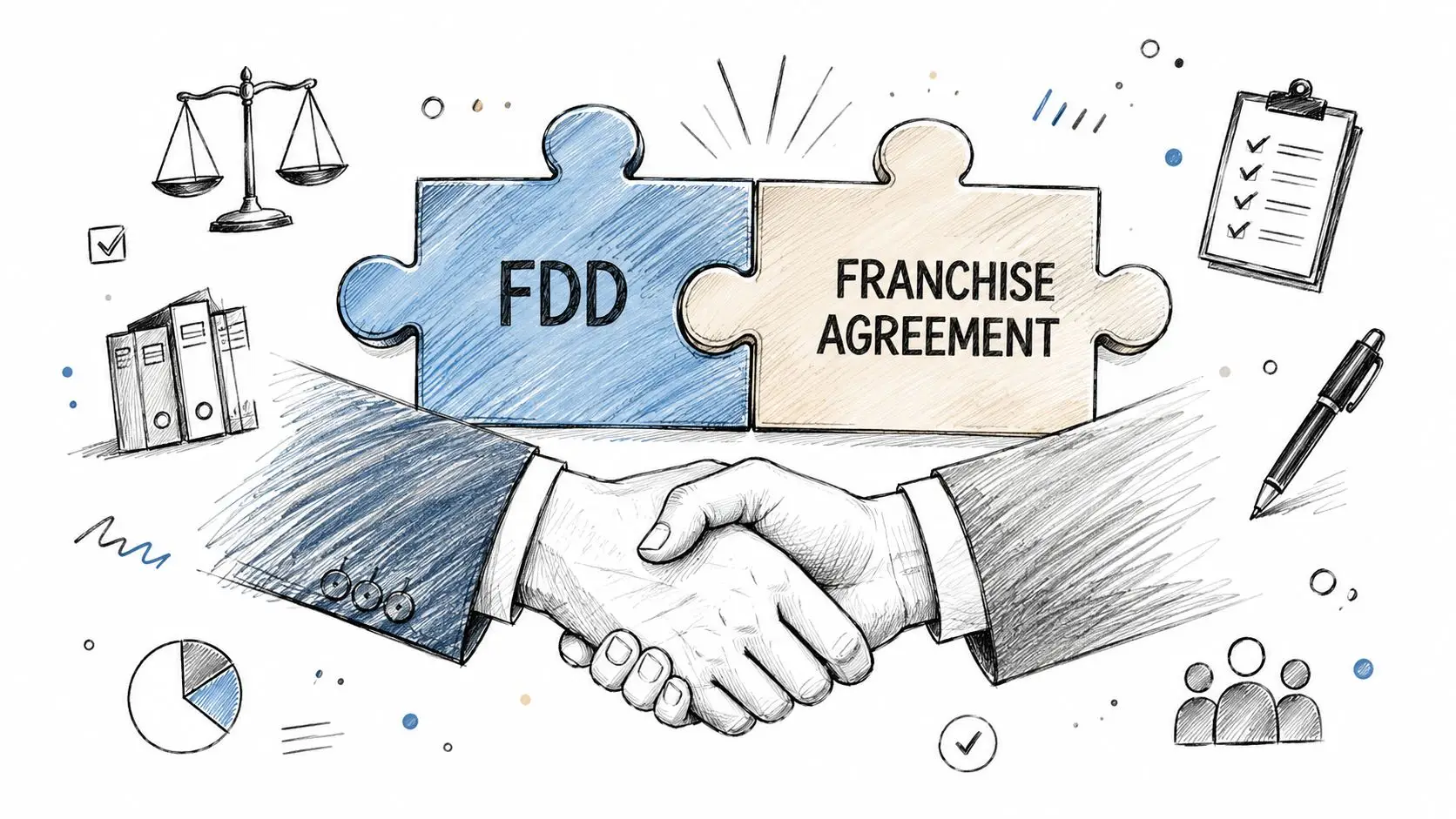
The FDD and franchise agreement serve different functions. The FDD discloses information about the franchisor, system, litigation, financial performance representations, and existing franchise relationships. The agreement establishes the enforceable operating relationship, including obligations that may control renewal, transfer, default, and exit.
Read both documents separately, then reconcile them. A favorable sales statement cannot cure a restrictive clause in the signed agreement. A disclosure statement also cannot substitute for reviewing the attached contract, particularly where renewal conditions or termination rights determine the buyer’s practical control.
The FTC’s franchise fundamentals guidance directs attention to Items 19, 20, 3, and 21. These cover financial performance representations, franchisee turnover, litigation, and financial strength. Together, they may expose network risk that a proposed royalty structure leaves out.
A live federal backdrop
The federal requirements remain active in 2026. A 2026 FTC filing states that the Franchise Rule’s current Paperwork Reduction Act clearance is projected to expire on August 31, 2026. The filing also restates the requirement for an FDD covering the franchisor, the business, the proposed franchise, and financial performance representations.
That administrative development does not change the immediate review discipline. A cross-border buyer should preserve the delivery record, identify the exact FDD version, and confirm that no payment or signature occurred prematurely. It should also flag any renewal or exit provision that could transfer control after the initial term.
Reconciling the FDD and the Franchise Agreement
Most foreign investors begin with the contract because it appears to contain the commercial deal. That sequence creates avoidable risk. The FDD often provides the context needed to understand whether the contract’s economics, restrictions, and operating assumptions match the franchisor’s disclosures.
Start with document control. Obtain the complete FDD, every exhibit, all state-specific addenda, and the proposed agreement in an editable or searchable format. Then confirm the FDD’s issue date and applicable state version before assessing any clause.
Build the reconciliation record
A reliable franchise agreement review uses a comparison schedule. The schedule should identify each disclosure item, the corresponding agreement provision, the commercial consequence, and any unresolved discrepancy.
Use the following sequence:
-
Confirm completeness. Verify that the FDD contains all 23 required items, then identify missing exhibits or unexplained gaps. The FTC’s Franchise Rule overview provides the regulatory reference point.
-
Read Item 22 with the contract. Item 22 attaches the franchise agreement and related agreements. Compare the attached version against the version presented for signature. A changed exhibit can alter the legal bargain without changing the sales narrative.
-
Compare economic terms. Match initial fees, royalties, advertising contributions, technology charges, renewal fees, transfer costs, and other payment obligations. Record whether the contract adds charges that the disclosure language describes differently.
-
Test territory language. Compare any promised exclusivity or protected area against the agreement’s reservations. Look for online sales, alternative channels, company-owned units, relocations, and neighboring territories.
-
Trace supplier controls. Match approved supplier provisions, purchasing obligations, rebates, and markup rights. The agreement may grant the franchisor discretion that the commercial presentation never discussed.
-
Check renewal and termination. Identify every condition, notice requirement, upgrade obligation, release, and post-term restriction. These provisions often determine whether the franchise retains economic value.
Escalate discrepancies early
A discrepancy doesn’t automatically invalidate the transaction. It does, however, create a negotiation issue and potentially a disclosure concern. The buyer should ask written questions, preserve the responses, and require agreed changes in the final documents.
The practitioner guidance on state and federal franchise issues identifies rushing, relying on sales pitches, missing state addenda, and delaying legal advice as recurring review errors. Those errors become more serious when the investor operates through a foreign holding company or relies on local management that lacks authority to negotiate.
Identifying High-Risk Technical Red Flags
A franchise agreement can change unit economics without changing the headline offer. The highest-risk provisions usually govern default, purchasing, territory, enforcement, and operational control. Review them as an interacting system, not as isolated clauses.
Rank each red flag by its effect on negotiation power. Risk increases where the franchisor can impose cost, accelerate termination, or restrict exit without a clear remedy. That assessment should also account for regulatory changes in 2026, including Australian reforms and expanding US state requirements, because local rules may alter how notice, termination, disclosure, or dispute provisions operate.
Economic and control provisions
Focus on these terms:
-
Short cure periods. The franchisee may not have enough time to correct a complex breach, particularly where the franchisor controls the relevant data, audit process, or approval.
-
Unilateral termination rights. Immediate or discretionary termination can destroy franchise value before the investor can challenge the alleged default or seek effective relief.
-
Mandatory supplier markups. Required purchasing may increase operating costs, while restrictions on alternatives prevent the franchisee from testing better pricing or service.
-
Weak territory protection. A territory may appear exclusive until reservations for digital sales, affiliates, relocations, alternative channels, or company outlets remove practical protection.
-
Out-of-state arbitration. A distant forum can increase cost, complicate evidence, and make urgent relief harder to obtain, especially for a foreign-owned franchisee.
Read these provisions together. Supplier restrictions become more serious when the franchisor can also change operating standards through an operations manual. A short cure period carries greater risk when the franchisor controls audits, approvals, and system data. The issue is the combined effect on cash flow and bargaining position.
Validate the network evidence
Review Items 19, 20, 3, and 21 separately. Item 19 earnings claims should match the assumptions in the buyer’s financial model. Item 20 should be tested for closures, transfers, and turnover patterns. Item 3 requires review of litigation history, while Item 21 helps assess the franchisor’s financial strength.
Do not treat repeated disputes or closures as isolated noise when the pattern appears across the network.
The FTC’s detailed franchise guidance supports examining these disclosure areas together. The commercial question is whether recurring disputes, closures, or transfers indicate structural pressure on franchisees. A pattern may also affect renewal prospects, transfer value, and the investor’s ability to exit later.
Convert red flags into negotiation positions
For each issue, record the requested amendment, the fallback position, and the consequence of refusal. This converts review findings into an investment decision.
Possible requests include longer cure mechanics, objective termination standards, defined territory reservations, supplier transparency, and a locally convenient dispute forum. Also seek clear limits on manual changes, audit discretion, and enforcement remedies where those provisions affect cost or continuity.
If the franchisor rejects every meaningful protection, that response is itself evidence. It may justify a higher risk adjustment, stronger contractual conditions, or a decision not to proceed.
The Hidden Leverage in Renewal and Exit Clauses
Startup economics attract attention because investors can see them immediately. Renewal and exit clauses deserve equal attention because they determine whether the franchise remains usable after the initial term and whether the investor can recover value through a transfer.
A renewal right often looks straightforward until the conditions are listed. The franchisee may need to sign the then-current agreement, complete upgrades, satisfy financial tests, waive claims, pay renewal charges, and meet notice deadlines. Each condition can give the franchisor added influence when the franchise has become valuable.
Renewal is not automatic continuity
Recent practitioner coverage reports increased disputes involving estimated initial costs in Item 7 and renewal conditions during 2025, while FTC franchise materials reportedly placed renewal conditions among the top issues raised by franchisees. The Polsinelli review of franchise developments and 2025 trends provides that context.
The central question is practical. Can the franchisee renew without accepting a materially different risk allocation? A clause that requires the franchisee to sign the franchisor’s then-current form can undermine the apparent value of a long operating history.
The review should test:
- Notice mechanics, including delivery method and deadline.
- Upgrade obligations, including who controls scope and cost.
- Release requirements, especially broad releases of existing claims.
- New agreement terms, including changed territory, fees, and dispute provisions.
- Performance conditions, including standards the franchisor can define later.
Exit must preserve commercial value
Transfer provisions can restrict the buyer’s ability to sell the unit, restructure ownership, or bring in strategic capital. The franchisor may hold approval rights, matching rights, transfer fees, training conditions, or a right to impose the current agreement on the transferee.
Termination creates a separate risk. A franchisee may lose brand access, customer goodwill, equipment value, and supplier relationships immediately. Post-term restrictions can then limit the ability to operate an independent business.
The recommended analysis maps three outcomes, renewal, transfer, and termination. If all three routes depend on broad franchisor discretion, the franchisee has limited bargaining power even after building the business.
Global Regulatory Shifts and Local Law Overrides
A cross-border checklist can fail when it assumes that contract language controls everywhere. Franchise regulation increasingly affects capital expenditure, investment recovery, post-term competition, termination speed, and renewal rights. Local law may narrow or override the drafting.
Australia illustrates the shift. Practitioner coverage reports that 2025 Australian reforms strengthened disclosure about significant capital expenditure, required a reasonable opportunity to earn a return on investment, restricted some post-term restraint-of-trade clauses in renewals and extensions, and introduced faster termination for serious misconduct. The 2025 Australian franchising update describes those developments.

Compare contract drafting with local remedies
The United States also requires local analysis. Connecticut requires written notice of termination, cancellation, or intent not to renew at least 60 days in advance. Connecticut requires six months’ notice for a franchisor’s decision not to renew a franchise, under its franchise termination statute.
Virginia adopted a 2026 rule making it unlawful, starting July 1, 2026, to offer or sell a franchise that restricts a franchisee’s right to compete after termination or expiration. That rule can affect standard non-compete language even when the franchisor uses a global template.
| Review question | Contract-only approach | Local-law approach |
|---|---|---|
| Termination | Read the default clause | Test notice and statutory limits |
| Renewal | Accept stated conditions | Check mandatory renewal protections |
| Competition | Enforce the restraint | Assess enforceability and prohibitions |
| Investment | Rely on contractual economics | Test disclosure and compensation duties |
A business assessing a food or beverage model should also evaluate the operating format, supply chain, and territory assumptions. A practical resource on a coffee franchise with AnchOps can help frame those commercial questions, although it cannot replace jurisdiction-specific legal analysis.
Plan for conflicting regimes
The agreement should identify governing law, forum, arbitration, notice, and mandatory local protections. Those provisions need coordinated review across the franchisor’s home jurisdiction, the franchise location, and any country where the franchisee’s parent company provides funding or guarantees.
A global template may reduce drafting time. It can also export unlawful or ineffective provisions across borders. Local-law overrides should therefore form part of the initial drafting architecture, not a late corrective exercise.
Strategic Negotiation and Risk Mitigation Steps
Boards need a sequence, not a generic warning. The recommended strategic path starts with document control and ends with a signed package that matches the negotiated commercial position.
-
Lock the disclosure record. Record delivery, version, state addenda, exhibits, and the earliest lawful signature date. No payment should occur before the required period ends.
-
Create the comparison schedule. Reconcile the FDD, Item 22 agreement, addenda, side letters, and sales representations. Assign an owner to every unresolved discrepancy.
-
Rank key points. Prioritize termination, cure, renewal, transfer, territory, suppliers, arbitration, guarantees, and post-term restrictions. Don’t spend negotiation capital on cosmetic wording while leaving exit control untouched.
-
Model operational consequences. Test supplier changes, required upgrades, territory reservations, renewal conditions, and enforcement costs against the proposed business plan. Use qualitative scenarios when reliable financial inputs remain unavailable.
-
Localize the package. Obtain advice in each relevant jurisdiction. Check notice periods, competition restrictions, disclosure duties, investment protections, and mandatory remedies.
-
Escalate deliberately. Request amendments in writing, preserve the franchisor’s responses, and set a walk-away position. A refusal to clarify a material clause should influence the investment decision.
RNC Group handles international commercial and franchise agreements, including drafting, negotiation, licensing structures, and cross-border risk coordination. Its strategic model examines the agreement, counterparties, jurisdictional exposure, and escalation options as one commercial problem.
Foreign investors and franchise networks should avoid signing under artificial urgency. To reduce costly mistakes, obtain a coordinated franchise agreement review and discuss the transaction with RNC Group before signing, paying funds, or accepting a renewal and exit structure that cannot support the business.
This article provides general information, not legal, tax, financial, or regulatory advice. Franchise outcomes depend on the agreement, disclosure record, parties, facts, and applicable law, so readers should obtain advice from qualified counsel before relying on any information or taking action.