
A franchise vs license agreement decision can create the biggest expansion mistake before the first unit opens. In 2026, the danger is not just weak drafting, it is reclassification. If a brand owner controls the business like a franchisor, regulators can treat the deal as a franchise even when the contract says “license.”
That matters because scale magnifies scrutiny. The global retail sales of licensed products and services reached $356.5 billion in 2023 and $369.6 billion in 2024 (licensed products and services infographic). Meanwhile, U.S. franchising remains a major regulated channel, with projected 2025 output above $936.4 billion and employment above 9 million (FRANdata outlook summary). The commercial point is simple, licensing monetizes IP, franchising replicates a controlled business system.
| Dimension | Franchise Agreement | License Agreement |
|---|---|---|
| Core purpose | Replicate a business model | Monetize specific IP |
| Operational control | Detailed and ongoing | Narrow and targeted |
| Compliance burden | Disclosure, timing, and often registration | Usually ordinary contract and IP law |
| Brand protection | Stronger system-wide controls | Weaker operational levers |
| Reclassification risk | Not the issue, franchise is the model | High if control and fees are present |
The Reclassification Trap That Catches Expanding Brands
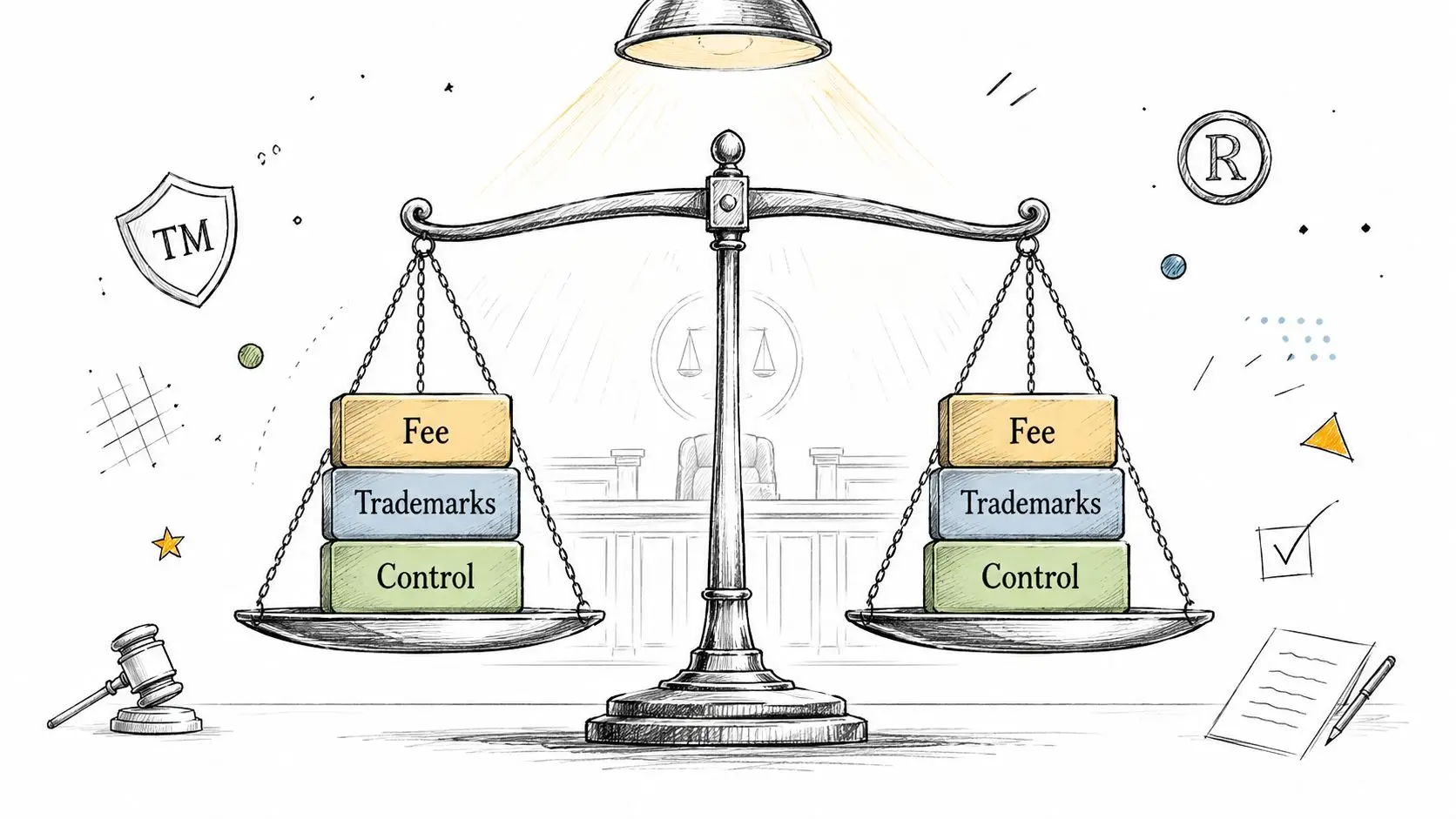
A contract title will not protect a business that operates like a franchisor. Regulators and courts look at substance over form, and they move quickly when a brand combines trademark use, operational direction, and required payment. The FTC’s compliance guide states the basic point clearly, a franchise exists when the trademark element, significant control or assistance, and a required fee are present (FTC Franchise Rule compliance guide).
Why the label fails
A licensor cannot safely present a passive relationship while dictating the day-to-day mechanics of the business. If the brand owner approves hours, staffing, sourcing, layout, and marketing execution, the arrangement starts to look like a franchise system rather than a clean license. The document title becomes secondary to the operating reality.
Practical rule: if the brand owner needs operational obedience, the deal needs franchise analysis before signature.
The risk is procedural as much as substantive. Under the FTC Franchise Rule, the franchisor must give a complete Franchise Disclosure Document at least 14 calendar days before signing or payment, and private agreement cannot shorten that waiting period (FDD waiting-period guide). Australian franchise law also imposes a 14-day post-disclosure delay before contract entry, and it applies to transfers as well (ACCC franchising disclosure obligations).
The commercial takeaway is blunt. A mislabeled license can function as an unregistered franchise offering, which exposes the brand owner to rescission claims, administrative action, and the cost of unwinding the whole structure.

The Three-Element Legal Test for Franchise Classification
Courts and regulators do not rely on the label on the cover page. They look for a three-part test, and if all three elements are present, the arrangement can be treated as a franchise even when the contract calls it a license.
Trademark use, control, and fee
The first element is trademark use. The operator must work under, or in association with, the brand owner’s mark or commercial symbol. That matters whenever customers are led to view the business as part of a common network.
The second element is significant control or significant assistance. Training manuals, site approval rights, marketing mandates, vendor limits, and store-format rules can all point toward franchise treatment if they regulate how the business runs, rather than only protecting the IP asset.
The third element is the fee element. The FTC standard includes a required payment of at least $500 during the first six months (Lantz Law Group summary of the FTC framework). That payment can be direct, and indirect economics also matter when the structure requires paid training, mandatory inventory, or other purchases that function as entry costs.
Licensing monetizes IP while franchising replicates a controlled business system, and the distinction determines regulatory exposure.
Where licenses cross the line
A quality rule protects the asset. An operating rule controls the business.
That line drives the risk analysis. A trademark license can require proper logo use and product quality standards. Once the licensor begins prescribing workflow, customer-service scripts, staffing practices, or promotional calendars, the arrangement starts to resemble a replicated business system.
Trail Star Development modular builds show how network expansion can be organized around standardized delivery and brand consistency (Trail Star Development modular builds). That kind of system-level control is exactly what can push a supposed license into franchise territory if the drafting does not match the operating reality.
Control and Compliance Differences Between Structures
The primary distinction between the two models lies in the level of control the brand owner wishes to maintain. A franchise agreement allows the owner to standardize the entire customer experience. A license agreement typically limits itself to intellectual property use and product quality.
Operational control and fee architecture
Franchises typically require compliance with an operations manual, approved suppliers, training, marketing rules, and territory controls. Licensing usually focuses on trademark guidelines, design standards, or technical specifications for the licensed asset itself. That is why franchising can deliver consistency, while licensing gives the partner more room to improvise.
Fees also tell the story. Franchises usually use an initial fee plus recurring royalties and, often, contributions to a marketing fund. Licensing can be simpler, with flat payments, per-unit royalties, or milestone-linked fees. The fee structure is not just commercial, it also affects reclassification analysis when payments are tied to a regulated system.
| Dimension | Franchise Agreement | License Agreement |
|---|---|---|
| Operational control | Operations manual, training, staffing, approved suppliers | Trademark or product-quality limits |
| Fee structure | Initial fee, royalties, marketing fund contributions | Flat fee, per-unit royalty, or milestone payment |
| IP scope | Brand, know-how, systems, software, trade secrets | Specific IP right, like a mark or patent |
| Compliance burden | Disclosure, timing, and often registration | Ordinary contract and IP law |
Compliance burden and market fit
Franchise regulation is procedural and front-loaded. In the United States, the FTC requires pre-sale disclosure. In Australia, the code imposes its own waiting period after disclosure is received. By contrast, a normal license agreement is usually governed by ordinary contract law unless the substance of the relationship changes.
That is why the right structure depends on the business model. If the brand needs uniformity, training, and auditability, franchising usually fits better. If the business only needs permission to use an IP asset, licensing may be cleaner and less burdensome.
Commercial test: if the owner needs more than one or two operational controls beyond quality standards, franchise treatment becomes much more likely.
For multinational companies, the compliance question should come before the branding question. A contract can say “license,” but if the objective is full-format replication, the safer route is to structure and document it as a franchise from the start.
When a License Becomes a Franchise in Court
A common dispute starts with a simple idea: expand fast without franchise disclosure friction. The brand owner drafts a “license,” then adds approval rights over suppliers, uniforms, store hours, and local marketing. On paper, the deal looks lean. In operation, it looks regulated.
The clause trail that courts follow
Courts usually do not rely on one clause alone. They look at the whole relationship. If the licensor requires approved vendors, prescribes customer-facing procedures, and audits daily operations, those controls can support a finding of significant assistance or significant control.
The fee structure matters too. If the operator pays an upfront amount and ongoing charges, the economic element is easier to prove. Once the three elements line up, the counterparty can argue that the licensor offered an unregistered franchise, not a bare license.
That is where the remedy risk spikes. The operator may seek rescission, damages, or both, and non-compete clauses can lose force if the underlying structure fails. The brand owner can also lose strength over IP enforcement because the court may view the whole arrangement through a franchise-law lens.
A related cross-border lesson comes from the compliance gap that many businesses miss. Public explainers note that mislabeled license deals can still be treated as franchises across jurisdictions, including the United States and Australia (licensing versus franchising overview). That is why a clean title page never cures a control-heavy structure.
The practical lesson is straightforward. If the business really needs operating control, the brand should not hide behind a license template. It should either scale back the controls or build the full franchise package with the right disclosures, timing, and local filings.
Choosing the Right Structure for Cross-Border Expansion
The right structure turns on how much control the brand needs and how much regulatory risk it is willing to carry in each market. Licensing fits low-control IP monetization, single-product distribution, and technology transfer where the operator stays largely independent. Franchising becomes the safer description when the model depends on uniform service delivery, training, or a shared customer experience.
Jurisdictional pressure points
The United States and Australia are the obvious franchise-compliance markets in this discussion. France and China also have franchise-specific regulatory frameworks, so multinational groups cannot assume that a U.S.-style license template will travel cleanly. Whether the local law treats the relationship as a regulated franchise is the key question, and contract wording alone cannot resolve it.
Master franchise and area development structures can sometimes solve market-entry problems more efficiently than direct licensing. They let a local partner build the network while taking on local compliance, training, and rollout obligations. That works where the brand wants scale without micromanaging each unit.
For businesses that want a practical execution path, franchise development planning should start before the first term sheet. A structured rollout can align brand protection, disclosure, and local regulatory reviews without forcing the wrong model into the wrong market. See franchise development resources for multijurisdictional rollout.
Decision matrix
| Decision Factor | License Appropriate | Franchise Required |
|---|---|---|
| Control level | Limited to IP quality standards | More than two operational controls |
| Business model | Isolated IP monetization | Replicable service or retail system |
| Local regulation | Light-touch contract regime | Franchise disclosure or registration rules |
| Brand consistency need | Moderate | High and enforced |
| Expansion method | Product or technology use | Full network replication |
The safest rule is practical, not theoretical. If the brand wants to dictate how the business runs, who supplies it, and how the consumer experience feels, the parties should assume franchise treatment may follow.
Drafting Clauses That Match Your Chosen Model
Drafting has to match the chosen model, or it will create contradictions that litigants can exploit. A license should protect the asset without managing the whole business. A franchise should disclose the system clearly and regulate it consistently.
Clauses to keep out of a license
A license agreement should avoid mandatory business-format requirements. It should also avoid prescribed hours, compulsory training programs, and performance-based territory rights that look like system management. Those clauses may feel useful, but they can create exactly the control profile that triggers franchise analysis.
Quality control still belongs in a license, but it should stay at the output level. The licensor can require approved branding, product specifications, and inspection of finished goods. What it should not do is run the partner’s store, workplace, or staffing decisions.
Clauses that franchise papers must align with
Franchise documents need internal consistency between the disclosure package and the agreement. Fee calculations, term and renewal language, termination rights, cure periods, and non-compete scope all need to match the disclosed system. If the documents diverge, the franchisee gets litigation ammunition.
Drafting rule: quality control is safe when it protects the mark. It becomes dangerous when it manages the operator.
Audit rights need similar discipline. A franchise can support broader inspection rights because the system requires compliance. A license should limit audits to royalty verification, branding checks, and anti-counterfeiting controls, not daily management.
For multinational work, RNC Group handles commercial drafting and management of licensing and franchise agreements in Israel and abroad. That kind of drafting support matters most when the client needs a structure that fits the actual risk, not just the preferred label.
Risk Mitigation Checklist Before Signing
Before anyone signs, test the deal against the law, not the sales pitch. The first question is classification. If the structure uses trademark rights, significant control or assistance, and a required payment, it should be treated as a franchise until counsel is satisfied otherwise.
Pre-signing checklist
- Confirm the classification first. Check whether the structure includes trademark use, significant control or assistance, and a required payment. If those elements are present, the franchise analysis starts there.
- Map the disclosure calendar. The disclosure timetable must be integrated into the launch plan from the start. In the U.S., the FDD delivery rule needs to be built into signing and funding schedules. In Australia, the Code disclosure process needs the same advance planning.
- Calibrate audit rights. Use brand-protection checks for a license, and broader system audits only when the relationship is a franchise.
- Stress-test the fee architecture. Make sure upfront fees, royalties, marketing contributions, and required purchases fit the intended legal category.
- Check termination and non-compete language. If the clause assumes franchise-style control, it may need franchise-law review before execution.
Cross-border enforcement also needs attention. Governing law, arbitration seat, and interim relief rights should be checked against the countries where the brand will operate. A clause that looks fine in one jurisdiction may fail in another if the structure is misclassified.
Review the agreement, the disclosure package, and the operating playbook together. That is where hidden reclassification risk usually appears, and where rescission rights or statutory penalties can follow if the paperwork and the operating model do not match.
Avoid costly mistakes before launch. RNC Group advises Israeli and multinational clients on franchise and license structuring, disclosure risk, and cross-border enforcement, and the firm can review the deal before it becomes a dispute. Visit RNC Group to connect with counsel that handles commercial expansion, regulatory reclassification, and international contract drafting.
Disclaimer. This article provides general legal information only and does not create an attorney-client relationship. Parties should obtain jurisdiction-specific advice before signing or relying on any franchise or license structure.