
Forensic accounting is the application of investigative and analytical accounting skills to financial issues in a form that meets court standards. Statutory auditing tests financial statements against reporting frameworks, but it doesn’t reconstruct disputed transactions for litigation.
A finance director may discover that an overseas distributor diverted revenue across several accounts. At the same time, a counterparty may seek an emergency freezing order, or an authority may demand proof of fund flows within a fixed deadline. The executive challenge isn’t finding unusual entries. It’s preserving evidence, quantifying loss, and presenting a financial explanation that survives challenge in Israel and abroad.
The practical answer to what is forensic accounting lies in its intended destination. A forensic accountant creates an evidentiary, traceable, and defensible work product for courts, arbitration panels, regulators, and settlement negotiations. The work can expose fraud, but it can also support damages claims, asset tracing, partnership disputes, bank restrictions, M&A claims, and regulatory inquiries.
Practical rule: If the dispute may reach court, appoint the expert before employees alter records, witnesses coordinate accounts, or counsel frames damages around incomplete data.
When Forensic Accounting Becomes a Business Lifeline
Forensic accounting becomes necessary when management needs more than an accounting explanation. A conventional finance team may identify an unexplained payment, but it usually doesn’t have the independence, investigative mandate, or litigation method required to establish who benefited and how the loss occurred.
The discipline applies accounting, investigation, and analytical skills to financial issues while preserving a clear connection between each conclusion and its supporting evidence. That connection separates a useful report from a collection of suspicions. Courts and tribunals need a transaction narrative that explains the movement of money, the supporting documents, and the resulting loss.
The first decision concerns urgency
Executives should retain an expert when one or more of these conditions exists:
- A material discrepancy has no innocent explanation: Management should preserve records before conducting informal interviews.
- A counterparty threatens proceedings: The expert can identify the documents needed for an injunction response or damages model.
- A regulator requests fund-flow evidence: The investigation should produce a controlled, reproducible answer rather than an improvised spreadsheet.
- A cross-border relationship has failed: Different currencies, entities, banks, and accounting systems can conceal the transaction chain.
Forensic work can produce quantifiable loss claims, asset-tracing maps, expert reports, and settlement materials. It can also help counsel decide whether litigation offers a realistic recovery path. In commercial disputes, that financial foundation often determines whether a party negotiates from strength or reacts to an opponent’s unsupported calculation.
Why internal handling often fails
Internal teams face a conflict between operational continuity and investigative rigor. They may also report to individuals connected to the transaction, lack access to foreign records, or create notes that later become difficult to defend. A rushed internal review can therefore preserve the wrong documents while damaging witness credibility.
The recommended strategic path is to separate ordinary finance operations from the forensic mandate. Counsel should define the question, protect the evidence, and select an independent expert who can explain the methodology under cross-examination. RNC Group’s international commercial litigation practice can coordinate that legal process with financial investigators, foreign counsel, and crisis-management decisions.
How the Discipline Evolved Into a Courtroom Tool
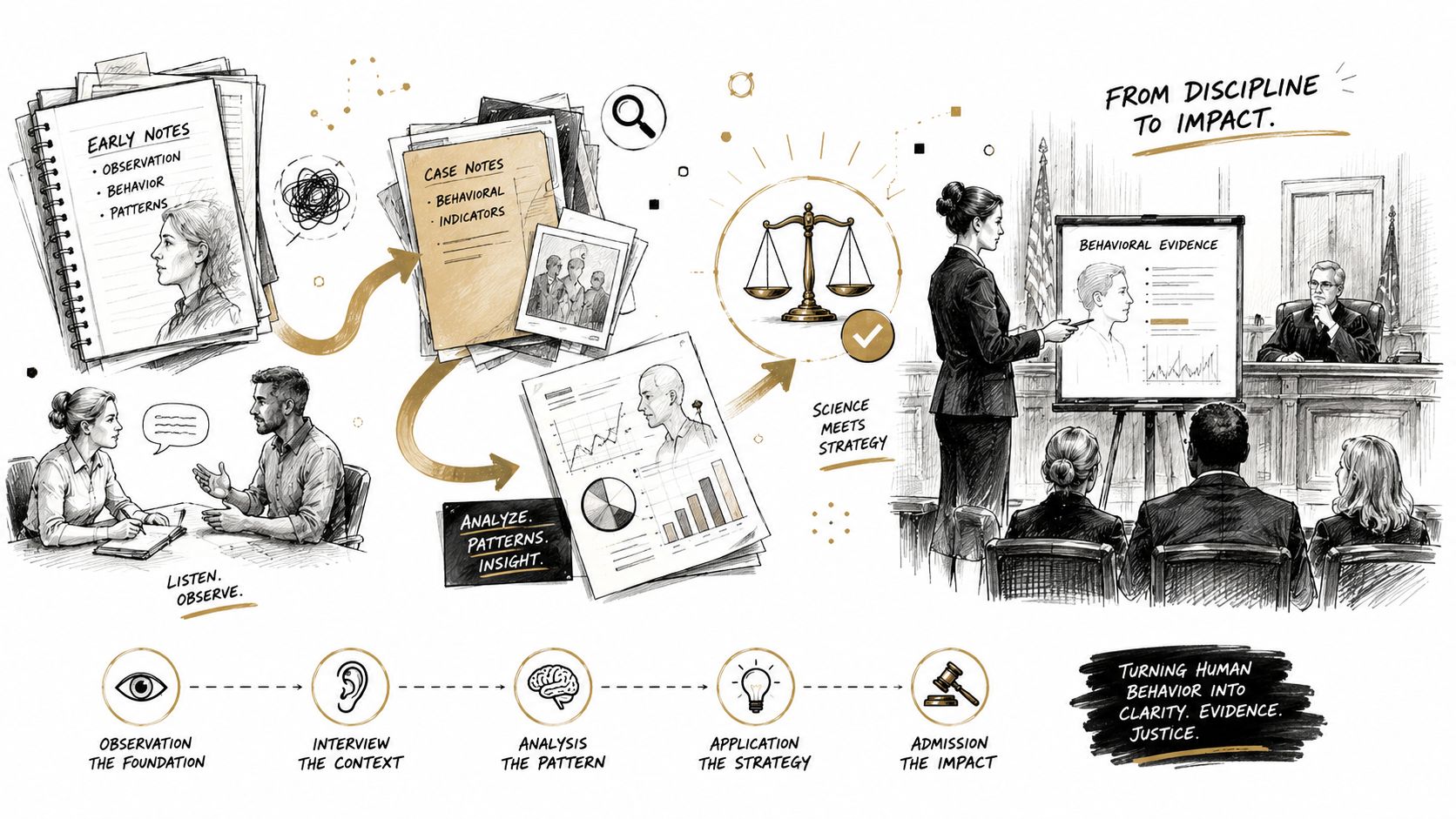
Forensic accounting developed gradually from courtroom assistance into a distinct professional discipline. The first known instance of an accountant serving as an expert witness is commonly traced to Meyer v Sefton in 1817, while the expression “forensic accounting” emerged in 1946. The later founding of the Association of Certified Fraud Examiners in 1988, together with the introduction of the Certified Fraud Examiner credential that year, gave the field a stronger institutional identity. These milestones appear in this historical account of forensic accounting.
The chronology matters because forensic accounting isn’t bookkeeping combined with suspicion. It developed as a method for explaining financial facts in a legal setting. Modern practitioners must document sources, preserve transaction chains, distinguish fact from inference, and communicate conclusions in language that a judge or arbitrator can test.
Evidence standards changed with the records
Earlier investigations focused heavily on paper ledgers, invoices, bank statements, and manual reconciliations. Digital accounting systems, electronic communications, cloud platforms, and e-discovery now require experts to preserve metadata and demonstrate how analysts handled source files.
Regulatory shocks also increased scrutiny. The Treadway Commission’s work, the Enron and WorldCom scandals, and expanding cross-border anti-corruption enforcement pushed companies and courts to demand clearer controls, stronger documentation, and more reliable expert analysis. Those developments don’t make every forensic report admissible automatically. They make method and documentation central to admissibility.
Modern forensic accounting remains a relatively young formal discipline. Consequently, executives should value repeatable methodology, professional credentials, and courtroom experience more than an expert’s instinct that a number “looks wrong.”
Forensic Accounting Compared With Statutory Auditing
Executives often confuse these disciplines because all three examine financial information. Their mandates differ, however, and choosing the wrong one can leave a serious evidentiary gap.
A statutory audit evaluates whether financial statements present a fair view under an applicable reporting framework. An internal audit evaluates controls, risks, and processes for management. Forensic accounting investigates a defined financial question and develops a defensible account of events.
The following matrix provides the practical distinction:
| Dimension | Forensic Accounting | Statutory Auditing | Internal Audit |
|---|---|---|---|
| Purpose | Investigate disputed facts, losses, or financial misconduct | Express an opinion on financial statements | Assess controls, risks, and operational processes |
| Methodology | Reconstruct transactions, trace funds, interview witnesses, and test anomalies | Test controls and samples against auditing standards | Review systems, controls, and management practices |
| Output | Expert report, damages model, tracing schedule, and supporting workpapers | Audit opinion and related communications | Internal findings and recommendations |
| Courtroom usability | Designed for deposition, arbitration, and trial | Usually designed for shareholders and reporting users | Usually designed for management |
| Question answered | What happened, how did money move, and what loss followed? | Do the statements meet the reporting framework? | Where might controls fail, and how can management improve them? |
The distinctions in this forensic accounting vs auditing comparison help management choose an appropriate mandate. The three disciplines complement each other, but none replaces the others.
Sampling doesn’t answer every litigation question
Auditors commonly use sampling because they seek reasonable assurance about financial statements. A forensic accountant may need to examine the full population of relevant transactions, particularly when a small number of payments carries the central dispute.
An audit report rarely explains the full causal story behind a disputed transfer. A forensic report should connect the source record, the transaction path, the witness evidence, and the loss calculation. That structure supports cross-examination because the opposing side can test each step.
Decision point: Retain a statutory auditor for financial statement assurance. Retain a forensic accountant when the business needs a transaction narrative that can support a legal position.
Core Techniques Behind a Defensible Investigation
A defensible engagement begins with evidence control, not a dramatic interview. The expert should identify the relevant systems, preserve original records, and create controlled working copies. Hash values and chain-of-custody logs can show that analysts didn’t alter the material they reviewed.
Four workhorses drive the analysis
Document reconstruction starts with bank statements, ledgers, invoices, contracts, payroll exports, accounting databases, and electronic communications. The expert reconciles dates, amounts, counterparties, approvals, and postings. The result should allow another qualified professional to reproduce the transaction path.
Interviews provide context that records can’t supply. Investigators should use open prompts with witnesses and reserve confrontation for subjects after the documentary record develops. Contemporaneous notes and signed statements help preserve what each person said and when.
Transaction tracing follows funds through accounts, related entities, intermediaries, and offshore structures. Bank-to-book reconciliations expose unexplained differences, while corporate registry searches can clarify ownership and control. The expert should distinguish direct proof from an inference based on timing or common control.
Data analytics identifies outliers across large populations. Useful tests include duplicate-payment screening, vendor-employee cross-matching, document-sequence gaps, weekend or holiday posting patterns, ratio analysis, and Benford’s Law screening. The leading digit 1 appears about 6.5 times more often than 9 in naturally occurring datasets, so material distortion can provide a red flag, not proof of fraud, as explained in ACFE’s data analytics discussion.
Map each technique to its evidentiary product
| Technique | Primary Data Source | Court-Ready Output |
|---|---|---|
| Document reconstruction | Ledgers, bank records, invoices, contracts, and exports | Reconciled schedules with cited source documents |
| Interviews | Employees, officers, vendors, and counterparties | Interview notes, signed statements, and issue chronologies |
| Transaction tracing | Bank accounts, entity records, and payment instructions | Flow-of-funds diagrams and tracing schedules |
| Analytics testing | Complete transaction populations and master data | Reproducible scripts, exception reports, and validation workpapers |
Analytics should narrow the investigation rather than replace judgment. A duplicate payment may reflect a legitimate correction, and a Benford deviation may result from the nature of the dataset. The expert must therefore verify anomalies against source documents and witness evidence.
Where Forensic Accountants Add the Most Value
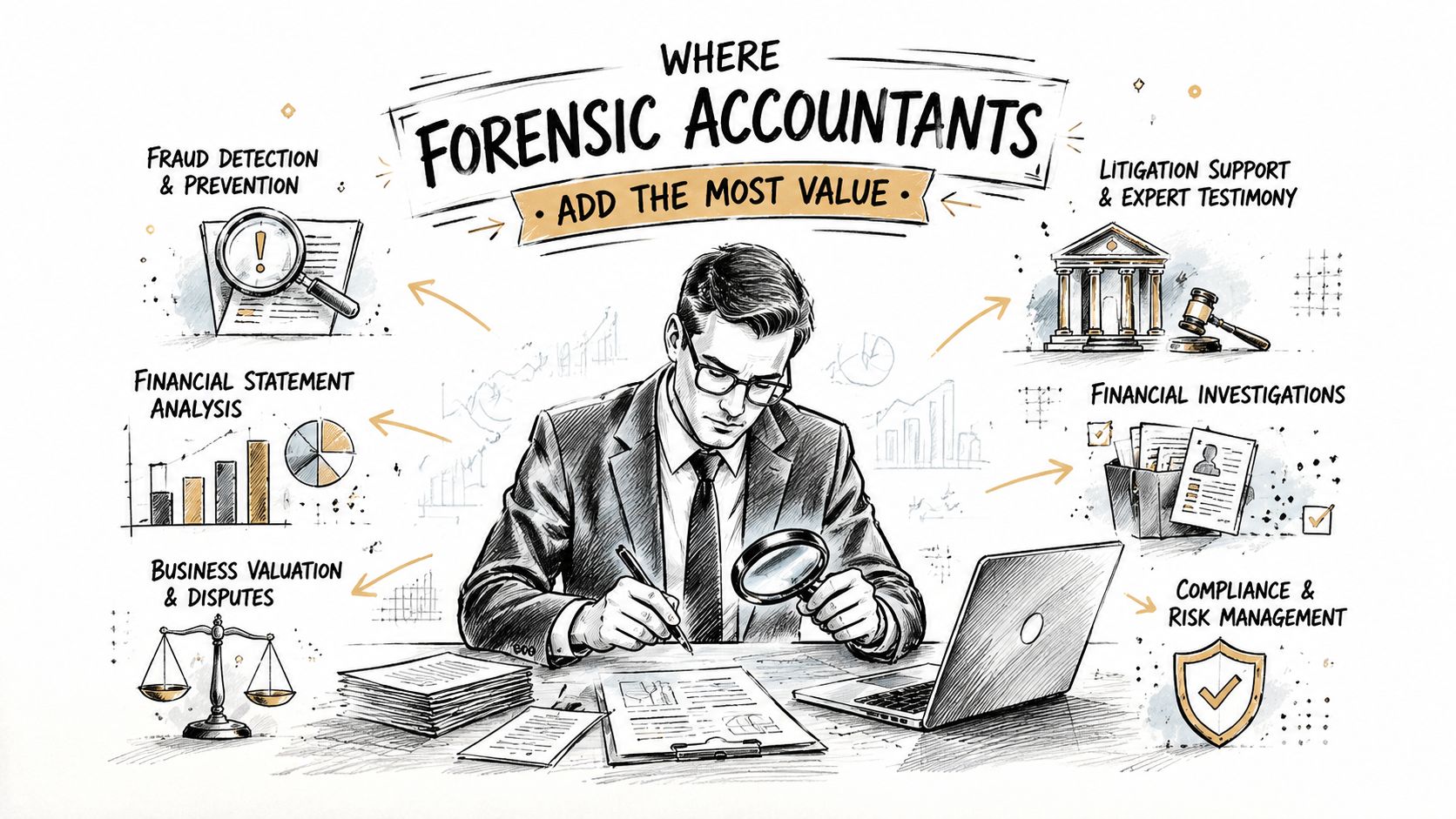
Forensic accountants create the greatest value where legal rights depend on financial proof. They can investigate internal fraud, support commercial claims, trace assets, quantify M&A losses, and explain banking restrictions. Their role extends well beyond criminal allegations.
Commercial disputes need numbers that match the legal theory
A breach-of-contract claim may require a lost-profit model. A shareholder dispute may require a reconstruction of distributions, related-party payments, or diverted opportunities. An M&A claim may require an earn-out calculation or an indemnity analysis tied to the transaction documents.
Asset tracing presents a different challenge. The investigator may need to connect payments across layered companies, identify beneficial ownership, and prepare evidence for a freezing order. Cross-border matters can also involve 28 U.S.C. § 1782 applications, Hague Evidence Convention requests, or letters rogatory. Each mechanism creates different timing, admissibility, and document-access issues.
Israeli bank restrictions require a separate response plan
Israel’s Unpaid Checks Law restricts an account for one year when 10 or more checks return for insufficient funds within a 12-month period. The restriction also prevents the customer from opening a new checking account at any Israeli bank. The Bank of Israel’s consumer information states that the restriction must begin at least 15 days after the bank sends its notice.
The law contains an anti-abuse safeguard. If the first and tenth returned checks occur fewer than 15 days apart, the account isn’t restricted. A forensic accountant can reconstruct the check history, identify disputed returns, verify notice dates, and provide counsel with the financial chronology needed to challenge or respond to the restriction.
Israeli risk point: An account restriction can affect banking relationships beyond the original disputed account, so executives should investigate the record immediately.
For commercial debt, the standard Israeli path generally begins with a formal demand letter, continues through a civil claim, and proceeds to the Execution Office after judgment. A neutral summary states that Magistrates’ Court claims can cover disputes up to NIS 2.5 million, while larger claims proceed to District Court. It also states that an uncontested default judgment often arrives within 4 to 6 months, as described in this guide to collecting commercial debt from an Israeli company. The expert should prepare the debt schedule before counsel sends the demand.
Credentials and Evidence Standards That Hold Up in Court
An expert’s credentials won’t rescue an unreliable method. They do, however, help counsel establish competence and anticipate cross-examination. Executives should verify credentials before signing an engagement letter, not after the opposing party attacks the expert.
Match each credential to its function
| Credential | Issuing Body | Courtroom Role |
|---|---|---|
| CPA or local chartered equivalent | Relevant professional authority | Establishes accounting and reporting competence |
| Certified Fraud Examiner | Association of Certified Fraud Examiners | Demonstrates focused fraud investigation training |
| Certified in Financial Forensics | American Institute of Certified Public Accountants | Supports specialized financial-forensics expertise |
| Jurisdiction-specific expert qualification | Applicable court or professional system | Addresses local admission and testimony requirements |
| Documented chain-of-custody practice | Engagement team and forensic systems | Supports the integrity and reproducibility of evidence |
The expert should also use hash-stamped working copies, write-blocked forensic images for devices, contemporaneous notes, and a signed engagement letter. The letter must define the questions, scope, assumptions, reporting format, and communication protocol.
Israeli proceedings require local procedural awareness
Experts appointed under the Israeli Courts Ordinance must file an undertaking of fidelity. Their workpapers may also become discoverable. Counsel should therefore decide early which communications require privilege protection and which materials the expert must retain for disclosure.
A strong pre-engagement checklist asks whether the candidate has testified in the relevant forum, handled foreign records, explained analytical limitations, and separated consulting work from opinion evidence. It should also test whether the expert can explain every conclusion without relying on unexplained software output.
A Practical Roadmap for Engaging an Expert
The engagement should progress in controlled phases. Executives often lose time by asking an expert to “look into everything.” A narrow initial question produces faster preservation, cleaner analysis, and better legal coordination.
Phase one defines the forensic question
Counsel and management should identify the disputed transaction, relevant entities, likely custodians, key jurisdictions, and required remedy. They should also decide whether the expert will quantify damages, trace assets, investigate misconduct, or address several defined questions.
The mandate should address privilege through a counsel-led protocol. The engagement letter should state the applicable accounting or reporting standard, such as AICPA forensic guidance, IFRS principles, or an equivalent professional framework. It should also distinguish a consulting expert report from an expert witness report.
Phase two secures the evidence
The team should preserve email, accounting exports, bank records, contracts, messaging data, and devices. Forensic imaging, write protection, hash values, and chain-of-custody logs protect the integrity of the collection.
Israeli counsel should assess procedural tools, including Rule 17 motions and discovery under the Civil Procedure Regulations. Foreign counsel may need parallel preservation notices, subpoenas, or evidence requests. The expert should never begin analysis from an unsecured spreadsheet supplied without provenance.

Phase three controls reporting and decisions
The expert can issue a preliminary findings memorandum, identify missing records, and update counsel as the evidence develops. The final opinion should state the facts relied upon, methodology applied, assumptions made, limitations encountered, and calculations performed.
Israeli counsel should align the final product with applicable expert-opinion requirements, including Rule 14 compliance where relevant. The recommended strategic path also includes a decision log recording preservation actions, scope changes, and unresolved questions.
Immediate engagement makes sense after a suspected diversion, an emergency injunction threat, a regulator’s demand, a disputed transaction closing, a returned-check escalation, or a demand for damages. Delay rarely improves evidence quality.
Why the Real Prize Is a Defensible Financial Narrative
The strongest forensic report rarely depends on one spectacular discovery. Courts and tribunals usually decide between competing explanations, and the credible explanation connects records, conduct, timing, ownership, and loss.
An isolated red flag collapses under cross-examination if the expert can’t show its source or explain innocent alternatives. A documented transaction trace stands more firmly when the expert ties each payment to bank records, accounting entries, interview notes, contracts, and calibrated analytical tests.
Build the story in a sequence the tribunal can test
A defensible narrative normally answers four questions:
- What changed? Identify the accounting, contractual, ownership, or banking event.
- Where did the money move? Trace each relevant transfer through accounts and entities.
- Who controlled the transaction? Connect approvals, beneficiaries, instructions, and corporate records.
- What loss followed? Calculate the loss under the legal theory and state limitations clearly.
This approach turns fragmented digital evidence into a coherent financial account. It also helps counsel separate recoverable loss from suspicious conduct that doesn’t establish a legally compensable amount.
The recommended next step is a privileged scoping call with counsel, followed by a controlled preliminary review. Executives should establish a relationship with a qualified expert before a crisis creates an appointment deadline, especially when Israeli proceedings overlap with foreign discovery or asset-recovery efforts.
RNC Group advises international businesses on cross-border commercial disputes, Israeli bank restrictions, demand strategy, and litigation coordination involving forensic financial evidence. To avoid costly preservation and quantification mistakes, contact RNC Group and arrange a focused assessment before the dispute escalates.
This article provides general information, not legal, accounting, tax, or investigative advice. Readers should obtain advice from qualified Israeli and foreign professionals before relying on any point in a specific matter, because procedural requirements and evidentiary decisions depend on the facts and forum.