
For most cross-border deals, free trade agreement benefits do not disappear because tariffs stay in place. They disappear because the company cannot prove entitlement, or never built the paperwork trail in the first place. That is why the question in 2026 is not whether FTAs exist, but whether a board has turned them into an operating system for sourcing, customs, contracts, and dispute prevention.
The commercial upside is real, but it is conditional. The WTO has estimated that full implementation of the Trade Facilitation Agreement would reduce global trade costs by an average of 14.3% and raise world trade by 0.6%. It also projected about 2.7% per year added to world export growth and more than 0.5% per year to world GDP growth, which shows how much value sits inside border process design, not just tariff lines (OECD publication hosting the WTO estimate).
Why Most Companies Miss Free Trade Agreement Benefits
Most companies treat an FTA like a background condition, not a legal instrument. That mistake is expensive. Preferential access only matters when the importer can satisfy origin rules, classification rules, and documentary proof at the border.
A useful benchmark comes from U.S. mid-year 2025 utilization data, where USMCA reached 75.88%, while GSP was 7.66% and AGOA was 15.28%. Those gaps show that eligibility and actual use are very different things (KIEP analysis). In practice, many firms lose the benefit because procurement never asked whether a component mix could satisfy origin thresholds, or because logistics teams relied on a freight forwarder without checking the supplier declaration chain.
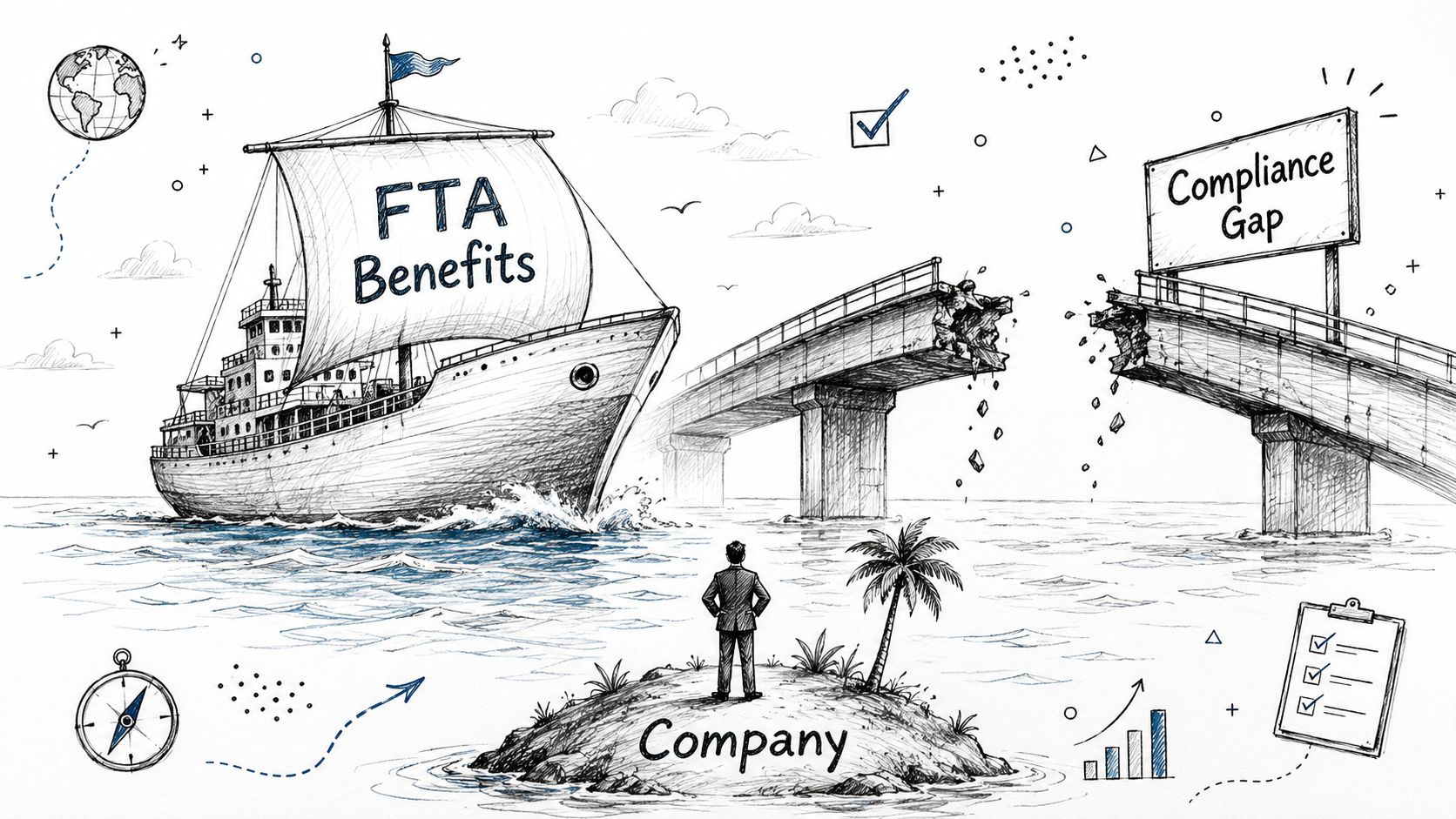
The hidden failure points
The failure usually starts upstream. A buyer signs a supply contract with no origin warranty, then discovers too late that an imported input breaks preferential status. A distributor assumes the certificate of origin is a shipping formality, then customs asks for supporting records and the savings vanish.
Practical rule: If the company cannot reconstruct origin from source records, it does not really control the preference.
Freight forwarders move cargo. They do not absorb the legal risk of a failed origin claim.
The best operators treat FTA entitlement like a compliance file, not a sales perk. They tie product codes, supplier declarations, and invoice language to the same record set. They also check whether an FTA network offers cumulation opportunities, because a single sourcing choice can make the difference between duty-free treatment and a full tariff bill.
The Economic Case for Free Trade Agreements
The commercial logic for FTAs starts with scale. IMF-cited research shows that trade agreements increase bilateral trade by about 40% on average, while longer-run estimates can be much larger. Baier and Bergstrand’s work found trade agreements can raise trade by around 100% in the long run (IMF trade paper). The same paper reports that countries with trade agreements see average gross exports 80 percentage points higher over the next ten years, with annual export growth about 3.8 percentage points higher.
That matters for boards because the effect compounds. A company that enters a new market under a well-used agreement gets lower marginal export costs, a broader addressable customer base, and more room to justify local compliance spending. The gain is not limited to exporters. Importers and manufacturers also benefit when tariff relief and customs simplification lower landed cost and shorten replenishment cycles.
What the evidence says about operational value
The World Bank’s evidence on NAFTA found that Mexican plants became more productive because the agreement increased import competition and improved access to imported intermediate inputs. The same research base also points to stronger gains for firms that both import and export, because they can use the agreement on both sides of the balance sheet (World Bank research summary). That is why FTA strategy should never sit only with the export team.
For commercial strategy, the lesson is simple. Tariff elimination can improve margin, but only if sourcing, pricing, and documentation all support the claim. For a board assessing expansion, the right question is not whether the agreement sounds favorable. The right question is whether operations can capture the concession without creating audit exposure.
A useful companion read on the broader economic philosophy behind tariff cuts and commercial incentives is capitalism rental value policy. It frames the same issue from a policy angle, which helps leaders understand why trade preferences can shift value toward firms that organize quickly and document well.
| FTA Agreement | Trade Volume Growth | Tariff Elimination Scope | Key Sectors Benefiting |
|---|---|---|---|
| WTO Trade Facilitation Agreement | World trade projected to rise by 0.6% | Lower border frictions through customs simplification | Broad goods trade |
| IMF-cited trade agreement research | Bilateral trade up about 40% on average | Preferential access that can compound over time | Goods exporters and importers |
| Long-run Baier and Bergstrand findings | Trade can rise around 100% in the long run | Market-access gains across partner economies | Cross-border manufacturers |
Core Mechanisms That Drive Commercial Value
FTA value comes from mechanics, not slogans. The first mechanic is the tariff schedule. Some goods enter duty-free immediately, while others move through phased reductions over time. A board that assumes every product gets instant relief often overpromises to finance and procurement.
The second mechanic is rules of origin. These rules decide whether the goods are “from” the FTA area for preference purposes. They may rely on wholly obtained status, substantial transformation, regional value content, or a change in tariff classification test. If the product fails the test, the tariff preference fails with it.
Customs procedures matter as much as tariff rates
Customs facilitation can be as valuable as the tariff cut itself. Advance rulings reduce uncertainty before shipment. Simplified clearance procedures lower border friction. Authorized economic operator status, where available, can help a company move goods with fewer delays and less friction at the border.
The best tariff rate is useless if the shipment sits in customs because the origin file is incomplete.
Regulatory harmonization also changes the economics. Mutual recognition and aligned technical standards reduce duplicate testing and certification costs, especially for regulated products such as medical devices and pharmaceuticals. In those sectors, the compliance burden often matters as much as the customs duty.
Israel’s treaty network makes this visible in daily practice. The EU, U.S., U.K., Canada, Mexico, and the UAE all create different commercial routes, different origin tests, and different operational thresholds. A company that exports the same product into several markets needs a separate origin map for each lane, not one generic “FTA policy.”
Practical Steps to Capture FTA Advantages
The first step is classification. The company should assign the correct HS code to every product line and then test origin qualification against that code. That sounds routine, but it is where many files collapse, because a small classification error can change the applicable origin rule.
Next comes evidence. Supplier declarations, bills of materials, production records, and commercial invoices must all support the same story. If a customs authority asks for proof, the company should be able to show how each input entered the calculation and why the finished product qualifies.
The documentation chain
A workable file usually includes:
- Correct HS classification for each SKU.
- Supplier origin declarations for key inputs.
- Commercial invoices with the preference statement used in that market.
- Record retention controls so the proof survives an audit cycle.
Contract drafting matters too. Origin warranties should sit in supply agreements, along with indemnity triggers if a supplier’s bad data destroys the preference. Force majeure clauses should also address tariff reimposition and preference loss, because a trade remedy can change the economics of a deal overnight.
Practical rule: Put the origin risk where the data lives, not where the shipment lands.
Supply-chain design must follow the paperwork. Some firms can nearshore key inputs to meet origin thresholds. Others can restructure logistics, vendor terms, or assembly steps to fit a customs facilitation program. For cross-border legal review and contract alignment, a firm like RNC Group can map the commercial clauses to the customs record set without letting the deal drift away from the origin test.
Risks and Limitations Businesses Must Manage
FTA value disappears fast when the company cannot prove entitlement. The usual failure point is the utilization gap. Eligible shipments are cleared at full duty because the team did not assemble the right origin file in time, or because the savings did not justify the internal work. SMEs feel this most sharply, since they rarely have dedicated trade compliance staff.
The cost burden is real. Origin audits consume staff hours. Classification opinions require legal review. Recordkeeping across several treaty markets creates ongoing administration, especially where one product moves through different documentary regimes.
Side effects boards should model
Overlap creates practical friction. Different FTAs can point to different origin paths, so one product may qualify under one agreement and fail under another. Procurement then faces a hard choice, accept a lower-cost input mix, or preserve flexibility for a different market.
Enforcement risk also cuts into the business case. A tariff preference means little if the partner country uses safeguards, anti-dumping tools, or sanitary barriers. In geopolitical disputes, partial suspension can also remove the expected benefit and leave the shipment exposed to duties that were never priced into the contract.
A board-level model should include:
- Audit costs for origin verification.
- Documentation costs for record retention.
- Contingency risk for trade remedies and suspension.
- Supply-chain rigidity if the company commits to the wrong origin path.
A board that prices the compliance burden upfront makes a better entry decision than one that counts tariff savings before proving entitlement.
Israel-Specific Legal Frameworks for Cross-Border Trade
Israel’s trade architecture makes legal planning matter from the start. The country’s FTA network includes the EU, the U.S., the U.K., Canada, Mexico, and the UAE, and each agreement creates different commercial advantages depending on the product and destination. Industrial goods, tech hardware, consumer goods, and regulated products do not all benefit in the same way.
The Israel Tax Authority’s Customs Division is central to origin verification. Firms should seek binding origin rulings before shipment when the classification or origin position is uncertain. That step can prevent avoidable clearance fights, especially where the commercial contract depends on preferential pricing.
Dispute prevention should sit in the contract
Arbitration drafting also matters. In international deals, counsel should align arbitration clauses with the counterparty jurisdiction and consider ICC or LCIA rules where appropriate. Enforcement usually turns on the New York Convention framework, so award portability should be checked before the first shipment leaves port.
Israeli contract law adds another layer. The Contracts (General Part) Law affects how warranty, indemnity, and limitation clauses operate in practice. If the agreement says the seller bears origin risk, the wording must be precise enough to survive a real dispute, not just a negotiation.
A sensible transaction checklist looks like this:
- Run a pre-transaction FTA eligibility audit.
- Check governing law and arbitration seat before signing.
- Line up a customs broker with cross-border experience.
- Confirm the documentary trail before goods move.
The practical takeaway is straightforward. Israel-based companies should treat trade agreements, customs rules, and dispute clauses as one system. A split approach usually creates clearance delays, unenforceable warranties, or a preference claim that fails at audit.
Building a Resilient FTA Strategy
Boards should treat FTA use as a recurring control, not a one-time project. Tariff schedules change. Supplier inputs change. Trade remedies change too. If the company only reviews origin once a year, it will usually discover problems after margin erosion has already started.
Quarterly audits work better than reactive cleanup. They force teams to revisit classification, check supplier declarations, and test whether current sourcing still satisfies the origin rule. They also give management a way to compare treaty routes before committing to a new market or a major procurement shift.
What disciplined companies embed
FTA checks should sit inside vendor onboarding, contract renewals, and M&A due diligence. That way, the company sees origin risk before it signs, not after customs asks for proof. Dispute resolution clauses should also match the trade route, because enforcement strategy matters as much as tariff savings.
The recommended strategic path is to involve trade counsel early, then keep customs brokers and origin specialists in the loop throughout the shipment cycle. That approach turns FTA benefits into durable operating gains instead of fragile claims. It also helps the board separate genuine savings from documentation noise.
When companies want a structured review of origin exposure, contract terms, and border-risk controls, the next step is a formal FTA opportunity assessment with qualified international trade counsel before the next fiscal year closes.
If your company is expanding across borders, the right advice has to join customs, contracts, and dispute planning in one file. RNC Group handles international commercial structuring, cross-border compliance, and trade-sensitive contract design for businesses that need the paperwork to match the pricing. Visit RNC Group to review whether your FTA claims are supportable before the next shipment or contract renewal.
Disclaimer: This article provides general information only and does not constitute legal advice. Specific FTA eligibility, customs treatment, and dispute strategy depend on the product, jurisdiction, contract terms, and current regulatory records, so readers should obtain advice on their own facts before acting.