
A foreign customer has stopped paying, moved its assets, and challenged the contract in a forum the Israeli exporter never considered. The board now faces a costly question: will enforcement produce a recovery, or only another legal bill?
International contract enforcement in 2026 requires an economic decision before it requires a procedural one. The right route depends on recoverable assets, counterparty solvency, forum mechanics, evidence, delay, and the cost of converting a legal victory into cash.
Why International Contract Enforcement Is an Economic Decision
A signed contract doesn’t guarantee a commercially useful remedy. The World Bank’s enforcing-contracts methodology measures the process from filing through final determination and, where relevant, payment. It assesses time, cost, and judicial-process quality, while counting attorney fees, court charges, and enforcement expenses.
That framework exposes the central problem. A claimant can hold strong contractual rights yet lose economic value through delay, procedural resistance, or collection costs. The World Bank’s most recent data collection round, completed in May 2019, covered 190 economies and showed enforcement taking less than 10 months in Singapore, New Zealand, and Rwanda, but almost four years in Bangladesh and India. World Bank benchmark data also recorded costs below 10% of the claim in Iceland, Luxembourg, and Norway, compared with more than 80% in Burkina Faso and Zimbabwe.
Practical rule: A claim makes commercial sense only when the expected recovery exceeds the combined cost of pursuing, recognizing, and executing the result.
The decision should therefore test four questions before counsel files anything:
- Asset location: Can the claimant identify attachable property, receivables, accounts, or payment streams?
- Counterparty domicile: Will the debtor appear voluntarily, resist jurisdiction, or use delay tactically?
- Recovery probability: Can the evidence establish liability, causation, quantum, and contractual standing?
- Net economics: Will legal spend, translation, experts, travel, and enforcement costs leave meaningful value?
ICC’s 2025 dispute resolution statistics recorded 894 new cases, a pending caseload of 1,869 matters, and a total caseload value of US$299 billion. The same statistics showed 41% of cases at or below US$4 million. Those figures highlight a practical issue for mid-market businesses. A dispute can matter commercially while still failing a strict litigation-economics test.
| Jurisdiction | Avg. enforcement time | Avg. cost | Recovery rate |
|---|---|---|---|
| Singapore | Under 10 months | Not stated | Not stated |
| New Zealand | Under 10 months | Not stated | Not stated |
| India | Almost four years | Not stated | Not stated |
| Bangladesh | Almost four years | Not stated | Not stated |
| Iceland | Not stated | Under 10% | Not stated |
| Zimbabwe | Not stated | More than 80% | Not stated |
The practical roadmap has six stages: drafting prevention, forum selection, award or judgment procurement, recognition, asset preservation, and escalation tactics. Each stage should serve the same objective, preserving recoverable value rather than merely obtaining a favorable document.
Drafting Contracts to Prevent Cross-Border Disputes
The executed contract remains the cheapest point to control enforcement risk. A clause that identifies the right forum, language, law, evidence standard, and security package can prevent years of procedural uncertainty.

Build the dispute architecture before signature
Start with the forum. An exclusive jurisdiction clause provides certainty, but it can limit access to courts where the debtor holds assets. A non-exclusive clause offers flexibility, yet it can invite parallel proceedings and jurisdictional challenges. Sellers sometimes need an asymmetric clause that preserves a right to sue in the buyer’s asset jurisdiction while binding the buyer to a designated forum.
Choice of law requires separate analysis. The governing law should support the contract’s commercial terms and avoid conflicts with Israeli mandatory rules, foreign public policy, and the practical interpretive habits of the selected court. A foreign court may also question whether the chosen law governs the specific issue before it.
Arbitration clauses need precision. The clause should state whether arbitration is mandatory, identify suitable rules such as ICC, SIAC, or LCIA rules, and define the seat. London, Zurich, Singapore, and Tel Aviv can produce different procedural consequences, especially for court supervision and interim relief.
The drafting file should also record:
- Seat: Select a jurisdiction with a supportive court system and predictable procedural law.
- Language: Avoid later disputes over translations, witness evidence, and tribunal correspondence.
- Tribunal composition: Decide whether one arbitrator or a panel suits the value and complexity.
- Qualifications: Add carve-outs for technical, accounting, regulatory, or industry expertise.
- Interim powers: Confirm how the tribunal and supervisory courts can protect assets or evidence.
The 2024 International Commercial Arbitration Law adopted in Israel on 12 February 2024 strengthens the importance of careful arbitration drafting. Section 9(a) follows the Model Law approach to enforcing arbitration agreements, tracking Article II(3) of the New York Convention.
Secure performance instead of relying on remedies
Security can change the recovery calculation more effectively than a stronger damages clause. Counsel should assess a letter of credit, parent guarantee, personal guarantee, retention-of-title provision, escrow arrangement, or staged payment mechanism before the transaction closes.
Israeli signatories may also need notarization, certified translations, or apostilles for foreign use. The contract file should identify those requirements at signing, not after a dispute begins. Missing formalities can delay recognition and create avoidable objections.
Choosing Between Litigation and Arbitration
Arbitration and litigation solve different enforcement problems. The correct choice depends on the resulting instrument, the debtor’s assets, the need for secrecy, the availability of interim relief, and the parties’ tolerance for cost.

Compare the result, not the label
An arbitral award benefits from the New York Convention framework, which supports recognition and enforcement across 172 states. A national judgment usually requires a recognition action in the enforcement country, subject to local law, treaties, jurisdictional standards, service requirements, and public-policy objections.
Arbitration normally offers greater confidentiality. Court proceedings often create public records, although access rules vary. That distinction matters where disclosure could damage a brand, reveal pricing, expose proprietary technology, or affect negotiations with other distributors.
Litigation may offer broader coercive tools in a particular jurisdiction. A court can sometimes grant a Mareva injunction, order third-party disclosure, or use mechanisms such as Section 1782 discovery in the United States, where available. Arbitration can also support interim measures, but the claimant must coordinate the tribunal, the seat, and the courts where assets sit.
| Decision factor | Arbitration | Litigation |
|---|---|---|
| Cross-border enforcement | Strong treaty framework for awards | Often requires local recognition |
| Confidentiality | Usually more private | Often more transparent |
| Interim relief | Depends on rules and court support | May provide powerful court remedies |
| Cost structure | Institutional fees and arbitrator fees | Court fees and litigation budgets |
| Flexibility | Party-designed procedure | Court-controlled procedure |
The cost asymmetry deserves scrutiny. Arbitration may involve institutional filing charges, tribunal fees, hearings, experts, and extensive document production. Litigation may involve lower court charges but still generate substantial attorney, expert, translation, and appeal costs.
Time also varies by forum and case. Businesses should treat any forecast as file-specific rather than automatic. A tribunal may deliver an award after a lengthy evidentiary process, while a court judgment may arrive sooner in one jurisdiction and much later in another.
The forum should match the asset map. A theoretically superior remedy becomes weak when the debtor’s value sits elsewhere.
For businesses assessing payment defaults, a practical guide from Zaro on payment disputes can help organize the early dispute process. The decision should then move beyond procedure and test collectability.
A hybrid structure can work for substantial transactions. The contract may require arbitration on the merits while preserving court access for interim relief, security enforcement, or asset preservation. Counsel should avoid assuming that every court will automatically respect an arbitration clause during a later recognition proceeding.
Obtaining and Enforcing Foreign Judgments and Arbitral Awards
Winning the merits creates an enforceable instrument. It doesn’t create payment automatically. The claimant must convert the award or judgment into a local order, defeat procedural objections, and identify execution targets.
The recognition pipeline
For arbitral awards enforced in Israel, the New York Convention remains central. Israeli courts generally assess recognized refusal grounds, including an invalid arbitration agreement, due-process failure, excess of authority, or public-policy concerns. The Israeli arbitration framework explains why those grounds require focused preparation rather than a wholesale retry of the dispute.
The claimant should assemble the following before filing:
- The authenticated award or judgment.
- The arbitration agreement or original contract.
- Certified Hebrew translations where required.
- Evidence showing proper service and participation.
- Proof that the award remains binding and enforceable at the seat.
- Corporate authority documents and power-of-attorney materials.
- Evidence identifying assets available for execution.
A recent Ontario appellate decision also illustrates a serious procedural trap. An arbitration clause isn’t self-enforcing during recognition proceedings. A party must actively invoke arbitration in the foreign forum, or it may later face enforcement of the resulting judgment despite the contractual arbitration language. The practical lesson applies broadly: counsel must preserve objections at the first procedural opportunity.
Foreign judgments follow a different route. Israel’s recognition process depends on statutory requirements, reciprocity, jurisdiction, finality, service, and public policy. Other common-law jurisdictions may demand detailed proof of the foreign court’s jurisdiction, the judgment’s final status, and the underlying procedural record.
| Path | Treaty basis | Typical timeline | Key refusal grounds | Practical fit |
|---|---|---|---|---|
| Arbitral award | New York Convention | Forum-specific | Invalid agreement, due process, excess authority, public policy | Cross-border commercial disputes |
| Foreign judgment | Local statute or bilateral route | Forum-specific | Jurisdiction, service, finality, public policy | Court-centered disputes |
| Israeli execution | Israeli enforcement procedures | Forum-specific | Procedural defects and debtor objections | Local asset recovery |
The reference to an eight-week challenge window requires particular care. A party should verify the applicable seat law, institutional rules, and procedural order because the relevant period can affect set-aside rights and enforcement strategy.
Once recognition succeeds, counsel must translate the ruling into payment. That may require Israeli enforcement officers, attachment of accounts, seizure of assets, third-party debt orders, or negotiated payment arrangements. Recognition is a gateway, not the finish line.
Interim Relief and Cross-Border Asset Preservation
A final award can arrive after the debtor has emptied its accounts. Asset preservation therefore belongs at the beginning of the file, not after recognition.

Sequence the applications carefully
The first task involves mapping the debtor’s value. Counsel should investigate bank relationships, subsidiaries, receivables, inventory, real estate, securities, intellectual property, and payment intermediaries. The team should also identify whether a letter of credit, escrow account, distributor receivable, or affiliate payment stream can preserve value.
The second task involves selecting the first court. The seat may supervise the arbitration, but an asset court may control the freeze. English worldwide freezing orders, Swiss saisie procedures, Singapore Mareva injunctions, and United States pre-judgment attachments each impose distinct jurisdictional and evidentiary requirements.
The application must address notice strategy. Advance notice can allow a debtor to move assets, while without-notice relief carries strict disclosure duties. The applicant must present adverse facts, explain urgency, and provide the required undertaking or security.
Coordinate preservation with evidence and fraud work
A suspected fraud changes the sequence. Counsel should preserve electronic records, payment instructions, accounting data, metadata, and communications before sending an accusation that alerts the counterparty. Criminal counsel may need to coordinate with civil counsel where the facts suggest forged documents, diversion of funds, or false representations.
Third-party debt orders can become valuable when a debtor lacks visible assets but continues receiving payments. A claimant may target receivables owed by customers, distributors, or banks, subject to the law of the relevant jurisdiction. Letter-of-credit interference requires particular caution because courts may protect the independence of the credit from the underlying contract.
Preservation principle: Identify the asset, identify the controlling court, and identify the procedural order before disclosing the full enforcement plan.
Escalation Matrix and Practical Checklists for 2026
An effective escalation plan prevents both premature litigation and indefinite delay. Each stage should have a decision gate tied to evidence, assets, and expected net recovery.
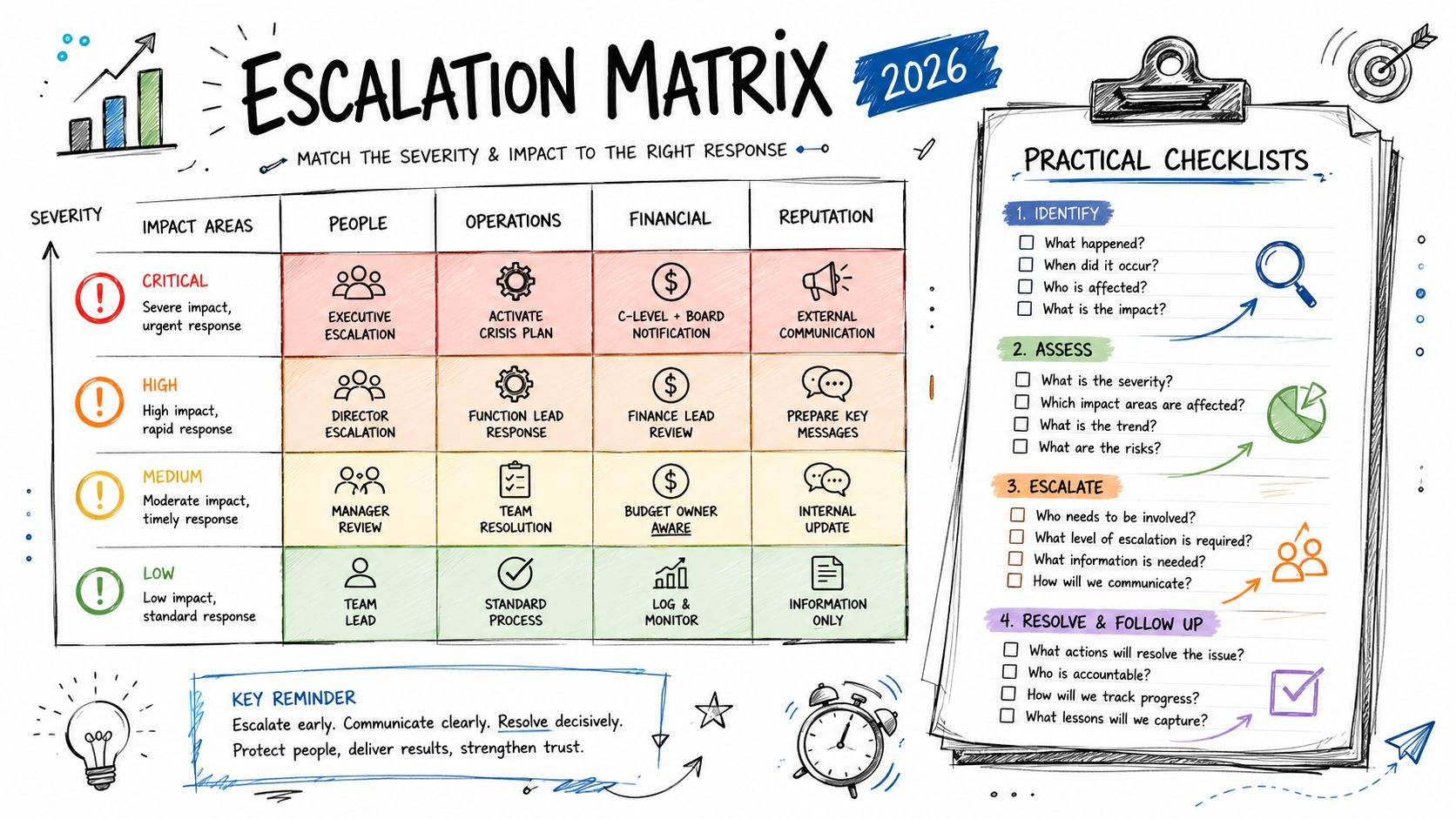
Use four controlled stages
Stage one, commercial demand. Send a precise demand that identifies breach, amount, cure requirements, documents, and consequences. Preserve settlement flexibility without waiving contractual or procedural rights.
Stage two, formal notice. Trigger the dispute clause, limitation protections, negotiation period, and arbitration or court timetable. The notice should name the correct parties and attach evidence that will later support service and jurisdiction.
Stage three, preservation and proceedings. Seek interim relief when the asset risk justifies it. File the merits case only after counsel confirms the forum, funding, evidence, and recovery target.
Stage four, recognition and execution. Prepare authentication, translations, service proof, and asset-specific enforcement applications before the award or judgment arrives.
Print these risk checklists
- Pre-signing audit: Confirm forum, law, seat, language, rules, security, signature authority, and apostille needs.
- Counterparty file: Verify ownership, registered address, bank information, group structure, payment history, and identifiable assets.
- Evidence hold: Preserve contracts, amendments, invoices, delivery proof, messages, accounting records, metadata, and witness details.
- Execution tracker: Record recognition filings, service dates, challenge deadlines, asset leads, attachment applications, and payment receipts.
Israeli businesses should also review returned-check exposure. The Bank of Israel states that restrictions begin after 10 returned checks within 12 months and last one year; a second restriction within three years can last two years. Bank of Israel guidance makes early account monitoring essential where cross-border cash flow depends on Israeli banking access.
The 2026 file also raises evidence-integrity and sanctions-screening risks. Counsel should authenticate digital records, document chain of custody, and screen counterparties, beneficial owners, banks, vessels, and payment routes before seeking relief.
RNC Group’s cross-border practice combines Israeli commercial advice, multilingual correspondence, enforcement planning, and coordination with international counsel. The recommended strategic path is to obtain an asset map and forum analysis before committing to arbitration or litigation.
RNC Group helps Israeli and international businesses assess contract enforceability, preserve cross-border assets, pursue recognition, and coordinate execution strategy. To avoid costly forum, evidence, and timing mistakes, contact the firm through RNC Group and request a focused enforcement assessment.
This article provides general information only and doesn’t constitute legal advice, a legal opinion, or a substitute for advice on specific facts. Laws, procedures, deadlines, treaty applications, and enforcement outcomes vary by jurisdiction, so readers should obtain advice from qualified counsel before taking action.