
On closing day, the buyer wires the agreed amount, receives the Israeli target, and expects the numbers to match. Then the closing balance sheet shows less working capital, more debt-like liabilities, or cash that the headline price assumed would remain.
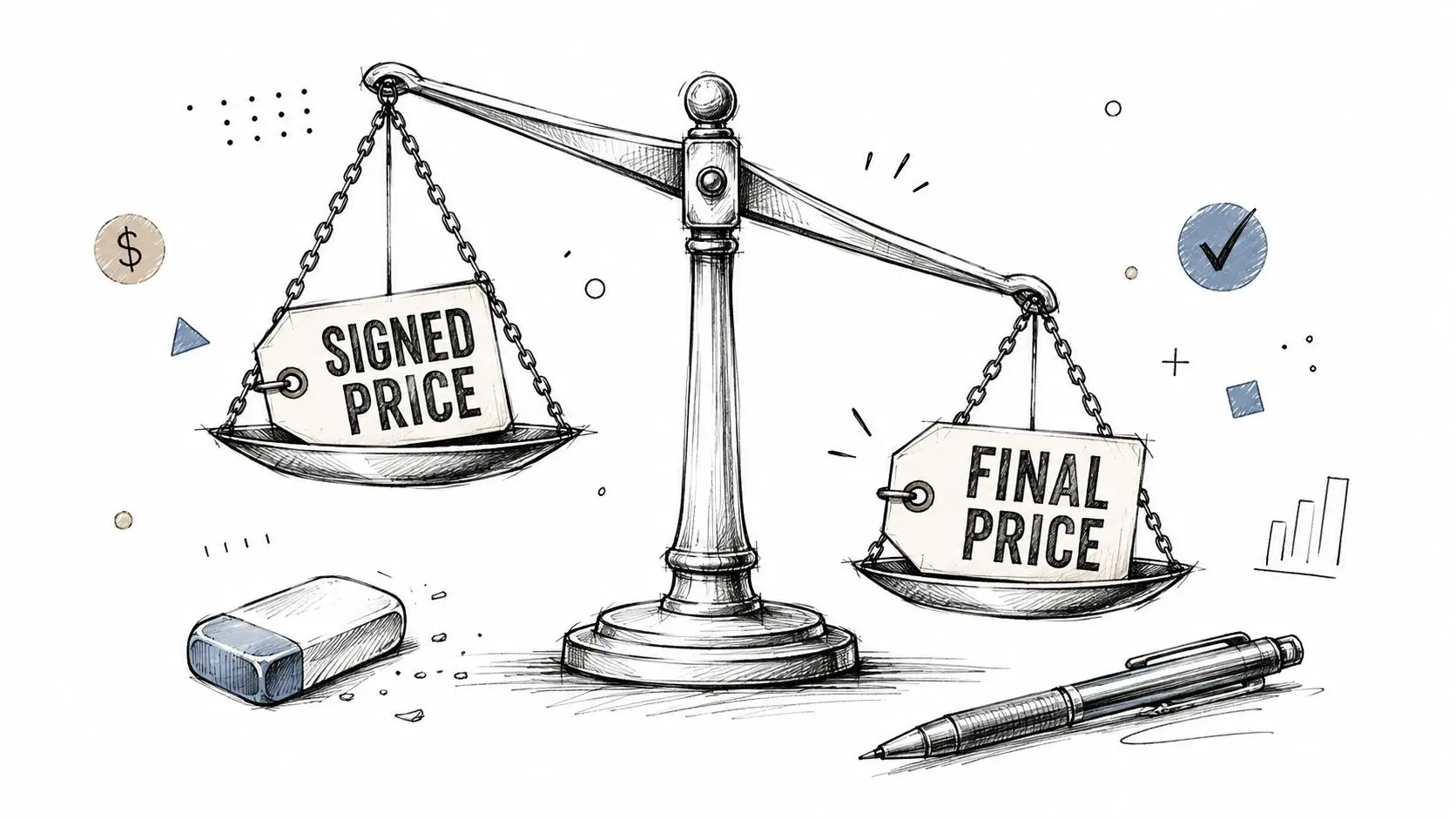
That moment exposes the purpose of a purchase price adjustment. The signed price often represents an estimate. The final price reflects the business delivered at closing, under the accounting rules and risk allocation written into the share purchase agreement.
Why Purchase Price Adjustment Still Decides the Final Deal Value
A buyer may agree an enterprise value with the seller, but enterprise value rarely equals the cash paid to shareholders. The final equity value normally reflects agreed adjustments for cash, debt, and working capital. Each adjustment connects the commercial promise to the balance sheet delivered on the completion date.
Consider an Israeli technology company with recurring customer receipts and substantial short-term obligations. The buyer may price the company on a cash-free, debt-free basis and assume a normal level of working capital. If receivables fall, payables rise, or the company draws additional debt before closing, the buyer receives a different economic package from the one used for pricing.
The adjustment mechanism allocates that difference. It can increase the price when the seller delivers more agreed value, or reduce the price when the balance sheet falls below the negotiated baseline.
Core principle: The headline price is often provisional. The delivered business determines the final price.
Purchase price adjustment provisions have become nearly universal in private-target M&A. A 2023 ABA study reported mechanisms in 92% of reported deals, compared with 95% in 2019, 86% in 2015, and 68% in 2007. The figures appear in the ABA deal analysis published by Goulston & Storrs.
That market practice matters for international clients because a buyer cannot treat the provision as boilerplate. The clause determines who bears the risk of ordinary balance-sheet movement between signing and closing. It also determines which accounting judgment controls when the parties disagree.
Why Israeli cross-border transactions need careful drafting
An Israeli target can create additional coordination demands. The parties may need to reconcile local reporting with IFRS or another buyer reporting framework. They may also need to convert shekel-denominated balances into euros or dollars under an agreed exchange-rate rule.
Timing creates another pressure point. A business can sign an agreement with one working-capital profile and close after a seasonal change, a major customer collection, or an unusual supplier payment. Therefore, the agreement must identify the relevant cut-off date and prevent either party from moving items between periods.
The recommended strategic path is to model the purchase price adjustment before signing. That model should show each component, its accounting source, its currency treatment, and the clause that governs it. RNC’s stock purchase agreement guidance addresses the broader contractual framework in which such provisions operate.
Understanding Purchase Price Adjustment and How It Works
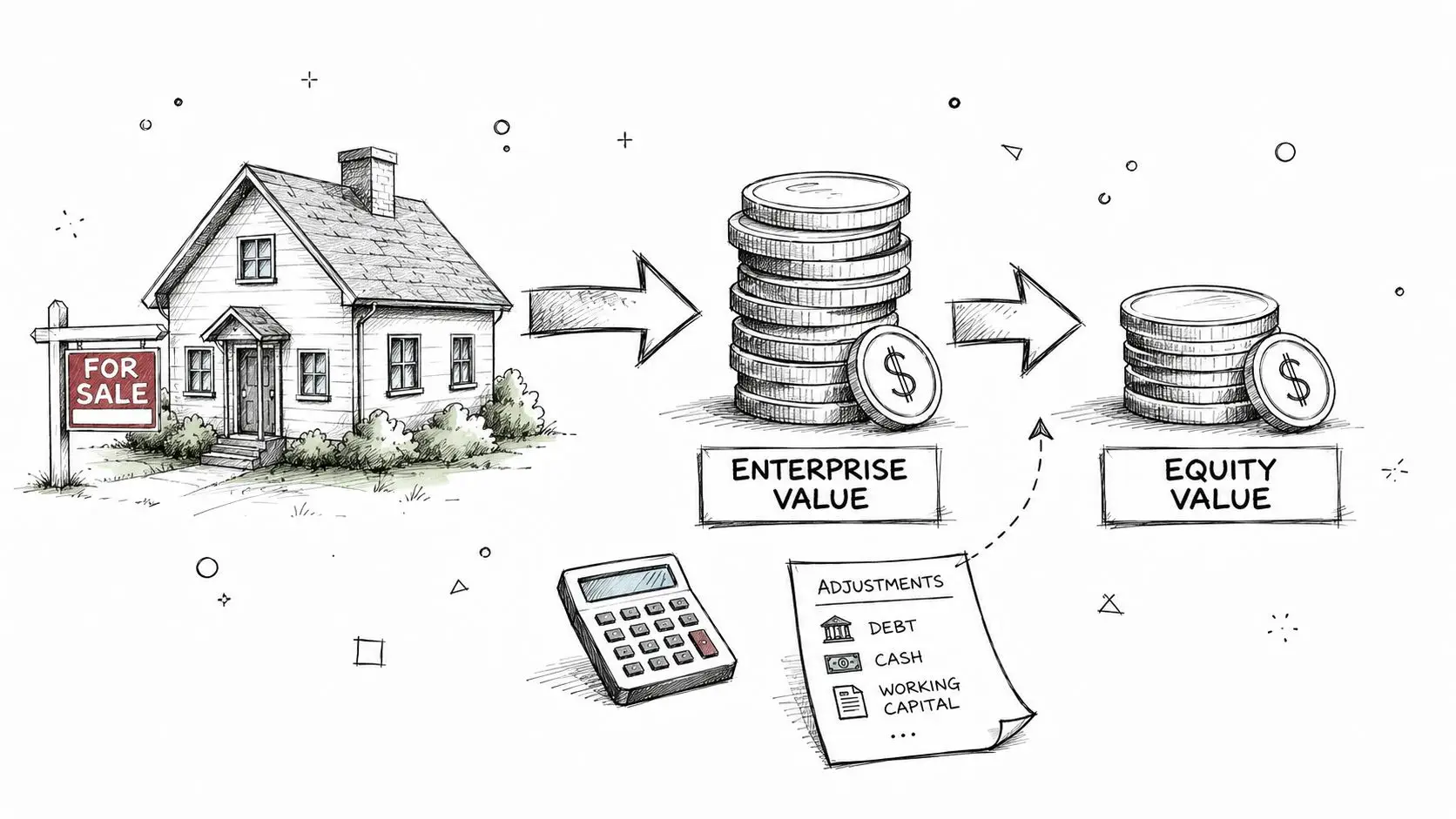
A useful analogy is a house purchase. The buyer agrees a value for the property, but the final payment may reflect an outstanding mortgage, cash held in the property account, or repairs required before handover. M&A applies the same logic to a business, although the balance sheet replaces the inspection report.
The starting point is usually enterprise value. That figure represents the agreed value of the operating business before specified balance-sheet adjustments. The parties then move from enterprise value to equity value by applying the contractual treatment of cash, debt, and working capital.
The three building blocks
Cash usually increases the value delivered to the buyer when the agreement uses a cash-free, debt-free structure. However, the parties must define included cash carefully. Restricted cash, trapped cash, customer funds, and security deposits may require separate treatment.
Debt usually reduces equity value. The definition can cover conventional bank borrowings, accrued interest, overdrafts, shareholder loans, or other debt-like obligations. The contract must prevent the same liability from reducing price twice through both debt and working capital.
Working capital measures the operating liquidity needed to run the business in the ordinary course. The parties compare actual closing working capital with a negotiated target, often called the working-capital peg. A shortfall normally reduces the price, while an excess normally increases it.
The mechanism commonly uses completion accounts. The buyer pays an estimated price at closing, and the parties later prepare accounts that speak as of the completion date. The final equity value then reflects the verified closing balance sheet, as described in Arnold & Porter’s explanation of completion accounts.
Why definitions matter more than labels
The label “net debt” doesn’t resolve a dispute. The parties must identify each included and excluded item, the applicable accounting policies, and the hierarchy between the agreement, an illustrative balance sheet, historical practice, and the relevant accounting standard.
Cut-off rules matter equally. A payment initiated before closing but cleared afterward may produce different results under different drafting. A customer receipt may affect cash, receivables, or working capital depending on the agreed presentation.
A completion account therefore acts like a financial photograph taken at closing. The camera captures the balance sheet, but the agreement decides what the camera sees, how it classifies each item, and how the parties convert that image into a price.
Closing Accounts Versus Locked Box and Earn Outs Explained
The mechanism choice determines whether the parties resolve uncertainty after closing or price the business by reference to an earlier balance sheet. Closing accounts provide post-closing precision, while a locked box provides greater price certainty before completion. An earn-out addresses a different problem, namely uncertainty about future performance or valuation.
| Feature | Closing Accounts PPA | Locked Box | Earn-Out |
|---|---|---|---|
| Pricing reference | Closing-date balance sheet | Historical balance-sheet date | Future performance |
| Main risk addressed | Cash, debt, and working-capital variance | Value leakage after the locked-box date | Valuation gap after closing |
| Post-closing true-up | Yes | No working-capital true-up | Yes, based on agreed performance |
| Main buyer concern | Accounting judgment and access to records | Leakage and historical accuracy | Manipulated metrics or operational interference |
| Main seller concern | Price uncertainty after closing | Liability for prohibited leakage | Dependence on buyer conduct after closing |
Closing accounts
A closing-accounts structure usually requires a special-purpose balance sheet prepared as of the closing date. The final purchase price adjusts pound-for-pound or euro-for-euro for agreed deviations in cash, debt, and working capital, as described in Winston & Strawn’s discussion of purchase price mechanisms.
This structure suits businesses with volatile working capital, incomplete reporting, or material movement between signing and closing. It gives the buyer a way to pay for the financial position delivered. The seller, however, may face prolonged uncertainty and a post-closing review controlled initially by the buyer.
Locked box
A locked-box price uses a historical balance-sheet date, often supported by audited accounts. The price doesn’t receive a post-closing working-capital true-up. Instead, the seller must prevent leakage, such as dividends, management fees, or seller expenses, after the locked-box date.
The structure works best when the buyer trusts the historical accounts and the business has stable operations. It also supports a clean closing because the parties don’t need to prepare a full completion balance sheet after payment.
Earn-outs
An earn-out links additional consideration to future results. It can bridge a valuation gap when the seller expects rapid growth and the buyer questions the forecast. Yet the parties must define revenue, profit, customer retention, or another metric with precision.
An earn-out shouldn’t substitute for a poorly drafted purchase price adjustment. The two mechanisms address different periods and risks. The PPA measures the business delivered at closing, while the earn-out measures agreed performance after closing.
For a cross-border Israeli deal, the decision should follow the quality of available financial information, the target’s volatility, the parties’ trust, and the buyer’s ability to monitor the business after completion.
How the Working Capital and Debt True Up Is Calculated
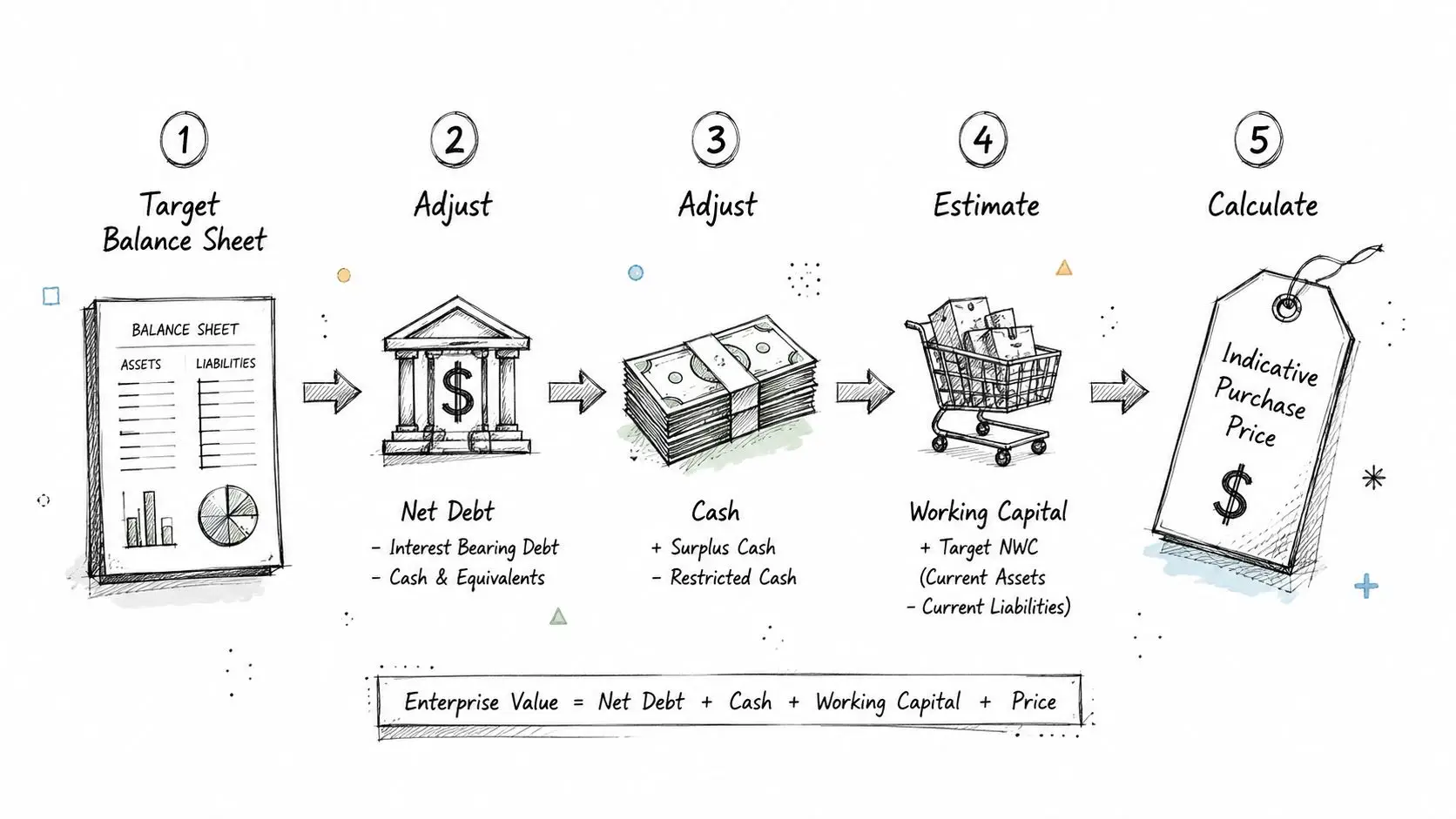
A true-up follows a logical sequence, even though the accounting details can become technical. The contract should connect every stage to a document, a deadline, and a responsible party.
The five-stage process
-
Set the target.
The parties agree the working-capital peg before signing. They should examine seasonality, customer collection patterns, inventory cycles, supplier terms, and unusual provisions. -
Estimate the closing price.
The buyer pays an estimated amount based on forecast closing cash, debt, and working capital. The agreement should state whether the estimate comes from the seller, the buyer, or a jointly approved statement. -
Prepare the closing accounts.
The responsible party prepares a special-purpose balance sheet as of the closing date. The accounts should follow the agreed hierarchy of accounting policies and use the specified exchange-rate convention. -
Compare actual figures with targets.
The calculation compares actual working capital with the peg. It separately identifies cash and debt variances, then applies the contractual formula. -
Settle the difference.
The buyer pays an additional amount or receives a refund. The parties should also state whether interest applies and how escrow funds support payment.
A simple formula may read:
Final equity value = estimated equity value + working-capital adjustment + cash adjustment minus debt adjustment.
The formula stays simple only when the definitions remain disciplined. For example, a receivable cannot count as working capital if the agreement classifies it as debt-like. The contract should also prohibit double counting and identify treatment for intercompany balances.
Timing creates practical uncertainty
Many practitioners resolve working-capital adjustments approximately 60 to 90 days after closing, according to Rivkin Radler’s discussion of locked-box and post-closing timing. That period allows the parties to assemble records, test balances, and review the calculation.
The buyer should preserve access to accounting systems and source documents during this period. A practical finance resource on financial control and working capital can also help management teams understand the operational records that support the calculation.
For Israeli targets, the parties should agree how shekel balances convert into the payment currency. They should also document treatment for tax balances, employee accruals, customer advances, and liabilities recorded under different reporting conventions.
Common Drafting Pitfalls That Trigger Post Closing Disputes
A buyer and seller can agree on the purchase price formula yet still reach very different final prices. The usual cause is not arithmetic. It is drafting that leaves accounting judgments open after closing, when each party has a direct financial incentive to interpret the numbers in its favour.
A 2023 Grant Thornton survey covering 3,668 deals in 2022 recorded 2,678 transactions with working-capital adjustments and 965 disputes. It also recorded 1,981 earn-out deals and 515 disputes, as reported in Grant Thornton’s survey on adjustment disputes. These figures show why the PPA should be drafted as a decision framework, not left to a later exchange between finance teams.

Vague accounting policies
“Consistent with GAAP” may still leave material questions unanswered. The SPA should establish a clear hierarchy among its own definitions, agreed accounting policies, illustrative accounts, historical practice, and the applicable reporting standard.
A target may report under one framework while the buyer consolidates under another. The agreement should state how the difference is reconciled. Without that bridge, both parties may apply technically defensible methods and produce different purchase prices.
Debt-like items without a schedule
Commercial liabilities can resemble ordinary working capital, which makes debt definitions a recurring source of conflict. Deferred consideration, unpaid transaction expenses, lease obligations, overdrafts, accrued interest, and shareholder balances should each receive an express classification.
An illustrative calculation should accompany the SPA. It should identify included and excluded items and provide examples for balances that could reasonably fall into either category. The schedule gives the parties a shared map before the accounting review begins.
A manipulable working-capital peg
A single closing-date target can misstate the result for a seasonal business. The seller might accelerate collections or delay payments, while the buyer might argue that those actions departed from ordinary operations.
The parties should examine historical monthly patterns, customer concentration, inventory requirements, and unusual cut-off effects. The peg can then reflect the business’s normal operating cycle rather than an artificial point in time.
Drafting discipline: Every material definition should have an example that shows how the parties will classify the item.
Weak objection and expert provisions
The SPA should specify who prepares the statement, when the other party may object, which objections qualify, and how an independent accountant is appointed. It should limit the expert’s mandate to accounting matters and explain how legal interpretation is handled.
The agreement should also separate an accounting disagreement from an allegation that the seller breached a representation. Otherwise, a warranty claim may be pushed into the PPA process, creating disputes about indemnity caps, procedural deadlines, and exclusive remedies.
Escrow that does not match exposure
Escrow provides payment security, but it cannot repair an unclear calculation. The amount should correspond to the likely adjustment range rather than follow a market habit. The agreement should address release timing, disputed amounts, interest, and the buyer’s right to draw after a final determination.
A small escrow can leave the buyer under-secured if the drafting permits a material adjustment. A larger escrow can unnecessarily restrict the seller’s proceeds. The better approach is to connect the fund to the defined risks, the objection process, and the time required to resolve them.
Negotiation Strategies and Israeli Cross Border Considerations
International buyers should negotiate the PPA as a risk-allocation system, not as a finance appendix. The commercial question is simple: which party should bear the cost when the business delivered at closing differs from the business priced at signing?
European market data shows a divided structure. Purchase price adjustments appeared in 48% of deals in 2025, unchanged from 2024. Within those deals, cash and debt adjustments reached 59%, working-capital adjustments reached 52%, and locked-box structures appeared in 54% of deals where PPAs weren’t used, according to ICLG’s European M&A analysis.
Negotiating with an Israeli target
The buyer should request monthly working-capital data, aged receivables, inventory schedules, supplier balances, bank statements, and details of related-party transactions. The seller should identify unusual items before signing and seek clear exclusions for liabilities already reflected in the valuation.
Currency deserves separate treatment. The parties should select the exchange-rate source, conversion date, and treatment of currency movements between signing, closing, and settlement. They should also coordinate the PPA with tax advice, including resources addressing tax strategies for non-resident founders.
Israeli accounting records may require a reporting bridge to the buyer’s framework. That bridge should state whether the SPA adopts local practice, IFRS, or a negotiated hierarchy. It should also identify how tax accruals, employee rights, deferred revenue, and intercompany balances affect the price.
Choosing leverage at the negotiating table
A buyer should press for closing accounts when financial volatility or reporting uncertainty creates genuine closing risk. A seller should consider a locked box when the accounts are reliable and the seller values certainty over upside from a later true-up.
Earn-outs require a different safeguard. The parties should define the metric, protect consistent accounting treatment, address post-closing control, and prevent either side from changing operations solely to influence the outcome.
The recommended strategic path is to run sensitivity scenarios before accepting the mechanism. Management should see how reasonable movements in working capital, debt classification, and currency conversion affect the final payment.
Illustrative Example and Action Plan to Secure Your Final Price
Suppose the parties agree on a $50 million headline price. At closing, the accounts show an $800,000 working-capital shortfall and $300,000 of additional net debt. With dollar-for-dollar adjustments, the final price becomes $48.9 million. The true-up is therefore a risk-allocation mechanism, not merely an accounting exercise.
A concise clause might provide:
“The final purchase price shall equal the estimated purchase price, adjusted dollar-for-dollar for the difference between closing working capital and target working capital, and for the difference between estimated and closing net debt.”
The clause is only the framework. Its schedules should define each included balance, establish the accounting hierarchy, specify the closing date, and set the objection and expert-determination procedure. Without those details, a seemingly clear formula can produce a second valuation negotiation after closing.
A practical pre-signing checklist
- Test the peg: Compare target working capital with historical operations and seasonal movements.
- Map every balance: Classify cash, debt, working capital, taxes, employee accruals, and related-party balances.
- Reconcile reporting rules: Record how Israeli books will be bridged to the buyer’s reporting framework.
- Model currencies: State the conversion source and date for shekel, dollar, and euro balances.
- Protect the process: Set preparation, review, objection, escrow, and settlement deadlines.
- Separate remedies: Distinguish accounting disputes from warranty breaches and indemnity claims.
- Preserve evidence: Maintain access to ledgers, bank statements, invoices, contracts, and accounting systems after closing.
The buyer should complete this work before signing. The seller should require worked examples that prevent broad accounting language from introducing a new valuation method.
RNC Group advises international clients on purchase price adjustment clauses, completion accounts, locked-box structures, escrow protections, and cross-border M&A disputes. Review the transaction with RNC Group before signing and address accounting, tax, currency, and enforcement risks in the SPA.
This article provides general information only and doesn’t constitute legal, accounting, tax, or investment advice. Transaction outcomes depend on the facts, governing law, contractual language, and available evidence. Readers should obtain advice from qualified professionals before relying on it.