
A foreign company decides to leave its Israeli warehouse, its German office, and its California showroom during the same restructuring cycle. Management approves the exit, but one notice misses a contractual window, another uses the wrong delivery method, and a third triggers a cure dispute. The planned saving becomes continuing rent, contested damages, and an urgent fight over possession.
Commercial lease termination in 2026 requires portfolio control, not just clause review. Each property has its own statutory rules, notice mechanics, evidence requirements, and damages model. The recommended strategic path is to map every lease before management announces an exit.
Why Commercial Lease Termination Is a 2026 Portfolio Risk
Commercial lease termination now exposes businesses to risks that extend beyond a single property. Government and institutional leases show how quickly policy shocks can turn termination rights into portfolio exposure. Recent evidence found one-year federal lease cancellation rates rising above 5%, compared with a historical 2% to 3%, and reaching 12% for soft-term leases in March 2025. The Yale School of Management analysis links that change to a broader repricing of government contract risk.
The expiry calendar also matters. Trepp reported more than 265 million square feet of commercial real estate leases set to expire in 2025, including 100 million square feet of industrial space, 85.5 million square feet of office space, and 58.5 million square feet of retail space. These figures show why termination, non-renewal, and holdover decisions can affect entire portfolios rather than isolated premises.
The missed deadline problem
A notice error can extend occupancy for an entire contractual cycle. Germany demonstrates the danger clearly. Under Section 580a(2) of the Civil Code, ordinary commercial termination must occur on the third working day of a calendar quarter, ending at the close of the next calendar quarter. The rule usually creates at least six months of notice, and often six to nine months depending on service timing. German commercial tenancy guidance explains how a missed deadline can shift the exit date by a full quarter.
That shift affects rent exposure, relocation planning, financial reporting, and negotiation power. It can also affect covenant calculations and insurance renewal discussions because the business still carries the premises and related obligations.
Practical rule: Treat every termination date as a financial control date, not an administrative reminder.
Macro pressure changes the negotiation
Landlords face the same repricing risk. A reletting assumption based on earlier market conditions may no longer support the expected recovery. A tenant that proposes surrender can therefore offer something valuable, such as controlled access, coordinated marketing, or a clean handover, while avoiding an unsupported admission of liability.
The strongest exit plan combines three workstreams:
- Legal timing: Identify the governing law, notice window, delivery method, and cure rights.
- Operational exit: Coordinate inventory removal, permits, fit-out reinstatement, utilities, and possession.
- Financial exposure: Model rent, service charges, guarantees, deposits, reletting, and disputed damages.
A clause-only review misses the interaction between these workstreams. A portfolio calendar exposes it early.
| 2025 macro indicators driving 2026 lease exit pressure | 2024 reading | 2025 reading | Lease-exit implication |
|---|---|---|---|
| One-year federal lease cancellations | Historical 2% to 3% | Above 5%, reaching 12% for soft-term leases in March | Policy shocks can accelerate termination exposure |
| CRE leases expiring | Not specified | More than 265 million square feet | Exit risk concentrates across portfolios |
| Industrial leases expiring | Not specified | 100 million square feet | Logistics operators need early capacity planning |
| Office leases expiring | Not specified | 85.5 million square feet | Office contraction can intensify surrender negotiations |
| Retail leases expiring | Not specified | 58.5 million square feet | Retail exits require coordinated possession and reinstatement |
The Five Legal Grounds for Ending a Commercial Lease
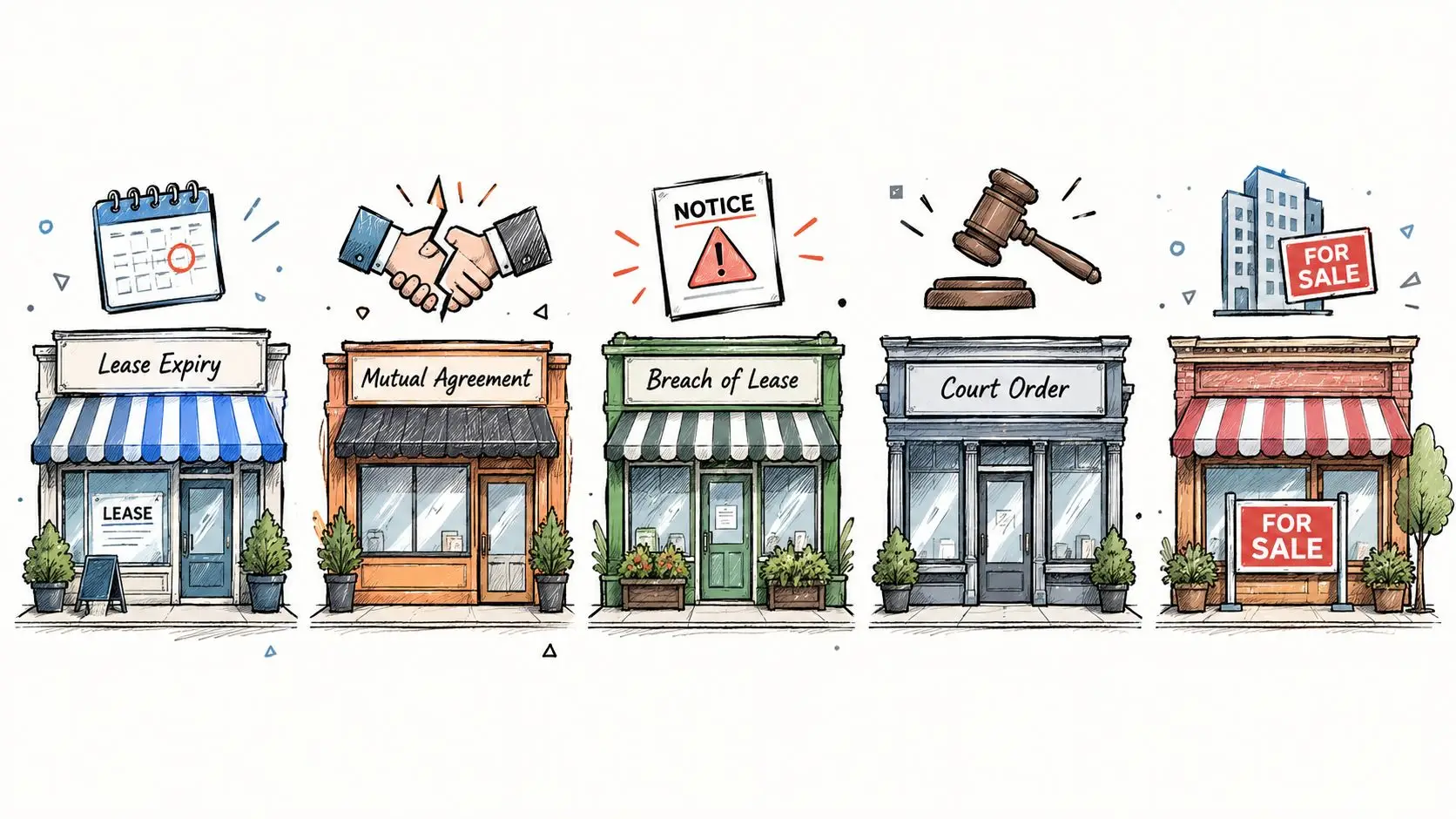
A commercial lease usually ends through one of five routes. The correct route determines the notice, evidence, negotiation posture, and remedy.
Contractual expiry
The cleanest route is expiry at the end of the fixed term. The parties must still check extension rights, renewal mechanisms, automatic continuation, and holdover provisions. A tenant that remains after expiry may create a new periodic tenancy or breach the surrender obligation, depending on the governing law and lease language.
Break clause
A break clause creates a conditional exit right. The tenant may need to pay all rent, serve notice in the prescribed form, deliver vacant possession, and satisfy other conditions. Courts often treat these conditions strictly because the clause grants an exceptional right to end a fixed term early.
A useful general resource on the mechanics appears in how to break a commercial lease in, although local counsel must adapt the analysis to the property’s jurisdiction.
Termination for breach
Persistent non-payment, an unlawful change of use, unauthorised alterations, insolvency events, and assignment without consent may support termination. The landlord normally must follow the contractual and statutory notice process before enforcing that remedy.
Tenants can also rely on landlord breaches where the breach materially affects possession, use, services, safety, or agreed building obligations. The tenant should preserve evidence before withholding rent or vacating.
Frustration or force majeure
Frustration has a high threshold. The event must undermine the lease’s commercial purpose, rather than merely make performance harder or less profitable. Force majeure usually depends on the clause wording, and many clauses excuse performance without automatically ending the lease.
Statutory triggers
Compulsory acquisition, demolition orders, and regulatory prohibition of the permitted use can create statutory or contractual exit routes. Israeli transactions may also involve special frameworks connected with the Law of Encouragement of Capital Investments, franchise arrangements, insolvency, or bankruptcy.
The parties should map the trigger against every connected document. A lease exit can activate lender covenants, franchise approvals, supply commitments, and guarantees.
Israeli Notice and Cure Rules for Landlords and Tenants
Israeli commercial lease termination depends on the agreement, mandatory property rules, and the breach process. The Sale Law, 1968 and the Hire Law, 1971 provide the statutory background, while possession and eviction disputes often turn on notice quality and cure opportunities.
Where no fixed term exists, commercial leasing may receive year-to-year treatment. That classification matters because a year-to-year commercial tenancy generally requires at least three months’ notice. The lease should therefore be reviewed before either party assumes that a month-to-month exit exists.
Breach requires a record
A material breach can justify termination only after notice and a reasonable opportunity to cure. Israeli commercial lease guidance connects this principle with the Contracts (Remedies for Breach of Contract) Law 5731-1970. For rent arrears, market practice commonly uses a written demand giving 7 to 14 days to pay before escalation. Israeli commercial lease guidance describes cure mechanics as central to the termination analysis.
An eviction guide states that a breach letter should usually allow 7 to 10 days to cure, unless the contract treats the breach as incurable. It also identifies payment debts exceeding 14 to 30 days from the contractual due date as potentially fundamental in the relevant framework. The Israeli eviction process guide describes special eviction claims in the Magistrate’s Court under Chapter 12 of the Civil Procedure Regulations, 5779-2018.
Landlord and tenant remedies remain reciprocal
A landlord cannot assume that a tenant’s default permits immediate self-help. The landlord should identify the breach, serve a compliant demand, calculate the cure period, and preserve proof of service. The tenant should use the same discipline when alleging landlord breach, especially before withholding rent or surrendering possession.
Foreign investors face an added trap. An English-law lease can govern commercial obligations, but Israeli mandatory rules may still control possession, eviction, and enforcement against Israeli real property.
| Israeli commercial lease notice and cure calendar | Statutory basis | Notice period | Cure window |
|---|---|---|---|
| Year-to-year commercial tenancy | Hire Law, 1971 framework | At least 3 months | Not applicable to ordinary expiry |
| Tenant rent arrears | Contracts (Remedies for Breach of Contract) Law 5731-1970 and lease terms | Written demand | Common practice of 7 to 14 days |
| Fundamental tenant breach | Contract and procedural framework | Written breach notice | Usually 7 to 10 days, unless incurable |
| Payment debt treated as fundamental | Israeli eviction framework | Contractual due-date analysis | Potentially beyond 14 to 30 days |
| Eviction filing after demand | Chapter 12 of the Civil Procedure Regulations, 5779-2018 | Procedural compliance required | Courts may expect a reasonable cure opportunity |
For leases covered by Israel’s Fair Rent Law, the statutory minimum notice is 60 days for tenants and 90 days for landlords. Israeli guidance also states that fixed-term leases don’t carry a general automatic 30-day exit right. The Israeli lease-breaking guide highlights the asymmetry.
Notice Timing Across Major Markets
A notice that works in one country may fail completely in another. Cross-border businesses should separate four questions: the statutory default, the contract’s notice period, the service method, and the cure process.
Germany uses fixed calendar logic for ordinary commercial termination. Section 580a(2) of the BGB links notice to the third working day of a calendar quarter and the end of the next calendar quarter. German lease termination guidance explains the resulting six to nine-month practical range.
The UK combines contract rights with the Landlord and Tenant Act 1954 framework. Official guidance states that a tenant usually gives 3 months’ notice after a fixed-term tenancy ends, while a landlord usually gives 6 months’ notice. Break clauses commonly require 3 to 6 months’ written notice, and statutory business-tenancy procedures can involve 6 to 12 months depending on the landlord’s objective. UK government guidance sets out the core framework.
California requires separate analysis of periodic tenancy rules, contractual defaults, and service requirements. Certain month-to-month commercial tenancies after one year now require 60 days’ notice, according to recent state-focused guidance. California commercial property guidance discusses this jurisdictional variation.
| Commercial lease notice timing: Germany, UK, California, Belgium | Statutory default notice | Typical contractual notice | Service method | Cure window |
|---|---|---|---|---|
| Germany | Calendar-quarter rule under Section 580a(2) BGB | Lease-specific | Follow lease and applicable law | Breach-specific |
| UK | Tenant usually 3 months, landlord usually 6 months | Break clauses often 3 to 6 months | Written notice under lease and statute | Breach-specific |
| California | Certain month-to-month commercial tenancies require 60 days after one year | Lease-specific | Statutory and contractual methods | Breach-specific |
| Belgium | The 3-6-9 framework remains relevant | Regional and contractual variation | Formal service rules apply | Breach-specific |
Belgian commercial leasing also varies across Flanders, Wallonia, and Brussels. The practical lesson is simple. A valid six-month UK notice cannot cure defective California service, and an Israeli cure process cannot repair a German notice that ignores the applicable statutory reasoning.
A Stepwise Termination Checklist for Both Sides
A defensible exit begins with evidence, not a notice template. Landlords and tenants should create a property file that connects the trigger, the contract, the service record, and the financial result.

Build the factual record
Collect the executed lease, amendments, rent ledger, default notices, complaint logs, photographs, inspection reports, and contemporaneous communications. Tenants should also preserve evidence of landlord failures, including access problems, service interruptions, safety concerns, and rejected repair requests.
A clear record prevents later arguments about whether the breach existed or whether the other party knew about it. Businesses planning relocation can also consult an office leasing guide while comparing replacement premises and operational requirements.
Draft and track the demand
The demand letter should track the lease’s default clause. It should identify the breach, state the required cure, reserve rights, and specify the deadline using the governing law’s calculation method.
Use a dated calendar with these fields:
- Trigger date: Record the breach, expiry event, or break date.
- Notice deadline: Calculate the final service date under the lease and statute.
- Cure deadline: Count the applicable days from valid service.
- Response status: Record payment, remedy, dispute, or silence.
- Escalation date: Identify the earliest lawful filing or enforcement date.
Prove service and preserve the exit
Use registered mail, courier, personal delivery with a witness, or email where the lease permits it. Keep delivery receipts, tracking records, signed acknowledgements, email metadata, and the exact document served.
After service, update the rent ledger and preserve relevant emails. Then prepare surrender paperwork, access arrangements, reinstatement specifications, inventory records, and key-transfer evidence. A tenant should avoid handing back keys informally because possession may become disputed.
A clean handover is evidence. It isn’t merely a facilities task.
Calculating and Limiting Damages After Default
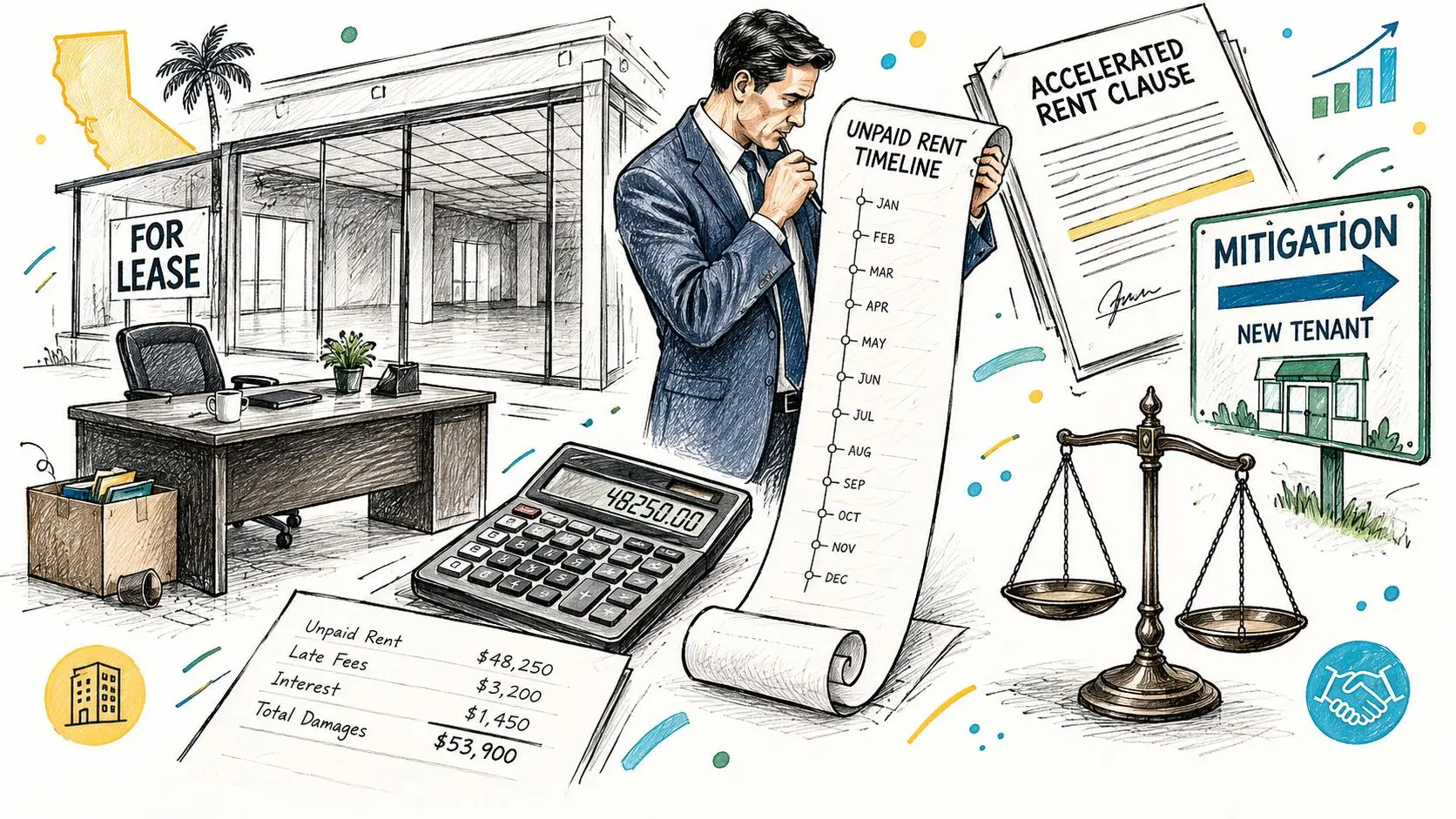
A tenant’s abandonment doesn’t automatically erase rent liability. A landlord’s damages claim also doesn’t automatically equal every future payment in the lease. California commercial-tenancy guidance describes the core mitigation model. Future-rent damages generally reflect the unpaid balance, reduced by rental loss the landlord could reasonably avoid through reletting. California mitigation guidance explains why documented marketing and replacement-tenant economics matter.
The calculation must follow the evidence
Consider a lease with 60 months remaining at $20,000 per month. The headline balance equals $1.2 million. However, a landlord that documents reletting after 14 months at $17,000 per month, with four vacant months, may reduce the recoverable amount to under $400,000, before considering other contractual items and legal adjustments.
That example demonstrates the difference between contractual exposure and recoverable loss. The landlord should document advertising, broker instructions, showings, inquiries, proposed rents, concessions, and reasons for rejecting candidates. The landlord shouldn’t accept a below-market replacement without recording the commercial reason, but it also shouldn’t leave space idle while claiming all future rent.
Security and defences change the result
Security deposits, personal guarantees, letters of credit, and rent insurance can affect collection. The lease and governing law determine whether the landlord may apply each instrument, and whether notice or accounting duties apply.
Tenants may challenge the baseline through constructive eviction, landlord breach, force majeure, or an agreed surrender. Those arguments can change the relevant loss period and undermine an accelerated-rent claim.
The recommended approach is a dual ledger. One column records contractual sums, while another records mitigation, security applications, replacement rent, reinstatement costs, and disputed credits. This format supports negotiation and helps counsel explain the exposure to directors, lenders, and insurers.
Negotiation Tactics, Sample Notice Language, and FAQs
A negotiated surrender often reduces uncertainty more effectively than a contested termination. The parties should define the surrender date, rent treatment, dilapidations cap, access rights, reinstatement scope, deposit application, guarantee release, and mutual releases.
The landlord usually values certainty of possession and a credible reletting process. The tenant usually values a defined liability ceiling and release from continuing obligations. A proposal should therefore trade timing and cooperation for financial finality, rather than merely request forgiveness.
Counsel may use drafting software for issue spotting, including an AI contract drafting tool. However, counsel must localize every notice to the lease, jurisdiction, service rule, and factual record.
Adaptable notice language
Breach with cure
The landlord identifies the following breach of the lease: [describe breach]. The tenant must cure that breach by [date], calculated under [governing law and lease clause]. If the tenant fails to cure within the applicable period, the landlord reserves all contractual and statutory rights, including termination, possession proceedings, and damages.
Break-clause invocation
The tenant exercises the break right under clause [number]. The termination date is [date]. The tenant will comply with every applicable condition, including payment obligations, vacant possession, reinstatement, and delivery through the method required by the lease and governing law.
These blocks require local legal review. They don’t replace the prescribed form or cure calculation.
Common questions
How long does commercial lease termination take?
The answer depends on expiry, a break clause, breach, statute, and service. Germany can create six to nine months of ordinary notice exposure, while UK procedures may involve three months for a tenant after a fixed term, six months for a landlord, and six to twelve months in some statutory business-tenancy situations. The contract may impose a different break window.
Can a tenant terminate for landlord breach?
Yes, potentially. The breach must usually affect a material contractual obligation, and the tenant should provide notice and a reasonable opportunity to cure where required. Vacating or withholding rent without preserving evidence can create a separate default.
What counts as repudiation?
Repudiation occurs when a party clearly indicates that it won’t perform a fundamental obligation, or acts inconsistently with continued performance. Courts assess the contract, conduct, and surrounding facts. A frustrated negotiation doesn’t automatically prove repudiation.
Is email notice valid?
Sometimes. The lease may require registered mail, courier, personal delivery, or another formal method. Email can fail when the contract or statute requires a different form, so the sender should use every permitted method that local counsel approves.
How does the landlord apply a security deposit?
The landlord should follow the lease and governing law, identify the amounts claimed, and provide an accounting where required. Applying a deposit doesn’t necessarily release the tenant from the remaining balance.
Should the dispute go to court or arbitration?
Court proceedings may suit urgent possession or eviction relief. Arbitration may protect confidentiality and provide a specialist tribunal, but it may not provide every form of property-related remedy. The dispute clause, interim-relief rules, location of the property, and enforcement needs should control the choice.
RNC Group handles cross-border commercial leasing, Israeli enforcement, multilingual legal correspondence, and coordinated dispute strategy. The firm’s approach focuses on aligning notice, cure, surrender, damages, and escalation decisions across the jurisdictions affecting the business.
RNC Group advises international businesses on commercial lease termination, breach notices, negotiated surrender, Israeli possession disputes, and cross-border damages planning. To avoid a missed deadline or defective notice, review the lease portfolio with RNC Group now, or contact the firm through its international legal team.
This article provides general information only and doesn’t constitute legal advice. Commercial lease rights depend on the lease, governing law, property location, service method, and facts, so readers should obtain advice from qualified counsel before serving notice, withholding rent, surrendering possession, or commencing proceedings.