
A regulatory alert reaches the general counsel’s inbox before breakfast. The message concerns AI governance, privacy, and cybersecurity obligations across several markets. By lunch, three teams have opened separate trackers, and nobody can say which issue requires executive action.
That situation now defines cross-border compliance. Regulatory noise creates risk when teams lack a system for filtering, assigning, and escalating obligations. A regulatory compliance framework should therefore operate as a business control system, not as a collection of legal reminders.
Why Your Business Needs a Regulatory Compliance Framework in 2026
A multinational business can receive alerts on AI governance, cybersecurity, data privacy, climate-risk disclosure, digital assets, and third-party risk during the same operating cycle. Each message may appear urgent, but few will apply to the company’s products, customers, data flows, or locations. Without a defined decision system, legal teams sort irrelevant signals while operational owners miss the obligation that requires action.
Analysts found that 85.3% of organizations monitor regulatory updates, but only 30.9% say their alerts are always relevant (Regology’s 2026 regulatory compliance analysis). The gap reflects a filtering failure, not a lack of awareness. Your framework must convert regulatory signals into decisions, accountable owners, deadlines, and evidence.
Practical rule: An alert has no operational value until someone determines its scope, priority, owner, and required response.
Why ad hoc compliance fails
Ad hoc compliance often begins with a legitimate concern. A founder forwards an alert to legal, legal sends it to security, and security asks operations whether it affects a product or vendor. A local subsidiary may use a separate process, while a commercial contract contains obligations that never enter the central register.
The result is duplicated controls, inconsistent escalation, and unreliable leadership reporting. Teams describe the same risk in different terms, making it difficult to distinguish an actual breach from a general regulatory development. Cross-border companies also lose time deciding which rules apply and which local differences require a documented response.
Use one decision workflow:
- Capture the signal: Record the source, jurisdiction, subject, and publication date.
- Test applicability: Compare the alert with products, customers, data flows, contracts, and locations.
- Rank the consequence: Assess legal exposure, operational disruption, reporting urgency, and reputational impact.
- Assign ownership: Name one accountable executive and the supporting legal, security, finance, or operational owners.
- Track closure: Require documented remediation, approval, and evidence.
This workflow turns regulatory noise into a controlled operating queue. It also gives non-Israeli clients entering Israel a practical execution model: identify the Israeli entity or activity in scope, map the local requirement to the global control, assign a local operator, and retain evidence that headquarters can review.
The commercial cost of fragmentation
Fragmented compliance slows market entry and complicates negotiations. It can produce conflicting representations in customer contracts, supplier questionnaires, and regulatory filings. Local implementation may also diverge from global policy without a recorded business or legal reason.
ISO 37301 offers an architecture for organizing obligations, risks, accountability, monitoring, and improvement. It applies across organization sizes, sectors, and ownership structures, and can integrate with standards such as ISO 9001, ISO 14001, and ISO 37001. Use that structure as a reference point, then configure controls around the company’s actual jurisdictions and operating model.

What a Regulatory Compliance Framework Really Is
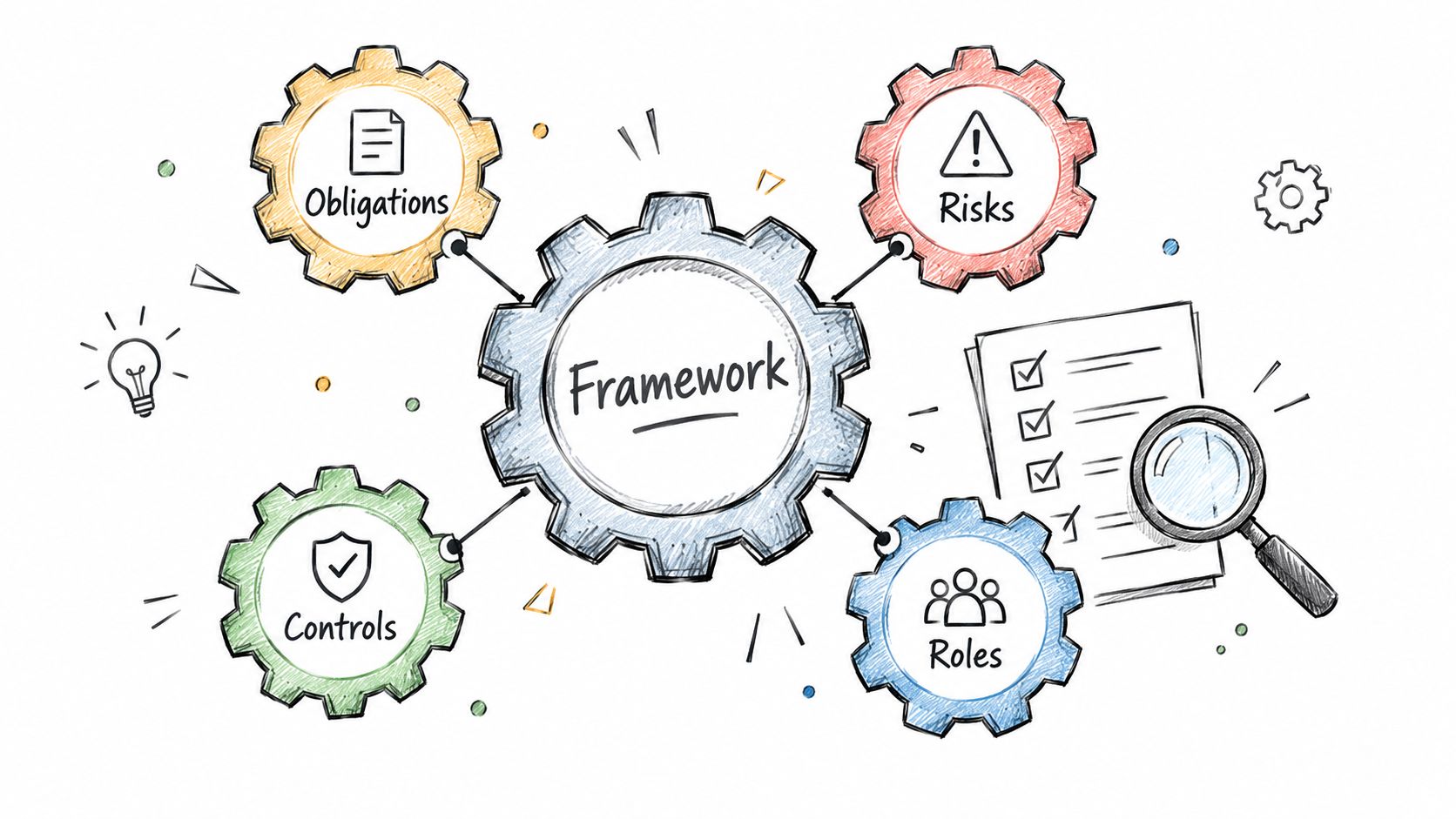
A regulatory compliance framework is the company’s operating system for legal and business obligations. It filters regulatory noise, identifies what applies, links each obligation to a business risk, assigns responsibility, and records how performance will be tested. It also defines the response when a control fails.
ISO 37301:2021 replaced ISO 19600:2014 and moved compliance from general guidance toward a certifiable international management system (ISO 37301 information). The practical value is the operating model. A company can design, run, review, and improve a documented system instead of maintaining a static checklist. Use the standard as architecture, then configure it for the jurisdictions, products, data, and operating decisions that affect the business.
Start with the obligations inventory
The framework begins with an obligations inventory. Capture laws, regulations, contractual commitments, industry requirements, internal policies, and voluntary standards that influence the business. For cross-border work, record the jurisdiction, local entity or activity, and the global requirement that each local rule supports or modifies.
Each entry should identify:
- The obligation: State the legal or contractual requirement in operational language.
- The scope: Identify the entity, product, process, data set, market, and relevant third parties.
- The owner: Assign a person with authority to implement and evidence compliance.
- The control: Describe the process that prevents, detects, or corrects non-compliance.
- The evidence: Specify the record that proves the control operates.
- The review trigger: Identify events that require reassessment, such as expansion, acquisition, product change, or a regulatory update.
Keep the inventory connected to the risk register. A new rule should lead to a decision about products, contracts, staffing, vendors, reporting, or local execution, rather than remain in a legal folder.
Treat ISO 37301 as architecture, not decoration
ISO 37301 requires an organization to establish, implement, maintain, and continually improve a compliance management system that reflects its values, objectives, strategy, and compliance risks (ISO 37301 sample). That requirement makes the framework organizational, not purely legal.
The framework should answer practical questions: Which obligations affect the product? Who approves the control? What evidence will an auditor or regulator inspect? What happens after an incident? How will the company confirm that remediation worked?
Security teams should connect compliance evidence with the information-security program. Guidance on audit evidence for ISO 27001 helps clarify how documented records support control testing and audit readiness.
Core Components That Make the Framework Work
A framework earns its value by connecting decisions, controls, and evidence. Governance assigns authority, the obligations inventory filters regulatory noise, risk assessment sets priorities, controls address exposure, and monitoring tests performance. Reporting returns the results to leadership, while remediation improves the system.
Governance gives the system authority
The board or executive team should approve the compliance policy and set risk tolerance. A compliance lead may coordinate the framework, but business owners must remain accountable because they control budgets, processes, and personnel.
Legal interprets obligations. Security manages technical safeguards. Finance oversees financial controls and reporting dependencies. Operations puts procedures into practice. Procurement manages third-party requirements, and human resources supports training and disciplinary processes.
Document escalation rights in operational terms. Each owner should know when to involve senior management, pause a transaction, suspend a vendor, or notify a regulator. For cross-border work, assign responsibility for deciding which local requirements change the baseline control.
The inventory and risk register create prioritization
The obligations inventory answers, “What applies?” The risk register answers, “What threatens the business most?” Link both records so regulatory change produces a business decision instead of another file in a legal folder.
Assess each obligation against its relevance, affected process, seriousness of non-compliance, control maturity, detection capability, and remediation cost. Record jurisdictional differences as well. A global policy can establish the baseline, while a local rule may require a specific notice, contract term, retention practice, or reporting route.
Controls convert legal requirements into action
Policies state expectations. Procedures explain execution. Controls provide the operating mechanism.
Use approval workflows, access restrictions, vendor reviews, contract clauses, incident escalation, training records, change management, and evidence retention where they address identified exposure. Every control needs an owner, operating frequency, performance standard, and defined response to failure. This structure lets teams apply one control across overlapping regimes while recording the specific obligations it satisfies.
Monitoring closes the loop
Combine legal updates with operational indicators. A useful report can show open regulatory questions, overdue control tests, unresolved incidents, supplier findings, contract deviations, and remediation status.
Audits test whether controls operate as designed. Remediation should identify the root cause, assign a deadline, record the corrective action, and confirm closure through a later review. ISO compliance management guidance describes integrating compliance with financial, risk, quality, environmental, and health-and-safety processes as a practical way to strengthen the management system.
How to Integrate Overlapping Regimes Into One Control Environment
A company facing one cyber incident may confront privacy duties, sector rules, contractual commitments, and disclosure requirements at the same time. Build one control environment, then map each regime to the controls that address its obligations. This filters regulatory noise and prevents separate programs from producing conflicting instructions.
Compliance activity in 2025 and 2026 has shifted from general guidance toward enforcement across overlapping regimes, including DORA, the EU AI Act, SEC cyber disclosure rules, and PCI DSS v4.0 (compliance trends analysis). The operating question is whether one control can satisfy several requirements and where a local exception must be added.
Build one control map
Use one policy library, one risk register, and one escalation path. Map each obligation to an existing control before creating a new one.
| Regime | Focus Area | Enforcement Signal |
|---|---|---|
| DORA | Digital operational resilience and ICT risk | Incident handling, resilience testing, and third-party oversight |
| EU AI Act | Artificial intelligence governance and risk management | System classification, documentation, and human oversight |
| SEC cyber disclosure rules | Public-company cybersecurity reporting | Material incident assessment and disclosure governance |
| PCI DSS v4.0 | Payment-card security controls | Control validation, evidence, and remediation |
| Global privacy laws | Personal-data processing and individual rights | Local applicability, notices, security, and response duties |
Treat the table as a decision tool, not a substitute for legal analysis. Each row should identify jurisdictional scope, an accountable owner, the control, and the evidence proving operation.
Filter alerts through a decision matrix
An alert should enter the workflow only after four decisions are recorded:
- Applicability: Does the rule reach the entity, product, data, transaction, or supplier?
- Urgency: Does it create an immediate deadline, incident clock, contract issue, or market-access barrier?
- Materiality: Could non-compliance affect customers, revenue, licensing, disclosure, or litigation exposure?
- Ownership: Which executive can approve resources and accept residual risk?
Consolidate reporting clocks in the same matrix. Some regimes may impose 4-hour, 24-hour, or other incident-reporting clocks. Track the shortest applicable clock until counsel confirms the legal position. The matrix should also show which team gathers facts, who approves the response, and where the evidence is stored.
A global baseline should remain consistent. Local variations should appear as mapped exceptions, not as independent systems.
Apply the same discipline to suppliers. A procurement AI mapping framework can connect AI-related supplier information with purchasing review, risk classification, and control ownership. This gives non-Israeli clients a repeatable basis for cross-border execution before local counsel confirms jurisdiction-specific exceptions.
Israel Specific Considerations for International Businesses
A global framework must treat Israel as an integrated jurisdiction, not as an afterthought. International businesses often enter Israel through distribution, licensing, franchising, employment, technology supply, investment, or commercial collaboration. Each structure can activate Israeli mandatory rules even when the contract selects foreign law.
Israeli courts generally respect choice-of-law clauses in commercial contracts. However, mandatory Israeli rules may still apply where the transaction has a sufficient Israeli connection, including consumer protection, employment minimums, and certain competition-law provisions (Israeli commercial contract guidance).
Map Israeli mandatory rules locally
The framework should identify the Israeli entity, counterparties, employees, customers, regulated activities, data flows, and performance location. It should then map the relevant Israeli requirements to the global contract, policy, and control structure.
The contract should not rely on a foreign governing-law clause alone. Counsel should review mandatory rules, language requirements, regulatory approvals, licensing issues, consumer-facing terms, employment arrangements, and competition concerns. The local mapping should also identify who handles notices, evidence, approvals, and disputes.

Design arbitration before a dispute arises
Israel enacted the International Commercial Arbitration Law 5784-2024 on 12 February 2024 (Israeli arbitration clause analysis). The law applies automatically to qualifying international commercial disputes where the parties have places of business in different countries, where the substantial part of the relationship or arbitration seat lies outside Israel, or where the parties expressly choose the law.
The dispute-resolution control should therefore record the governing law, arbitration seat, language, institution, service method, interim-relief strategy, and enforcement jurisdictions. Those details belong in the contract approval process, not in a post-dispute file.
Israeli courts can stay litigation and refer parties to arbitration when a valid arbitration agreement exists. Under the newer international regime, referral becomes mandatory for qualifying international commercial disputes under Section 9(a) (Israeli litigation and arbitration guidance). The recommended strategic path aligns the clause, litigation response, evidence preservation, and enforcement plan from the outset.
Practical Checklist to Build and Strengthen Your Framework
A useful framework starts with ownership, sequence, and a clear view of how the business operates. Begin with the business model, markets, products, contracts, data, suppliers, and decision-makers. Software and policy drafting come later, after the company knows which obligations it must control.
Build the operating foundation
Use this order:
- Inventory the business: Record entities, activities, customers, products, data, employees, suppliers, and jurisdictions.
- Identify obligations: Capture laws, regulations, contracts, internal policies, licensing conditions, and customer requirements.
- Assess risk: Rank exposure by legal consequence, operational impact, reporting urgency, and control weakness.
- Map controls: Link each obligation to a policy, procedure, approval, technical measure, or evidence record.
- Assign owners: Name accountable executives and supporting legal, security, finance, HR, procurement, and operations contacts.
- Set monitoring: Define review triggers for regulatory changes, incidents, acquisitions, market entry, product changes, and supplier changes.
- Test and remediate: Review evidence, record deficiencies, correct root causes, and verify closure.
Fix the common failure points
Alert fatigue requires filtering. The legal team should stop mass forwarding and require an applicability decision before escalating a regulatory update.
Unclear ownership requires one accountable person. Contributors may support a control, but one owner must answer for its performance.
Duplicated controls require clear mapping. If one vendor review addresses privacy, cybersecurity, procurement, and contractual requirements, record one shared control and map each relevant obligation to it.
One-time projects require recurring review. Compliance changes with the company, so acquisitions, incidents, market entry, product changes, and supplier changes should trigger reassessment.
Integrate compliance with business processes
ISO 37301 supports embedding compliance into financial, risk, quality, environmental, and health-and-safety processes, as described in the ISO compliance management guidance. Existing operational data can then support compliance monitoring without creating parallel reporting.
Tax and commercial teams should validate business identifiers and counterparties before contracting. A practical checklist for VAT ID validation can support that onboarding control.
RNC Group publishes a compliance audit checklist covering business registration and licensing approvals in each relevant jurisdiction. Use that type of legal audit as an input to the obligations inventory, while keeping operational ownership inside the business.
Putting the Framework Into Action and Next Steps
A franchise network entering Israel may first map licensing, consumer, employment, competition, brand, data, and dispute obligations. The global office can issue the baseline franchise policy, while Israeli counsel maps local exceptions into the contract approval and monitoring process. The system then assigns the franchise owner, local operator, finance team, and legal team specific evidence duties.
A technology company collaborating with an Israeli counterparty may face different risks. The parties should map intellectual-property ownership, confidentiality, data access, security controls, subcontractors, governing law, arbitration, and exit rights before signing. The recommended strategic path prevents a foreign-law clause from obscuring mandatory Israeli rules or leaving enforcement mechanics unresolved.
The framework becomes credible when leadership can answer five questions quickly. What applies? What matters most? Who owns it? What evidence exists? What happens if the control fails?
RNC Group advises international businesses on Israeli commercial contracts, cross-border compliance design, arbitration clauses, crisis management, and enforcement strategy. To avoid costly mistakes before signing or responding to a regulatory issue, visit RNC Group and submit the matter for focused legal assessment.
This article provides general information only and doesn’t constitute legal advice. Regulatory obligations depend on the facts, jurisdictions, contracts, and business structure, so readers shouldn’t rely on this material without obtaining advice on their specific circumstances.