
A payment fails without warning. The bank blocks an operating account, a guarantee is called, or a compliance team demands documents before releasing funds. Within hours, suppliers lose confidence, employees face payment delays, and a foreign executive must make legal decisions in a system they don’t fully know.
Banking disputes move faster than ordinary commercial claims because liquidity, reputation, and counterparty confidence suffer immediately. A banking litigation lawyer must therefore classify the problem before choosing a remedy. The wrong classification can waste strategic advantage, delay relief, and damage the banking relationship.
The practical model is phased. First, contain the disruption. Next, preserve evidence and strengthen your position. Then, proceed to court only when litigation offers the strongest remedy.
When a Bank Move Freezes Your Business Overnight
A foreign company operating through Israel may discover the problem through a rejected payment rather than a formal letter. The finance director sees a declined transfer, checks the account, and finds that the bank has placed a hold. The bank may describe the action as a compliance review, a court-driven restriction, or a response to suspected irregularities.
Those labels matter. A court order, regulator directive, AML or KYC review, and sanctions action require different responses. A banking litigation lawyer should obtain the formal freeze notice first, because the notice often identifies the decision-maker, legal basis, scope, and available challenge route.

Classification controls the remedy
An emergency motion may suit a court-imposed freeze. A detailed compliance submission may work better for an AML review. A sanctions action may require a licensing or delisting application. Direct confrontation without identifying the source can make the bank less willing to cooperate.
Practical rule: Secure the legal basis before arguing about the merits.
The first response should protect operational continuity. The company should identify affected accounts, pending payments, payroll exposure, guarantees, credit facilities, and correspondent-bank dependencies. It should also preserve every statement, notice, email, transaction record, and compliance request.
The first objective is containment
Containment doesn’t mean accepting the bank’s position. It means preventing a temporary banking action from becoming a business failure. Management should activate lawful alternatives, notify critical counterparties carefully, and avoid inconsistent explanations that could later undermine credibility.
The second objective is advantage. Counsel should test whether the bank followed its agreement, statutory duties, regulatory obligations, and internal process. The third objective is forum selection. Israeli court proceedings, arbitration, mediation, regulatory correspondence, or parallel foreign action may each serve a different purpose.
Foreign executives need a local lawyer who can sequence those actions without treating court as the automatic first move. The best route often begins discreetly, then escalates with evidence and a defined remedy.
What a Banking Litigation Lawyer Actually Does
A banking litigation lawyer combines financial regulation, contract analysis, injunction practice, disclosure, and asset tracing. General commercial counsel may understand the contract, while transactional banking counsel may understand the facility. Specialist litigation counsel must connect both areas to an immediate procedural strategy.
The role resembles air-traffic control. Several legal and commercial events may move at once, including a frozen account, an approaching payment deadline, a threatened guarantee call, and a foreign proceeding. Counsel must sequence each response so that one action doesn’t obstruct another.
The lawyer controls sequence, not just pleadings
The first task involves diagnosis. Counsel identifies who imposed the restriction, which documents support it, and whether the bank acted under contract, law, regulation, or a third-party order.
The second task involves preservation. Financial disputes depend on records that may sit across accounting systems, messaging platforms, bank portals, and external service providers. Counsel should issue preservation instructions before employees delete messages or systems overwrite transaction histories.
The third task involves applying court-ordered search-and-trace relief, freezing injunctions, and third-party disclosure against banks in appropriate financial disputes, according to guidance on banking litigation and financial disputes. Those tools can identify where money moved and protect assets before a final judgment.
Litigation counsel differs from transactional counsel
Transactional counsel designs the facility, guarantee, security package, or account structure. Litigation counsel asks what happens after performance breaks down. That inquiry includes evidence, urgency, jurisdiction, disclosure, privilege, and enforcement.
A strong banking litigation lawyer also manages communication. The client must provide the bank with a coherent explanation, without making admissions that weaken a later claim. The lawyer must separate facts, assumptions, and legal positions in every submission.
Law firms also need reliable intake and response systems during urgent disputes. Resources on proven strategies for law firms can help practices structure communication coverage, although technology can’t replace legal judgment.
The technical tools change the negotiation
Early tracing can reveal whether assets remain recoverable. Disclosure applications can expose records held by third parties. An injunction can prevent dissipation, while a carefully drafted demand can preserve the possibility of settlement.
The recommended strategic path is therefore not “file immediately.” It is contain, preserve, test, and escalate. Court becomes more effective when counsel can show the judge a clear chronology, a defined legal wrong, and a proportionate remedy.
Common Banking Disputes That Require Litigation Counsel
Banking claims often look similar at first. A client says, “The bank stopped my money.” The legal trigger may involve an account restriction, an unauthorized debit, a guarantee, fraud, or regulatory controls. Each category creates a different evidential and procedural problem.
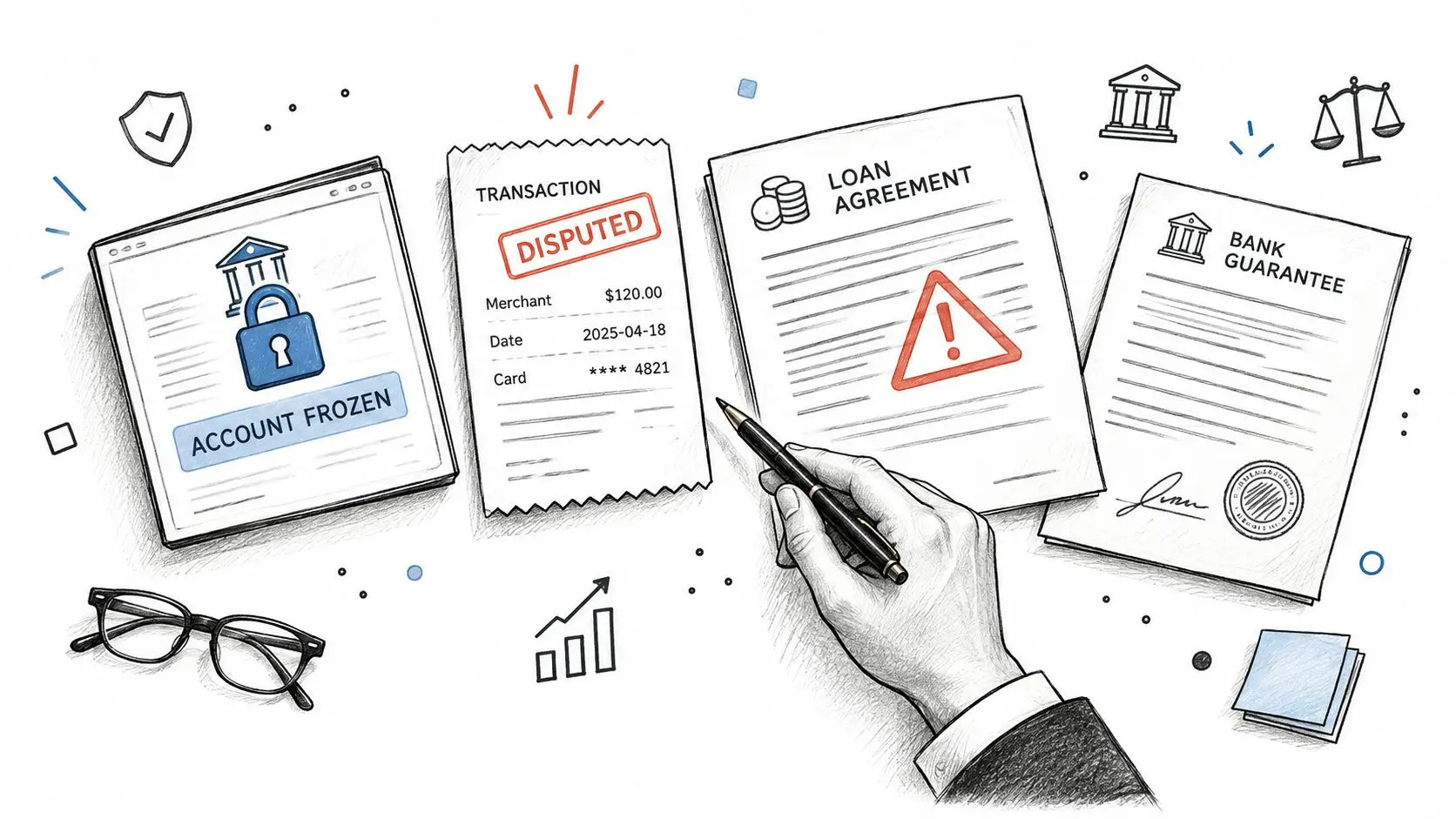
Account freezes and closures
The first question asks who ordered the freeze. A bank may rely on a court order, regulatory instruction, AML or KYC review, or sanctions concern. The company should obtain the formal notice, preserve account records, and identify whether the bank restricted one account or the broader relationship.
The remedy follows the classification. Counsel may pursue an emergency motion, a compliance response, or a licensing or delisting application. A general accusation of unfairness won’t replace the required procedural route.
Unauthorized or erroneous debits
These disputes require transaction-level analysis. The client should preserve payment instructions, approval records, authentication logs, invoices, account statements, and communications with the bank. Counsel must determine whether the debit resulted from bank error, employee authority, fraud, mandate interpretation, or a disputed contractual charge.
The bank will usually examine authorization and notice. Therefore, the legal argument must match the transaction trail rather than rely on a broad denial.
Guarantees and enforcement demands
A bank guarantee can create immediate pressure because the bank may treat the demand as separate from the underlying commercial dispute. Counsel must examine the guarantee wording, demand conditions, notice mechanics, fraud allegations, and any injunction jurisdiction.
A challenge may focus on the demand itself, while the underlying contract proceeds separately. That split can make timing decisive. Negotiation may preserve the relationship, but an injunction may become necessary if the demand threatens irreparable commercial harm.
Fraud and APP scams
Fraud claims require tracing, not only blame. Counsel should map the payment path, identify recipient accounts, preserve bank communications, and consider urgent relief against parties or institutions holding the funds. Cross-border recovery often requires parallel steps in several jurisdictions.
The overview of the CRA rules lawsuit illustrates why regulatory context can shape banking disputes beyond a single account. The immediate legal task remains narrower, identify the applicable rule, the bank’s duty, and the evidence showing breach.
AML, KYC, and sanctions action
Compliance action creates a difficult balance. The bank may have confidentiality constraints, while the client needs enough information to respond. The client should prepare a consistent ownership, transaction, source-of-funds, and commercial-purpose narrative.
A banking litigation lawyer should avoid threatening proceedings before reviewing the compliance record. An aggressive letter can trigger further escalation. A precise submission can instead give the bank a defensible route toward restoring services.
Choosing Between Litigation and Alternative Resolution Paths
Foreign businesses usually want four things: rapid relief, controlled cost, confidentiality, and enforceability. No forum provides all four in every dispute. The decision should follow the remedy the client needs, not a general preference for court or settlement.
Court litigation offers the strongest emergency toolkit when the client needs an injunction, disclosure, or third-party evidence. Arbitration may provide confidentiality and a neutral forum, but its emergency powers depend on the arbitration agreement and applicable rules. Mediation can protect the banking relationship, yet it can’t compel a reluctant bank to release funds.
Regulatory or compliance challenges can work well when the dispute arises from a bank process rather than a final judicial order. They may also create a less adversarial record. However, they don’t always deliver compensation or asset-preservation measures.
Dispute Resolution Path Compared
| Resolution Path | Best For | Speed to Relief | Enforceability |
|---|---|---|---|
| Court litigation | Injunctions, disclosure, tracing, and urgent bank orders | Strongest where emergency relief is available | Court judgment and procedural orders |
| Arbitration | Contractual banking claims with a valid arbitration clause | Depends on tribunal and emergency provisions | Award enforcement depends on applicable law |
| Mediation | Guarantee, fee, and relationship disputes | Potentially fast if both sides engage | Settlement requires clear enforcement terms |
| Regulatory or compliance challenge | AML, KYC, sanctions, and account-review disputes | Can be direct when the bank controls the process | Outcome depends on the authority and remedy |
Match the forum to the leverage
A guarantee dispute may justify negotiation before a claim, especially where the bank wants documentary comfort and the client wants continuity. A suspected fraud may justify court action immediately because delay can allow funds to move beyond practical recovery.
Arbitration may suit a cross-border contract with a carefully drafted clause. It may not suit a client that needs a bank, which isn’t a party to the arbitration, to produce records. Courts often offer the more direct path for third-party disclosure.
Mediation works best after counsel has built a strong litigation position. The client can negotiate from evidence rather than anxiety. Regulatory engagement works best when the bank can lawfully reconsider its decision without waiting for a judge.
The recommended strategy is staged. Preserve the right to litigate, use correspondence and compliance submissions to test resolution, and file when the threatened harm or evidence risk makes delay unacceptable.
Cross Border and Israeli Specific Considerations
Israeli account restrictions create consequences that foreign executives often underestimate. Under Israel’s Checks Without Cover Law, a bank account becomes restricted for one year when 10 or more checks return for insufficient funds within 12 months, provided that the first and tenth returned checks are at least 15 days apart. The Bank of Israel’s public guide sets out those conditions.
The restriction mainly bans drawing checks on the account. The Bank of Israel states that the restriction begins on the date in the bank’s notice, but not earlier than 15 days after the notice is sent, as explained in its consumer information materials. Counsel must therefore verify service, dates, returned items, and whether the bank applied the statutory test correctly.

Restriction severity affects business planning
Bank of Israel materials describe a severe restriction lasting two years when statutory conditions indicate repeated or chronic check dishonor behavior. The Bank of Israel annual survey provides the relevant framework.
Foreign companies should separate a check restriction from an account freeze. The former follows statutory conditions. The latter may arise from court, regulatory, compliance, or sanctions action. Each route creates different deadlines and evidence requirements.
Israel remains an active disputes forum
England and Wales recorded banking and finance as the sector with the highest number of new High Court claims for four consecutive years from 2022 to 2025, according to ICLG’s analysis of banking disputes. The sector peaked at 1,151 claims in 2023, then recorded 1,029 in 2024 and 996 in 2025, still exceeding every other sector.
Early 2026 data showed Q1 claim volumes rising 15% year on year, although banking and finance ranked third in that quarter. For foreign executives, those figures reinforce England’s role as a major forum, while Israeli proceedings may remain essential where the bank, account, assets, or evidence sits in Israel.
Uganda’s Commercial Court handled more than 1,075 banking-related cases worth about sh2.3 trillion from 2022 to 2026. It completed 796 cases worth sh447 billion, while 623 cases worth about sh1.9 trillion remained pending in 2026, as reported in CMS’s analysis of changing banking disputes. These figures show how disputes can tie up capital and why counsel should coordinate parallel enforcement early.
Cross-border execution needs coordination
A foreign judgment may require recognition and enforcement in Israel. An Israeli judgment may require enforcement abroad. Counsel should assess jurisdiction clauses, service, translation, asset location, sanctions exposure, correspondent-bank pressure, and the availability of local counsel.
Multilingual evidence also matters. Translations should preserve defined terms, account references, dates, and financial terminology. International coordination should follow the asset trail, not merely the defendant’s registered address.
How to Engage Counsel and Prepare for Action
A company should engage a banking litigation lawyer as soon as a bank blocks access, rejects material payments, threatens a guarantee call, or requests an explanation that could affect the relationship. Early advice costs less than reconstructing evidence after systems change and employees leave.
The first response should follow a disciplined checklist:
- Obtain the formal notice: Secure the freeze, restriction, dishonor, closure, or guarantee documents, including delivery records.
- Preserve transaction trails: Save statements, payment instructions, approval records, invoices, messages, portal records, and bank correspondence.
- Map exposure: List every affected account, guarantee, facility, payment, supplier, employee, and foreign banking relationship.
- Check deadlines: Identify notice periods, limitation issues, response dates, court deadlines, and guarantee expiry provisions.
- Prepare the narrative: Build a consistent explanation of ownership, source of funds, transaction purpose, and the requested remedy.
- Control communications: Appoint one decision-maker and route bank contact through a documented process.
The first forty-eight hours
During the first 48 hours, the objective is containment. Counsel should identify the legal source of the action, protect essential payments, prevent inconsistent statements, and decide whether emergency relief remains necessary.
The company shouldn’t destroy or alter records. It shouldn’t accuse bank employees of misconduct without evidence. It shouldn’t move funds in a way that creates a new compliance concern.
Build leverage before filing
The medium-term phase involves chronology, legal analysis, witness preparation, tracing, and carefully targeted correspondence. Counsel may request reconsideration, submit compliance material, negotiate security, or prepare an application for disclosure or interim relief.
Fee structures vary. A firm may charge hourly fees, staged fixed fees, retainers, or a blended arrangement for emergency work and later proceedings. The engagement letter should define the first phase, decision points, likely disbursements, and authority for urgent filings.
Trial timing depends on court availability, complexity, evidence, interlocutory applications, and cross-border service. Counsel should give a staged forecast rather than promise a fixed result or timetable.
RNC Group uses a phased escalation approach that analyzes the client, opponent, and surrounding commercial context before court action. That method fits banking disputes because the strongest case often begins with disciplined containment and evidence control.
Resolving Banking Disputes With a Phased Strategy
The banking litigation lawyer’s framework should remain simple enough for an executive team to use under pressure.
Classify the action. Identify whether the bank relied on a court order, regulator, compliance review, sanctions process, statutory check restriction, contract, or alleged fraud.
Preserve and trace. Secure notices and records. Map the money, guarantees, accounts, counterparties, and decision-makers before evidence disappears.
Choose the forum for advantage. Use compliance engagement, negotiation, mediation, arbitration, or court according to the remedy required. Don’t choose a forum merely because it feels familiar.
Escalate proportionately. Seek an emergency order when delay threatens funds or operations. Otherwise, build pressure through a precise demand and a credible filing strategy.
Courts and regulatory channels are tools, not destinations. Early classification prevents the company from using an expensive remedy that cannot solve the actual problem.
Foreign executives facing an Israeli account restriction, disputed debit, guarantee call, or cross-border recovery issue should assemble the bank notice and full transaction record before making further representations.
A banking dispute can become more expensive with every uncontrolled communication. Contact RNC Group to assess the bank’s action, preserve evidence, coordinate Israeli and foreign counsel, and select a phased route from containment to enforcement.
This article provides general information and doesn’t constitute legal advice. Banking restrictions, guarantees, compliance actions, limitation periods, and enforcement procedures depend on the documents and facts of each matter. Readers shouldn’t rely on this material without obtaining advice from qualified counsel who has reviewed the specific dispute.