
In 2026, a partnership agreement dispute resolution clause can determine whether a cross-border business keeps operating or loses control of its assets, management, and evidence. The counterintuitive point is that negotiated settlement still dominates formal proceedings. In FINRA’s 2025 statistics, 1,118 cases reached direct settlement, representing 44% of cases, while 371 cases settled through mediation, representing 15% (FINRA dispute-resolution statistics).
That pattern supports a practical conclusion. A dispute clause should function as an operational system, not as boilerplate added at signing. It should prevent disputes, reduce internal escalation, and provide a credible external forum when cooperation fails.
What Changed in Partnership Disputes by 2026
A weak dispute clause can stop a cross-border partnership before anyone reaches the underlying commercial issue. Language, notice, service, interim relief, and enforcement problems can leave directors arguing about procedure while a financing round, transfer, or key customer decision waits.
Cross-border partnerships involving Israel face a practical choice. They must build a clause that operates through three layers: prevention, de-escalation, and external resolution. Each layer should address a different failure point. Governance rules reduce avoidable disputes. A defined escalation process gives the parties time and structure to resolve them. Arbitration or court proceedings provide a decision when cooperation ends.

Settlement needs structure
FINRA’s 2025 figures show 1,118 direct settlements, or 44% of cases, and 371 mediation settlements, or 15%, compared with 56% and 12% respectively in 2024 (FINRA’s published statistics). The figures do not determine the right process for every partnership. They do show why a clause should preserve a controlled settlement opportunity before adjudication creates cost, publicity, and operational disruption.
Consider a founder deadlock. One partner refuses to approve a financing round, while the other argues that the refusal breaches the agreement. If the clause has no short notice period, defined escalation meeting, or temporary authority for routine business, the company may miss the signing window before the dispute reaches a decision-maker. A staged process should set deadlines while protecting ordinary operations.
Practical rule: A private resolution mechanism should protect business continuity, not merely postpone confrontation.
Generic templates leave operational gaps
A standard partnership agreement may name arbitration or a court without explaining how the parties get there. It may omit notice mechanics, escalation deadlines, confidentiality, emergency relief, or the arbitrator’s authority. Each omission creates room for a procedural fight.
Ownership transfers require the same scrutiny. A change in control may trigger consent, notification, or termination rights, so The Owner’s Shortlist explains change of control provides useful commercial context for reviewing related provisions.
The partnership agreement dispute resolution clause should therefore connect governance powers, deadlock procedures, transfer restrictions, confidentiality, and enforcement planning. That three-layer design gives the parties a workable route from prevention to de-escalation and, if necessary, an enforceable external decision.
Separating Governing Law from Forum Selection
A dispute clause often fails because the drafting team treats governing law and forum selection as interchangeable. They aren’t. The governing law clause selects the substantive rules, while the forum clause selects the process or institution that will decide the dispute.
A dispute resolution clause can legally split into two provisions, a governing law clause and a forum clause (Ashurst and Perkins Coie overview). The first may select Israeli law, English law, or another legal system. The second may require mediation, arbitration, or court proceedings in a chosen place.

Select law based on commercial reality
The governing law should fit the partnership’s actual structure. Consider the place of incorporation, management, assets, intellectual property, financing, and principal performance. Also consider mandatory rules that may apply regardless of contractual choice.
A foreign governing law may offer commercial familiarity. However, it can increase translation, expert evidence, and interpretation costs. Israeli companies expanding abroad should test whether the selected law aligns with the assets and decisions likely to become contentious.
Select a forum that can deliver the remedy
The forum must support the remedies the business may need. Arbitration can protect confidentiality and offer procedural flexibility. Courts may provide stronger powers over third parties, public records, urgent applications, or insolvency-related issues.
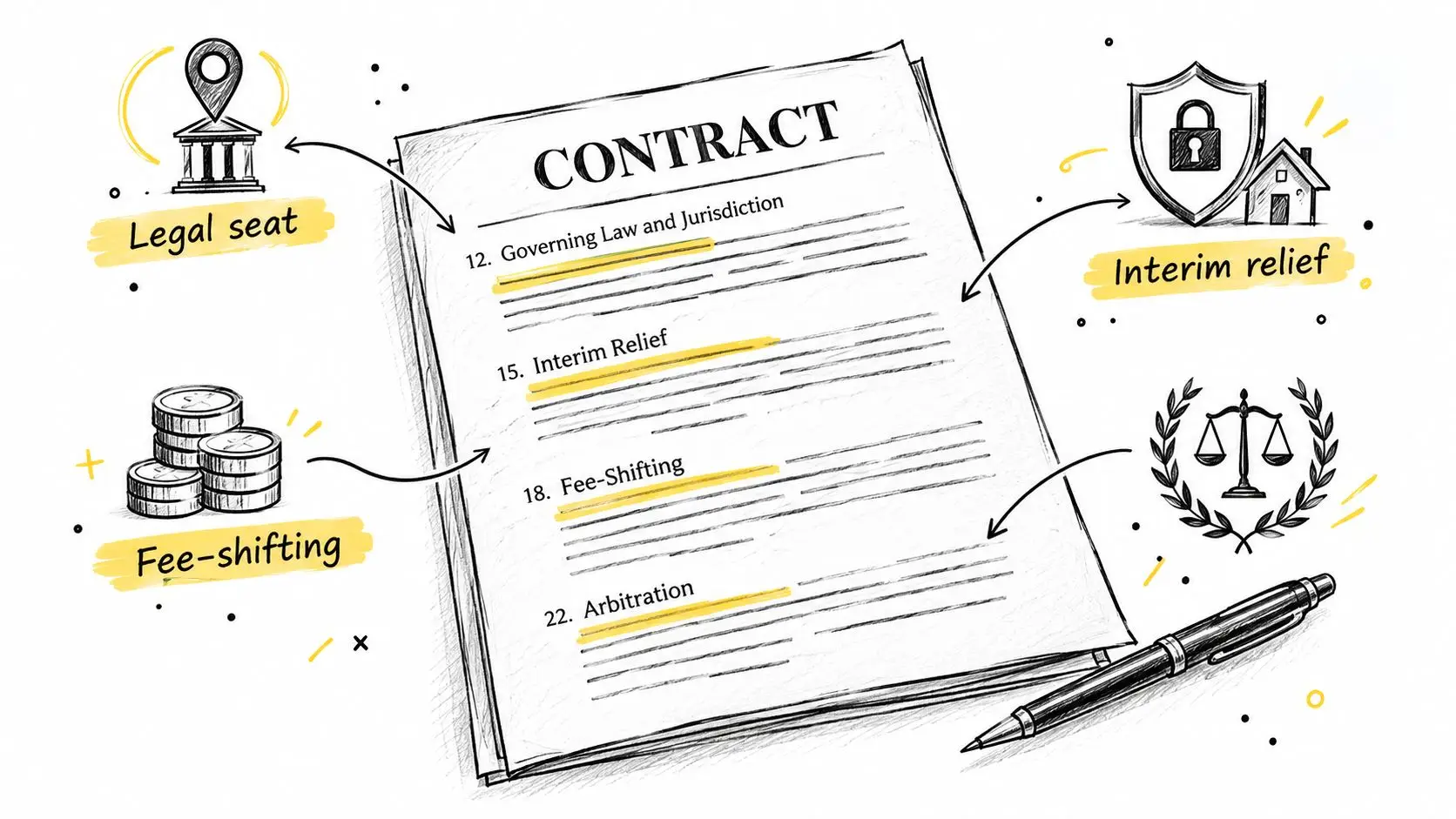
The clause should also identify the arbitration seat. The seat determines the procedural law supervising the arbitration and often affects court support and challenges. The hearing venue can differ from the legal seat, so the drafting should distinguish both concepts.
Avoid decorative complexity
Market commentary has identified movement toward simpler clauses that prioritize enforceability over optionality (A&O Shearman on future-proofing clauses). The concern is practical. Asymmetric rights, multiple institutions, competing courts, and unilateral options can create an argument about where the dispute belongs.
A board should ask four direct questions:
- Substantive law: Which law should interpret ownership, duties, valuation, and breach?
- Seat: Which legal system should supervise arbitration?
- Forum: Which institution or court should hear the dispute?
- Enforcement: Where must the resulting award or judgment operate?
A shorter clause with mandatory sequencing often performs better than an elaborate clause with competing pathways. Cross-border certainty depends on clarity, not ornament.
Designing a Three-Layer Escalation Ladder
A strong clause starts before a legal dispute exists. The most effective structure uses three layers, prevention, internal de-escalation, and external resolution. Each layer should address a different failure mode.
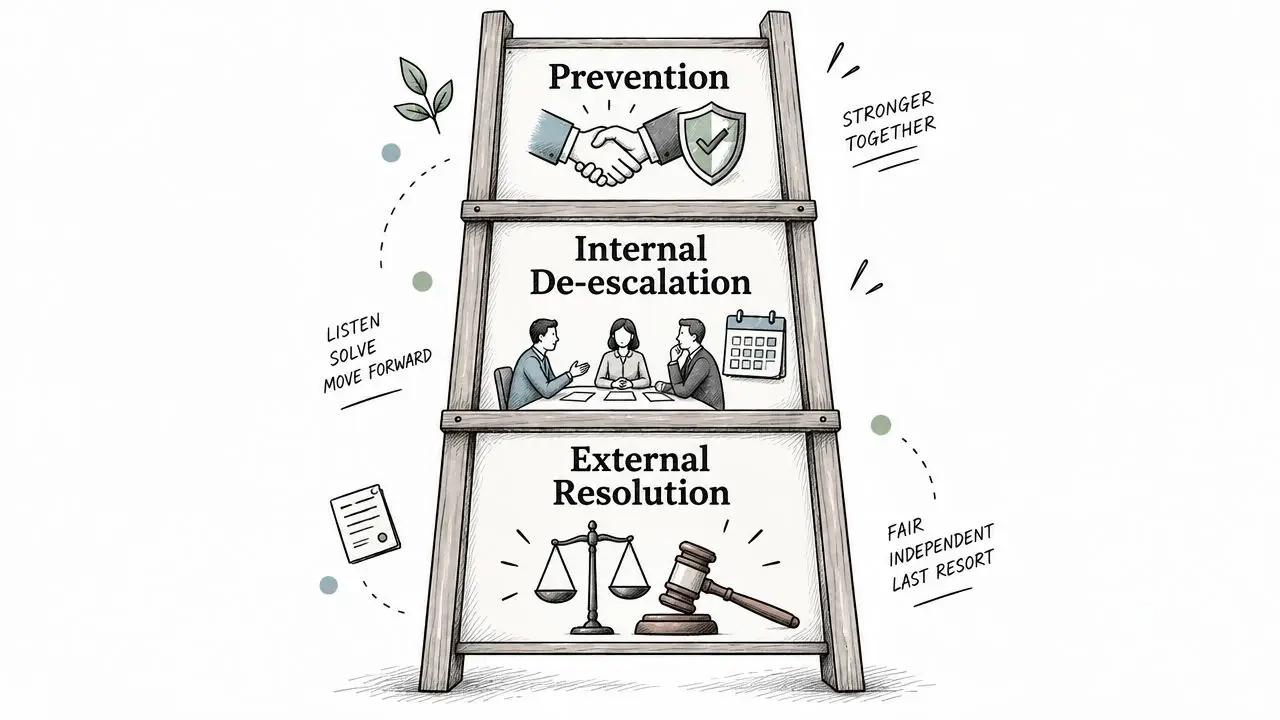
Layer one prevents avoidable disputes
Prevention starts with governance. The agreement should define reserved matters, approval thresholds, information rights, signing authority, capital obligations, and reporting duties. It should also state how partners handle conflicts of interest and urgent business decisions.
These provisions reduce disputes because they answer operational questions before personalities dominate. They also create evidence. Clear minutes, notices, approvals, and financial reports help the parties identify the underlying disagreement.
| Layer | Mechanism | Primary Objective |
|---|---|---|
| Prevention | Reserved matters, reporting duties, authority limits | Reduce ambiguity |
| Internal de-escalation | Notice, management meetings, escalation ladder, cooling-off period | Preserve the relationship |
| External resolution | Mediation, arbitration, or litigation | Obtain a binding outcome |
Layer two creates controlled internal pressure
The clause should identify who may issue a dispute notice. It should require a meeting between authorized representatives, not merely a conversation between lawyers. It should also set a deadline for that meeting and define the information each party must provide.
A cooling-off period can prevent impulsive termination, asset transfers, or public accusations. Yet the period should not block urgent relief. The agreement should preserve access to a court or emergency procedure when a party risks asset dissipation, confidentiality breaches, or irreversible harm.
The internal ladder may also require escalation to senior executives, a board committee, or an independent adviser. Each step needs a defined trigger. Otherwise, one party can argue that the other skipped a prerequisite.
Layer three resolves the remaining dispute
If internal steps fail, mediation should usually come next. It gives the partners a confidential setting to test settlement without surrendering their legal positions. The clause should state who appoints the mediator, which rules apply, where the mediation occurs, and when a party may proceed to arbitration or court.
Deadlock provisions deserve separate treatment. A buy-sell clause can force a commercial exit rather than invite indefinite stalemate. Under this mechanism, one partner names a price, and the other must choose whether to buy the offeror’s interest or sell their own interest at that same price (academic discussion of buy-sell mechanisms).
That mechanism carries serious valuation and financing risks. The parties should address payment timing, permitted funding, valuation assumptions, transfer completion, and consequences for nonperformance. A shotgun provision may work between financially balanced partners, but it can operate unfairly where one partner controls liquidity.
Drafting Arbitration Rules and Cross-Border Enforcement
Arbitration becomes useful only when the clause answers procedural questions before the dispute starts. A simple reference to “binding arbitration” leaves too much room for argument. The parties should select rules, institution, seat, language, appointment method, and tribunal powers.
An arbitration clause in a partnership agreement should specify how an arbitrator is appointed, what powers the arbitrator has, and whether any right of appeal exists (JAMS arbitration commentary). Those details shape cost, speed, evidence, and enforceability.
Choose the procedural framework
Name an established institutional or ad hoc framework. Then define the appointment process if the selected rules leave room for disagreement. The clause should address tribunal composition, qualifications, conflicts, language, document production, hearings, and confidentiality.
The seat requires particular care. A hearing may occur in a convenient city, while the seat remains elsewhere. The agreement should state both clearly if the parties intend that distinction.
Preserve urgent remedies
Arbitration may not provide immediate control over third parties or assets. The clause should therefore preserve applications to competent courts for interim relief. It should explain whether a party may seek freezing orders, protective orders, injunctions, evidence preservation, or security.
The wording must avoid contradiction. A clause that says arbitration is exclusive but also permits broad court litigation may generate jurisdictional arguments. The better approach identifies the limited court powers that remain available.
Address enforcement realities
Cross-border enforcement requires more than selecting a prestigious institution. Counsel should examine the likely asset locations, service requirements, local public policy, language needs, and recognition process. Israeli parties should also assess whether the chosen forum can provide effective relief against assets or counterparties outside Israel.
Language deserves operational attention. Translation errors can change the meaning of a notice, witness statement, or settlement term. For hearings involving multiple languages, a certified arbitration interpreter may help preserve procedural fairness and an accurate record.
Costs also require deliberate drafting. The clause may authorize allocation of legal fees, tribunal costs, and expert expenses according to the outcome or the parties’ conduct. It should avoid language that creates uncertainty about the tribunal’s power to make that allocation.
Finally, define the gateway precisely. State who sends notice, when the period begins, how service occurs, which steps are mandatory, and when arbitration may commence. Those details reduce forum fights and protect the final award from avoidable procedural attacks.
Drafting Pitfalls and Operational Redlines
Complexity can appear polished during negotiation. It becomes dangerous during a founder dispute. Every optional step creates another opportunity to argue that arbitration started too early, mediation lacked authority, or a notice failed to satisfy the contract.
A practical methodology requires tight trigger language. The clause should identify who may initiate the process, the deadline after notice, the forum rules, the seat, governing law, confidentiality, and interim relief rights (NADR publications).
Redline the vague language
The following phrases create avoidable risk:
- “The parties shall try to resolve disputes amicably.” Replace this with a named decision-maker, written notice, meeting requirement, and deadline.
- “Mediation may occur before arbitration.” Replace “may” with mandatory sequencing if mediation serves as a condition to arbitration.
- “Arbitration shall take place in Israel.” State the legal seat, institution, language, and procedural rules.
- “The parties may seek urgent relief.” Identify the courts or emergency mechanism that may grant it.
- “The prevailing party may recover costs.” Confirm that the tribunal has authority to award fees and define relevant costs.
A clause also needs a clear definition of “dispute.” Some agreements cover only contractual claims. Others include statutory, tort, fiduciary, ownership, and validity claims. The parties should decide whether related claims must proceed together.
Limit optionality
A unilateral option to choose arbitration or litigation can benefit one party in theory. In practice, it may encourage a jurisdictional fight. Multiple institutions can create the same problem.
Drafting principle: Use one mandatory route unless the commercial relationship genuinely requires a carefully bounded option.
Confidentiality also needs scope. The clause should address disclosures to affiliates, funders, insurers, auditors, regulators, professional advisers, and courts. It should state whether confidentiality survives settlement or termination.
The final review should test the clause against an actual crisis. A reviewer should ask who sends the first notice, where it goes, which language controls, who attends the meeting, what happens if the other party refuses, and which court can protect assets. If the answers aren’t immediate, the drafting still needs work.
Strategic Risk Mitigation and Next Steps
A partnership agreement dispute resolution clause should match the partnership’s economics, governance, and geography. The same wording won’t suit a founder venture, a family-owned business, and a multinational joint venture. Each structure creates different risks around control, valuation, information, and enforcement.
Recent commentary on joint ventures emphasizes that internal governance mechanics often create more value than the final arbitration step. Forced meetings, notice triggers, escalation ladders, and cooling-off periods can keep the business functional while the parties address the disagreement (joint venture misalignment analysis).
An objective review sequence
A company reviewing its existing agreements should take these steps:
- Map the dispute universe. Identify likely conflicts involving control, capital, distributions, intellectual property, valuation, transfers, and termination.
- Test the governance layer. Confirm that authority, voting, reporting, and reserved matters operate without hidden gaps.
- Audit the notice process. Confirm permitted senders, delivery methods, addresses, language, and effective dates.
- Separate law and forum. Check that governing law, seat, hearing venue, institution, and court jurisdiction align.
- Protect urgent interests. Preserve access to interim relief, evidence preservation, and asset protection.
- Test enforcement. Review likely asset locations, recognition risks, translation needs, and service requirements.
- Validate execution. Confirm that every partner signed the correct version and that electronic signing records remain available.
Execution controls can matter as much as clause language. A practical resource on 10 signature security best practices can help transaction teams review authentication and recordkeeping procedures.
For Israeli companies and foreign corporations, the recommended strategic path is a coordinated legal review before a dispute emerges. RNC Group handles international commercial agreements, staged dispute strategies, forum selection, arbitration planning, and cross-border correspondence for businesses operating between Israel and foreign markets.
The recommended strategic path is to avoid a clause that merely names arbitration. It should create a functioning system that prevents confusion, forces disciplined escalation, and preserves a credible route to a binding result.
A review of this article should not replace advice on a specific agreement, dispute, jurisdiction, or enforcement issue. Laws and procedures change, and the outcome depends on the contract language and facts. No reader should rely on this information without obtaining advice from qualified counsel.
RNC Group advises Israeli and international businesses on partnership agreements, dispute-resolution architecture, arbitration, mediation, and cross-border enforcement strategy. Businesses seeking to avoid costly drafting mistakes can contact the firm through RNC Group for a focused review of their partnership infrastructure.