
Under Israeli law, specific performance is a principal contractual remedy rather than merely an exception, but courts still condition enforcement on feasibility, definiteness, and the absence of statutory barriers, especially in cross-border disputes. A specific-performance clause strengthens the contractual position, but it doesn’t guarantee that a court will order performance or that another jurisdiction will recognize and enforce the order.
Can a carefully drafted specific performance contract secure the transaction, delivery, transfer, or service the parties bargained for, or does it merely create an argument for later litigation? The answer depends less on emphatic wording than on the legal system, the precision of the obligation, the evidence available at the time of breach, and the practical ability to enforce an order across borders.
For non-Israeli businesses dealing with Israeli counterparties, that distinction matters. Israeli law gives enforced performance a more prominent position than traditional common-law systems, yet the requested act must still be possible, sufficiently defined, and legally available. A remedy that looks powerful on paper can become difficult to obtain where the asset is replaceable, the obligation requires continuing supervision, or the defendant and relevant assets are outside Israel.
Table of Contents
- What Specific Performance Means for Commercial Contracts
- How Equity and Israeli Statutory Law Shape the Remedy
- Common-Law versus Israeli Approaches to Performance Orders
- Why Strong Clauses Do Not Guarantee Performance Orders
- How to Draft Enforceable Specific Performance Obligations
- When Specific Performance Makes Economic Sense by Deal Type
- Enforcement Tactics and Cross-Border Risk Management
- Practical Next Steps for International Commercial Parties
What Specific Performance Means for Commercial Contracts
What happens when a breach leaves money unable to restore the commercial position the contract was meant to create? Specific performance is a court-ordered remedy requiring the breaching party to perform the precise contractual obligation, rather than merely paying damages. Its practical use is strongest where substitute performance is unavailable or materially different, including unique real estate, scarce assets, or strategically important contractual rights. The legal treatment of specific performance explains why the remedy is materially different from an ordinary damages award.

A damages claim asks the court to value the loss and order financial compensation. A performance claim asks the court to require the promised act itself. That distinction can be decisive where the contract concerns a particular property, a scarce production allocation, an irreplaceable licence, a control position, or a transaction whose timing affects its value.
The adequacy question
Courts generally begin with an adequacy-of-damages analysis. If the claimant can obtain an equivalent substitute in the market and recover the relevant price difference, money may be treated as sufficient. If no equivalent substitute exists, or if the value of replacement is difficult to calculate, a performance order becomes more plausible.
The claimant should therefore build evidence around practical, not rhetorical, questions:
- Market availability: Can an equivalent asset, service, right, or transaction be obtained?
- Uniqueness: What makes the promised performance materially different from available substitutes?
- Timing: Would a later substitute arrive too late to deliver the contracted commercial benefit?
- Replacement cost: Can the cost of replacement be calculated reliably?
- Strategic value: Does the obligation concern control, exclusivity, access, or another position that money cannot reproduce?
A strong clause won’t fill an evidentiary gap. The contract and the surrounding records should show why the substitute isn’t equivalent.
Practical rule: Draft the evidence trail at the same time as the remedy clause. If uniqueness matters, the contract should identify the feature that makes the subject matter irreplaceable.
Once granted, non-compliance can expose the defendant to contempt-related sanctions, making the order operationally stronger than an ordinary damages award. That strength also creates a drafting risk. Courts are less comfortable ordering obligations that are vague, personal in nature, or dependent on continuing judicial supervision. The requested act should be stated as a concrete obligation with identifiable deliverables, deadlines, conditions, and verification steps.
How Equity and Israeli Statutory Law Shape the Remedy
Specific performance developed from a structural divide in English legal history. Common-law courts traditionally treated damages as the primary, or effectively exclusive, contractual remedy. The English Court of Chancery developed specific relief where money couldn’t adequately compensate the injured party, creating a separate equitable tradition shaped by concerns such as uniqueness, mutuality, supervision, and the adequacy of damages.
That history still affects commercial expectations. A party trained in a common-law system may assume that damages are the normal remedy and that performance is exceptional. A party contracting under Israeli law starts from a different statutory framework.
The Israeli statutory shift
Under Israel’s Contracts (Remedies for Breach of Contract) Law, 1970, specific performance, often described as enforced performance, is treated as a principal remedy for breach rather than merely an exceptional equitable remedy. The injured party may generally seek performance, termination, or damages, subject to the statutory structure and its exceptions. An overview of Israeli contract law describes the significance of that remedial position.
The modern Israeli approach followed a major statutory change. Before the 1970 legislation, Israeli law generally followed the common-law model in which damages were ordinary and specific performance was exceptional. The legislation shifted the framework toward a civil-law model in which enforced performance became the primary remedial entitlement, subject to defined limitations. Comparative commentary on the Israeli remedial framework highlights why common-law precedent shouldn’t be applied mechanically to an Israeli-law dispute.
This doesn’t mean an Israeli court will order every promised act. Feasibility, precision, statutory barriers, personal-service concerns, and supervision remain material. A party seeking performance must still identify the exact obligation and show that the court can formulate and administer an order without converting the litigation into indefinite operational management.
For a non-Israeli counterparty, the governing-law clause is therefore not a technical afterthought. It can change the starting point of the remedy analysis, the assumptions that counsel bring to negotiations, and the urgency of preserving evidence after a breach.
Common-Law versus Israeli Approaches to Performance Orders
The central difference is remedial orientation. Traditional common-law systems generally place damages at the center of contractual relief and reserve specific performance for circumstances in which money isn’t adequate. Israeli statutory law gives enforced performance a principal position, although the claimant must still overcome the applicable exceptions and practical limitations.
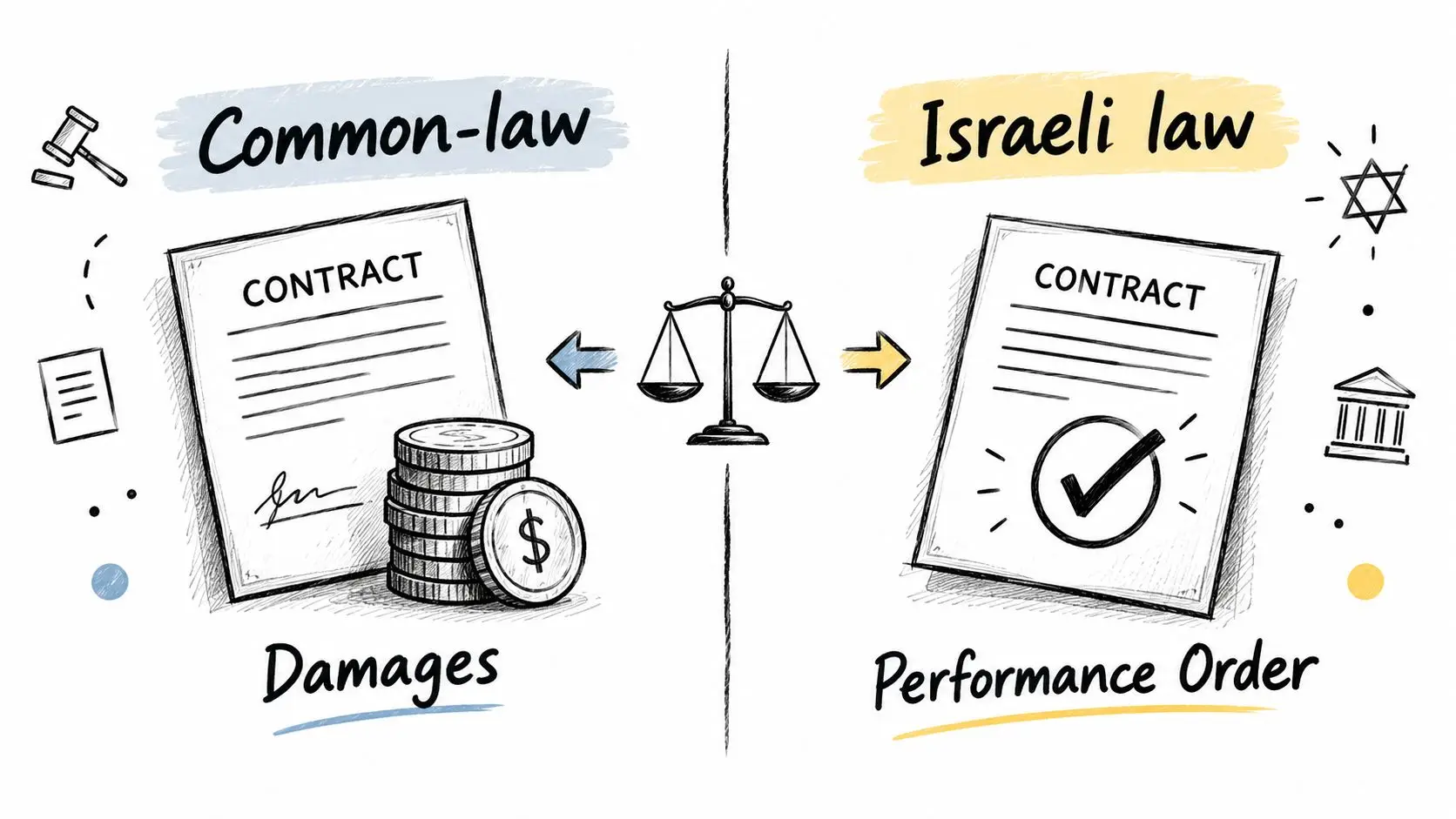
The differences that affect contracting strategy
| Issue | Traditional common-law assumption | Israeli-law starting point |
|---|---|---|
| Remedy hierarchy | Damages commonly occupy the primary position | Enforced performance is treated as a principal remedy |
| Substitute performance | A reliable market substitute can support damages as sufficient | The same practical question remains relevant |
| Precision | Vague obligations create serious enforcement difficulty | The requested performance still needs to be possible and sufficiently definite |
| Supervision | Courts may resist orders requiring ongoing supervision | Supervision and feasibility remain important constraints |
| Cross-border effect | A local order may require recognition elsewhere | Israeli entitlement doesn’t automatically solve foreign enforcement |
The difference is most significant when the contract is linked to Israel but performance, assets, or the defendant are elsewhere. An Israeli-law clause may improve the claimant’s substantive argument, but it doesn’t automatically determine the procedure in the forum where recognition or enforcement is sought.
A multinational business should separate three questions that are often collapsed into one:
- What remedy does the governing law make available?
- Can the selected court formulate and grant the order?
- Can the order be recognized and implemented where the defendant or asset is located?
Those questions can produce different answers. A termination-and-damages clause may allocate commercial consequences without excluding a performance request unless the contract and applicable law support that result. Conversely, a performance clause may be persuasive on the parties’ expectations while remaining subject to mandatory rules in the enforcement forum.
The practical conclusion is straightforward. Foreign precedent can inform negotiation, but it shouldn’t be treated as a reliable prediction of an Israeli court’s remedial analysis. Governing law, forum, arbitration arrangements, asset location, and the nature of the promised act need to be reviewed together.
Why Strong Clauses Do Not Guarantee Performance Orders
A clause stating that damages are inadequate and that the parties are entitled to specific performance is useful, but it isn’t self-executing. Courts assess the pleaded facts, the feasibility of the order, the precision of the obligation, and the evidence showing that performance is genuinely necessary. Procedural timing can matter as much as the clause itself, particularly where an asset may be transferred or a commercial relationship may change before judgment.
Why claimants move toward money
A performance claim can become unattractive when the requested order is difficult to define or administer. A claimant may also need to preserve evidence showing that the asset is unique, that replacement isn’t realistic, that the obligation remains feasible, and that the defendant’s conduct hasn’t made performance impossible.
A clause alone doesn’t answer those questions. The more useful architecture includes:
- Milestones: The parties record intermediate acts rather than relying on one ultimate closing or delivery date.
- Audit rights: The claimant can verify performance and preserve contemporaneous records.
- Escrow arrangements: Relevant documents, funds, or assets can be protected while obligations remain outstanding.
- Notice procedures: The contract creates a clear record of breach, cure opportunities, and continuing readiness to perform.
- Irreplaceability language: The agreement identifies the commercial features that make substitute performance inadequate, without assuming that the court must accept the conclusion.
- Operational records: The parties preserve market searches, allocation data, technical specifications, and correspondence relevant to feasibility.
The question to ask at formation isn’t only, “Can the contract request specific performance?” It is, “What records will prove, months or years later, that this particular performance was feasible, precise, and irreplaceable?”
How to Draft Enforceable Specific Performance Obligations
Vague promises are difficult to enforce because they leave the court to determine what performance means after the relationship has broken down. A better approach translates the commercial objective into an outcome that can be measured, verified, and tied to a defined consequence.

Build the obligation around the result
Performance-based contracting becomes technically enforceable when the parties specify objective outcomes, measurable standards, verification methods, and consequences for variance. Outcome-based contracting guidance supports a structure that makes the performance question observable rather than dependent on competing impressions.
Each material obligation should address:
- Metric: What result must be achieved?
- Baseline and target: What is the starting condition, and what must the counterparty deliver?
- Measurement frequency: When and how often will performance be measured?
- Accepted data source: Which records, systems, tests, or reports control?
- Testing and audit rights: Who can verify the result, and on what notice?
- Cure period: What opportunity exists to correct a variance?
- Consequence: How is a payment adjustment, service credit, termination trigger, or other remedy calculated?
The metric should measure the result rather than an input that may not produce it. For example, verified availability or response time is more useful than a staffing promise if the commercial objective is reliable service. The contract should also state whether the metric is a condition of payment, a warranty, or an independent covenant, because that classification can affect remedies and termination rights.
Prevent disputes over measurement
Definitions need to cover exclusions for force majeure, customer-caused delay, and measurement outages. Without those exclusions, the parties may litigate whether the metric failed because of a breach or because the measurement environment was disrupted.
Adaptive-review provisions can permit recalibration when technology, regulation, or market conditions change. They should not permit one party to dilute the original standard unilaterally. A workable clause states who can request review, what evidence supports adjustment, how the parties decide, and what happens while the review remains unresolved.
The drafting objective isn’t to make the clause sound severe. It is to make the required act sufficiently concrete that a court, arbitrator, or appointed verifier can identify what must happen and determine whether it happened.
When Specific Performance Makes Economic Sense by Deal Type
Specific-performance provisions are most rational when the promised transaction is difficult to replace and damages may not protect the expected benefit. They are less compelling where money can readily substitute for delivery or where enforcement would require prolonged judicial supervision.
M&A and asset sales
In an acquisition, the buyer may seek an order requiring the seller to close, while the seller may seek enforcement of the buyer’s obligation to consummate the transaction. The value of the remedy can arise from the uniqueness of the target, the control position, the timing of the opportunity, or the difficulty of finding an equivalent business.
The clause should be coordinated with closing conditions, exclusivity, termination fees, reverse break fees, escrow, financing limitations, and dispute-resolution provisions. A remedy clause that ignores those mechanisms may create internal tensions rather than useful negotiating power.
Financing and recurring services
Financing arrangements often present a different economic case. The underlying obligation may be more readily valued in money, and an order requiring continuing conduct may create supervision concerns. That doesn’t make specific performance irrelevant, but it does mean the parties should identify the particular obligation for which performance is clearly superior to damages.
For services, licensing, distribution, or supply arrangements, the strongest provisions usually attach performance to measurable deliverables, verification, cure procedures, and carefully defined consequences. They shouldn’t assume that a court will supervise an ongoing relationship indefinitely.
Enforcement Tactics and Cross-Border Risk Management
The enforcement plan should begin before breach. A claimant that waits until the counterparty has transferred the asset, changed the operating relationship, or destroyed relevant records may face a weaker practical position even if the contract contains an apparently strong remedy.

Preserve the proof of irreplaceability
The evidence should connect the promised act to the commercial harm caused by non-performance. Relevant material may include:
- The exact act required: The signed contract, schedules, specifications, approvals, and implementation records should identify the performance sought.
- Continuing feasibility: Records should show that the defendant can still perform and that the claimant remains ready to accept performance.
- Scarcity or uniqueness: Market inquiries, allocation records, technical dependencies, and transaction-specific features can demonstrate why substitution isn’t equivalent.
- Supervision risk: The proposed order should avoid requiring the court to manage an open-ended relationship.
- Timing: The record should show why delay would undermine the contracted benefit.
The recommended strategic path is a remedy-specific review at formation and immediately after breach. The review should test the requested performance against governing law, forum, arbitration terms, asset location, and the recognition rules that may apply where enforcement is needed.
Protect the position before judgment
Interim measures may be important before assets or relationships change, subject to the authority and procedural rules of the selected forum. Notice should be sent carefully. It should identify the breach, preserve rights, confirm readiness to perform where relevant, and avoid unnecessary admissions about impossibility or substitute value.
Monetary arbitral awards generally have more established cross-border recognition mechanisms than performance orders. That doesn’t make arbitration unsuitable for a performance dispute, but the dispute-resolution clause should be assessed with the remedy in mind. The parties should ask whether the selected tribunal can grant the requested relief, whether the seat permits it, and whether the likely enforcement state will recognize and implement that form of order.
A performance strategy fails when it treats the first judgment as the finish line. Cross-border enforcement must be designed from the moment the contract is signed.
Where non-compliance may lead to contempt-related consequences, the order must be clear enough for the defendant and enforcing court to understand exactly what conduct is required. Ambiguity creates room for resistance and makes enforcement more difficult.
Practical Next Steps for International Commercial Parties
A non-Israeli company entering an Israeli-linked transaction should not begin with boilerplate. It should begin by identifying the commercial outcome that money would fail to replace. The answer may concern a particular asset, closing, licence, delivery allocation, operational capability, or control position.
At contract formation
The recommended strategic path is to create a short remedy schedule alongside the main agreement. It should record:
- The promised act: State the act, deliverable, deadline, dependencies, and acceptance criteria.
- The proof: Identify the records, tests, reports, and audit rights that will establish performance or breach.
- The remedy interaction: Coordinate performance rights with damages, termination, service credits, escrow, exclusivity, and agreed fees.
- The legal map: Review governing law, forum, arbitration, asset location, and likely recognition issues together.
- The exception analysis: Test feasibility, precision, supervision, personal-performance concerns, and any statutory barriers.
For an Israeli counterparty, a termination-and-damages clause shouldn’t be assumed to eliminate a request for enforced performance unless the contract and applicable law support that result. The parties should also avoid treating an acknowledgment of irreparable harm as conclusive. It can help show commercial intent, but the claimant still needs facts that support the requested order.
Immediately after breach
The first response should preserve evidence and protect optionality. A business should stop informal deletion practices, collect relevant communications and transaction records, document market availability, confirm whether performance remains possible, and obtain advice on interim measures before the position changes.
A cross-border dispute also requires disciplined coordination between commercial, litigation, and local counsel. The same facts may support performance in one forum but damages or another remedy in a different enforcement state. Counsel should therefore assess not only the merits of the order, but also the practical route from contract to judgment to implementation.
RNC Group provides drafting and advisory services for commercial agreements involving performance clauses, measurable service obligations, delivery requirements, minimum purchase commitments, and contractual risk management. Businesses seeking to avoid costly mistakes in a specific-performance dispute can contact RNC Group for a jurisdiction-aware review of the agreement, evidence, forum, and enforcement strategy.
RNC Group advises international businesses and Israeli companies on commercial agreements, performance obligations, and cross-border disputes involving Israeli counterparties. The firm can review whether a specific-performance clause is supported by measurable obligations and a workable enforcement pathway, and readers can visit RNC Group to discuss the risk before a breach becomes a larger dispute.
In our experience, the performance clauses that hold up are the ones tied to a specific, measurable act and backed by records kept from day one, not by strong wording alone.
Seeking specific performance across borders? Winning the judgment is only half the battle.
Enforceability, interim relief and the defendant’s asset location decide whether a performance order is worth more than paper. Strategy must start before filing.
We litigate and enforce contract claims with cross-border elements. Reach us on WhatsApp or by email.
This article is for general information only and does not constitute legal advice. Laws and their application depend on the facts and jurisdiction and may change. Although we aim to keep this information accurate and current, we do not guarantee that it is complete or up to date. The article may contain omissions or errors. Reading this article does not create an attorney-client relationship with RNC Group. Before making a decision or taking action, seek advice from a qualified lawyer in the relevant jurisdiction.