
Contract drafting is the structured process of converting a commercial arrangement into precise, legally operative rules that allocate risk, define measurable obligations, anticipate breach scenarios, and supply evidence of what the parties intended. It normally covers the parties' identities and authority, scope of work or goods, price and payment, performance standards, warranties, confidentiality, intellectual property, liability, dispute resolution, governing law, termination, and post-termination obligations.
A founder may be dealing with this problem today: a supplier, distributor, investor, or overseas partner agrees to a commercial arrangement in meetings and emails, then the relationship begins to change. The parties remember the deal differently. One side believes approval is required before delivery; the other believes delivery itself constitutes acceptance. A payment is withheld, intellectual property is disputed, or a termination notice arrives, and the document fails to answer the question that matters most: who must do what, by when, and what happens if that obligation is not performed?
Table of Contents
- Why Contract Drafting Matters More Than You Think
- The Anatomy of a Contract Core Clauses and Risk Allocation
- The Drafting Process A Step-by-Step Framework
- Plain Language vs Legal Precision Finding the Balance
- Cross-Border and International Contract Drafting Considerations
- When to Seek Professional Legal Counsel for Contract Drafting
Why Contract Drafting Matters More Than You Think
A contract can look complete and still leave the business exposed. A long document may contain formal language, schedules, and signature blocks while failing to define the deliverable, acceptance process, responsibility for third-party costs, or remedy for delay. The problem isn't always that the parties failed to reach a commercial understanding. Often, they failed to convert that understanding into rules that remain workable when circumstances become difficult.

Consider an Israeli technology company appointing a foreign commercial partner to introduce its product in another market. The founders expect the partner to generate leads, protect confidential information, obtain approvals, and report sales. The partner expects exclusive territory, marketing support, and payment for introductions. If the agreement says only that the partner will “promote the product” and receive a commission, each side may believe the document confirms its own understanding.
That is where what is contract drafting becomes a practical business question rather than a vocabulary exercise. Contract drafting converts the arrangement into enforceable written terms and identifies the evidence that will show whether each party performed. Under Uniform Commercial Code §2-201, a United States sale-of-goods contract priced at $500 or more generally requires a signed writing to be enforceable, subject to exceptions. The writing also limits enforcement to the quantity shown in it. That rule concerns a particular United States sales context, not every commercial contract or Israeli transaction, but it illustrates the broader point: legally significant details need to appear in a form recognized by the applicable legal system.
Every sentence allocates risk
A deadline decides who bears the consequences of delay. An acceptance clause decides whether the customer can reject work. An indemnity decides which party absorbs a specified third-party claim. A limitation of liability may protect one side from a large loss, while an exception may preserve responsibility for particular misconduct or obligations.
The drafter isn't merely recording what was agreed. The drafter is deciding how the agreement behaves when assumptions fail.
Practical rule: If a business employee can't identify the responsible person, required action, deadline, evidence of completion, and consequence of non-performance, the clause needs another review.
International transactions increase the stakes because several legal systems may influence interpretation, execution, enforcement, taxation, language, and dispute procedure. A contract that works as a domestic operating document may be incomplete for a cross-border relationship. The parties may need to decide which law governs substantive rights, where a dispute is heard, which language controls, and how notices and signatures will be authenticated.
The recommended strategic path is to treat drafting as commercial risk design. Legal counsel, executives, finance, operations, and technical teams should all test whether the document reflects the transaction they intend to operate, not merely the template they started with.
The Anatomy of a Contract Core Clauses and Risk Allocation
A contract starts to matter the day something goes slightly off script. Delivery is late. A key input is missing. The customer says the work is incomplete, while the supplier says it met the spec. At that point, the document is no longer a record of goodwill. It becomes the operating manual for the relationship.
That is why the core clauses have to do more than sound legally correct. They need to tell people inside the business what to do, when to do it, who approves it, and what happens if the expected sequence breaks. If non-lawyers cannot find those answers after signature, the contract is underdesigned.
The commercial foundation
Start with identity. The opening provisions should name the correct legal entities, include registration details where relevant, state addresses, and make clear who has authority to sign. If the wrong affiliate signs, or a signatory lacks authority, the parties may spend time arguing about who is bound before they even reach the dispute.
Then comes scope, which is where a commercial idea turns into a working system. A usable scope clause identifies the deliverables or goods, the specifications they must meet, any dependencies on the other party, the exclusions, the milestones, the acceptance criteria, and the change process. “Provide support” is too vague to run a real service relationship unless the agreement explains what support includes, how requests are submitted, and how response or resolution is measured.
Payment terms need the same level of design. Price alone is not enough. The clause should say which currency applies, when invoices can be issued, how taxes and expenses are handled, what triggers payment, how disputed invoices are treated, whether withholding is allowed, and what follows from late payment where the law permits it. For Israeli businesses, tax treatment and invoicing should be checked against the transaction and applicable law, because not every supply, location, or cross-border structure is treated the same way.
Protection when performance diverges
Risk allocation becomes practical rather than abstract. Representations and warranties assign responsibility for present facts and promised conditions, such as authority, compliance, ownership, or the condition of goods and services. Indemnities deal with specified losses or third-party claims. Liability limits set the outer financial boundary of exposure. Read together, these clauses answer a simple operational question: if a problem appears, who absorbs the cost first, and how far does that exposure go?
Confidentiality and intellectual property clauses are often treated as standard text, but they control day-to-day behavior. A workable confidentiality clause defines what information is protected, how it may be used, who may receive it, which exclusions apply, what security is expected, and whether information must be returned or deleted. Intellectual-property language should separate pre-existing materials from new work and state clearly whether the customer receives ownership, a license, or narrower usage rights. Without that distinction, teams may assume they bought rights they only licensed, or reuse materials they were never allowed to copy.
Termination also needs to be drafted as an exit process, not a dramatic final paragraph. The clause should identify triggers, notice requirements, cure periods where appropriate, the effect of insolvency or a change of control, and what happens to ongoing work once the relationship ends. Post-termination terms may cover unpaid amounts, transition support, confidentiality, data handling, continued use of intellectual property, return of property, and dispute rights.
The enforcement architecture
Enforcement clauses decide where disagreements go and under which rules they are resolved. Governing law answers one question. Forum answers another. A contract may choose one legal system to govern substantive rights and a different court or arbitral structure to handle procedure. If the parties select arbitration, the clause should address the institution or ad hoc framework, the seat, the language, the appointment method, the number of arbitrators, confidentiality, interim relief, notices, and costs.
Loose drafting here creates expensive distraction. A generic arbitration sentence can leave major procedural issues open. An inconsistent dispute clause can trigger an argument about venue before anyone addresses the underlying commercial problem.
The same operational discipline applies after signature. A change agreed in calls or email but never reflected in the signed text can leave the business performing one deal while the contract still describes another. Finance leaders reviewing contract modification oversight for CFOs should look closely at approval authority, version control, evidence of consent, and whether changes to scope, price, timing, or delivery also change the risk allocation.
The technical objective is not formal validity alone. It is to reduce interpretive variance when real events differ from the parties' original expectations.
The Drafting Process A Step-by-Step Framework
Good drafting starts before anyone edits a template. The legal team needs a reliable account of the commercial deal, the business objective, the intended operating model, and the risks that the parties have negotiated.
Start with the transaction map
The first working document should identify:
- The parties: Which entity is contracting, who owns the relevant rights, and who has authority to sign?
- The exchange: What does each party provide, and what does each party receive?
- The dependencies: Which approvals, inputs, licenses, personnel, data, or third parties affect performance?
- The failure points: What could delay delivery, reduce value, expose confidential information, or create a third-party claim?
- The exit plan: How can the relationship end, and what must continue afterward?
The answers should come from the people who will administer the agreement, not only from the negotiating team. Finance may identify invoicing risks that the business sponsor overlooked. Operations may know that a proposed acceptance test cannot be performed. Technical personnel may distinguish between a deliverable and the underlying system used to create it.
Draft from the deal, not from memory
A template can provide structure, but it shouldn't determine the transaction. The drafter should select the appropriate agreement framework, then replace assumptions with transaction-specific terms. Defined terms should be necessary, used consistently, and tied to the provisions that depend on them.
Cross-references deserve a deliberate check. A clause referring to a nonexistent schedule, an incorrect notice period, or an undefined “service level” can create uncertainty even when the surrounding language appears polished.
| Stage | Key action | Common pitfall |
|---|---|---|
| Commercial analysis | Record objectives, dependencies, risks, and negotiated positions | Treating meeting notes as complete instructions |
| Term capture | Identify scope, price, timing, ownership, remedies, and exit rights | Leaving material terms in email or oral discussions |
| Framework selection | Choose a suitable agreement structure and schedules | Reusing a template designed for a different transaction |
| Clause drafting | Convert each obligation into an actor, action, trigger, deadline, and remedy | Using broad promises without operational criteria |
| Stakeholder review | Obtain legal, commercial, finance, operations, and technical feedback | Asking reviewers to comment without assigning review questions |
| Consistency check | Test defined terms, schedules, cross-references, and hierarchy clauses | Allowing conflicting provisions to survive compilation |
| Execution review | Confirm final text, authority, signature process, and document retention | Signing a version that doesn't match the negotiated version |
Test the finished document
A useful final review asks a non-lawyer to locate the answer to practical questions. Where is the delivery requirement? How does the customer reject defective work? Which email address receives formal notice? What happens to confidential information after termination? Who approves a scope change?
If the answer requires reconstructing several clauses, schedules, and emails, the agreement may need clearer architecture. The recommended strategic path is to produce a compliance calendar or responsibility matrix alongside the signed contract, showing each obligation, owner, trigger, evidence, and escalation route.
Plain Language vs Legal Precision Finding the Balance
A founder signs a contract that looks clean and readable. Two weeks later, the operations team still cannot answer basic questions. When does the approval clock start? Which defects allow rejection? Who must send notice, and to which address? That is the true test. Contract drafting is not only legal writing. It is operational design for the people who have to carry the deal out after signature.
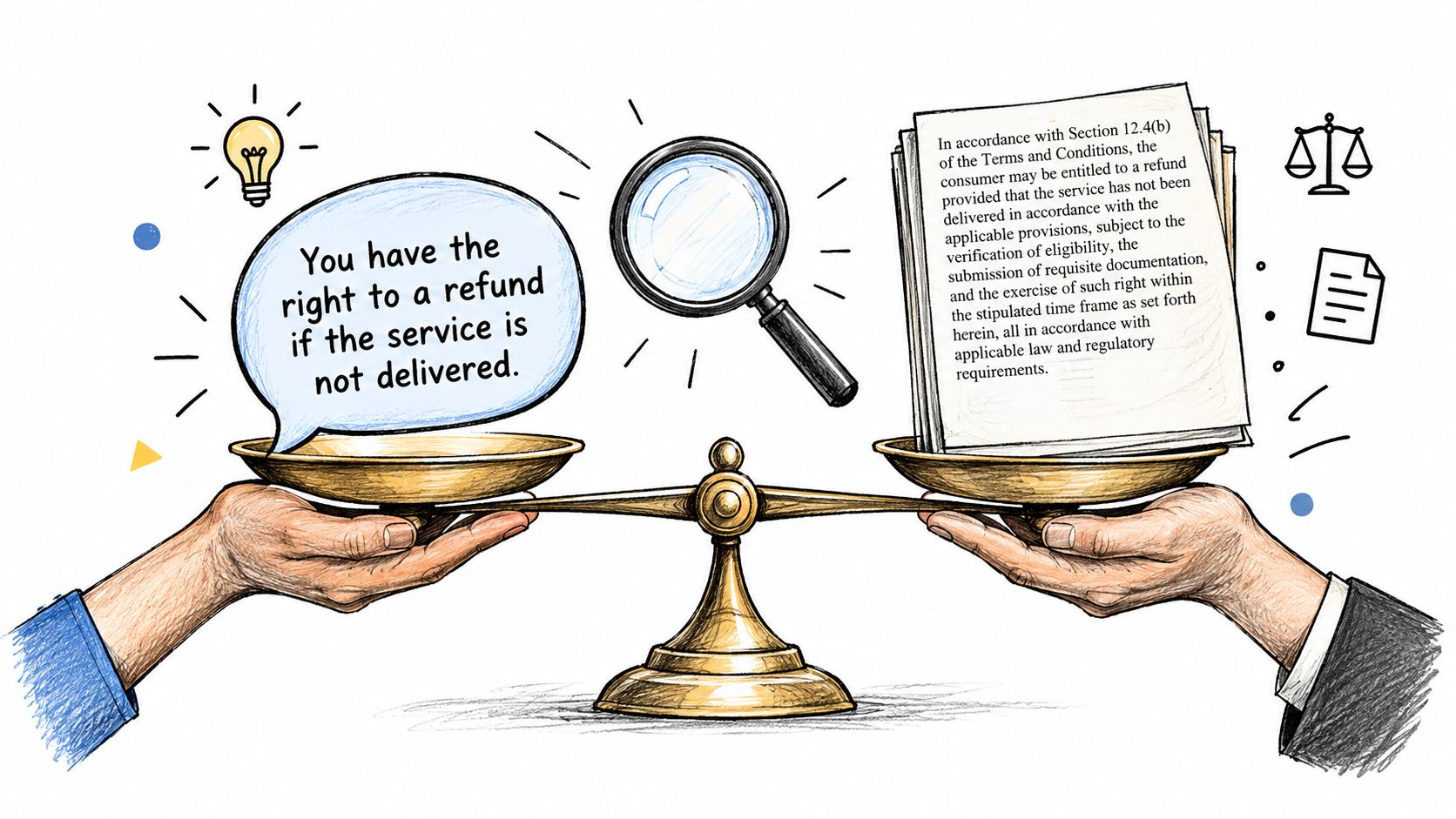
Research noted earlier shows that simplified contract language improves understanding and recall for both lawyers and non-lawyers. That matters, but plain language does not mean stripped-down language. A contract becomes easier to use when the reader can find the rule, understand what triggers it, and follow what happens next.
Clarity is not the same as simplicity
Take a familiar example. “Payment will be made promptly” sounds friendly, but it gives finance no working instruction. “The customer shall pay each undisputed invoice within the agreed period after receipt” is better only if the contract also explains what counts as receipt, what an invoice must include, when a dispute must be raised, and what happens while that dispute is pending.
That is the balance to aim for. The language should be readable, but the obligation must still work under pressure, during delay, disagreement, or handover to a new team member.
Effective drafting usually has five features:
- Active responsibility: say who must act.
- Concrete triggers: tie deadlines to events that can be proved, such as receipt of a document or completion of testing.
- Controlled terminology: use one defined term consistently instead of alternating between near-synonyms.
- Logical sequencing: place the rule, the process, the exception, and the remedy in an order a reader can follow.
- Visible dependencies: show when one party's deadline depends on an input, approval, or delivery from the other.
Some legal terms still earn their place. A defined term can prevent repetition and preserve an important distinction. A remedy may need qualification because it interacts with limits on liability, indemnities, termination rights, and mandatory legal rules. Removing technical language is useful only when the meaning survives intact.
Design for the day after signature
The daily users of a contract are often not lawyers. They are project managers, accounts-payable staff, sales leaders, compliance teams, and technical leads. They need to locate deadlines, approvals, reporting duties, service levels, escalation rights, and evidence requirements without piecing together old calls and email threads.
A contract can be legally precise and still fail operationally. That happens when approval paths are buried, schedules conflict, or responsibilities are scattered across unrelated clauses. A plain-English summary does not solve that problem if the underlying allocation of risk is incomplete or the remedy cannot be enforced.
Plain language is a risk-control technique, not a substitute for legal analysis.
A strong review therefore runs in two directions. Legal reviewers check whether the wording creates the intended rights, limits, and remedies. Business users check whether they can perform, monitor, and prove compliance from the document itself. Both groups are testing the same thing from different angles: whether the contract can run the deal.
Cross-Border and International Contract Drafting Considerations
An international agreement adds more than a second address and a foreign currency. The parties must design how the contract will be interpreted, performed, challenged, and enforced across legal and linguistic boundaries.
The first decision concerns substantive law. The next concerns the forum and procedure for resolving disputes. Those choices should align with the parties' assets, counterparties, performance locations, and likely enforcement locations.
Build a complete dispute clause
A cross-border dispute-resolution provision should address the governing law and, where arbitration is selected, the seat, institution or procedural rules, tribunal composition, appointment method, language, confidentiality, interim relief, notices, and costs. The UNCITRAL Model Law materials describe the arbitration lifecycle, including the arbitration agreement, tribunal jurisdiction and composition, court intervention, and recognition and enforcement.
The seat matters because it connects the arbitration to procedural law and to courts that may supervise or set aside an award. The institution and rules must also fit together. A clause that names one institution while selecting incompatible rules, or that omits the seat, can create satellite litigation before the merits are addressed.
Arbitration isn't automatically superior to court proceedings. The appropriate mechanism depends on enforcement needs, confidentiality, interim measures, cost, speed, available assets, and the legal systems involved. The recommended strategic path is to select the procedure deliberately rather than copying a generic sentence into a template.
Treat language as a legal control
A multilingual contract needs more than translation. Different languages may express legal concepts through different terminology, assumptions, or levels of precision. A translation can be linguistically fluent while creating a different reasonable interpretation of the obligation.
Practical safeguards include:
- A prevailing-language clause: State which version controls if the texts conflict, subject to mandatory local-law limits.
- Locked numbering: Keep clause and schedule numbers aligned across language versions.
- A controlled glossary: Map defined terms and technical expressions across languages.
- A coordinated notice clause: Confirm which language may be used for formal notices and evidence.
- A single approval process: Prevent one language version from being amended without updating the others.
Electronic execution requires its own analysis. The UNCITRAL electronic commerce framework is built around non-discrimination against electronic communications, functional equivalence between electronic and paper records, and technology neutrality. It also recognizes that electronic-signature methods can differ and that reliability, identification, consent, and preservation of the signed record matter.
These principles aren't automatically binding law in every jurisdiction. The parties should check the law governing execution, the chosen dispute forum, and the countries where enforcement may occur.
Preserve the enforcement record
For arbitration, the New York Convention framework makes the written arbitration agreement and the executed record important at the enforcement stage. The parties should preserve the signed contract, incorporated rules, schedules, amendments, signature evidence, and records showing how the agreement was accepted.
A hardship clause also deserves careful treatment. Under the UNIDROIT Principles, hardship concerns a later event that significantly alters the contractual balance because performance becomes materially more costly or the counter-performance loses value, subject to conditions concerning timing, foreseeability, control, and assumed risk. A hardship mechanism doesn't automatically suspend performance or guarantee a price adjustment. The contract should state notice requirements, evidence, interim performance, negotiation procedure, and the result if renegotiation fails.
When to Seek Professional Legal Counsel for Contract Drafting
A founder signs a deal that looks familiar, then six months later the sales lead, finance manager, and operations team each read the same clause differently. That is usually the point at which legal review stops feeling optional. Contract drafting is not only legal writing. It is operational design for the people who must find their obligations quickly, understand them, and carry them out after signature.
An approved internal process may be enough for a simple, familiar, low-risk agreement. Professional counsel becomes much more useful when the deal involves significant value, unfamiliar jurisdictions, intellectual property, exclusivity, regulated activity, unusual liability allocation, multilingual documents, or a relationship that may be hard to unwind.
Time is part of the risk. World Commerce & Contracting's analysis reported average cycle times of 11.6 weeks for medium-complexity domestic contracts and 13.7 weeks for comparable international contracts, using its 2023 data. The same source also reported drafting and contract development as 15% of the responsibility categories. In larger transactions, documents also tend to become longer and denser, with more representations, covenants, conditions, indemnities, and remedies layered into the text.
That is where outside counsel earns its keep.
In our experience, many contract disputes we see trace back to a clause that was left vague at signing, usually the payment trigger, the termination right or the dispute forum. Agreeing these three points in writing before work starts is the cheapest protection a business has.
RNC Group handles commercial agreement work involving Israeli businesses, international counterparties, partnerships, founders' arrangements, mergers and acquisitions, franchises, licensing, and commercial collaborations. Its role can include mapping the transaction, drafting and negotiating terms, coordinating multilingual documents, aligning governing law and dispute provisions, and planning what happens if there is breach or termination.
A useful question is whether the agreement will still protect the business when the relationship becomes tense, the parties are operating across jurisdictions, or a non-lawyer has to administer the document under pressure.
Signing a drafted contract? The risk hides in the clauses you skim.
Liability caps, termination triggers, IP ownership and dispute clauses decide outcomes years later. A template rarely matches your deal.
We draft and review commercial contracts daily. Reach us on WhatsApp or by email.
This article is for general information only and does not constitute legal advice. Laws and their application depend on the facts and jurisdiction and may change. Although we aim to keep this information accurate and current, we do not guarantee that it is complete or up to date. The article may contain omissions or errors. Reading this article does not create an attorney-client relationship with RNC Group. Before making a decision or taking action, seek advice from a qualified lawyer in the relevant jurisdiction.