
A business bank account review can fail even when the account has no obvious fee problem. In 2026, banks increasingly assess compliance exposure, transaction architecture, fraud controls, and legal risk together, so a low-cost account may create the greatest operational danger for a global firm.
The central question is no longer, “Which bank charges the least?” It is, “Can this institution understand, support, and safely process the company’s actual business model?” That question matters particularly for firms with Israeli operations, complex ownership, cross-border payments, automated treasury systems, or disputed transactions.
A disciplined review should therefore assess the following before a company selects or retains an account:
| Review area | What management should test | Why it matters |
|---|---|---|
| Compliance | Ownership, source of funds, expected activity | Inconsistent information can trigger restrictions |
| Usage cost | Transactions, cash activity, wires, foreign exchange | Headline fees may conceal material operating costs |
| Technology | Accounting, ERP, API, and payment integration | Manual work increases friction and control risk |
| Resilience | Secondary banking access and payment continuity | One blocked account can disrupt the entire business |
| Israeli exposure | Returned-check controls and restriction rules | A restriction can affect the customer across the banking system |
The 2026 Compliance Shock in Corporate Banking
In 2026, a routine review can become a corporate liquidity event. Banks now treat account monitoring as an active risk-management function, not a passive administrative exercise.
That shift challenges a common assumption. Many finance teams still compare monthly fees, transaction allowances, and relationship support while treating compliance as an onboarding formality. Yet cross-border firms face continuing scrutiny over ownership, counterparties, transaction purpose, and source of funds.
The 2026 banking trends report identifies digital onboarding, self-service, continuous fraud protection, API connectivity, and real-time treasury as core expectations for business customers. These capabilities affect risk as much as convenience. A bank that cannot receive reliable transaction data or verify payment context quickly may escalate uncertainty during a review.
Why fee tables give incomplete answers
A bank can advertise attractive pricing while imposing operational conditions that create serious legal and commercial exposure. For example, the institution may require detailed explanations for unusual payment flows, delay outgoing transfers, or request refreshed ownership documents during a period of commercial pressure.
Global firms also face heightened sensitivity when their structures include multiple jurisdictions, layered ownership, high transaction volumes, or rapid growth. Those features don’t prove misconduct. However, they can make the company harder for a bank’s monitoring system to classify.
Board-level rule: Treat every account as a continuing compliance relationship, not as a completed onboarding project.
The recommended strategic path is to map the company’s exposure before selecting a banking partner. That map should identify payment corridors, beneficial ownership, expected counterparties, cash activity, foreign exchange needs, API dependencies, and dispute scenarios.
A better selection question
Management should ask whether the bank can explain its escalation process, documentation requirements, transaction controls, and account-exit procedures. The bank may not disclose every internal rule. Still, the company’s team should obtain clear information about service channels, review responsibilities, payment limits, and continuity options.
A business bank account review that ignores these questions produces false comfort. A review that combines cost, compliance, technology, and legal resilience gives directors a more realistic view of banking risk.
Analyzing the True Cost of Cross-Border Operations
The cost of an account appears in usage, not in the opening advertisement. A proper business bank account review should therefore separate fixed charges from activity-based charges and then connect each cost to the company’s payment profile.
A useful starting point involves four activity groups:
- Routine electronic activity, including electronic debits and credits.
- Itemized transactions, such as checks, deposits, withdrawals, or other counted items.
- Cash-like activity, including cash deposits and cash withdrawals.
- Cross-border activity, including wires, foreign exchange, and payments involving multiple jurisdictions.
The distinction matters because account providers may count these categories differently. UMB’s business checking structure includes 100, 200, or 300 transactions per cycle, depending on account tier, and charges $0.40 for each additional item. However, electronic debits and credits, bill pay, debit-card activity, and ATM transactions don’t count toward that allowance, as explained in UMB’s business checking terms.
Build a transaction map before comparing accounts
Finance officers should extract actual activity from the company’s ledger and payment systems. They should then classify each item by payment type, currency, destination, counterparty, and processing channel.
This method prevents a common error. A company may appear to have high transaction volume, yet much of its activity may fall outside the provider’s counted-item definition. Another company may show fewer payments but incur substantial costs through cash handling, wire fees, foreign exchange spreads, or minimum-balance conditions.
The MoneySavingExpert business bank account guide highlights the gap between free signup pricing and usage-based charges. A free account can still impose costs through excess transactions, cash deposits, withdrawals, wire transfers, or balance rules.
Calculate cost by operational scenario
The review should test at least three scenarios:
- Normal operations: The ordinary monthly pattern, including payroll, suppliers, customer receipts, and intercompany payments.
- Growth operations: Higher payment flows, new jurisdictions, additional currencies, and greater use of automated systems.
- Disruption operations: A blocked payment, delayed transfer, rejected deposit, or temporary account restriction.
Each scenario should include direct fees and indirect costs. Indirect costs include staff time spent reconciling manual reports, delayed supplier payments, emergency foreign exchange conversions, and legal work caused by unclear bank communications.
Foreign exchange deserves separate treatment. A bank may disclose a transfer fee while applying a less favorable conversion rate. The review should therefore compare the total amount received by the beneficiary, not merely the stated wire charge.
Negotiate based on evidence
A company with documented payment patterns can negotiate from a stronger position. It can request transaction allowances suited to its needs, clearer cash-handling terms, defined escalation contacts, and integration support.
The analysis should also test whether a low-fee provider supports the company’s actual operating model. BECU’s business checking materials highlight no monthly maintenance fee, no charge on electronic debits and credits, no foreign transaction fees, free bill pay, and remote check deposits. Those features may matter more than a headline fee when the firm operates across borders or relies on rapid deposit workflows, as described in BECU’s business checking features.
Comparing Traditional Institutions and Digital Challengers
Traditional banks and digital challengers solve different problems. A legacy institution may provide branch access, established treasury services, and broader relationship coverage. A digital challenger may offer faster onboarding, clearer interfaces, and more flexible integration.
Neither model automatically suits a global firm. The right choice depends on the company’s payment architecture, cash needs, regulatory profile, and tolerance for service dependency.
Banking Infrastructure Comparison Matrix
| Feature Category | Traditional Legacy Banks | Digital Challengers |
|---|---|---|
| Onboarding | Relationship-led, document-heavy, and often manual | Digital-first, self-service, and potentially faster |
| API connectivity | May depend on treasury packages or third-party systems | Often central to the product architecture |
| ERP integration | Frequently available through established providers | May offer modern connectors or direct interfaces |
| Foreign exchange | Relationship pricing may be available | Transparent digital workflows may improve visibility |
| Cash deposits | Branch and cash-handling infrastructure may exist | Physical cash support may be limited |
| Remote deposits | Often available through established channels | Usually central where check deposits form part of the model |
| Fraud controls | Mature controls with formal escalation channels | Continuous digital monitoring may be prominent |
| Treasury services | Broad capabilities for complex groups | Strong automation, but potentially narrower service scope |
| Human support | Relationship manager and specialist teams | Digital support, with human escalation varying by provider |
| Account closure risk | Formal processes can still produce sudden restrictions | Automated monitoring may escalate activity quickly |
The matrix shows why a simple bank-versus-fintech debate doesn’t help directors. A digital account may reduce manual work while creating dependence on API uptime, automated classification, and digital support. A legacy account may support more complex treasury requirements while requiring slower documentation and more formal escalation.
Test the complete operating chain
A technology-driven company should test whether the bank connects reliably with its accounting and enterprise systems. QuickBooks access, for example, appears in UMB’s Premier tier rather than across every tier. That detail illustrates a broader point. Integration often depends on the selected product, not merely the bank’s overall capabilities.
The evaluation should cover payment initiation, approval controls, reconciliation, reporting, user permissions, and audit records. It should also test how the system handles rejected payments, changed beneficiaries, unusual currencies, and urgent transfers.
Digital speed doesn’t remove legal risk
Digital onboarding can reduce friction, but speed can also conceal unresolved ownership or source-of-funds questions. Automated systems may flag a payment without giving the company enough context to correct the issue through ordinary support channels.
Traditional institutions create different risks. Relationship managers may understand the commercial context, but internal handoffs can delay responses when compliance, fraud, and treasury teams become involved.
Practical rule: Select infrastructure that preserves evidence, explains decisions, and supports rapid lawful escalation.
The best architecture may combine both models. A company can use a relationship bank for complex treasury and maintain a digital account for operational payments. That structure requires careful authority controls, reconciliation, and documented transfer procedures.
Navigating AML Reviews and De-Banking Risks
A bank review becomes dangerous when the institution’s understanding of the company diverges from the company’s actual activity. The bank may see rapid payment growth, new counterparties, unfamiliar jurisdictions, or complicated ownership. Management may see ordinary expansion.
That gap can produce requests for source-of-funds evidence, contracts, invoices, ownership records, and transaction explanations. If the company responds slowly or inconsistently, the bank may restrict activity while it reassesses the account.
How a review escalates
The process often begins with a routine request. The bank asks the company to confirm ownership, business purpose, expected flows, or the source of a particular payment. The company then provides incomplete records, changes its explanation, or submits documents that don’t match its account profile.
At that point, the bank may place restrictions on transfers or request enhanced information. The bank’s decision may reflect internal risk policy rather than a finding that the company committed an offense.
UK parliamentary reporting illustrates the scale of this risk. The UK Parliament reported that 2.7% of small-business accounts closed during one year because banks closed them. The Treasury Committee later stated that more than 140,000 business accounts closed at the lender’s instigation in 2023, according to the parliamentary de-banking figures.
Why international firms attract scrutiny
Complexity increases the importance of documentary consistency. The following features deserve advance preparation:
- Ownership changes: Keep current registers, resolutions, and authority records aligned.
- Payment corridors: Explain why the company pays or receives funds from each jurisdiction.
- Commercial purpose: Link major transfers to contracts, invoices, financing documents, or completion records.
- Transaction growth: Update the bank before actual activity materially exceeds the expected profile.
- Disputes: Separate disputed funds and preserve correspondence that explains contested transactions.
International businesses can also consult practical resources, including these compliance tips for Dubai entrepreneurs, when they operate through regional structures or payment corridors.
Control the information gap
The company should maintain a bank-facing compliance file. That file should contain a concise business description, group chart, beneficial ownership evidence, principal contracts, licensing materials, payment explanations, and an internal contact responsible for bank responses.
A polished file won’t guarantee continued access. It does, however, reduce avoidable confusion and gives counsel a factual record if the bank later restricts or closes the account.
Statutory Triggers for Account Restrictions in Israel
Israeli companies must treat returned checks as a systemic banking risk. The relevant law doesn’t merely affect a single payment. It can restrict the account and then affect the person across the banking system.
Under Israel’s Checks Without Cover Law, an account becomes restricted for one year when ten or more checks return for insufficient funds within a 12-month period. The restriction applies only when the returns result from lack of cover, not from other technical reasons, as stated in the Bank of Israel guide to checks without cover.
Understand the statutory mechanics
Management should distinguish between a check returned for insufficient funds and a check rejected for another reason. That distinction affects whether the statutory threshold applies.
The law also contains a safeguard. The account won’t become restricted if the first returned check and the tenth returned check occur within fewer than 15 days, according to the Bank of Israel consumer information.
This safeguard doesn’t replace liquidity controls. It only prevents a short burst of refusals from automatically triggering the restriction in the described circumstances.
The restriction follows the customer
The legal consequence extends beyond the individual account. The Bank of Israel’s annual survey states that the law creates a one-year regular restriction at the threshold of ten returned checks and a two-year severe restriction for repeat behavior within the statutory framework, as explained in Israel’s banking system annual survey.
For an executive managing an Israeli subsidiary, this creates immediate operational questions. Can payroll continue? Can suppliers receive payments? Can the company maintain credit facilities? Can authorized signatories use another account without triggering further scrutiny?
Implement preventive controls
A disciplined control process should include:
- Daily liquidity visibility: Treasury should monitor cleared funds, expected receipts, and scheduled checks.
- Refusal records: Staff should record each refused check, bank notice, reason code, and proposed cure.
- Early escalation: Counsel and management should review the position before the statutory threshold approaches.
- Payment redesign: The company should consider electronic payment methods where appropriate.
- Counterparty communication: Suppliers should receive accurate information without creating admissions or unnecessary alarm.
The company should never wait for a formal restriction notice before assembling its evidence. Bank records, account statements, correspondence, and cash forecasts may become central to urgent legal and commercial action.
Executing a Phased Escalation Plan for Frozen Funds
A blocked account creates two problems at once. The company must address the bank’s legal and compliance concerns, while also preserving payroll, supplier payments, customer confidence, and contractual performance.
Passive reliance on customer support rarely provides sufficient control. The recommended strategic path uses a phased response that separates evidence, continuity, communication, and legal escalation.
Phase one, preserve the record
Management should immediately collect:
- Bank notices and messages.
- Account statements and transaction logs.
- Refused payment details and reason codes.
- Ownership and authorization documents.
- Contracts, invoices, and proof of funds.
- Internal approvals for disputed or unusual transactions.
- Evidence of threatened commercial loss.
The company should nominate one response team. That team should prevent employees from sending inconsistent explanations to different bank departments.
Phase two, stabilize operations
The company should prepare lawful alternatives without attempting to bypass a restriction. It can review available accounts, confirm signatory authority, prioritize essential payments, and communicate carefully with affected counterparties.
Operational discipline matters more than speed alone. A rushed transfer to an unsuitable account can create a second compliance problem.
The treasury team should document every payment decision. It should also preserve evidence showing which obligations remain unpaid because of the banking action.
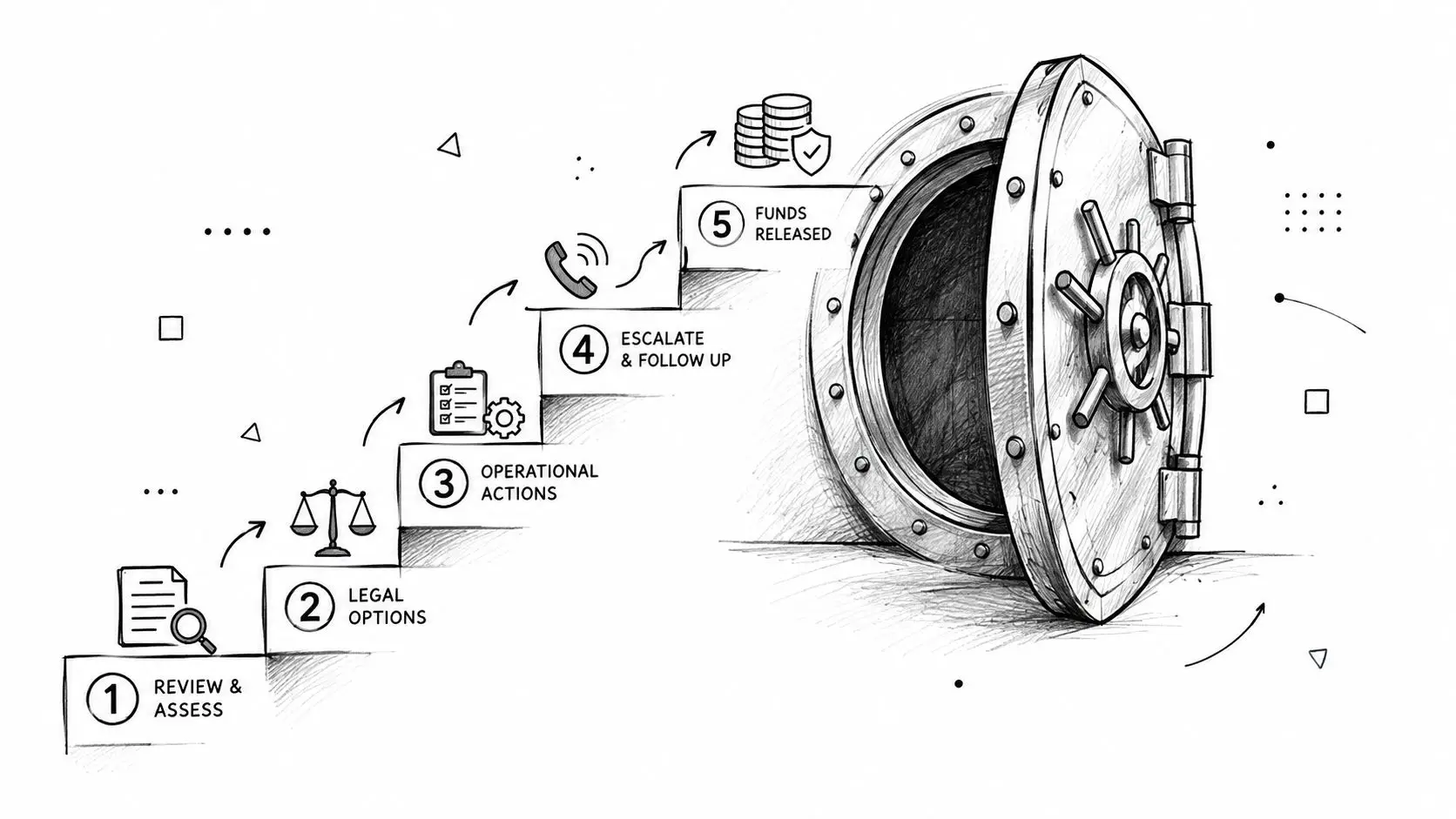
Phase three, communicate with precision
Counsel should send a focused request for clarification. The request should identify the blocked activity, ask for the legal or contractual basis, provide relevant documents, and request instructions for lawful access to undisputed funds.
The company shouldn’t accuse the bank of misconduct before the facts support that position. It should also avoid vague assurances. Specific explanations, indexed documents, and a clear chronology give the bank a better basis for reassessment.
Phase four, escalate legally
If the bank refuses to provide meaningful reasons or maintains disproportionate restrictions, the company should evaluate available remedies. The analysis may involve contractual duties, banking regulation, urgent injunctive relief, unreasonable refusal arguments, and damages caused by payment disruption.
RNC Group’s Risk Management & Account Unblocking service addresses banking restrictions and account issues through structured legal and operational intervention. The firm also handles multilingual correspondence and cross-border commercial disputes, which can matter when the bank, account holder, and counterparties operate in different jurisdictions.
Phase five, protect the future position
Once access returns, management should identify the failure that caused the escalation. The company should update its bank profile, ownership records, payment controls, and emergency arrangements.
A successful unblocking doesn’t end the risk. It creates a clear instruction for future reviews, namely, maintain a current documentary explanation of the business and its funds.
Strategic Recommendations and Legal Disclaimer
A global firm shouldn’t judge an account by monthly pricing alone. The correct business bank account review measures compliance compatibility, transaction economics, system integration, service quality, and legal resilience.
Customer experience remains commercially important. A UK business-banking survey placed customer service and support at 27.5% of stated priorities, while ease of use and accessibility represented 26%. Fees and charges represented 8.6%, and onboarding and account opening represented 3.8%, according to Finder’s UK business banking comparison.
U.S. satisfaction data points in the same direction. A 2025 small-business banking study found that 84% of small-business banking customers also held a personal account relationship with their bank. Satisfaction among those customers stood 64 points higher than among customers without that relationship. The study also reported that 61% of small businesses received financial advice from their banks, and 94% of those businesses said the advice improved their financial habits.
Adopt a portfolio approach
A multi-bank structure can reduce concentration risk, but it introduces governance obligations. Each account needs clear ownership, approval controls, reconciliation procedures, and documented permitted uses.
The board should approve:
- Primary-bank criteria: Treasury capability, compliance responsiveness, and integration quality.
- Secondary-bank criteria: Independent access, usable payment rails, and clear authority controls.
- Israeli safeguards: Returned-check monitoring and rapid legal escalation.
- Review cadence: Reassessment after ownership changes, new payment corridors, or material growth.
- Crisis protocol: Named decision-makers, evidence requirements, and communication rules.
The recommended strategic path is to maintain redundancy without creating unexplained account activity. Banks should understand why the company uses each account and how funds move between them.
This article provides general information about business bank account reviews, Israeli account restrictions, compliance processes, and commercial risk. It doesn’t constitute legal, financial, tax, or banking advice, and readers shouldn’t rely on it without obtaining advice based on their facts, documents, jurisdictions, and current law.
RNC Group advises Israeli and international companies on account blockages, returned-check restrictions, cross-border banking disputes, commercial correspondence, and emergency liquidity planning. Visit RNC Group to discuss a strategy before a banking review becomes an operational crisis.