

For corporate entities and business clients evaluating the Israeli real estate market, the initial decision point is strategic: does one acquire a new apartment “off-plan” directly from a developer, or purchase an existing, second-hand property from a private seller?
This is not a mere question of preference. It represents a fundamental divergence in legal frameworks, financial structures, and risk profiles. A sophisticated understanding of this choice is the critical first step toward securing a successful and defensible investment in Israel’s dynamic, and often complex, property market. This guide provides an advisory risk comparison, focusing on the legal and commercial distinctions that drive informed decision-making.
Choosing Your Path: Off-Plan Versus Existing Homes

The choice between a new build from a developer and an existing apartment from a private seller is where investment strategy crystallizes. One offers the allure of a modern, customized asset, while the other provides the tangible certainty of a property that can be physically inspected today. The decision is a calculated balance of potential against reality.
The Appeal of the New vs. the Certainty of the Old
Acquiring an off-plan property in Israel is an investment in a contractual promise—a commitment based on architectural plans, technical specifications, and, increasingly, sophisticated digital models. The physical asset does not yet exist. For this reason, professional 3D architectural rendering services have become integral; they are the primary tool for visualizing the end product. The trade-off for this forward-looking investment is the benefit of modern amenities, new construction, and the ability to personalize finishes to precise specifications.
A second-hand property, by contrast, offers immediate clarity. What you see is precisely what you acquire. The apartment is built, its condition is verifiable through physical inspection, and its legal history is documented and traceable. This path entirely sidesteps the construction timelines, potential delays, and other uncertainties inherent in buying off-plan.
For our corporate and business clients, this decision often mirrors their broader investment philosophy. An off-plan purchase is analogous to a venture capital investment—it carries higher potential for appreciation but is subject to development and market-timing risks. A second-hand property is more akin to a blue-chip stock, offering stability, predictable returns, and immediate utility.
To provide a clearer framework, let us dissect the primary legal and commercial differences between these two investment paths.
Key Legal and Financial Differences: A Risk Comparison
| Attribute | Off-Plan Property (From Developer) | Second-Hand Property (From Private Seller) |
|---|---|---|
| Governing Law | Governed by the Sales Law (Apartments), which provides specific, robust buyer protections and statutory guarantees. | Governed by general contract and property laws; the principle of caveat emptor (“let the buyer beware”) is dominant. |
| Payment Protection | Mandatory bank guarantees under the Sales Law secure the buyer’s funds against developer insolvency. | No statutory guarantees. Funds are typically held in a lawyer’s escrow account until title transfer is complete. |
| Due Diligence | Focus on the developer’s permits, financial stability, project viability, and contractual terms. | Focus on physical inspection, title search, and uncovering existing liens, encumbrances, or structural defects. |
| Payment Structure | Staggered payments over a 2 to 5-year construction period. Common structures include milestone-based payments or the traditional 20/80 model. | Full payment is typically due within a compressed timeframe, usually 60-90 days from contract execution. |
| Condition & Defects | The developer has statutory liability for construction defects for a defined warranty period (bedek). | The seller is only liable for defects they were aware of and actively concealed. The burden of proof is high for the buyer. |
| Financial Risk | Exposure to the Building Input Index (Madad), which can escalate the final purchase price based on construction cost inflation. | The purchase price is fixed and not subject to index-linked increases. Risk is concentrated in potential renovation costs. |
As the table illustrates, the legal and financial frameworks are distinct. An off-plan purchase is uniquely governed by Israel’s Sales Law (Apartments), legislation designed specifically to protect buyers in this scenario. It mandates critical safeguards like bank guarantees for stage payments and holds developers accountable for construction defects. These are powerful, statutory protections absent in a private sale.
In a second-hand transaction, the legal doctrine of caveat emptor prevails. The onus falls squarely on the buyer and their legal counsel to conduct exhaustive due diligence—from structural surveys to meticulous title searches—to uncover any latent issues. The financial outlay also differs dramatically: off-plan deals permit payments over several years, whereas a second-hand purchase demands the full price within a few months. Understanding these foundational distinctions is imperative before committing capital to property in Israel.
Legal Guarantees: The Sales Law (Apartments) as a Protective Shield

When acquiring an off-plan property in Israel, an investor enters a highly regulated legal arena designed to mitigate risk. This stands in stark contrast to the second-hand market, which operates largely under the principle of caveat emptor—”let the buyer beware.”
The off-plan transaction is governed by a formidable piece of legislation: the Sales Law (Apartments), 1973. This law imposes strict, non-negotiable duties on developers, creating a safety net for buyers that is often more robust than protections found in many Western jurisdictions. A thorough command of this framework is central to any risk management strategy, as it transforms a potentially speculative venture into a secured investment, provided its protections are rigorously enforced.
The Bank Guarantee: A Financial Firewall
The most critical protection afforded by the Sales Law is the mandatory bank guarantee. This is not an optional contractual term. Upon payment of more than 7% of the purchase price, the developer is legally obligated to provide the buyer with a guarantee from a recognized Israeli bank.
This guarantee functions as an insurance policy for every shekel transferred during construction. Its purpose is to shield the buyer from the catastrophic risk of developer insolvency. Should the developer fail to deliver the apartment due to bankruptcy or other specified defaults, the bank guarantee ensures the full return of the buyer’s funds.
From our firm’s extensive experience managing high-value transactions for corporate and international clients, the bank guarantee is the single most important document after the sale contract itself. It serves as the legal firewall separating the buyer’s capital from the developer’s operational and financial risks.
Consider a common scenario: a buyer pays 80% of the property’s value over a two-year construction period. The developer subsequently enters bankruptcy proceedings. Without a bank guarantee, these funds would be entangled in liquidation, with recovery highly uncertain. With the guarantee, the buyer can claim and recover their investment directly from the bank. This provides a level of security fundamentally different from the short-term escrow arrangements used in second-hand deals, which are designed to secure title transfer, not to underwrite long-term construction risk.
Developer Accountability: Defects and Specifications
Beyond financial protection, the Sales Law holds developers accountable for the quality of their product. The purchase agreement must include a detailed technical specification sheet (Hebrew: mifrat techni). This document legally binds the developer to deliver an apartment with the exact materials, finishes, and dimensions promised. Any deviation constitutes a breach of contract.
Furthermore, the law establishes a statutory warranty period for defects, known as the bedek period, providing a clear legal framework for compelling the developer to rectify issues that arise post-delivery.
This warranty comprises two distinct phases:
- The Bedek Period: An initial inspection phase lasting one to seven years post-delivery, depending on the nature of the defect. During this time, the burden of proof rests on the developer to demonstrate that the buyer caused the issue.
- The Warranty Period: Following the bedek period, a longer warranty phase begins. Here, the burden of proof shifts to the buyer, who must demonstrate that the defect originated from faulty design, materials, or workmanship.
This statutory liability offers a significant advantage, granting clear legal recourse for quality control—a protection entirely absent when purchasing a second-hand property ‘as-is,’ where the discovery of latent defects post-closing becomes the buyer’s sole responsibility.
Navigating Today’s Market
While the Sales Law provides a constant legal shield, the market itself is always in flux. Right now, there is a historic shift in the Israeli property market, with a significant inventory of unsold new apartments. This has altered the negotiating landscape, granting more leverage to buyers. However, a saturated market can also impose financial strain on developers, making rigorous due diligence on their track record and financial health more critical than ever. The combination of legal protections and astute commercial vetting is paramount to success.
Managing Payments and the Building Input Index (Madad) Risk

The financial mechanics of an off-plan purchase differ fundamentally from a second-hand transaction. While a second-hand deal is a financial sprint—requiring full payment within 60 to 90 days—an off-plan purchase is a marathon. Payments are staged over the entire construction period, often spanning two to five years. This extended timeline, however, introduces unique financial risks that can catch unwary investors.
Payment Schedule Differences: 20/80 vs. Milestones
Historically, the preferred payment structure was 20/80. A buyer would pay 20% at contract signing and the remaining 80% only upon receiving the keys. This model was highly favorable to buyers, minimizing upfront capital and deferring the need for a full mortgage for several years.
Regulatory changes by the Bank of Israel have curtailed the prevalence of 20/80 financing, prompting a shift toward milestone-based payment schedules. Under this model, payments are linked to specific, verifiable construction stages.
A typical milestone plan might be structured as follows:
- 20% at contract signing.
- 10% upon completion of the building’s foundation and skeleton.
- 20% following completion of exterior walls and roofing.
- 30% after installation of internal systems (plumbing, electrical).
- 20% final payment upon readiness for handover.
This structure aligns the buyer’s payments with tangible progress, creating a more balanced risk distribution and a transparent, auditable investment path well-suited for corporate or business clients.
The Madad Risk: Israel’s Silent Price Escalator
Beyond the payment schedule lies a more subtle yet potent financial risk: the Building Input Index (Hebrew: Madad Tsumot HaBniya). This is one of the most misunderstood elements of an off-plan transaction and can significantly inflate the final purchase price.
The Madad is an official index published monthly by Israel’s Central Bureau of Statistics that tracks inflation across all construction inputs—steel, cement, labor, transportation, etc. Critically, the outstanding balance of the apartment’s purchase price is almost always contractually linked to this index.
We have consistently seen the Madad convert a seemingly fixed-price agreement into a moving target. For example, an investor signs a contract for a NIS 3 million apartment. If the Madad increases by 5% over the two-year construction period, an additional NIS 150,000 becomes due at closing. This is a silent cost that accrues without any change to the physical asset.
This linkage is standard in nearly all Israeli off-plan contracts, used by developers to hedge against rising costs. For the buyer, it means effectively assuming the inflation risk of the entire construction industry. This is a material departure from most Western property markets, where off-plan prices are typically fixed.
Mitigating Index Exposure
While eliminating the Madad linkage is often unfeasible, skilled legal counsel can negotiate terms to mitigate its impact. An effective strategy is to argue for “unlinking” a portion of the price. For instance, a strong case can be made that the land component, which the developer already owns, should not be subject to construction cost inflation.
Another tactic involves adjusting the payment schedule. Accelerating payments reduces the outstanding balance exposed to the index. This is a strategic trade-off: it reduces financial leverage but increases cost certainty. The decision must be weighed based on the client’s financial position and risk tolerance. As recent long-term market forecasts suggest continued volatility in construction costs, addressing the Madad risk is a non-negotiable aspect of contract negotiation.
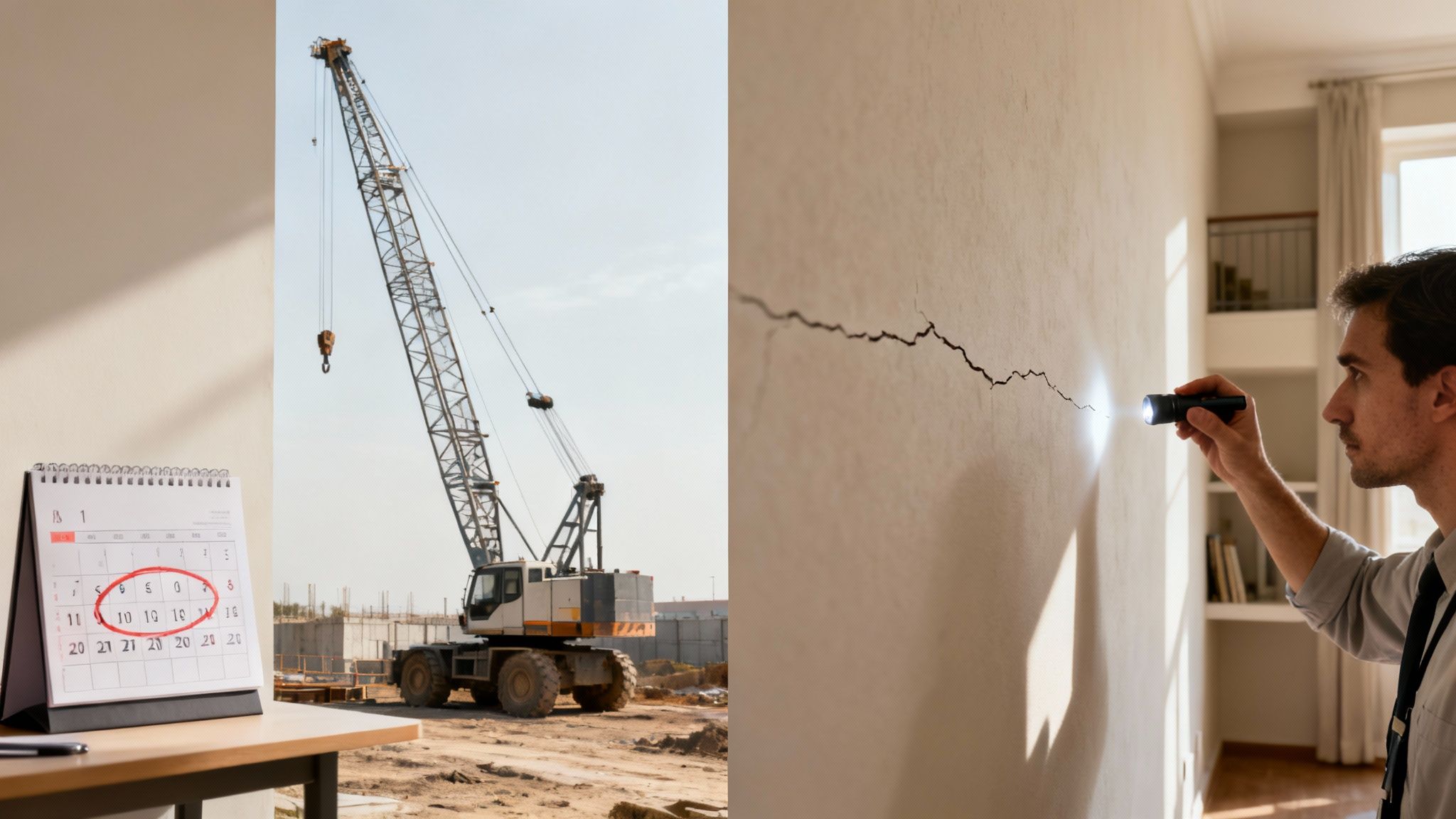
Delays vs. Defects: Pinpointing The Real Risk In Your Purchase
Every property transaction involves risk; the key is to correctly identify and mitigate the specific risks associated with the chosen path. When buying off-plan in Israel, the primary adversary is the calendar. In a second-hand purchase, the danger shifts to latent physical or legal defects. For any serious investor, understanding these distinct risk profiles is essential for deploying the correct defensive strategy.
Off-Plan Investments: The Crushing Cost of Delays
The single greatest operational risk in an off-plan acquisition is a delay in delivery. While Israel’s Sales Law (Apartments) effectively protects capital from developer insolvency via mandatory bank guarantees, it does not automatically shield investors from the significant commercial damages caused by project delays.
A delay is not a mere inconvenience; it is a direct financial liability. It can disrupt mortgage financing, eliminate projected rental income, and create unforeseen holding costs. For a business planning to use the property for operations or executive housing, a delayed handover can derail core strategic objectives.
This is precisely why a meticulously drafted penalty clause in the purchase agreement is non-negotiable.
From a litigation perspective, a vague or weak penalty clause is a critical vulnerability. We insist on clauses that trigger significant, escalating financial penalties for the developer for every month of delay beyond a minimal grace period. This is not merely about compensation; it is about converting the delivery date from an aspirational target into a legally binding and financially painful obligation.
Current market dynamics, which show a surge in building permits alongside slowing sales, can strain developer cash flow and make project timelines more fragile. A deeper look at these Israeli real estate market trends underscores the importance of contractual rigor.
Second-Hand Properties: The Threat of Hidden Defects
With an existing property, the timeline risk is negligible, as possession is typically transferred within weeks. Instead, the primary threat shifts from the calendar to the concrete. The most significant risks are latent defects—problems not discoverable during a standard viewing.
These can range from manageable issues to catastrophic liabilities:
- Systemic Failures: Hidden foundational cracks, slow-leaking pipes within walls, or outdated and hazardous electrical wiring.
- Illegal Construction: Additions, rooms, or entire floors constructed without proper municipal permits. This can result in a demolition order from the municipality, with the new owner bearing the cost.
- Title Encumbrances: Undisclosed heirs with a claim to the property, pre-existing liens that were never discharged, or boundary disputes that cloud legal ownership.
Unlike an off-plan deal where the developer has a statutory warranty, a second-hand purchase is largely governed by caveat emptor. The seller is typically liable only for defects they actively and knowingly concealed. Proving fraudulent intent to a court’s satisfaction presents an exceptionally high evidentiary bar.
Your Defensive Playbook: Proactive Due Diligence
The most effective defense in a second-hand transaction is not subsequent litigation but exhaustive, front-loaded due diligence. This is a phase where no corners should be cut.
The Non-Negotiable Due Diligence Checklist:
- Full Physical Inspection: Engage a qualified structural engineer (mehandes) to conduct a comprehensive inspection of the building’s structural integrity.
- Exhaustive Title Search: Legal counsel must perform a meticulous search of the property’s records at the Israel Land Registry (Tabu) to verify the seller’s unencumbered title and ensure the absence of mortgages, liens, or third-party claims.
- Municipal File Review: This critical step involves a review of the official building file at the local municipality to confirm that all structures on the property are fully permitted and legal.
In summary, the risk equation is clear. For an off-plan purchase, strategic focus must be on contractually securing timelines and imposing robust penalties for delays. For a second-hand property, the entire strategy must be built around intensive due diligence to uncover any physical or legal liabilities before the contract is executed.
How Taxation And Value Appreciation Differ
Beyond the sticker price, a sophisticated investor analyzes tax liabilities and long-term value potential. Taxation and appreciation are two domains where off-plan and second-hand properties diverge significantly, and a misunderstanding of these differences can lead to costly strategic errors.
The tax structure for acquiring a new versus a used property in Israel is fundamentally different. It is imperative to understand the application of Purchase Tax and Value Added Tax (VAT), as it has a material impact on the final capital outlay.
The Nuances Of Purchase Tax And VAT
All property acquisitions in Israel are subject to Purchase Tax (Mas Rechisha). For foreign investors or those buying an additional property, this is a progressive tax that begins at 8% and increases for higher-value assets. This tax applies to both off-plan and second-hand transactions.
The key differentiator is VAT. When purchasing an off-plan property from a developer, the quoted price legally includes VAT, currently at 17%. In contrast, a private sale of a second-hand apartment is exempt from VAT. This creates a significant difference in the underlying asset cost that is not immediately apparent when comparing list prices.
A common error among international clients is to compare a NIS 3 million off-plan apartment to a NIS 3 million second-hand property at face value. In reality, the developer’s pre-tax price for the new apartment is approximately NIS 2.56 million; the remainder is a tax liability. Acknowledging this is crucial for accurate valuation and financial modeling.
This distinction directly affects financing and asset valuation. A significant portion of the payment to a developer is a pass-through tax, not a contribution to the asset’s intrinsic value.
Analyzing The Investment Horizon And Appreciation Potential
The long-term value trajectory for each property type is influenced by different market forces. An off-plan purchase is a projection of future growth, while a second-hand property offers more immediate, stable appreciation based on existing market conditions.
An off-plan apartment often carries the potential for a significant value increase upon project completion. The investment is in a new building with modern amenities and construction standards, particularly in large, master-planned communities where the development itself can create a newly desirable neighborhood, rewarding early investors. However, this potential is accompanied by risk. The 2- to 5-year construction period exposes the investment to economic shifts, interest rate fluctuations, and changes in local demand that could alter the property’s value upon delivery.
A second-hand property, conversely, represents a more grounded investment. Its value is anchored by established neighborhood comparables, historical price data, and existing rental demand. Growth is typically more stable and less susceptible to the performance of a single project. For investors prioritizing immediate cash flow or capital preservation, this predictability is a key advantage.
Comparing Value Drivers
| Feature | Off-Plan Property | Second-Hand Property |
|---|---|---|
| Primary Value Driver | Potential for a value “pop” on completion; appeal of a new, modern building. | Steady, market-based growth tied to the location’s established reputation and historical trends. |
| Risk Profile | Higher risk, linked to construction delays, market fluctuations during the build, and developer performance. | Lower immediate risk, but potential for unforeseen renovation costs or issues with an older structure. |
| Growth Trajectory | Potential for a sharp initial increase, followed by alignment with broader market trends. | More linear and predictable growth, mirroring the local market’s historical performance. |
Ultimately, the choice must align with defined financial objectives. An investor pursuing higher growth and comfortable with market timing and construction risks may favor an off-plan transaction. A corporate buyer or an individual prioritizing stable, predictable returns and immediate utility will likely find a well-located second-hand property to be a more suitable strategic fit.
Off-Plan vs. Second-Hand: Making the Right Strategic Call
The decision between a new, off-plan apartment and an existing, second-hand property in Israel is not about which is inherently superior, but which is strategically aligned with the investor’s objectives. The correct path depends on a rigorous assessment of risk tolerance, financial capacity, and ultimate commercial goals.
At its core, the decision presents a trade-off. Does one pursue the significant potential upside of a brand-new, modern asset protected by statutory guarantees, while accepting the uncertainties of a multi-year construction timeline? Or is the priority the tangible certainty of an existing property that is physically verifiable and can generate immediate returns, where all details are confirmed before capital is committed?
Aligning Your Choice with Your Goals
For an objective centered on long-term capital appreciation, an off-plan purchase can be a powerful instrument, provided the investor has the liquidity to manage potential delays. The ability to secure a future asset at today’s prices, customize it, and benefit from the initial value increase common to new developments is a compelling formula for growth. Critically, the legal framework of Israel’s Sales Law (Apartments), particularly the mandatory bank guarantees, provides a robust safety net for investment capital.
Conversely, if the objective is immediate cash flow, capital preservation, or acquiring an asset for instant operational use—such as corporate housing—a thoroughly vetted second-hand property is almost invariably the more prudent choice. This approach eliminates timeline risk and the financial volatility of the Building Input Index (Madad). The asset is tangible, its income potential can be realized immediately, and its market value is anchored in established, verifiable data.
From our firm’s cross-border experience, the most successful investors are those who define their desired outcome with absolute clarity before entering the market. A clear objective dictates the correct path and prevents costly strategic misalignments.
The Indispensable Role of Your Lawyer
Regardless of the chosen path, attempting to navigate an Israeli property transaction without expert legal counsel is an unacceptable risk. Your lawyer is not merely a document processor; they are your primary risk mitigation strategist.
For an off-plan deal, counsel will dissect the developer’s contract, fortify penalty clauses for delays, and ensure every bank guarantee is flawlessly executed. For a second-hand purchase, they lead the due diligence process, uncovering hidden liens, verifying building permits, and protecting against title defects.
Ultimately, successful real estate investment in Israel requires the ability to master the investment decision-making process, integrating all legal, financial, and risk variables. An informed choice is the bedrock of a secure and profitable venture. This guide has laid out the key legal and commercial distinctions to empower that decision, ensuring your entry into the Israeli real estate market is built on a solid strategic footing.
This article does not constitute legal advice and is not a substitute for consulting with a qualified attorney. Do not rely on the contents of this article for taking or refraining from taking any action.