

When one hears the word ‘invasion’ (פלישה), the immediate image is almost always military: tanks crossing a border, soldiers on enemy soil. But in today’s business world, an ‘invasion’ is a far broader, more tangible, and immediate threat. Developing a robust corporate invasion and crisis strategy is essential in these circumstances. It can be a cyberattack that paralyses operations, an aggressive market maneuver by a competitor eroding your position, or a geopolitical event that tears your supply chain apart.
Senior executives are no longer just defending factories or offices. They are defending digital gateways, intellectual property, and their company’s global standing.
Understanding Corporate ‘Invasion’ in the Modern World
In a deeply interconnected economy, the concept of a ‘פלישה’ (invasion) has fundamentally transformed. It is no longer confined to a physical battlefield; it unfolds simultaneously across digital, commercial, and political arenas. For corporations, this means the traditional fortress walls are now porous. Defenses must be sophisticated and multi-layered.
These are not theoretical risks but real-world events that can destabilize even the most robust companies overnight. A state-sponsored cyberattack can erase decades of data, and a sudden geopolitical shift can render entire supply chains obsolete. This reality demands a proactive, integrated approach to crisis management—one that merges legal acuity with decisive operational command.

The Three Dimensions of Corporate Invasion
To counter these threats effectively, one must understand their distinct nature. Each type of invasion targets a different aspect of the business and demands a unique strategic response.
- Cyber Invasion: Hostile actors breach your digital infrastructure to steal data, disrupt operations, or demand ransom. The immediate damage is operational paralysis and severe reputational harm, with the legal focus on data privacy laws, reporting obligations, and potential litigation.
- Commercial Invasion: This is a strategic assault by a competitor aimed at seizing market share, poaching key talent, or launching a hostile takeover. The impact is on market valuation and competitive standing, requiring a legal focus on antitrust law, intellectual property rights, and corporate governance.
- Geopolitical Invasion: Arising from international conflicts, sanctions, or political instability, this directly impacts business operations. It compromises supply chains, access to capital, and employee security. Here, the legal focus is on navigating sanctions, invoking Force Majeure clauses in contracts, and managing cross-border disputes.
The following table summarizes these three dimensions, clarifying their essential distinctions.
| Type of Invasion | Primary Impact Area | Key Legal Focus |
|---|---|---|
| Cyber Invasion | Operational Disruption & Reputation | Data Privacy, Breach Notification |
| Commercial Invasion | Market Share & Company Value | Antitrust, Intellectual Property |
| Geopolitical Invasion | Supply Chain & Asset Security | Sanctions, Force Majeure Clauses |
Understanding this framework is the first step toward building a resilient defense strategy. Each arena requires different tools and expertise.
The horrific Hamas attack on southern Israel on October 7, 2023, in which approximately 1,200 people were murdered, highlighted for Israeli companies in the most extreme way how vulnerable they are. This tragic event exposed immense weaknesses in security and supply chains, causing a surge in demand for professional crisis management services.
To better understand the multifaceted nature of corporate invasion in the global landscape, one can learn from real-world events, such as the lessons from global banks adapting to the Russian invasion of Ukraine. This guide will provide the legal and strategic frameworks essential for withstanding these modern threats and turning a crisis into a position of strength.
Your First 72 Hours: A Legal and Operational Playbook
When an invasion hits—whether it’s a devastating cyberattack, a sudden geopolitical shockwave, or a hostile business move—the initial chaos can be paralysing. But what you do in those first 72 hours isn’t just damage control. It’s about setting the stage for either a measured recovery or a long, drawn-out crisis that bleeds resources and reputation. For any leadership team, this window demands a cool head and a clear, structured playbook that merges legal savvy with operational grit.
First things first: people. Your absolute, non-negotiable priority is the safety of your employees. Securing your team and confirming their well-being isn’t just the right thing to do; it establishes a baseline of control and shows true leadership. At the same time, you lock down your assets. This is a two-front battle: securing physical locations while simultaneously isolating compromised networks, killing access credentials, and—critically—preserving every shred of digital evidence. You can’t afford to let the crime scene be contaminated.

Mobilise Your Crisis Response Team
Trying to handle a full-blown crisis with your day-to-day management team is a rookie mistake. You need a dedicated task force, and you need it activated now.
Your very first call should be to your expert legal counsel, specifically one who lives and breathes crisis management. Why? Because this single action immediately wraps your entire investigation—every internal email, every strategy meeting, every report—in the protective blanket of attorney-client privilege. Without it, every message becomes potential fuel for the fire in future litigation.
A well-prepared crisis response team isn’t a committee; it’s a command centre. It must include:
- Legal Counsel: To drive the strategy, contain liability, and ensure every move is legally sound.
- Executive Leadership: The ultimate decision-makers on operational and financial moves.
- IT & Cybersecurity Forensics: The technical experts who contain the breach, assess the digital damage, and preserve the evidence.
- Communications/PR: To shape the narrative, both internally and externally, always under legal guidance.
- Operations & HR: To manage employee welfare, logistical continuity, and internal updates.
This core group ensures you’re responding with a single, strategic voice, not just reacting from a dozen different corners of the company.
Conduct a Rapid Legal and Contractual Assessment
While the tech and ops teams are in the trenches stabilising the situation, your legal team needs to perform an urgent triage of the company’s legal exposure. This isn’t a leisurely deep dive; it’s a high-speed scan to identify immediate duties, glaring risks, and potential lines of defence.
The goal of this initial legal review isn’t to find the perfect answer. It’s to build a defensible position. It’s about finding your contractual shields and knowing your regulatory duties before your opponents have a chance to define them for you.
The documents that need to be on the table within hours are:
- Insurance Policies: What are you covered for? Business interruption, cyber incidents, political risk? You need to know fast. These policies have notoriously strict notification deadlines, and missing one can kill your claim before it even begins.
- Key Commercial Contracts: Pull the agreements with your most important customers, suppliers, and partners. Look for mandatory notification clauses, limitations on liability, and especially any Force Majeure provisions that might be triggered by what’s just happened.
- Loan Agreements and Covenants: Could this crisis trigger a default or breach of your financial covenants? You need to assess this immediately to determine if a proactive conversation with your lenders is required.
These first 72 hours are a sprint, not a marathon. By focusing ruthlessly on employee safety, securing your assets, establishing privileged communications, and executing a rapid legal triage, you shift from a position of chaos to one of control. You lay the foundation for a strategic response that can weather the storm to come.
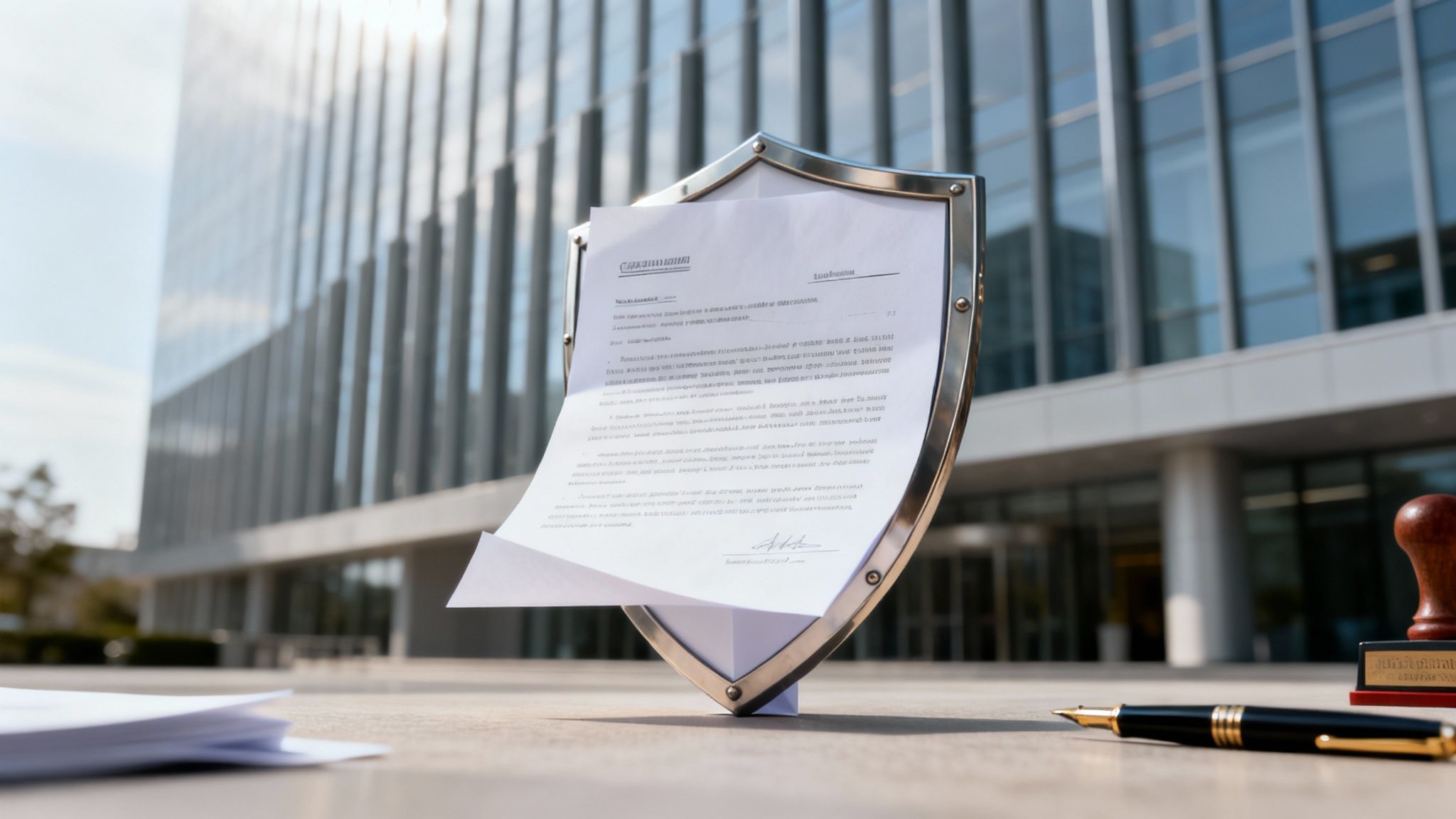
Using Your Contracts as a Corporate Shield
During normal times, your commercial contracts are just the background music of your business relationships. They set the rules for transactions, outline what’s expected, and then mostly sit in a file. But when a corporate פלישה (invasion) hits—whether it’s a geopolitical earthquake, a paralysing cyberattack, or a sudden market collapse—those documents instantly change. They stop being routine paperwork and become your first line of legal defence. They become your corporate shield.
Knowing how to activate this shield isn’t just a theoretical legal exercise; it’s a core crisis management skill. Your agreements are packed with clauses that, if you know how to use them, can protect your company from devastating liabilities and unexpected risks. The trick is knowing which clauses to look for and having a plan to enforce them when everything is on the line.
Unpacking Force Majeure
The most famous of these defensive clauses is Force Majeure, which literally means “superior force.” Think of this provision as a contractual emergency brake. It’s designed to excuse a party from their obligations when something massive and completely unpredictable happens that’s far beyond their control. It’s for events that make performing the contract impossible, not just more difficult or expensive.
But you can’t just declare “Force Majeure” and walk away. It’s a precise legal move. The events that usually qualify are pretty catastrophic:
- Acts of War: This covers declared wars, invasions, or major armed conflicts that directly stop you from being able to do business.
- Government Actions: Think of sanctions, embargoes, or other official orders that legally prevent you from fulfilling the contract.
- Natural Disasters: Events like earthquakes or floods that physically destroy essential infrastructure.
- Cyber Warfare: A severe, state-sponsored cyberattack could increasingly be argued as a modern-day Force Majeure event.
To successfully use this clause, you need a methodical approach. You have to prove that the event was unforeseeable, completely out of your hands, and the direct reason you couldn’t perform. And almost without exception, you must formally notify the other party immediately. Hesitation can cost you everything.
Beyond Force Majeure: Your Other Strategic Clauses
While Force Majeure is for when performance becomes impossible, other clauses are vital for navigating the messy reality of a crisis. Each one is a different tool in your defensive toolkit.
A Material Adverse Change (MAC) clause, common in merger and acquisition deals, is a critical escape hatch. It allows a buyer to back out of a deal if a disastrous event occurs that fundamentally wrecks the value of the company they’re buying before the deal closes. What counts as “material” is often the million-dollar question that ends up in high-stakes court battles, demanding sharp legal analysis.
International sanctions clauses are also non-negotiable for any business operating globally. These clauses give you the right to suspend or terminate an agreement if the other party—or the country they’re in—gets hit with international sanctions. This is crucial for protecting your own company from accidentally breaking complex global laws and facing crippling fines.
In a crisis, your contracts are not just legal documents; they are strategic assets. The difference between survival and failure often comes down to how well you understand and assert the rights you negotiated in times of peace.
To get the most out of your contracts when facing an invasion, you need to act fast. An AI Legal Contract Analyzer can be a powerful ally, helping you rapidly scan agreements to find these critical clauses, flag risks, and identify what you can do right now.
Ultimately, whether you’re trying to excuse your own company’s inability to perform because of a פלישה or hold a partner accountable for theirs, your entire case rests on the specific words in those agreements. Our job is to turn that passive text into an active, enforceable shield that protects your bottom line, limits the damage, and allows you to navigate the chaos from a position of strength.
Managing Disputes Across International Borders
A corporate פלישה (invasion) rarely respects national borders. For any Israeli company with global reach, a crisis that ignites in one place can instantly spiral into a tangled web of international disputes. All of a sudden, you’re not just tackling one problem; you’re fighting on multiple fronts. One day it’s frozen assets in Europe, the next it’s a supply chain collapse in Asia, all while juggling litigation across several court systems at once.
This is the chaotic reality of cross-border crisis management. In this arena, a narrow, localised legal approach isn’t just ineffective—it’s a recipe for disaster. What you need is a coordinated, global strategy that views the entire conflict as a single, interconnected battlefield. This demands a legal team that thinks and acts internationally, giving you a decisive strategic edge when the stakes couldn’t be higher.
The Strategic Advantage of a Global Legal Network
When a crisis explodes across borders, time becomes your most precious—and perishable—asset. You can’t afford to waste weeks vetting unfamiliar local lawyers in every new jurisdiction. A pre-established global network gives you immediate, on-the-ground access to elite, pre-vetted counsel in key economic hubs worldwide. This isn’t just about convenience; it’s about executing a seamless, synchronised plan.
Working with a network like ADVOC ensures that the legal strategy hammered out in Tel Aviv is flawlessly implemented in London, New York, or Singapore. It means every legal filing, every negotiation, and every court appearance is part of one unified plan. This prevents the kind of contradictory actions and communication breakdowns that can cripple a fragmented defence.
In international disputes, victory rarely comes from a single knockout blow. It’s won through the cumulative effect of coordinated legal pressure, applied strategically across multiple jurisdictions.
The recent geopolitical turmoil is a stark reminder of these very challenges. Take, for example, Israel’s ground פלישה into Gaza, which began on October 27, 2023. This event created a massive ripple effect for multinational corporations and Israeli firms alike, triggering a cascade of high-stakes issues—from banking restrictions and property disputes to complex international litigation. These are exactly the scenarios where deep, global expertise is paramount. You can find more in-depth analysis of this multifaceted conflict and its global implications on cfr.org.
Choosing Your Battles: Jurisdictional Strategy
One of the most powerful weapons in your cross-border litigation arsenal is the ability to choose where you fight. Selecting the right jurisdiction—a practice sometimes called “forum shopping”—is a deeply strategic decision that can dramatically shift the outcome of a case.
It’s about weighing critical factors, such as:
- Legal Precedents: Does the local case law favour your position? Some legal systems are known for being more plaintiff-friendly or for having more sophisticated commercial courts.
- Discovery Rules: The amount of evidence you can demand from your opponent varies wildly. US-style discovery is famously broad, whereas many European jurisdictions are far more restrictive.
- Enforcement of Judgements: Winning a case is only half the battle. You need to be able to actually collect. Choosing a jurisdiction that’s a signatory to international enforcement treaties (like the New York Convention for arbitral awards) is crucial.
The challenge of enforcing a foreign judgement is something that can’t be overstated. A favourable ruling from an Israeli court might as well be a paperweight if you can’t compel a counterparty to release assets held in another country. A sharp, global legal strategy anticipates this from day one. It might involve initiating parallel actions or securing pre-emptive asset freezes to make sure that when you win, you actually win. This kind of proactive, multi-jurisdictional thinking is the hallmark of sophisticated international crisis management.
Strategic Considerations in Cross-Border Crisis Litigation
When legal disputes cross international lines, both the party bringing the lawsuit (the plaintiff) and the one defending against it (the defendant) face a unique set of strategic choices. The table below outlines some of the key factors that businesses must weigh when navigating these complex legal battlegrounds.
| Strategic Factor | Consideration for Plaintiffs | Consideration for Defendants |
|---|---|---|
| Choice of Forum | Seek jurisdictions with favourable precedents, broad discovery rules, and plaintiff-friendly procedures to maximise leverage. | Aim to move the case to a jurisdiction with more restrictive rules, higher burdens of proof, or legal precedent that favours the defence. |
| Asset Freezing | Proactively seek pre-judgment asset freezes in multiple jurisdictions to prevent the opponent from moving or hiding funds before a ruling. | Vigorously challenge freezing orders by arguing against their necessity or legal basis, and seek security bonds from the plaintiff. |
| Enforcement Strategy | Prioritise legal action in countries that are signatories to key enforcement treaties to ensure a final judgement can be collected globally. | If assets are in non-signatory countries, this can be used as leverage, making enforcement more difficult and costly for the plaintiff. |
| Public Relations | Use litigation announcements in key markets to shape the public narrative, pressure the opponent, and build stakeholder support. | Employ a counter-PR strategy to mitigate reputational damage, frame the lawsuit as baseless, and reassure investors and customers. |
| Coordination | Maintain a single, unified legal strategy across all jurisdictions to present a consistent case and avoid contradictory arguments or actions. | Exploit any inconsistencies in the plaintiff’s multi-jurisdictional filings to undermine their credibility and overall case. |
Ultimately, success in international litigation hinges on a forward-thinking, multi-layered strategy. It requires not only winning the legal argument in one court but orchestrating a series of coordinated moves across the globe to secure a definitive and enforceable victory.
Developing a Phased Strategic Response Plan
Winning in a crisis isn’t about one dramatic courtroom showdown. It’s about securing the best possible business outcome through a deliberate, calculated campaign. This means moving beyond reactive legal moves to a sophisticated strategy built for the long haul. An effective response to a corporate פלישה (invasion) isn’t about throwing everything at the wall and seeing what sticks; it’s about playing chess, not checkers.
The foundation of this approach is a meticulous, multi-dimensional analysis. Before we take any significant action, we deconstruct the entire situation. This involves a deep dive into our client’s position—not just their legal standing, but their operational vulnerabilities, financial pressures, and reputational risks.

Analysing the Opponent and the Battlefield
Just as critical is a thorough analysis of the opponent. Who are they, really? What drives them, where are their pressure points, and what is their end game? A hostile competitor in a commercial dispute has very different weaknesses than a state-sponsored actor in a cyberattack. Understanding these nuances is everything.
Finally, we assess the broader context—the “battlefield” itself. This includes the regulatory environment, the media landscape, and any geopolitical currents that could sway the outcome. Only after synthesising these three pillars—client, opponent, and context—do we begin to engineer a phased, strategic escalation plan.
A bespoke strategy isn’t a rigid script; it’s a dynamic playbook. It outlines a sequence of moves, each designed to escalate pressure and build leverage, with the flexibility to adapt as the opponent reacts.
This methodology allows us to control the tempo of the conflict, forcing the adversary to react to our moves, not the other way around.
The Stages of Strategic Escalation
A well-designed, multi-stage strategy is what empowers a company to regain control and protect its name. This tailored approach works across a huge range of scenarios, from fending off a hostile takeover to recovering assets after a devastating cyber breach.
The plan typically unfolds in carefully calibrated phases:
Initial Containment and Negotiation: The first phase often starts behind the scenes. It might involve discreet, back-channel communications or “without prejudice” settlement offers. The goal here is to test the opponent’s resolve and see if a swift resolution is possible before committing to a costly, public fight. This preserves resources and maintains confidentiality.
Targeted Legal and Commercial Pressure: If the quiet approach doesn’t work, the escalation begins. This isn’t an all-out legal assault, but a series of precise, surgical actions. It could mean filing a targeted injunction to stop a specific harmful activity, lodging regulatory complaints to create external pressure, or activating specific contractual clauses to disrupt the opponent’s business relationships.
Full-Scale Litigation and Public Campaign: This is the most visible and aggressive phase, reserved for when other options have been exhausted. It involves comprehensive litigation, backed by a carefully managed public relations strategy. The objective here isn’t just to win in court, but to shape the public and industry narrative in our client’s favour.
This phased approach ensures every action is purposeful and cost-effective. By starting with lower-intensity tactics and escalating only when necessary, we maximise the chances of reaching a favourable outcome efficiently. It turns a defensive fight into a chance for growth, allowing the company to emerge from the crisis stronger, more resilient, and firmly in control of its future.
Building a Resilient Enterprise Before the Next Crisis
The most effective way to win a battle is to avoid it altogether. While previous sections focused on managing a corporate פלישה (invasion) in real-time, this final, crucial part shifts the focus from reaction to resilience. The goal is to build a corporate framework so robust that it can absorb future shocks before they fully materialize, transforming your business from a potential victim into an entity prepared for any scenario.
Proactive defense begins long before a crisis appears on the horizon. It is woven into the fabric of your commercial agreements, corporate governance procedures, and operational infrastructure. Waiting for an emergency is not a strategy; it is a gamble. True resilience is built in times of stability, like a fortress engineered to withstand any storm.
Fortifying Your Legal and Operational Foundations
Building this resilience requires a multi-dimensional approach that addresses both legal vulnerabilities and operational weak points. The entire concept is to create redundancy and clarity where ambiguity could lead to disaster.
These are the key areas requiring immediate fortification:
- Drafting “Crisis-Aware” Commercial Contracts: Your agreements must be built for extreme scenarios. This means abandoning generic Force Majeure clauses in favor of provisions that specifically address state-sponsored cyberattacks, sudden sanctions, or pandemic-scale supply chain disruptions.
- Establishing “Watertight” Corporate Governance: A clear chain of command and pre-defined crisis management protocols are critical. Who has the authority to make critical decisions? Who speaks for the company? Answering these questions now prevents fatal hesitation later.
- Diversifying Critical Supply Chains: Over-reliance on a single supplier or geographic region is one of the most common failure points during a geopolitical
פלישה(invasion). Building a diverse and resilient supply chain is a strategic imperative that provides essential flexibility. - Implementing Advanced Cybersecurity Measures: This goes far beyond a firewall. It includes regular penetration testing, comprehensive employee training on phishing and social engineering, and an incident response plan that has been pressure-tested and refined through drills.
Resilience is not a one-time project; it is a continuous process of anticipation, adaptation, and reinforcement. It is about fostering an organizational culture that views preparedness as a core business function, not an afterthought.
Learning from the Past to Preempt Future Risks
The ability to anticipate future threats often lies in analyzing patterns from the past. Historical events provide invaluable data on how crises escalate and how swift, decisive action can alter outcomes.
For example, historical conflicts like the 1956 Suez Crisis set precedents for rapid military responses where strategic objectives were achieved within days. In the business world, this underscores the critical need for equally swift crisis-resolution frameworks. The recurring patterns of escalation seen in regional conflicts over the decades highlight the absolute importance of proactive risk analysis and preparing bespoke strategies to contain disruptions before they become catastrophic. You can learn more about the strategic implications of these events by reading the history of the Arab-Israeli wars on Britannica.
By studying these precedents, businesses can better anticipate how a political or military פלישה (invasion) might create ripples that wash over the commercial landscape. This foresight enables the creation of more effective contingency plans and more durable corporate structures. Ultimately, future-proofing your business means embedding this strategic awareness into every facet of your operations, ensuring you are prepared to navigate uncertainty with confidence and strength.
Frequently Asked Questions
When a company is hit with a crisis on the scale of an ‘invasion’—be it physical, digital, or commercial—critical questions arise that demand swift, precise answers. We have compiled the most urgent questions we hear from our clients, with practical answers that distill the correct strategy.
What is the very first legal step my company must take?
The first, and unquestionably most important, action is to immediately engage legal counsel specializing in crisis management. This is not merely about getting good advice; it is a strategic move that places your entire initial response under the protective umbrella of the attorney-client privilege.
This privilege is your most vital line of defense. It ensures that internal communications, fact-finding processes, and strategic discussions remain confidential and cannot be used against you in future legal proceedings. Critically, it also allows you to manage external communications in a controlled manner, preserve essential evidence as required, and avoid inadvertently creating additional liabilities.
Can we use our contracts to get out of a deal during a crisis?
This is certainly a possibility. Your existing agreements likely contain clauses such as Force Majeure or Material Adverse Change (MAC), which are designed for precisely these situations—catastrophic, unforeseeable events that make fulfilling the contract impossible or fundamentally alter the economics of the deal.
However, it is crucial to understand that invoking these clauses is a high-stakes legal maneuver. Courts interpret them very narrowly and will scrutinize every detail of the situation. Success depends entirely on a precise legal strategy that proves the event meets the specific criteria defined in the contract. Expert legal counsel is therefore non-negotiable.
A crisis does not respect borders, and neither can your legal defense. A global network provides immediate, coordinated expertise across jurisdictions, turning a logistical nightmare into a strategic advantage.
Our international assets have been frozen. What can we do?
An asset freeze is a formidable challenge, often involving a tangle of complex international sanctions and geopolitical dynamics. The immediate response must be multi-pronged and decisive.
The strategy involves formally petitioning the government bodies that imposed the freeze, exploring legal challenges in the appropriate jurisdictions, and simultaneously activating diplomatic channels where possible. Navigating these turbulent waters requires an integrated international legal network, as a coordinated response across different countries is a prerequisite for any chance of success.
Why is a global legal network so important?
A corporate פלישה (invasion) almost never remains within one country’s borders. A cyberattack can originate in one nation, strike servers in another, and affect customers worldwide. A global legal network gives you immediate access to elite, pre-vetted experts wherever your assets, partners, or operations are located.
This eliminates the dangerous delay of searching for and vetting local counsel in the middle of a fire. It ensures a seamless and effective strategy, making certain that every action taken—whether in Tel Aviv, London, or New York—is perfectly synchronized and aligned with your central objectives.
This article does not constitute legal advice and is not a substitute for consulting with a qualified attorney. Do not rely on the contents of this article for taking or refraining from taking any action.