

Owning property in Israel means paying Arnona, the municipal property tax. But when that property sits empty, are you still on the hook for the full bill? Absolutely. The tax liability doesn’t disappear—it shifts directly to you, the owner. This is precisely why mastering the rules for an arnona exemption for an empty property is a critical money-saving strategy, especially for international investors looking to maximize their returns.
Many owners fall into the costly trap of assuming an empty unit is automatically off the tax roll. It isn’t. The moment a tenant leaves, the financial responsibility becomes yours. Failing to act can lead to thousands of shekels in unnecessary expenses.
Why You Need to Master Arnona Rules for Vacant Properties
The Arnona system is the financial engine of local governance in Israel, funding everything from sanitation and infrastructure to schools. It generates roughly NIS 12 billion each year from residential properties alone across Israel’s 257 local authorities.

The regulations are designed with a clear goal: keep properties occupied. The moment a tenant moves out, the law defaults the full tax liability to the owner, a powerful mechanism to discourage vacancy. You can explore a deeper dive into Israel’s local property tax system in this comprehensive report.
For a foreign investor, understanding this system isn’t just about compliance; it’s about turning a potential financial drain into a manageable part of your portfolio strategy.
The Two Main Routes to an Exemption
When your property is unoccupied, you generally have two main avenues for seeking tax relief. Each is designed for a completely different scenario and comes with its own strict rules and limitations.
- The One-Time Vacancy Exemption: This is your primary option for a newly empty, habitable property. It provides a tax holiday for up to six months. The crucial catch? It’s a one-time allowance per owner, for that specific property. Once you use it, it’s gone for good.
- The ‘Unfit for Habitation’ Exemption: This path is for properties that are genuinely unlivable—think major structural damage, no essential utilities, or properties undergoing a gut renovation. This exemption can be granted for as long as the property remains in that dilapidated state, offering significant long-term savings.
Knowing which route fits your situation is the first step. For anyone involved in the process of buying property in Israel, getting this right from the start is fundamental to accurate financial forecasting and avoiding costly surprises.
Two Paths to Arnona Exemption for Vacant Properties
To make your decision clearer, here’s a quick comparison of the two exemption types. This table lays out the key differences to help you choose the right savings strategy for your property.
| Exemption Type | Typical Duration | Key Requirement | Best For |
|---|---|---|---|
| One-Time Vacancy | Up to 6 months | The property must be completely empty and unused. This is a one-time allowance per owner, per property. | Properties that are newly vacant between tenants or right after a purchase. |
| Unfit for Habitation | Ongoing (until fit) | The property must be structurally unsound or missing essential utilities like water or electricity. | Properties undergoing major, down-to-the-studs renovations or those that are truly derelict. |
Each path requires a different application process and set of documents, so understanding the distinction is crucial before you file.
Don’t navigate the Israeli legal system alone. Schedule a consultation regarding your specific case.
Securing Your One-Time Vacancy Exemption (Up to 6 Months)
The most common way to get an arnona exemption for an empty property is through the one-time vacancy rule. This is the standard path for a property that’s perfectly liveable but currently unoccupied—perhaps you’re between tenants, or you’ve just closed a purchase.
The most critical part is in the name: this is a one-time exemption per owner, per property. Once you use this six-month grace period for a particular asset, it’s gone. You can’t use it again for that same property, making it a valuable tool to use strategically.

Timing is everything. The clock on your six months starts the day the property is officially empty. If you wait a few weeks to file, you’ve lost that portion of the exemption period forever. The moment your tenant moves out or you receive the keys to a vacant unit, you must act immediately.
Kicking Off the Application Process
You must formally notify your local municipality that the property is vacant and that you are claiming the exemption. This does not happen automatically; the responsibility is entirely yours. Each municipality has a specific checklist of required documents, and an incomplete package is the fastest way to a rejection.
Here’s the core documentation you’ll need to assemble:
- Proof of Ownership: A copy of the title deed (Tabu) or the signed purchase agreement.
- Formal Notice of Vacancy: A sworn affidavit (tatzhir) where you declare the exact date the property became empty and state that it’s completely unused.
- Utility Bills: Recent water and electricity bills showing little to no consumption provide hard evidence that backs up your claim.
- Copy of Your ID: For Israelis, a copy of your Teudat Zehut. For foreign nationals, your passport is required.
- The Official Form: Each municipality has its own specific application form. You must find it, fill it out completely, and ensure its accuracy.
For international clients, managing this from another country is a significant challenge. Gathering documents, ensuring correct Hebrew translations, and meeting tight deadlines almost demands local assistance. This is a primary reason why many foreign investors rely on professional property management in Israel to handle the bureaucracy.
Preparing for Municipal Inspections
After submitting your application, don’t be surprised if the municipality wants to verify your claim. They have the right to send an inspector to confirm the property is truly empty. They’ll be looking for furniture, personal items—anything that suggests someone might be living there.
A key tip for overseas owners: Ensure every last item from a previous tenant is removed. An inspector who sees “just a few things left behind” can easily rule that the property is still in use, leading to a swift denial of your tax exemption.
This is where having your own evidence is a game-changer. Take date-stamped photos of every empty room the day it becomes vacant. This creates a powerful visual record that supports your sworn affidavit and can be invaluable if you need to appeal an incorrect decision.
The entire process, from filing to approval, can take several weeks. You will likely continue to receive Arnona bills in the meantime. We advise paying them to avoid any late fees or penalties. Once the exemption is approved, it will be applied retroactively, and you’ll receive a credit or refund.
For anyone managing this from abroad, a real estate power of attorney is essential. It gives your local representative the authority to file paperwork and communicate directly with the municipality on your behalf, ensuring nothing critical is missed.
The ‘Unfit for Habitation’ Exemption (Long-Term Savings)
What happens when a property isn’t just empty, but is genuinely unlivable? The standard six-month exemption doesn’t cover this scenario. This is where the ‘unfit for habitation’ exemption comes into play, offering a more robust, long-term solution for an arnona exemption for an empty property. This applies to properties that are derelict, undergoing a foundation-to-roof renovation, or are otherwise unsafe to occupy.
Be warned: municipalities are incredibly strict when reviewing these claims. They require hard proof that the property is a health and safety hazard or lacks basic necessities. If your property just needs a fresh coat of paint or minor cosmetic work, this exemption is not for you.
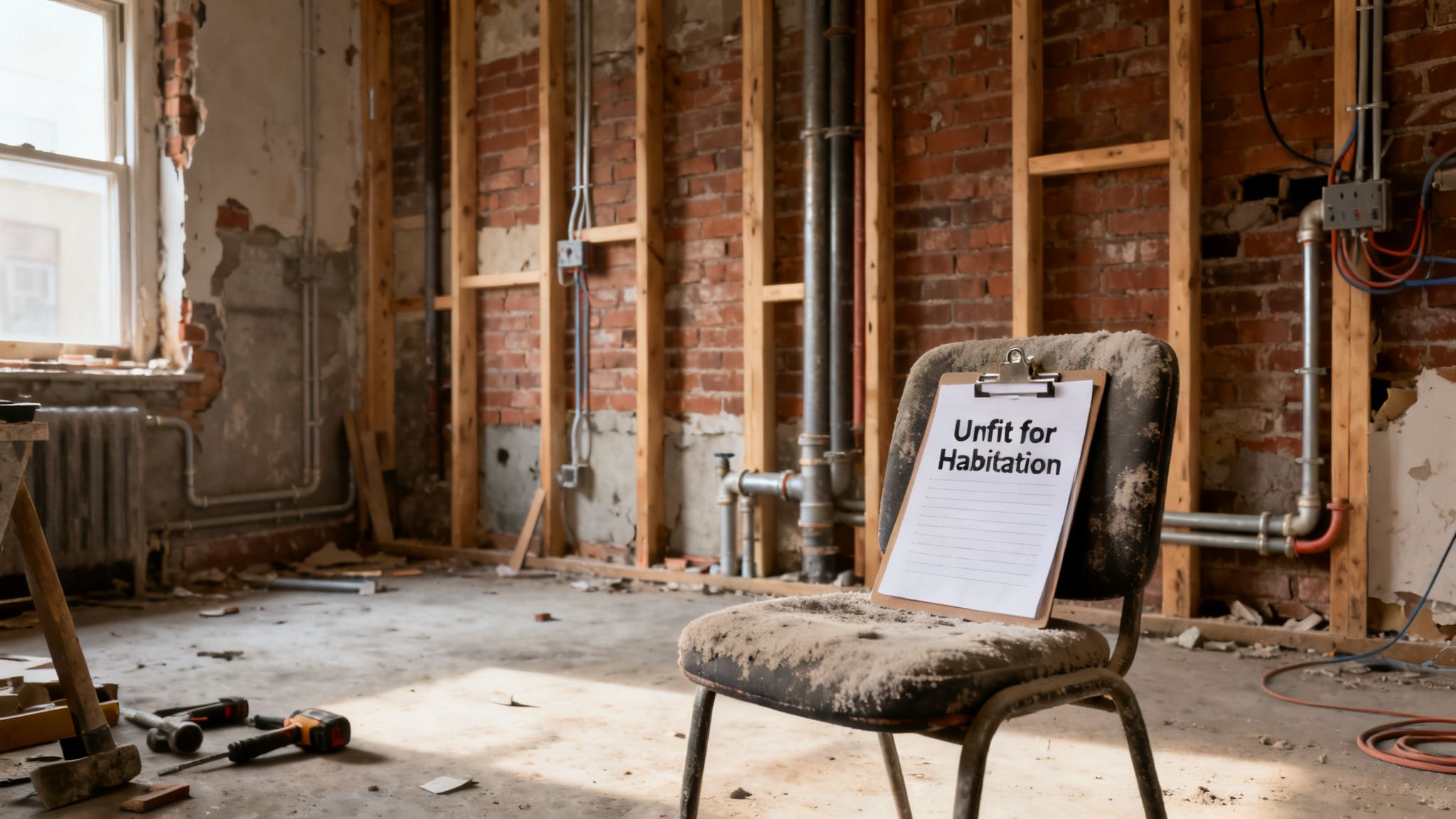
This exemption can provide relief for up to three years—and can sometimes be extended—making it an essential financial tool for owners undertaking major projects. The clock starts the moment the property is rendered uninhabitable and only stops when you formally notify the municipality that it’s ready for use again.
Defining ‘Unfit for Habitation’: The Criteria
While local bylaws can vary, the core definition of an “unfit for habitation” property (neches she’eino ra’ui le’shimush) is consistent across Israel. You must prove the property cannot be used for its intended purpose due to severe, fundamental problems.
Common qualifying situations include:
- No Essential Utilities: The property is physically disconnected from the city water supply or the national power grid. Simply having the service turned off is not enough; the infrastructure must be missing or non-functional.
- Major Structural Damage: This includes collapsed roofs, failing walls, or catastrophic fire or water damage—anything that makes the building fundamentally unsafe.
- Deep Renovation State: If a property has been gutted to the studs—with floors ripped out, walls removed, and fixtures gone—it clearly qualifies. The key is proving it’s an active, large-scale construction site.
- Official Condemnation Order: A formal order from a municipal or government authority declaring the building dangerous is definitive proof for the exemption.
Claiming this exemption is a far more involved process than a simple vacancy declaration. It often comes up during a property purchase in Israel, especially when investors acquire a run-down building for a major overhaul.
Building Your Case for the Municipal Inspector
When you submit this type of request, a municipal inspection is guaranteed. The inspector will visit the site to verify your claims, and your success depends entirely on the evidence you provide. You must build a case that is so thorough it leaves no room for doubt.
To prepare for this inspection, your documentation must be airtight.
Key Insight: The inspector’s only job is to confirm that the property cannot be used in its current state. Your job is to make that conclusion unavoidable. A well-organized, comprehensive file often makes the difference between approval and denial.
Here’s the evidence you need to gather:
- Photo and Video Documentation: Take extensive, date-stamped photos and videos of everything. Show exposed wiring, missing plumbing, structural cracks, and gutted rooms.
- Professional Reports: A formal assessment from a licensed engineer or contractor detailing the structural issues and scope of repairs is incredibly persuasive.
- Permits and Contracts: If you’re renovating, provide copies of all approved building permits and signed contracts with your construction team.
- Utility Disconnection Letters: Obtain official confirmation from water and electricity companies stating that services have been physically disconnected.
For owners abroad, managing this and preparing for an on-site inspection is a logistical nightmare without local help. A real estate power of attorney is absolutely essential. It empowers your legal team in Israel to manage the application, meet inspectors, and advocate for you to secure this critical long-term exemption.
Don’t navigate the Israeli legal system alone. Schedule a consultation regarding your specific case.
Navigating the Application and Inspection Gauntlet
Successfully securing an arnona exemption for an empty property comes down to the details of your application and how you handle the inevitable municipal inspection. This is where small missteps can lead to expensive denials. Treat this as a formal legal filing, not a casual request.

Whether you’re aiming for the one-time vacancy exemption or the more complex ‘unfit for habitation’ status, the burden of proof is on you. The municipality will not give you the benefit of the doubt. Your only tool is a meticulously prepared, comprehensive file.
For our clients overseas, managing this process from abroad is nearly impossible without local support. A real estate power of attorney is essential, empowering your local counsel to file papers, meet inspectors, and deal directly with the municipality.
Building an Airtight Application
Your application is only as good as the evidence attached to it. While each municipality has its quirks, a core set of documents is always required. Submitting an incomplete file is the fastest way to get your application rejected.
Here’s what you’ll almost certainly need:
- Proof of Ownership: A copy of the property’s title deed (Tabu) or a fully signed purchase contract.
- Sworn Affidavit (Tatzhir): A formal, signed declaration stating the precise date the property became vacant and confirming it’s completely empty. For ‘unfit’ claims, it must detail the property’s condition.
- Utility Bills: Recent electricity and water statements showing zero (or near-zero) consumption are persuasive, objective proof.
- Heavier Evidence for ‘Unfit’ Claims: This requires contractor agreements, approved building permits, and a formal engineer’s report detailing structural defects.
Expert Tip: Never underestimate the power of a picture. We always advise clients to include a dedicated album of date-stamped photos. For a vacancy claim, show every empty room. For an ‘unfit’ claim, show the gutted interiors and damaged structures. A strong visual narrative can often convince an inspector before they even visit.
Preparing for the Municipal Inspector’s Visit
If you’re claiming ‘unfit for habitation,’ a physical inspection is guaranteed. For standard vacancy claims, it is highly likely. The inspector’s job is to see if the reality on the ground matches your paperwork. Your job is to make their conclusion unavoidable.
The inspector is trained to look for red flags:
- Any Sign of Occupancy: A stray piece of furniture, boxes in storage, or personal belongings can kill a vacancy claim. The property must be truly empty.
- Genuinely Uninhabitable Conditions: Cosmetic issues don’t count. The inspector wants to see exposed wiring, missing toilets, a torn-out kitchen, or obvious structural problems.
- Consistency is Key: The inspector will have your file. If your affidavit says the kitchen was gutted, it better be. Any discrepancy destroys your credibility.
For those we assist with property management in Israel from overseas, ensuring the property is perfectly prepped for this visit is one of our most critical tasks.
Getting Ahead of Common Denials
Municipalities tend to deny applications for a few common reasons. Knowing them allows you to build a case that preemptively counters them. Many denials aren’t a final ‘no,’ but an invitation to provide better proof.
The usual culprits are incomplete paperwork, weak evidence, or an inspector who decides the property is still usable. If you get a denial, your first move is to request the official reason in writing. Often, it’s something fixable—like adding a contractor’s report or providing clearer photos.
The secret to turning a potential denial into an approval is building an unshakeable case from day one. This proactive mindset is crucial, especially when dealing with high-value assets, mirroring the same rigor we apply to due diligence essentials for luxury acquisitions.
Don’t navigate the Israeli legal system alone. Schedule a consultation regarding your specific case.
Why Getting an Exemption Isn’t So Simple: Israel’s Housing Policies
To get your Arnona exemption for an empty property approved, you must understand the context. This isn’t just a bureaucratic exercise; your request lands in the middle of a national housing crisis. Knowing this is key to anticipating tough questions and building a case that wins.
Israel is in the grips of a serious, long-term housing shortage, which drives property and rental costs to record highs. From the government’s perspective, every vacant apartment is a unit not helping solve the problem. That pressure flows directly to the municipal authorities you’re dealing with.
The Government’s War on “Ghost” Apartments
Municipalities are being pushed by the national government to get “ghost” apartments back on the market. This is a core policy objective. When your application hits their desk, their default setting is skepticism. You have to convince them your property is legitimately vacant for a good reason, not just sitting empty as a speculative asset.
This policy has led to punitive measures to make holding an empty property costly.
- Double Arnona: In a growing number of cities, properties left empty for long periods without a valid exemption can be hit with double the standard Arnona rate. This is a significant financial penalty.
- Increased Inspections: Municipalities are investing more resources into verifying vacancy claims, cross-referencing utility bills and sending inspectors more frequently.
- Less Flexibility: Officials are sticking to the letter of the law and are far less likely to grant exemptions in borderline cases.
Israel’s Vacant Property Problem by the Numbers
The scale of the issue is staggering. Recent data shows Israel has around 140,500 empty apartments, a 44% jump from 97,400 in 2000.
The Central Bureau of Statistics found that only 37% of these homes are available to live in. The rest are the real problem: 27% are used only occasionally, and a massive 36% are vacant for no clear reason. That’s nearly 90,000 properties sitting idle, which is why the government is taking such a tough stance.
This national context is the “why” behind your paperwork. Your application must prove, beyond a doubt, that you are not part of the problem. You must show a legitimate reason for the vacancy—a gap between tenants, a major renovation, or serious damage.
This kind of government intervention isn’t unique to Israel. Understanding the motivations behind these policies can be illuminated by looking at broader housing policy frameworks in other countries.
Tying Arnona into Your Broader Investment Strategy
The government’s housing policy impacts more than just Arnona. The same pressure to keep properties occupied influences other areas, such as the complex rules around the taxation on apartment rentals, which are also structured to encourage long-term leasing.
Seeing this bigger picture helps you build a smarter strategy. When you file for an exemption, you’re not just filling out a form—you’re making a case to an authority under immense pressure. Your documentation must be compelling enough to cut through their skepticism.
For those managing this from abroad, local experts who understand this dynamic are indispensable. It’s what makes professional property management in Israel a true strategic asset.
Don’t navigate the Israeli legal system alone. Schedule a consultation regarding your specific case.
Your Arnona Exemption Questions, Answered
When dealing with an arnona exemption for an empty property, details matter. Getting straight answers to common questions is key to protecting your investment and avoiding unnecessary bills. Here are the most frequent queries we tackle.
Can I Claim the Six-Month Exemption More Than Once for the Same Property?
No. The standard six-month vacancy exemption is strictly a one-time deal per owner, for that specific property.
Once used, it’s gone for good—even if the property becomes empty again years later while still under your ownership. This “one and done” rule makes timing a critical strategic decision. If the property empties again, you must either find a new tenant fast or see if it qualifies under the tougher “unfit for habitation” rules.
What if My Property Is Under Renovation?
A property undergoing a gut renovation often qualifies for an Arnona exemption under the ‘unfit for habitation’ category. The key is proving the work is so substantial that the property is genuinely unlivable.
To build a solid case, you need compelling evidence, not just a fresh coat of paint. You’ll typically need:
- Signed agreements from contractors detailing the full scope of work.
- Official building permits issued by the municipality.
- Clear photos and videos showing the property is gutted, without a functioning kitchen or bathroom, or in a state of major construction.
A municipal inspector will visit to verify your claim. They need to see a real construction zone.
What Should I Do if My Exemption Request Is Denied?
A denial is not the final word. First, formally request a written explanation from the municipality for their rejection. Often, it’s something fixable like missing paperwork.
Once you have their reasoning, you can file a formal appeal. Your appeal must directly address the issues they raised by providing the missing documents or stronger proof.
This is where professional legal help often becomes essential. An attorney can dissect the denial, build a powerful appeal, and handle the bureaucracy. If the administrative route fails, pursuing the matter through commercial litigation in Israel may be necessary to enforce your rights.
How Do Municipalities Verify That a Property Is Empty?
Municipalities use several methods to confirm a property is unoccupied.
Their most common verification tools include:
- Utility Data: A sustained period of zero (or near-zero) water and electricity usage is strong evidence.
- Sworn Affidavits: Your signed declaration (tatzhir) is a legally binding document and the foundation of your claim.
- Physical Inspections: Municipal agents often conduct on-site visits, which are mandatory for “unfit for habitation” claims.
- Neighbor Reports: While less official, municipalities sometimes act on tips from neighbors or the building’s management committee (va’ad bayit).
For owners abroad, it’s crucial the property is completely empty. Even a few boxes could lead an inspector to decide the property is “in use,” torpedoing your claim. A professional property management service in Israel is invaluable here, ensuring the asset is properly cleared and ready for inspection.
Don’t navigate the Israeli legal system alone. Schedule a consultation regarding your specific case.