
As a senior litigator with over three decades navigating Israel’s complex property and finance laws, I’ve guided countless families through the labyrinthine process of reclaiming lost legacies. Tracking down dormant bank accounts in Israel or learning how to find family land in Israel is more than an administrative task—it’s a profound journey into your heritage, often culminating in the recovery of significant wealth. This guide is forged from that experience, focusing on the practical “how” and the critical “why” to protect your interests.
This is a quest driven by a powerful pain point: the feeling that part of your family’s story, and its corresponding wealth, has been lost to time. Many are unaware that ancestors—from Holocaust survivors to immigrants who forged new lives—left behind significant assets. These forgotten land parcels and blocked accounts are not just historical artifacts; they are tangible links to your heritage, often representing a substantial financial inheritance.
My experience has shown that these two searches are deeply intertwined. A record for a dormant bank account can hold the key to a piece of property, and a land search may uncover forgotten financial ties. The secret to success lies in understanding why these assets become lost and mastering the modern strategies required to reclaim them.
The Scale of Lost Assets in Israel: Why This Matters Now
The volume of unclaimed assets in Israel is staggering. Billions of shekels sit idle in dormant bank accounts alone. As of 2025, the total value of accounts inactive for over ten years has surpassed NIS 12 billion, spread across approximately 1.5 million accounts. A significant number of families have a rightful claim to these funds. The Bank of Israel’s own publications detail the growing scale of this issue.
As a litigator, I’ve seen a single, decades-old document unlock millions. The challenge isn’t a lack of assets; it’s a deficit of information and a clear, strategic process—a gap this guide is designed to close.

Why You Need a Strategic Approach
While the Israeli government provides official tools, the path to recovery is rarely a straight line. The process becomes exponentially more complex when managed from overseas, fraught with bureaucratic hurdles and language barriers. To effectively cut through the red tape, partnering with a trusted asset recovery company specializing in these cross-border claims is not just a convenience—it’s a strategic necessity. Their expertise is designed to overcome the very obstacles that derail most individual efforts.
The following sections provide the actionable steps that will transform your search from a hopeful inquiry into a concrete recovery operation.
Step 1: Locating Dormant Bank Accounts and Blocked Accounts
This is where the hunt begins. The Bank of Israel’s official online portal, “Eitan,” is your primary digital tool for locating dormant accounts, but it’s only as effective as the information you feed it. A successful claim is never born from a casual name search; it is built on a foundation of meticulous archival work. You must become your family’s historian, because a single, long-forgotten document can be the key that unlocks a blocked account.
Why Your Preliminary Research is Everything
To extract a meaningful result from the system, you need precise identifiers. The more specific your data, the higher your probability of a match.
- Israeli ID Number (Teudat Zehut): This is the single most critical piece of information. If your relative lived, worked, or held any official status in Israel, they had one. Scour old passports, official correspondence, or any document issued in Israel.
- Full Name and All Variations: Do not underestimate this. Names were frequently Hebraized or transliterated with inconsistent spellings. Document every possible version—think Avraham, Abraham, and Abe; or Cohen, Kagan, and Katz.
- Date of Death: This is essential for searching a deceased relative’s assets, as the portal uses this to cross-reference records.
- Old Financial Documents: Dig for anything. Bank statements, passbooks, checkbook stubs, or personal letters mentioning a specific bank provide the direct clues you need.
Common Pitfalls and How to Overcome Them
I’ve seen countless clients perform a single search, find nothing, and wrongly conclude it’s a dead end. This is a severe and common pitfall. A “no results found” message doesn’t mean nothing exists; it means your search parameters need refinement.
Expert Case Study: A client was searching for his grandfather, “David Goldstein,” with no success. He had completely forgotten that his grandfather Hebraized his name decades prior. A new search for “David Zahavi” immediately uncovered a significant blocked account that had been dormant since the 1960s. This underscores the necessity of cross-referencing digital searches with old family letters and documents.
This challenge is magnified for heirs of Holocaust survivors, whose records are often fragmented or were created under extreme duress. Here, the search must expand beyond the standard portal to include organizations like HASHAVA, which specialize in Holocaust-era assets and work directly with Israeli financial institutions.
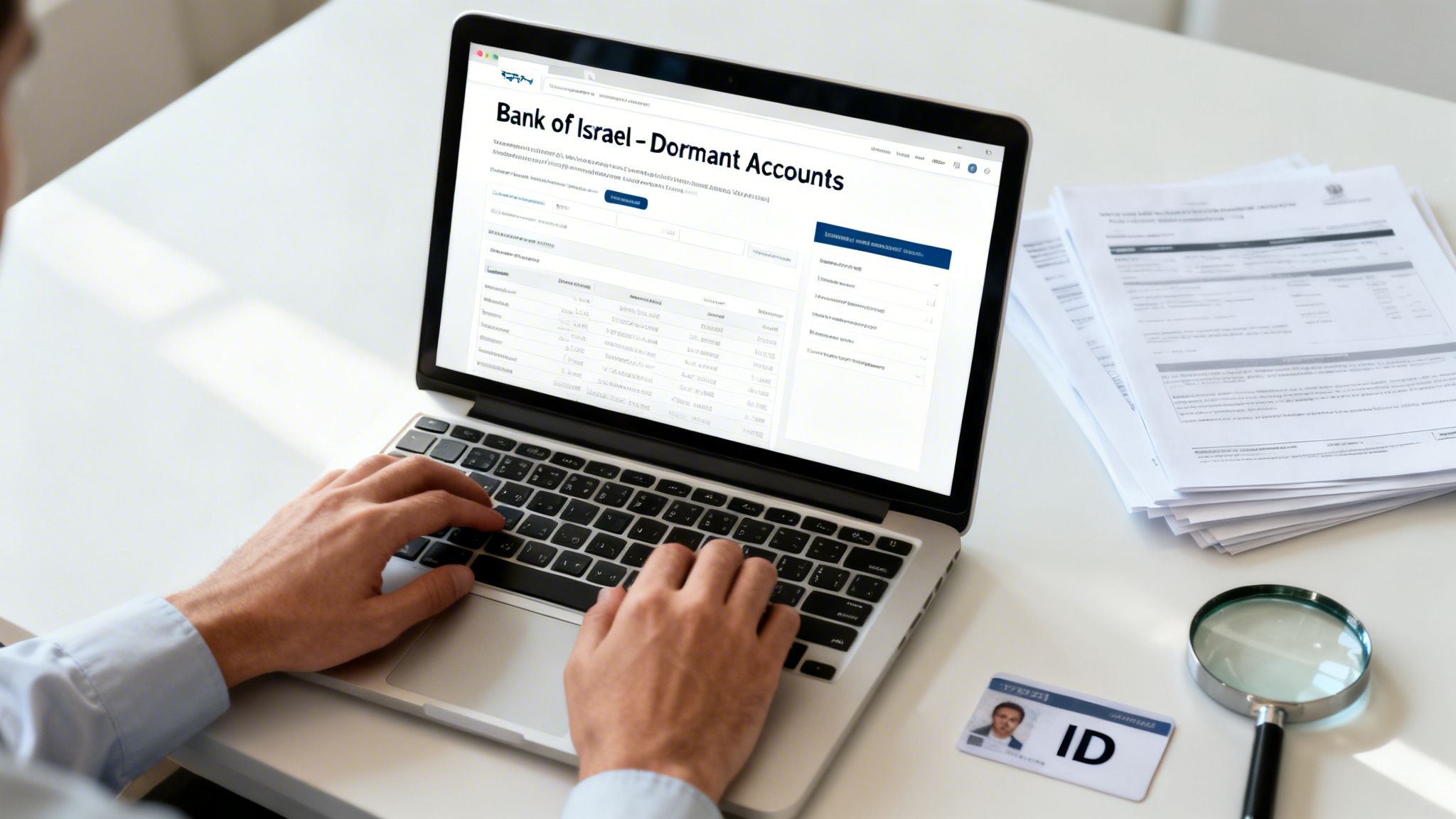
Unlocking Corporate and Restricted Funds
For businesses, these dormant funds can be a game-changer. A company’s predecessor entities or founders may have left assets in accounts that are now inactive. Uncovering these can provide the capital for a new Company Registration in Israel or be the key to resolving complex financial situations, such as dealing with Restricted Bank Accounts.
This table summarizes the key institutions in your search and expert tips for navigating them effectively.
Key Israeli Institutions for Asset Recovery
| Institution / Database | Primary Function | What You Need to Search | Expert Tip for 2026 Compliance |
|---|---|---|---|
| Bank of Israel “Eitan” Portal | Centralized search engine for dormant and blocked accounts across all Israeli banks. | Israeli ID number (Teudat Zehut) of the account holder and their date of death. | The system’s algorithms are improving. Always attempt searches with alternate name spellings and date variations if your initial query fails. |
| HASHAVA | Locates and restitutes assets of Holocaust victims. | Family names, birth dates, and places of origin. Any pre-war documentation is invaluable. | New digital archives are being integrated. Prepare to provide detailed family trees and historical context to substantiate your claim. |
| Individual Banks | Direct inquiry for accounts that may not appear on the central portal due to age or record type. | Deceased’s name, ID number, and any evidence of a prior banking relationship (e.g., old statements). | As of 2026, banks must respond to digital inquiries from authorized legal counsel within a shorter, mandated timeframe. This is a key strategic advantage. |
This discovery stage is about casting a wide, informed net. Use every piece of historical data to uncover what was lost. Once you secure a positive hit, the next phase—proving your claim—begins.
Step 2: Navigating the Israel Land Authority to Find Family Land
While locating a dormant bank account is a digital-first task, the quest to find family land in Israel is an entirely different undertaking. It is less a search and more an archaeological dig through layers of history, demanding an investigator’s tenacity. In my 30 years in Israeli real estate law, I’ve seen this journey connect families to their heritage in profound ways, unearthing not just property, but a deep sense of identity.
Your search will inevitably lead you to two gatekeepers: the Israel Land Authority (ILA) and the Land Registry Office (Tabu). Unlike a simple bank inquiry, you cannot approach them with just a family story. To even begin, you need hard data.
How to Initiate a Land Registry Search
The most successful claims I’ve litigated began with specific identifiers. Without them, you are searching for a needle in a national haystack.
- Gush/Chelka (Block/Parcel) Numbers: This is the gold standard. An old tax receipt, a deed, or even a handwritten note with these numbers makes your path incredibly direct. This is the property’s unique legal identifier.
- Family Names and ID Numbers: Searching by name is possible but challenging due to the same transliteration issues seen with bank accounts. However, pairing a name with a relative’s Teudat Zehut (Israeli ID number) significantly cuts through the noise.
- Historical Property Descriptions: This is the last resort for when all other leads are cold. Vague clues like “the land near the old well in the village of…” require serious archival work, often pulling pre-state maps from the Ottoman or British Mandate eras.
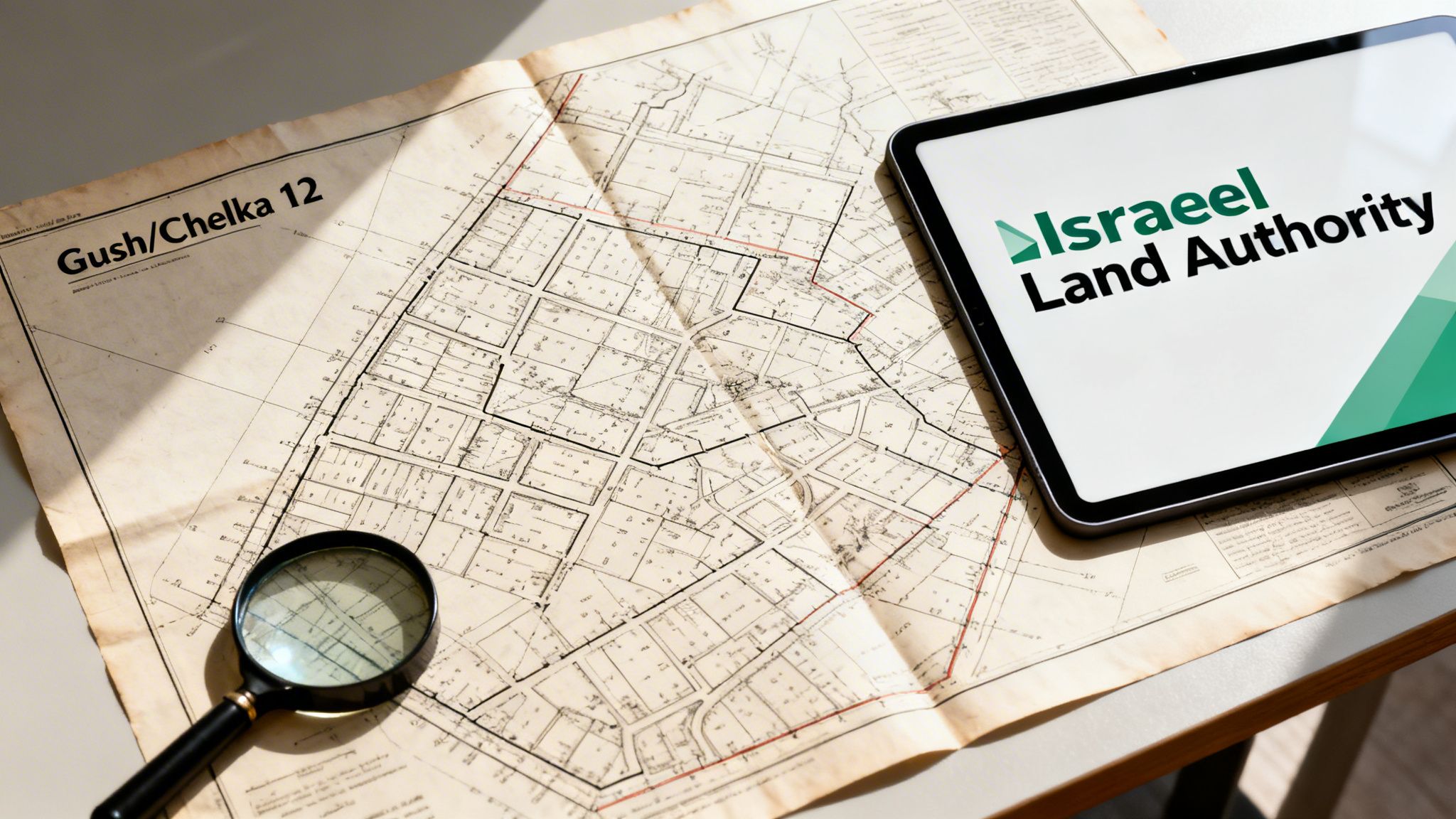
A powerful link exists between unclaimed land and dormant bank accounts. Many pre-1948 properties are tied to absentee owners whose descendants may also have claims to long-forgotten bank deposits. Over 250,000 hectares of such land are currently under state custodianship. Consider the 2025 data: 4,200 successful claims led to the recovery of NIS 1.8 billion in assets, and 32% of these cases involved bank deposits dormant since the 1980s. You can explore more macro data on Israel’s account balances on the CEIC Data website.
Why Evidence is Your Most Critical Asset
Securing a potential match in the registry is merely the first step. The real battle begins with proving ownership. This is the hurdle where most families falter.
Expert Case Study: I represented a Canadian family with a compelling story about owning land in the Galilee but zero paperwork. The breakthrough came from an unexpected source: a 1930s photograph showing their great-grandfather on the property with a partially visible boundary marker. By combining that image with archival research that unearthed a corresponding tax ledger, we constructed a successful claim.
This case illustrates a critical point: you build a mosaic of evidence. A single “smoking gun” document is rare. Instead, you create a compelling legal case by piecing together a collection of partial proofs.
The screenshot below shows the official Israel Land Authority portal, your primary digital resource for initiating these searches.
This portal is your gateway, but its effective use demands precise information, almost always in Hebrew, making professional assistance crucial for anyone navigating this from abroad.
The Absentees’ Property Law: A Common and Severe Obstacle
One of the most complex roadblocks is the Absentees’ Property Law of 1950. This law transferred the property of individuals who were not in Israel during a specific historical period to state custodianship. If your family’s land falls into this category, reclaiming it is not a simple ownership transfer; it is a full-blown legal battle against the State of Israel. To prevail, you must prove a continuous family lineage and demonstrate that the original owners never willingly abandoned the property. This is high-stakes litigation where experienced representation is non-negotiable.
For a corporation, discovering ancestral land can be a strategic windfall or a massive liability if the title is clouded. These scenarios often require aggressive Commercial Litigation to clear the title and secure the asset. The key is decisive action, armed with properly vetted historical evidence.
Step 3: Proving Inheritance and Legally Claiming Your Assets
Finding a dormant bank account or an old family plot is a monumental victory. But in my three decades of handling these cases, this is where the real work—and the most severe pitfalls—begin. To take possession of these assets, you must legally prove you are the rightful heir. In Israel, this hinges on one critical document: a Tzav Yerusha, or Inheritance Order.
The Inheritance Order is the master key. Without it, no bank will release funds from a blocked account, and the Land Registry Office (Tabu) will not transfer a property title. It is the single, non-negotiable instrument that unlocks your family’s legacy.

How to Secure an Israeli Inheritance Order: The Process
The application for an Inheritance Order is a formal legal process filed with the Israeli Inheritance Registrar. It demands absolute precision. Any error, missing document, or improper certification will result in immediate rejection, sending you back to square one.
Your objective is to construct an unbroken, legally certified chain of lineage from the asset’s original owner directly to you. This requires a specific set of documents:
- Original Death Certificate: For the deceased asset owner.
- Original Birth Certificates: For all potential heirs to establish direct parent-child relationships.
- Original Marriage Certificates: To prove spousal claims and trace the family tree.
- Official Name Change Documents: If anyone in the line of inheritance changed their name.
Severe Common Pitfall: Submitting standard photocopies or uncertified documents is a disastrous and frequent mistake. Every official document issued outside Israel must have an apostille certification. This internationally recognized seal validates the document; without it, Israeli authorities will discard it without review.
Why Certified Translation is Non-Negotiable
Beyond the apostille, every non-Hebrew document must be translated into Hebrew by a certified Israeli notary. A generic translation from your home country is worthless in this context. This is a strict rule designed to ensure total legal accuracy.
Getting this wrong can derail your entire claim. I once had a case delayed by over a year because a notary in the client’s home country mistranslated a single word on a birth certificate, creating enough ambiguity about the lineage that we had to restart the entire process—translation, certification, and submission.
Expert Strategies for Complex Claims Approaching 2026
As we head toward 2026, evidentiary standards are tightening, but so are the tools at our disposal. For very old, pre-state properties where paper records are spotty or non-existent, we are deploying new strategies to build a case.
One powerful new strategy is using DNA evidence to establish lineage. When combined with archival records and family testimony, a professionally conducted DNA test can build a compelling case where one was previously impossible.
Digital records are also becoming more critical. As government and municipal archives are slowly digitized, we can cross-reference these new files with old family papers to strengthen an application and accelerate a claim that would have taken years just a decade ago. A perfectly prepared application can yield an Inheritance Order in 4-6 months. However, disputes between heirs, a contested will, or documentation gaps can easily stretch the process to 18-24 months. The key to success is eliminating every possible administrative roadblock from day one.
Step 4: Protecting Your Reclaimed Assets (2026 Compliance & Beyond)
You’ve located a dormant bank account or identified family land in Israel. The discovery is exhilarating, but this is the moment to pivot from discovery to defense. From my perspective as a litigator, this is where many families stumble. They celebrate the find but lose momentum, or worse, lose a portion of the assets to taxes, disputes, or poor planning. As we look toward 2026, protecting these assets demands a new level of strategic foresight.
Structuring reclaimed assets in an Israeli trust is a key 2026 strategy for tax efficiency and long-term protection.
Why 2026 Compliance Rules Matter
Israeli authorities are systematically tightening compliance rules for international claims to combat fraud and streamline processes. The year 2026 is a critical turning point.
Here’s what you must prepare for:
- Hardened Digital Verification: Simple scanned documents will be rejected. For international claims, banks and the Administrator General will mandate digitally verified documents submitted through secure portals, a task managed by authorized Israeli counsel. This standard eliminates forgery and makes a local, tech-savvy representative indispensable.
- Shrinking Response Windows: Leniency for overseas heirs is ending. Official notices from the Administrator General will carry shorter, non-negotiable deadlines. Missing a 30-day deadline to respond to an inquiry can see your claim deprioritized, causing costly delays.
Expert Strategy for 2026: Do not wait for an official notice. The moment you identify a potential asset, your legal team must begin compiling and certifying all necessary documents. Being ready to file instantly is your single greatest strategic advantage.
How to Shield Your Claim From Competing Heirs and Fraud
The moment an asset of significant value is unearthed, you must assume that other potential heirs—some legitimate, some not—will surface. I have seen families torn apart and fortunes bled dry by protracted legal fights. A defensive mindset is non-negotiable.
Your primary shield is an irrefutable line of succession. This goes far beyond presenting birth certificates. We guide clients in building a comprehensive “proof of lineage” file, including historical correspondence, dated photographs, and sworn affidavits from community elders. This body of evidence becomes priceless if a competing party contests your inheritance order.
For tangled family trees, filing for a declaratory judgment is a powerful, preemptive move. This form of Commercial Litigation asks the court to formally affirm your status as the rightful heir, effectively neutralizing future challenges before they can gain traction and saving years of conflict.
Advanced Strategies for Structuring Your Newfound Assets
Reclaiming the assets is only half the victory. What you do next determines their future value. Simply wiring funds to your home bank or holding a property title in your own name can trigger massive tax liabilities and create a management nightmare. For large estates, an Israeli trust is the most robust tool available.
- Asset Protection: A properly drafted trust insulates assets from creditors, future lawsuits, and opportunistic claims.
- Tax Optimization: It allows for strategic distributions that can dramatically minimize capital gains and inheritance taxes in both Israel and your country of residence.
- Succession Planning: It creates a clear, legally binding roadmap for passing wealth to the next generation, bypassing another painful probate process.
Navigating this final stage is fraught with potential missteps. This table highlights the most frequent and severe mistakes we see and how to avoid them.
Severe Common Pitfalls in Israeli Asset Recovery and Expert Mitigation Strategies
| Severe Common Pitfall | Consequence | Expert Mitigation Strategy |
|---|---|---|
| Ignoring Tax Implications | Double taxation on inheritance and capital gains erases a significant portion of the asset’s value. | Engage a cross-border tax specialist before any assets are transferred. Structure the holdings within an Israeli trust or other tax-efficient vehicle. |
| Co-mingling Reclaimed Funds | Funds from a dormant account are mixed with personal savings, creating an accounting nightmare and legal disputes among heirs. | Immediately open a new, dedicated account in Israel solely for the reclaimed funds, managed by your legal representative. |
| Relying on Verbal Agreements | Heirs verbally agree on how to split assets, only to have the agreement dissolve when the money or property materializes. | Formalize all distribution agreements among heirs in a legally binding document before applying for the Inheritance Order. |
While these strategies are tailored to Israeli assets, the underlying principles are universal. For a broader perspective, exploring general Advanced Strategies for Protecting Your Assets can provide valuable insights, as core concepts often apply across jurisdictions. The goal is not just to find what was lost, but to transform it into a secure and lasting legacy.
Answering Your Top Questions on Reclaiming Israeli Assets
After 30 years in Israeli real estate and finance litigation, I’ve seen that the moment a client discovers a potential dormant bank account or family property, a wave of urgent questions follows. It’s an exciting prospect, but it also opens up a world of legal complexity. Here are the practical, straightforward answers to the questions my clients ask most often.
How Long Does It Take to Claim a Dormant Bank Account in Israel?
There’s no single answer, but experience gives us a reliable forecast. In a best-case scenario—where you have every document ready to go, like the original owner’s Israeli ID (Teudat Zehut) and your apostilled birth certificate—a claim might be settled in 3-6 months after filing.
But that’s rarely the whole story. The process almost always hinges on first obtaining an Israeli Inheritance Order, known as a Tzav Yerusha. This is a legal requirement that adds its own timeline. A completely smooth inheritance filing can take 4-6 months, but any hiccup can easily stretch the entire recovery process to 12-24 months.
The common roadblocks I see every day are predictable:
- Documentation Gaps: One missing death certificate or a document that isn’t properly apostilled can bring everything to a standstill for months.
- Heir Disagreements: If family members can’t agree on how to divide the assets, the process is legally frozen until the dispute is resolved in court.
- Deep Genealogical Work: For assets dating back to pre-state Israel, proving your direct lineage can become a major research project, requiring deep dives into historical archives.
What if I Find Family Land but Someone Else Is Occupying It?
This is the point where your asset recovery mission becomes a serious legal conflict. You absolutely cannot handle this on your own. This is a classic case for our Commercial Litigation team.
Your first and only move is to legally and formally establish your ownership with the Land Registry Office (the Tabu). Once your title is indisputable, we issue a formal legal notice demanding the occupants vacate. Their response dictates what comes next. It could lead to a structured negotiation or, if they refuse to leave, an eviction lawsuit.
I can’t stress this enough: Israeli law provides a strict, court-ordered process for evictions. Any attempt to remove occupants yourself is illegal and will seriously compromise your legal position.
Can I Handle the Search and Claim Process Entirely from Abroad?
You can certainly kick off the initial research from anywhere with online searches. But it’s a common and costly misconception that you can complete the entire claim process remotely. It’s practically impossible.
Israeli banks, the Land Registry, and the Inheritance Registrar all require official filings in Hebrew. Many steps must be completed in person or by an authorized Israeli lawyer. An Inheritance Order, for example, has to be processed through the Israeli court system.
The standard—and frankly, the only effective—way to manage this is by granting a power of attorney to a reputable Israeli law firm. This allows them to act on your behalf, from filing documents to appearing in court. It’s how successful international claims get done.
What Are the Typical Costs Involved?
I always tell clients to budget for three distinct cost categories when planning to reclaim a dormant account or family property in Israel.
- Investigation & Retrieval Fees: This covers the professional search work, archival research, and the fees charged by government bodies for retrieving official documents.
- Legal Fees: This is for our professional services—preparing and filing the inheritance application, handling all communications, and representing your interests. We provide a clear fee structure upfront, which could be a fixed rate, hourly, or a contingency fee based on the recovered asset’s value.
- Government & Third-Party Fees: These are non-negotiable costs paid to others. They include court filing fees, official Hebrew translations by certified notaries, and the apostille certifications required for your foreign documents.
At RNC Group, we provide the strategic legal counsel needed to navigate these complex, cross-border claims from discovery to recovery. If you believe you have a claim to a dormant bank account or family land in Israel, contact our team for a consultation.