

Picture this: your local municipality approves a new zoning plan, and suddenly, the sleepy plot of land you own can now host a six-story apartment building instead of a single-family home. Its value skyrockets. This is where Israel’s Betterment Levy, known in Hebrew as Hetel Hashbacha, comes into play. For international investors, this tax on the increased value of your land can feel like a hidden financial trap.
This isn’t a sales tax or a capital gains tax. It’s a direct claim on the “betterment”—the financial windfall you get when a planning committee’s decision boosts your property’s potential. Understanding how this levy works, who is liable for it, and how that liability can be shifted is critical for anyone doing business in Israel’s real estate market.

Understanding The Betterment Levy in Israel
The Betterment Levy (Hetel Hashbacha) is a tax imposed by a local municipality on the increase in a property’s value resulting from the approval of a new zoning or building plan. Think of it as the public’s way of reclaiming a portion of the value it created through a planning decision. For any international investor following a Buying Property in Israel Guide, ignoring this levy is a surefire way to face unexpected, significant costs.
What is the Betterment Levy? A Formal Definition
At its core, the Betterment Levy is a tax on the increase in the value of real estate that occurs due to one of three specific public planning actions:
- Approval of a new local or district master plan (TABA).
- Granting a deviation or relief from an existing plan (e.g., permission for an extra floor).
- Authorizing a non-conforming use for a property (e.g., allowing a commercial business in a residential zone).
The logic is that since the value increase was created by a public action, not the owner’s investment, the public is entitled to a share.
The 50% Rate and When Liability Occurs
The tax rate is fixed and significant: 50% of the increase in the property’s value. Liability for the levy is established the moment the new plan is approved, but the payment is typically only demanded when you “realize” the new rights. This happens when you:
- Sell the property.
- Receive a building permit based on the new plan.
- Begin using the property in a way authorized by the new plan.
This delay between when the liability is created and when the payment is due creates a hidden financial risk that can surprise unprepared investors. It is distinct from other real estate taxes, like the one calculated with the Purchase Tax Calculator & Rates. This is why thorough Due Diligence Essentials are critical to uncover any dormant levy obligations before purchasing a property.
Don’t navigate the Israeli legal system alone. Schedule a consultation regarding your specific case.
How the Levy Is Triggered and Calculated
The Betterment Levy, or Hetel Hashbacha, doesn’t just appear out of thin air. It’s a direct result of specific municipal planning decisions that suddenly make your property more valuable. Getting a handle on these triggers is your first line of defense against this often-surprising tax.
Liability for the levy kicks in the very moment a local planning authority approves a value-boosting change. This creates a financial obligation that can lie dormant for years, waiting until you decide to sell the property or use those new rights.
The Three Primary Triggers
Under Israel’s Planning and Building Law, three main events can wake the sleeping giant. Each one is an official act that directly inflates your property’s potential worth.
- Approval of a New Master Plan (TABA): This is the big one. When a municipality greenlights a new city building plan (TABA), it can rezone whole districts, permit denser construction, or change land use from, say, agricultural to residential. If your property benefits from this city-wide upgrade, the levy is triggered.
- Granting a Building Permit with a Deviation: Let’s say you want to build something that bends the rules—adding an extra floor or pushing out the building’s footprint. If you apply for a permit with this kind of exception and the municipality approves it, that approval can trigger the levy. The value increase is pinned directly to that specific concession.
- Authorization of Non-Conforming Use: This happens when you get official permission to use your property for something not allowed under current zoning—like opening a shop in an area zoned purely for residential use.
For anyone involved in Israeli real estate, these triggers are critical. They carry serious financial weight. For those managing a property from overseas, keeping an eye on these local decisions is a huge challenge, which is why having a Real Estate Power of Attorney can be a lifesaver for handling things remotely.
The Calculation The Core Formula
The math behind the Betterment Levy seems simple, but its impact is massive. The local authority brings in a municipal appraiser to put a number on the financial windfall your property just received from the planning change.
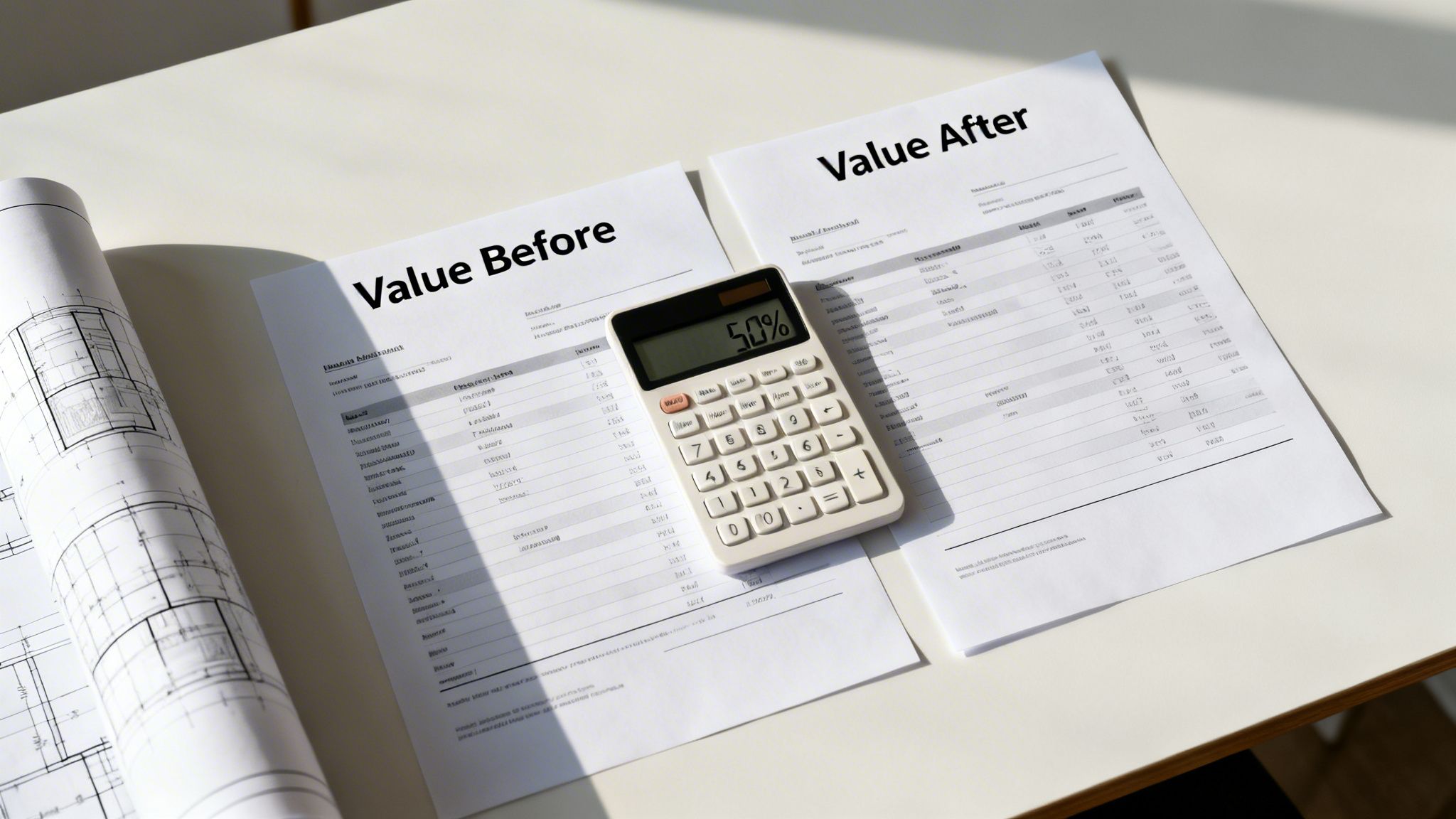
The formula is as straightforward as it gets: The levy is 50% of the difference between the property’s market value immediately before the planning approval and its value immediately after.
Crucially, this appraisal looks only at the value added by the planning decision. It completely ignores general market trends or any improvements you’ve made yourself.
A Step-by-Step Calculation Example
Let’s walk through a real-world scenario. Imagine you own a piece of land valued at NIS 2,000,000, where the current zoning allows for just a single-story house.
- The Trigger: The municipality approves a new TABA that now lets you build a three-story building on that same land.
- Valuation Before: A municipal appraiser assesses the land’s market value under the old rules, confirming it’s worth NIS 2,000,000.
- Valuation After: The appraiser recalculates the value with the new, beefed-up building rights. With the potential to build a three-story structure, the land is now worth NIS 3,000,000.
- Calculate the Betterment: The increase in value—the “betterment”—is simply the difference between the two numbers.
- NIS 3,000,000 (Value After) – NIS 2,000,000 (Value Before) = NIS 1,000,000
- Calculate the Levy: The levy is a flat 50% of that betterment figure.
- 50% of NIS 1,000,000 = NIS 500,000
In this case, the final Betterment Levy owed is NIS 500,000. This bill becomes due when you finally “realize” these new rights—either by selling the property or by applying for a building permit under the new plan.
But here’s the key takeaway: this initial assessment is rarely the end of the story. Think of it as the opening bid in a negotiation, not the final bill. Contesting it almost always requires expert legal help, much like navigating other complex financial disputes detailed in our guide to Commercial Litigation in Israel.
Don’t navigate the Israeli legal system alone. Schedule a consultation regarding your specific case.
Determining Who Pays the Betterment Levy
Figuring out who’s on the hook for the Betterment Levy is where many international investors get tripped up. By law, the person who owned the property when the value-boosting plan was approved is the one who pays. But in practice, real estate contracts frequently and legally shift this burden from the seller to the buyer.
This creates a major financial risk for unprepared buyers. Imagine a zoning plan was approved in 2015, creating a dormant tax liability. The original owner sells the property in 2020. In 2024, the new investor applies for a building permit, and the municipality sends a hefty bill to the current owner. Who pays? The answer lies in the contract.

Contractual Shifting of Payment from Seller to Buyer
It is standard practice in Israeli real estate transactions for the purchase agreement to address the Betterment Levy directly. Often, the liability is contractually shifted from the seller to the buyer. Why would a buyer agree to take on this potential tax?
- Negotiating Leverage: A savvy buyer uses this as a tool. By agreeing to assume the potential levy, the buyer can often negotiate a lower purchase price, effectively pricing the future tax cost into the deal.
- Future Value: The buyer is purchasing the property for its future development potential. Taking on the levy associated with those future rights is seen as part of the investment.
This contractual transfer turns the levy from a hidden landmine into a known, calculated investment variable. But for it to work, the agreement has to be ironclad.
The Critical Role of the Purchase Agreement
A poorly drafted contract is a recipe for disaster. Vague wording can spark expensive court battles years later. A solid purchase agreement must be crystal clear about the Hetel Hashbacha.
Key clauses need to explicitly define:
- Responsibility for Past Plans: The contract must state who is responsible for levies from plans approved before the signing date. This is typically shifted to the buyer.
- Responsibility for Future Plans: It should also clarify who pays for levies stemming from plans approved after the contract is signed but before the final title transfer.
- Indemnification: A strong clause is needed to require the responsible party to cover the costs if the municipality mistakenly bills the wrong person.
For an overseas investor, trying to manage these complex negotiations and ensure the contract is bulletproof is nearly impossible without local expertise. This is precisely why granting a Real Estate Power of Attorney to a trusted Israeli legal advisor isn’t just a convenience—it’s a critical risk-management move.
The purchase contract is your single most important defense against inheriting an unexpected, multi-million shekel tax bill. Ambiguity is the enemy; every potential levy scenario must be explicitly assigned to either the buyer or the seller.
The Israeli government loves the betterment levy; it’s a highly effective way to fund public infrastructure. The levy captures a steep 50% of any property value increase that comes from planning decisions, and local authorities are very good at collecting it. In a recent year, the national fund for this levy swelled to NIS 7.5 billion. The fact that wealthier central regions accounted for 60% of that total shows just how significant this tax is in prime investment areas. You can read the full report about these findings for yourself.
Due Diligence: The Key to Uncovering Hidden Levies
Before you even think about signing a contract, thorough due diligence is non-negotiable. This process goes way beyond a simple title search. Your legal team needs to dig deep into the property’s entire planning history at the local municipality.
The goal is to smoke out any approved plans that have already created a levy liability that’s just waiting to be triggered. This proactive check allows a buyer to put a number on the potential tax exposure and use that figure as leverage during price negotiations. If you skip this step, you’re essentially buying blind and just hoping no past planning decisions come back to haunt you. This deep dive is a fundamental part of the Due Diligence Essentials for any serious investor.
Don’t navigate the Israeli legal system alone. Schedule a consultation regarding your specific case.
Navigating Exemptions and Reductions
Staring down a potential Betterment Levy assessment doesn’t automatically mean you’re on the hook for the full 50% rate. Not by a long shot. The law actually provides several clear pathways for property owners and investors to dramatically slash, or even completely wipe out, this tax.
Thinking about these exemptions isn’t just about legal compliance; it’s a core financial strategy. For anyone involved in Israeli real estate, but especially for those Managing Property from Overseas, knowing these rules can completely change the numbers on a project. The right investment in the right area could carry tax incentives that redefine its profitability.
Key Exemptions for Residential Properties
Several exemptions are specifically aimed at protecting homeowners and kickstarting development where it’s needed most. Just remember, these aren’t automatic handouts—you have to formally apply and prove you meet the strict criteria.
- Small Residential Exemption: This is a big one for everyday homeowners. If you sell your apartment and the value increase came from a plan allowing for its expansion, you can be exempt from the levy. The key condition? The total expanded area can’t go over 140 square meters. It’s designed to shield regular families, not large-scale developers.
- Designated Development Zones: The government often earmarks specific neighborhoods or areas for rehabilitation. If your property falls within one of these zones, it might be fully exempt. This is a classic incentive to draw investment into underprivileged communities.
- Protected Dwellings: This rule protects long-term residents from being taxed out of their homes. If you (or a close relative) have lived in the property for at least four years after the new plan was approved, you may qualify for an exemption when you sell.
Urban Renewal: The Ultimate Tax Incentive
By far, the most significant breaks on the Betterment Levy are found in urban renewal projects. The government wields these tax incentives like a powerful tool, encouraging developers and homeowners alike to join nationwide efforts to modernize and strengthen Israel’s aging housing stock.
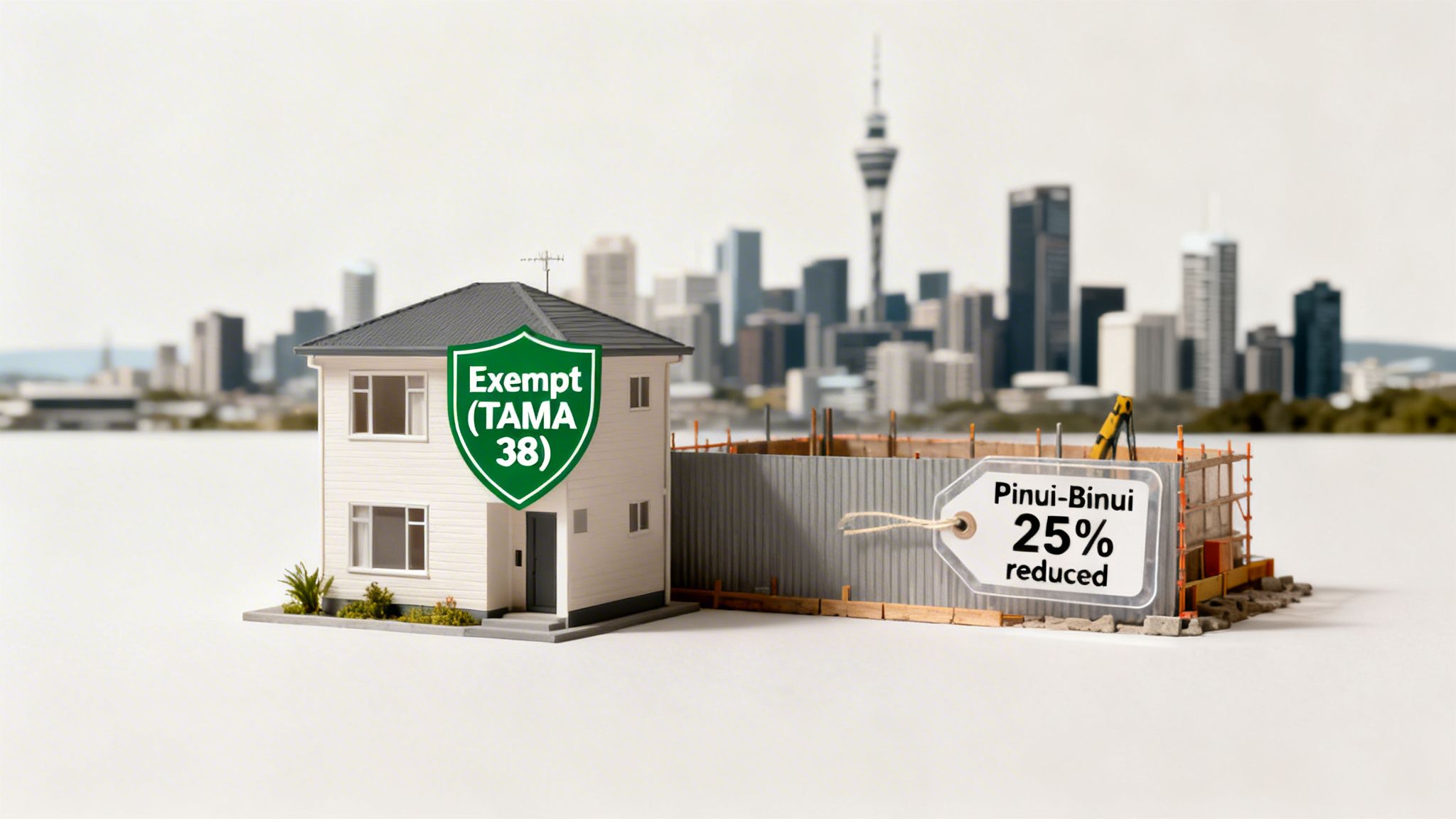
This creates a fascinating dynamic where the betterment levy—a tax that funds urban improvements—is also waived to fuel that very renewal. For instance, TAMA 38 projects, which focus on retrofitting buildings constructed before 1980 against earthquakes, offer a complete exemption from the 50% levy. This allows developers to add new units without getting hit with a crippling tax bill.
Similarly, large-scale Pinui-Binui (demolition and reconstruction) projects often enjoy a reduced levy, typically set at just 25%. As you can imagine, this creates some tension. The national government is tripling urban regeneration budgets, yet municipalities lose out on the levy income needed to build supporting infrastructure. You can get more insight into this push-and-pull on workinprogress.co.
Understanding the specific urban renewal plan governing your property is non-negotiable. The difference between a full 50% levy, a reduced 25% levy, and a complete exemption can be millions of shekels.
Applying for Your Exemption
Claiming an exemption isn’t a passive process. When the municipality sends you the levy assessment, the discount isn’t automatically included. You have to formally and proactively submit an application to the local authority.
This means putting together a detailed file with evidence proving you meet every legal requirement for the specific exemption you’re after. It’s a bureaucratic maze of paperwork and legal arguments. For investors, especially those based abroad, navigating this process without expert legal help is a huge risk.
Miss a deadline or submit the wrong document, and you could forfeit a massive financial benefit. The stakes are simply too high to leave to chance when a betterment levy in Israel is on the table. It’s a situation where having strong legal counsel, much like you’d need for Commercial Litigation in Israel, is absolutely crucial.
Don’t navigate the Israeli legal system alone. Schedule a consultation regarding your specific case.
Challenging an Inflated Levy Assessment
Getting a Betterment Levy bill from the local municipality isn’t the end of the story. Far from it. In Israel, it’s best to think of that initial assessment as the opening bid in a negotiation. Many of these first calculations are intentionally aggressive, and the appeals process is a standard, expected part of the real estate investment game.
Successfully fighting an inflated assessment can mean the difference between a staggering liability and a manageable business cost. The good news is that the procedure is well-defined, giving investors a clear path to make their case.
The Formal Appeals Procedure
Once that assessment notice (Shumat Hetel Hashbacha) lands on your desk, the clock starts ticking. You usually have a very tight window, often just 30 days, to file a formal objection. This isn’t just about sending a letter saying you disagree; it’s a structured legal process.
Your first move is to file an objection with a deciding appraiser (Shamai Machria). This is an independent, court-appointed expert who reviews the case and issues a binding decision on the property’s real increase in value. To do this, you absolutely must submit a counter-appraisal from your own expert, breaking down exactly where and why the municipality’s valuation is wrong.
If the deciding appraiser’s ruling doesn’t go your way, the fight isn’t over. The next step is taking the case to the district’s Appeals Committee (Va’adat Arar). Think of this as an administrative tribunal where both sides present their arguments before a final decision is made.
Why Challenging the Levy Is Not an Option—It’s a Necessity
The success rates for these appeals are so high, it makes you wonder why anyone would pay the initial bill without a fight. The data clearly shows a pattern: municipalities tend to overstate their initial demands, almost as a negotiating tactic.
A deep-dive analysis by the State Comptroller covering a five-year period tells a stunning story. Out of nearly 7,000 betterment levy appeals filed, a massive 95% ended with the property owner getting a reduction. On average, the final charges were cut by a third. That’s a huge amount of money left on the table if you don’t appeal.
But be prepared for a wait. This process can drag. Some districts average over 282 days to close a case—double the official government standard. Delays like that can put a serious strain on developers and investors trying to manage their cash flow. You can read more about these systemic real estate issues to get a better sense of the landscape.
Building a Bulletproof Case
Winning an appeal comes down to one thing: a solid, evidence-based argument. You can’t just say the number is too high. You need to build a compelling case that systematically picks apart the municipal appraiser’s work.
Here’s what a strong appeal absolutely must include:
- A Counter-Appraisal: This is the heart of your case. A detailed report from a credible, independent appraiser is non-negotiable.
- Comparative Sales Data: Nothing speaks louder than facts. Showing recent sales of similar properties in the area is a powerful way to prove the municipality’s “after” valuation is out of touch with reality.
- Legal Arguments: This is where a sharp legal team earns its keep. They can spot procedural mistakes or incorrect applications of planning law that could invalidate the assessment entirely.
This isn’t a DIY project. The process requires highly specialized expertise. While a general guide on how to dispute a tax assessment can give you a feel for the principles, navigating the Israeli system is a unique challenge. It demands the same level of meticulous preparation and expert representation found in complex Commercial Litigation in Israel, where every detail matters.
Don’t navigate the Israeli legal system alone. Schedule a consultation regarding your specific case.
Your Strategic Game Plan for the Betterment Levy
Successful investors in Israel learn one thing quickly: the betterment levy isn’t just another random tax to be paid. It’s a strategic variable you can manage. For anyone investing from abroad, this means dropping a reactive mindset and adopting a proactive one. It’s about creating a solid, actionable plan that weaves everything we’ve discussed into a clear framework.
This isn’t about waiting for a bill to show up in the mail. It’s about anticipating, calculating, and minimizing this unique tax liability from the second you start eyeing a property. When you bake the Hetel Hashbacha into your initial investment analysis, you turn a potential financial bombshell into a predictable cost of doing business.
The Three Pillars of a Rock-Solid Action Plan
Your entire strategy needs to rest on three non-negotiable pillars. Get these right, and you’ll protect your capital and ensure the levy doesn’t unexpectedly gut your returns. Think of this as your pre-flight checklist before pulling the trigger on any Israeli real estate deal.
Pillar 1: Go Deep on Pre-Acquisition Due Diligence
Before you even think about signing on the dotted line, your due diligence has to be exhaustive. I’m not talking about a simple title check. This means taking a deep dive into the property’s complete planning history at the local municipality. Your goal is to uncover every approved zoning plan—past, present, or pending—that could trigger a future betterment levy in Israel. This is a non-negotiable step in your Due Diligence Essentials.Pillar 2: Ironclad Contract Negotiation
The purchase agreement is your primary shield. It absolutely must state, clearly and without ambiguity, who is responsible for any potential betterment levy. Often, a buyer will agree to take on liability for past levies in return for a better price, but a vague clause is just a future lawsuit waiting to happen. Be precise.Pillar 3: Budget for it. Always.
Never assume a levy won’t apply. Your financial modeling for the deal has to include a line item for potential levy costs, and that includes the professional fees you’ll need for an appeal. A smart appeal can slash the initial assessment, turning what looks like a massive liability into a much more manageable expense.
When you treat the Betterment Levy as a predictable part of your investment analysis, you can navigate the complexities of Israeli real estate with confidence and shield your returns from nasty surprises.
Trying to manage a property from thousands of miles away demands exceptional planning and boots-on-the-ground expertise. This is especially true when you’re up against complex tax issues, making it a critical aspect of Managing Property from Overseas.
Don’t navigate the Israeli legal system alone. Schedule a consultation regarding your specific case.
Answering Your Questions About the Betterment Levy
Once you get the hang of the Hetel Hashbacha, a few practical questions almost always pop up. Let’s tackle some of the most common ones that investors ask, so you can move forward with a clear, functional understanding of how this all works on the ground.
So, When Do I Actually Pay the Levy?
This is a great question because it highlights a key timing difference. The liability for the levy is created the second a new zoning plan is approved, but the bill doesn’t land on your doorstep right away. The payment is only triggered when you “realize” – or cash in on – the new property rights.
This “realization” happens at the earliest of these three events:
- When you sell: The moment you transfer the property rights (or even a part of them).
- When you build: The moment you’re issued a building permit that uses the new zoning rights.
- When you use it: The moment you start using the property in a way the new plan allows, but the old one didn’t.
So, while the potential obligation might exist for years, the municipality will only send you the assessment when you take one of these actions.
How Does This Levy Fit in with Other Property Taxes?
It’s easy to get taxes mixed up, but the betterment levy is its own animal. For instance, it has absolutely nothing to do with the Purchase Tax Calculator & Rates, which is what the buyer pays when acquiring a property.
Here’s where it gets interesting: the betterment levy can work in your favor when it comes to capital gains tax (Mas Shevach). The amount you pay in betterment levy can be deducted as a recognized expense when calculating your capital gains upon selling the property. This smart provision prevents you from being taxed twice on the same increase in value. Just make sure your paperwork is in order to claim the deduction.
What If a Plan Is Canceled After a Levy Was Imposed?
It’s rare, but it happens. A municipality might approve a value-adding plan and then later cancel it or change it in a way that hurts your property’s value. The law has a built-in safety net for this. If you paid a betterment levy in Israel based on a plan that gets reversed, you are entitled to a refund.
You’ll need to file a formal claim for the refund with the local committee. The amount you get back will be proportional to the decrease in value caused by the plan’s cancellation, ensuring you don’t pay for a “betterment” that evaporated.
This safeguard is crucial, but getting your money back requires navigating municipal bureaucracy. For investors Managing Property from Overseas, trying to manage this process from a distance can be a nightmare. It really underscores the need for a local expert who knows how to push the right buttons and get your funds returned.
Don’t navigate the Israeli legal system alone. Schedule a consultation regarding your specific case.