
In the high-stakes world of international business, your corporate reputation is not just an asset—it is your most valuable currency. For any enterprise operating within or engaging with Israel, understanding the country’s unique defamation law, known colloquially as Lashon Hara, is not a mere compliance exercise. It is a fundamental component of strategic risk management and a powerful tool for reputation defense. This legal framework offers surprisingly robust protections against reputational attacks, operating on principles that diverge significantly from the standards in jurisdictions like the U.S. or the UK.
Navigating Reputational Risk Under Israeli Defamation Law
For international executives and corporate counsel, safeguarding brand integrity across borders is a relentless challenge. An unsubstantiated online review, a competitor’s misleading press release, or a disgruntled former employee’s social media tirade can inflict immediate and widespread damage. In Israel, however, the legal system provides a robust and direct path to counteract such threats, treating reputational harm with a gravity that often surprises foreign entities.

This guide serves as a strategic roadmap for protecting your business interests. We move beyond abstract legal theory to deliver actionable insights, grounded in our deep expertise in Israeli commercial litigation and crisis management. Understanding these principles is your first line of defense in a world where information—and misinformation—travels at the speed of a click. A proactive legal strategy is not just advisable; it is indispensable for protecting your reputation.
The Core Pillars of Israeli Defamation Law
To manage risk effectively, one must first grasp the foundational concepts that make Israeli law so distinct. We will focus on three critical areas every corporate leader must understand:
- The Definition of “Lashon Hara”: Derived from a traditional concept meaning “evil tongue,” this term defines what constitutes defamation. The legal interpretation is broad, covering not just written text but also spoken words, online posts, and even images that could degrade or humiliate a business entity.
- Statutory Compensation without Proof of Damage: A key feature of the law. Israeli courts can award significant monetary damages without the plaintiff being required to prove actual financial loss, creating a powerful deterrent against baseless accusations.
- The “Emet Di’barti” Defense: Understanding the primary “truth” defense is crucial for both plaintiffs and defendants. It is a stringent two-part test: the defamatory statement must not only be factually accurate, but there must also have been a genuine public interest in its publication.
The term “defamation” carries different weights globally. For instance, organizations like the Anti-Defamation League (ADL) primarily focus on tracking antisemitic incidents and hate speech, showing how the term is applied in specific socio-political contexts. According to their research, such incidents have soared in the United States in recent years, demonstrating the severe real-world impact of defamatory and hateful rhetoric. You can read the full research about these trends in the U.S. from the ADL.
This uniquely protective legal environment is precisely why a specialized understanding of defamation law in Israel is paramount. It equips your organization not just to react to a crisis, but to anticipate and neutralize reputational threats before they escalate.
Understanding Lashon Hara: Israel’s Unique Defamation Framework
For those accustomed to a Western legal background, Israeli defamation law can feel like stepping into a different world. In jurisdictions like the US or UK, the burden on the plaintiff is often incredibly high. In Israel, the system is constructed around the powerful, centuries-old concept of Lashon Hara, which literally translates to “evil tongue.”
Grasping this principle is the first line of defense for your company’s reputation in Israel. This is not merely about hurt feelings; it is a legal framework that treats a company’s good name as a tangible, defensible asset.
The Israeli Defamation Law of 1965 casts an exceptionally wide net. A statement does not need to be blatantly false or malicious to be deemed defamatory. The central question is whether the “publication” could lower an entity’s standing in the eyes of others.

This protective posture is a game-changer for international businesses. A statement becomes legally problematic if it could potentially:
- Humiliate or degrade a person or a company.
- Expose them to contempt or ridicule for their actions or character.
- Damage their office, business, profession, or trade.
In practical terms, this means that aggressive commentary that might be permissible elsewhere could easily result in legal liability in Israel.
The Expansive Definition of “Publication”
Another potential pitfall for foreign companies is the broad definition of a “publication” under Israeli law. The drafters of the 1965 law were remarkably forward-thinking, creating a technology-neutral definition that encompasses virtually any method of information sharing.
A publication is not limited to a newspaper article or a television broadcast. For your business, a defamatory statement can originate from anywhere and still create serious liability. Israeli courts have consistently recognized modern communication channels as publications, including:
- Social Media Posts: A competitor’s misleading update on Facebook or a disgruntled ex-employee’s rant on LinkedIn.
- Online Reviews: A negative Google review that extends beyond subjective opinion to make false factual claims.
- Internal Communications: An all-staff email that unfairly tarnishes a manager’s professional reputation.
- Spoken Words: Casual remarks at an industry conference or even in a private meeting, provided a third party heard them.
This broad interpretation ensures the law remains potent and relevant, holding individuals and companies accountable regardless of the medium they use.
When a Statement Crosses the Legal Line
Let us place this into a real-world context. Imagine a competitor posts on an industry forum that your company’s new product “failed safety tests” and implies you are concealing the results. In the U.S., you would likely face a prolonged and costly legal battle to prove malicious intent and specific, quantifiable financial losses.
In Israel, the path is far more direct. The statement itself is inherently likely to damage your business. The focus immediately shifts. The core question is not how much revenue you lost, but whether the statement could reasonably be expected to cause reputational harm.
Israeli law is engineered to protect reputation as an intrinsic value. Unlike legal systems where proving damages is the primary hurdle, here, the potential for harm is often sufficient to mount a powerful legal response. This completely changes the strategic calculus, offering a potent shield for businesses operating in the market.
This framework places the protection of a good name at the forefront, making the Israeli legal system a formidable environment for those who would attack a company’s reputation. Understanding these core principles of Lashon Hara is non-negotiable for any business leader seeking to navigate this market securely.
Compensation Without Proof of Harm: The Power of Statutory Damages
In most legal systems, winning a defamation lawsuit can be an arduous undertaking. Plaintiffs are typically required to prove, with concrete evidence, that a defamatory statement directly caused a quantifiable financial loss—a canceled contract, a decline in sales, a dip in stock price. It is an exhausting, expensive, and often futile exercise.
Israel’s legal framework fundamentally inverts this concept, providing a uniquely powerful tool that shifts the balance of power back to the victim: statutory damages.
This is not a minor legal tweak; it represents a fundamental philosophical difference. Outlined in Section 7A(b) of the Defamation Law, this provision empowers Israeli courts to award significant compensation without the plaintiff needing to prove a single shekel of actual financial damage. The law inherently recognizes that the deepest wounds from a reputational attack are not always visible on a balance sheet. They are the intangible stains on a company’s good name, the erosion of public trust, and the damage to the morale of its people.
The Strategic Edge in a Fight for Your Reputation
The moment statutory damages enter the equation, the entire dynamic of a defamation dispute changes, providing the victim with immediate and powerful leverage. The argument is no longer a protracted battle over complex financial models and expert witnesses. Instead, it zeroes in on the heart of the matter: was the statement defamatory? Yes or no.
This is one of the most striking differences in Israeli law. While defamation is a criminal offense in many legal systems, including the Palestinian Authority, Israel’s civil remedy of statutory damages offers a direct and potent path to vindication. You can find more on the broader human rights and legal context in the region here.
This legal tool is incredibly effective in settlement negotiations. When the entity that attacked your reputation faces the real threat of a court awarding substantial damages—without you having to prove financial loss—they are far more likely to seek a resolution. This often leads to swift retractions and public apologies, neutralizing the crisis before it escalates into a costly and public legal war.
Putting a Price on Reputation: Understanding the Numbers
Israeli law provides clear financial parameters for statutory damages, which are periodically updated to reflect the economy. This creates predictability for all parties involved.
A court can award damages of up to approximately NIS 75,000 for each defamatory publication, without any proof of harm. Critically, if it can be proven that the defamation was published with malicious intent—a deliberate plan to cause harm—that amount doubles to roughly NIS 150,000.
The “malicious intent” clause serves as a powerful deterrent. Consider a calculated smear campaign launched by a competitor or a disgruntled former employee. This provision allows for punitive action that not only compensates for the damage but also sends a clear message that such attacks will not be tolerated. Courts will examine the evidence—aggressive language, timing of posts, a refusal to retract—to determine if the act was malicious.
To better understand the financial remedies available, it is helpful to compare the two main paths side-by-side.
Damages in Israeli Defamation Claims
Here is a breakdown of the two primary avenues for seeking monetary compensation in Israeli defamation cases.
| Type of Damages | Proof of Damage Required? | Maximum Award (Approx.) | Strategic Consideration |
|---|---|---|---|
| Statutory Damages | No | NIS 75,000 (Doubles to NIS 150,000 with proof of malicious intent) | Ideal for swift action when the harm is intangible (reputation, trust) and difficult to quantify financially. It creates immediate leverage. |
| Actual Damages | Yes | Unlimited (based on proven financial loss) | Best suited for cases involving clear, demonstrable, and significant financial harm, such as major lost contracts or a documented decline in revenue. |
This dual-track system affords tactical flexibility. In some instances, the goal is to shut down an attack quickly and decisively, making statutory damages the perfect tool. In others, when a defamatory attack has caused catastrophic and measurable financial loss, pursuing a claim for actual damages is the appropriate course of action.
With cross-border experience, we help clients navigate this choice. We analyze the situation to determine the most effective strategy, ensuring your response is always proportional, strategically sound, and designed to achieve your primary objective: protecting your reputation.
Key Defenses Against a Defamation Claim in Israel
While Israel’s defamation law offers a potent shield for one’s reputation, it is not a one-sided sword. The legal framework is carefully balanced to protect free speech, ensuring that legitimate criticism, journalism, and honest opinions are not stifled. For any corporate leader operating in or with Israel, understanding these defenses is as vital as knowing the risks of a claim in the first place.
Facing a Lashon Hara lawsuit can be a jarring experience, but a strong, well-argued defense can be an impenetrable fortress. Success hinges on deploying one of several robust statutory defenses. These are not mere loopholes; they are foundational principles designed to separate malicious falsehoods from protected speech.
The Truth Defense: Emet Di’barti
The most powerful defense against a defamation claim is, quite simply, the truth. However, in Israel, this defense—known as Emet Di’barti (“I spoke the truth”)—is more complex than it sounds. It is not enough for a statement to be factually correct; it must also clear a second, equally important hurdle.
This two-pillar structure is a signature feature of defamation law in Israel and a critical point of difference from US or UK law, where truth alone is often an absolute defense.
To successfully argue Emet Di’barti, you must prove both of the following:
- The statement was factually true. This demands concrete evidence to substantiate the core claims. Vague assertions or secondhand rumors will not suffice in court.
- There was a public interest in the publication. This is where most legal battles are fought. The court must be convinced that the public had a legitimate reason to know this information—for instance, matters of public health, questionable corporate governance, or the conduct of public officials.
Imagine a company that exposes a competitor’s misleading product claims. Proving the facts might be straightforward. But they must also demonstrate that revealing this information served the public interest by protecting consumers. This crucial second step prevents the “truth” defense from being twisted into a weapon for purely anti-competitive mudslinging.
The Good Faith Defense: Tohm Lev
What about statements that are opinions rather than verifiable facts? Israeli law provides a comprehensive “Good Faith” or Tohm Lev defense. This is a significant defense, covering a wide range of scenarios where someone publishes something without malicious intent.
This defense is outlined in Section 15 of the law and lists 12 specific circumstances where a publication made in good faith is protected. It is vital for businesses engaged in public discourse, from publishing market analysis to providing internal reports. It is the law’s way of acknowledging that not all criticism is defamatory.
The Good Faith defense is a cornerstone of balanced free speech in Israel. It shields everything from fair criticism of a public official’s actions to an employee reporting suspected misconduct to their superior, provided the statement was made honestly and for a proper purpose.
For a company, this could apply when publishing a critical review of a new technology, providing an honest (though negative) reference for a former employee, or responding to public inquiries about its operations. The key is that the publisher must genuinely believe their statement is true and is not motivated by a personal vendetta or a desire to cause harm.
Major Defenses in Israeli Defamation Law
Knowing which defense to use and how to build a case around it is a matter of strategy. Here is a quick overview of the principal legal defenses a defendant can raise against a Lashon Hara claim.
| Defense Name | Core Requirement(s) | Common Business Context |
|---|---|---|
| Emet Di’barti (Truth) | 1. The statement is factually true. AND 2. There is a public interest in the publication. |
Investigative journalism, public company disclosures, whistleblower reports exposing wrongdoing. |
| Tohm Lev (Good Faith) | The publication was made in good faith under one of 12 statutory circumstances (e.g., expressing an opinion, fair criticism). | Product reviews, opinion pieces on corporate conduct, reporting employee misconduct to management. |
| Privileged Publications | Statements made in specific, protected contexts, such as judicial proceedings or government meetings. | Official court filings, testimony given in legal proceedings, statements made during Knesset sessions. |
Navigating these defenses requires a deep understanding of Israeli case law and procedural nuance. Simply claiming “good faith” is not enough to win. Successfully building a case around Emet Di’barti or Tohm Lev involves meticulous evidence gathering and a legal argument that resonates with the court.
While the law provides these protections, using them effectively in a high-stakes situation depends on experienced counsel. Understanding the real-world complexities of precedents and litigation costs in Israeli courts is vital for building a rock-solid defense, an area where detailed comparative analysis offers a significant edge. For more on the challenges in analyzing international legal standards and data, you can gain further insights here.
Defamation in the Digital Arena: Online and Social Media
The internet does not just spread information; it is an accelerant. What was once a local dispute can explode into a global reputational crisis in a matter of hours. For any multinational company operating in Israel, this means the old rules of defamation are now being stress-tested in the borderless arena of social media, online forums, and digital news. A single comment posted anywhere in the world can impact your bottom line in Israel almost instantly.
This new reality presents formidable challenges. The speed and seeming anonymity of the web can create a sense of lawlessness, but Israeli courts have been unequivocal: the Defamation Law applies with its full force online. A malicious tweet, a misleading Facebook post, or a fake online review is considered a “publication” just like a printed newspaper article. This places not only the author in the legal crosshairs but, in some situations, the platforms themselves.
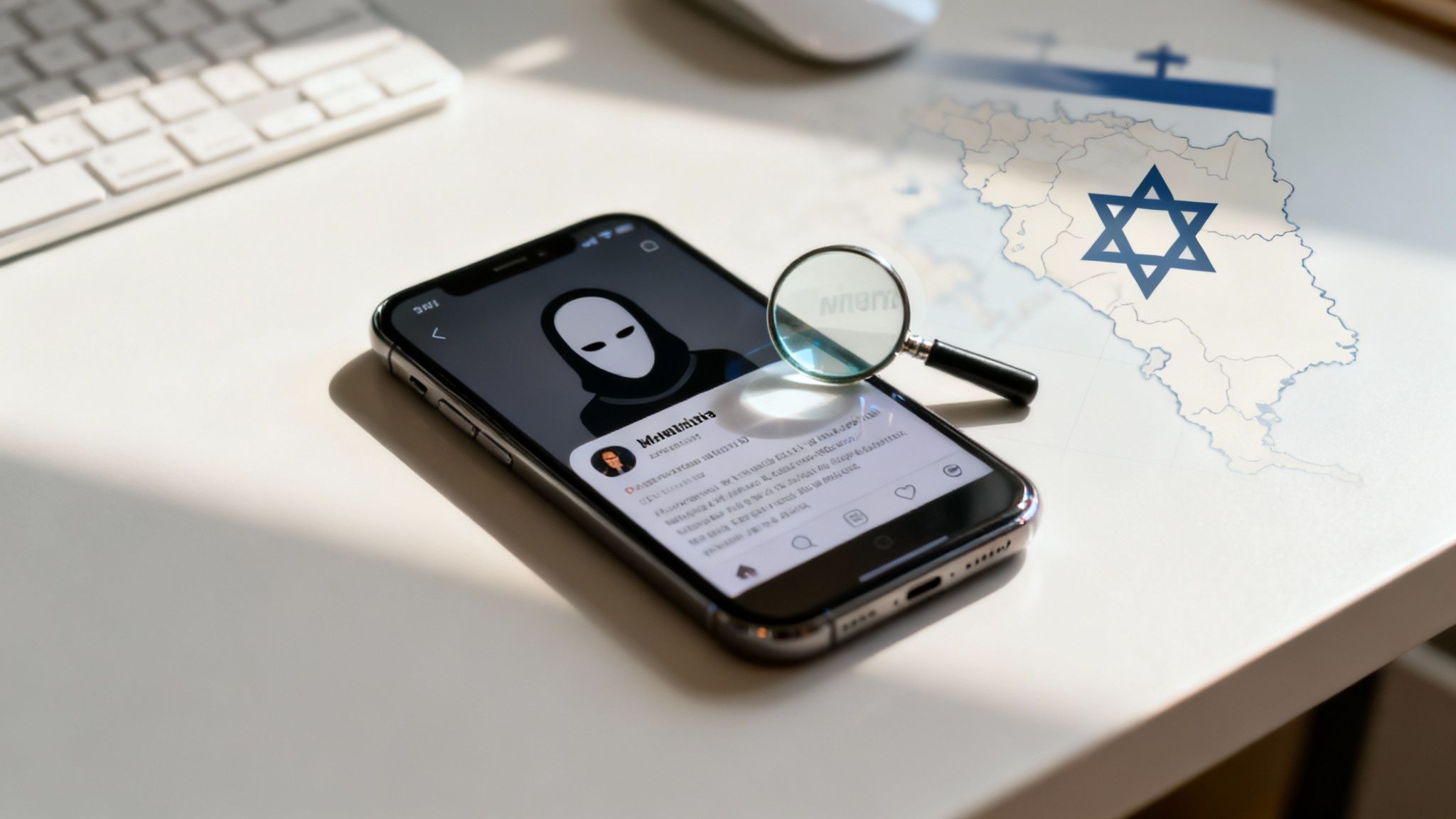
It is precisely this digital application of defamation law in Israel that makes proactive crisis management so critical. You must be prepared to defend your corporate reputation from attacks that can materialize without warning.
Unmasking Anonymous Attackers
One of the greatest frustrations for businesses facing online attacks is the anonymous troll hiding behind a fake profile. How do you fight back when you do not know who you are fighting? Fortunately, Israeli law provides a powerful, court-driven process to pierce this veil of anonymity.
We can petition the court for an order that compels a platform—whether it is a social media giant like Meta, a web host, or an Internet Service Provider (ISP)—to reveal the identity of the user behind the defamatory post. The court will typically grant this order if the plaintiff can show a prima facie case that a wrong, such as defamation, has been committed. This is not just a theoretical tool; it is a practical mechanism used to ensure attackers cannot use anonymity as a shield to evade accountability for the damage they inflict. In an era where misinformation spreads rapidly, knowing how a good fake news detector works can also be an essential first step in spotting and flagging potentially defamatory content.
Liability of Online Platforms and ISPs
The next logical question from international clients is often, “Can we sue the platform, too?” The liability of intermediaries like social media networks and ISPs is a complex and constantly evolving area of law in Israel.
As a general rule, a platform that acts merely as a passive conduit for information is not held liable as the primary publisher. However, this protection is not absolute. Their liability can be triggered under a couple of key conditions:
- Knowledge and Inaction: If a platform is formally notified about specific defamatory content but fails to remove it within a reasonable timeframe, it can be seen as having “adopted” the publication and could face liability.
- Editorial Control: If a platform begins to exercise significant editorial control, blurring the line between a neutral host and an active publisher, its risk of being held directly responsible skyrockets.
This nuanced legal landscape demands a strategic, step-by-step approach. In a crisis, the first move is often a carefully drafted takedown notice sent to the platform. This creates a formal record, puts the platform on notice, and lays the groundwork for stronger legal action if it fails to act.
Cross-border digital defamation is the new frontier of corporate risk. A defamatory post originating in one country can inflict severe damage on a business in Israel, creating a complex jurisdictional puzzle. Successfully navigating these cases requires not just expertise in Israeli law, but a deep understanding of international legal frameworks and enforcement mechanisms.
This is precisely where cross-border litigation experience makes a real difference. A legal team must be equipped to manage cases that do not respect national borders, coordinating legal actions across multiple jurisdictions to get defamatory content removed and hold attackers accountable—no matter where they are. In today’s world, protecting your reputation requires a legal strategy that is as borderless as the internet itself.
Practical Steps for Corporate Reputation Management
Knowing the law is one thing; taking decisive action when a crisis hits is another entirely. For companies operating in Israel, protecting your reputation is not a passive activity—it demands a structured, proactive game plan. The best-prepared organizations can neutralize threats before they escalate into costly, public legal battles. The real goal is to build a defensive perimeter around your brand’s integrity.
A solid defense begins long before any attack. Establishing clear internal protocols is step one. This means creating and, more importantly, enforcing a robust social media policy for all employees. Everyone must understand the fine legal line between a personal opinion and a statement that creates corporate liability.
At the same time, actively monitoring your brand online is non-negotiable. Keeping an eye on the digital conversation allows your team to spot potential threats in real-time. For those new to this, a practical guide to B2B SaaS brand monitoring can be a good starting point for setting up your own system.

Executing a Rapid Response Plan
When a defamatory attack does surface, speed and precision are everything. Hesitation can be perceived as weakness and gives misinformation time to spread. You need a strategic, multi-stage response to regain control of the narrative and demonstrate that you will fiercely defend your name.
Your first move should be measured and legally sound. Avoid firing back with emotional or aggressive public replies that only add fuel to the fire. Instead, the first official step is almost always to have legal counsel send a formal cease and desist letter.
This is not just a strongly worded email. This legal instrument serves several critical functions:
- Puts the Offender on Notice: It formally informs the person or company that you consider their statements defamatory and are monitoring the situation closely.
- Demands Immediate Action: The letter will typically demand a full, public retraction and an apology.
- Creates a Legal Record: It establishes a clear paper trail, proving you took reasonable steps to resolve the issue before escalating. This can be vital later if you need to prove malicious intent in court.
Preparing for Strategic Litigation
If the offender digs in their heels and refuses to comply, the next phase is preparing for potential litigation. This does not mean running straight to the courthouse. It means methodically building your case. This involves preserving all evidence—screenshots, links, witness accounts—and documenting any early signs of damage to your business.
A swift and assertive legal posture often secures a victory without ever setting foot in a courtroom. The credible threat of a lawsuit, especially one seeking statutory damages without proof of harm, is often enough to force a retraction and bring the attack to a decisive end.
This entire process highlights the immense value of having a strategic legal partner on your side before a crisis even begins. Our role is not just about litigation. We provide proactive counsel to help you manage risks before they escalate, offering the cross-border expertise you need to protect your reputation in a complex global market. When an attack happens, we are ready to act decisively, ensuring your response is not just reactive, but powerfully strategic.
Frequently Asked Questions
Can A Corporation Sue For Defamation In Israel?
Yes, absolutely. Under Israeli law, a company’s reputation is treated as a critical, tangible asset. Just like an individual, a corporation can file a Lashon Hara (defamation) claim if a statement is likely to damage its business, trade, or goodwill.
The rules are the same. This means businesses have access to the same powerful legal tools as individuals, including the ability to sue for statutory damages without needing to prove a specific financial loss. The law recognizes that a targeted attack on a company’s integrity can be as devastating as one on a person’s character, and it provides a robust means to fight back.
How Long Do I Have To File A Defamation Lawsuit?
The statute of limitations for a civil defamation claim in Israel is seven years from the date the defamatory statement was published.
However, from a crisis management perspective, waiting is a strategic error. Swift action is essential to contain the damage, preserve digital evidence before it disappears, and demonstrate to the court the urgency and seriousness of the situation. Hesitation allows a false narrative to spread and take root, making it exponentially more difficult to reclaim your reputation.
At RNC Group, we provide the strategic, cross-border legal counsel necessary to protect your corporate reputation in Israel and beyond. If your business is facing a reputational threat, contact us to formulate a decisive response. Learn more at https://www.rnc.co.il.
Facing defamation – or accused of it? Act on a reviewed strategy.
Defamation turns on wording, context, publication and truth defences. Generic templates do not fit your facts or platform.
We assess the publication, the evidence and the response options with you. Reach us on WhatsApp or by email.
This article does not constitute legal advice and is not a substitute for consulting with a qualified attorney. Do not rely on the contents of this article for taking or refraining from taking any action.