

When a company invests in Israeli real estate, registering the property in the “Tabu” is the definitive act of securing ownership. Unlike systems that rely heavily on title insurance, Israel’s Tabu provides something far more concrete: state-guaranteed proof of title. For corporate entities navigating commercial law, litigation, and crisis management, understanding this system is the bedrock of any secure property transaction in the country.
Understanding the Bedrock of Israeli Property Ownership
For any corporation acquiring property in Israel, mastering the Tabu system is not a mere formality—it is the cornerstone of a robust risk management strategy. It offers a level of certainty that often surpasses the expectations of foreign investors and serves as the ultimate proof of ownership.
The entire registry operates on a powerful legal principle: Constructive Notice. In simple terms, if a right, lien, or ownership claim is recorded in the Tabu, the law presumes universal knowledge of its existence. This crucial doctrine eliminates “I was unaware” as a valid legal defense, establishing the Tabu as the single, authoritative source of truth for all matters concerning property rights.
Core Concepts: Gush and Helka
To navigate the Tabu, one must understand its specific terminology. The system uses precise geographic and legal coordinates for every property, with the two most fundamental terms being:
- Gush (Block): A large tract of land, analogous to a city block or a major subdivision. It serves as the macro-level identifier.
- Helka (Parcel): A specific, numbered plot of land located within a Gush. Often, an entire apartment building will occupy a single Helka.
- Tat Helka (Sub-Parcel): In multi-unit properties, this designates the individual unit—a specific office, apartment, or retail space—that has been legally subdivided within the building’s Helka.
Grasping these identifiers is the first step in conducting effective due diligence, ensuring the asset being acquired is precisely what is recorded in the state’s official registry.
The Tabu Land Registry is a Torrens system, which provides a state-guaranteed title. Once registered, the Tabu deed is the definitive, legally binding proof of ownership, clearly detailing the Block (Gush), Parcel (Helka), and Sub-Parcel (Tat Helka) identifiers.
This robust system underpins Israel’s stable property market. With nearly 700,000 active businesses in Israel as of 2023, the Tabu secures billions in commercial real estate transactions. Proper registration can save an investor 30–50% in potential future litigation costs compared to the risks associated with unregistered deals.
Tabu Registration vs Common Western Systems
For international investors, the Israeli system can feel distinct. While the outcome—secure ownership—is the same, the mechanism differs fundamentally from the deed-based systems common in jurisdictions like the United States. Here is a practical breakdown.
| Feature | Israeli Tabu System (Torrens) | Typical Western System (e.g., Deed System) |
|---|---|---|
| Title Guarantee | State-guaranteed. The government certifies ownership. | Not state-guaranteed. Title is proven by a chain of deeds. |
| Proof of Ownership | The registration itself is the proof. The certificate of title is conclusive. | A recorded deed is evidence of transfer, but not absolute proof of ownership. |
| Primary Risk Mitigation | The state registry’s accuracy and guarantee. | Title Insurance. Private insurance policies protect against defects in the title history. |
| “Source of Truth” | A single, centralized government registry (the Tabu). | A chain of historical documents. The “truth” is pieced together from past deeds. |
| Dispute Resolution | Disputes are rare. The state’s register is considered indefeasible. | Title disputes can arise from forged deeds, errors, or undiscovered heirs. |
Ultimately, the Tabu’s Torrens system provides a superior degree of certainty directly from the state, reducing reliance on third-party insurance to cover potential historical title defects. This is a key strategic advantage for corporate investors seeking clarity and security.
Securing Your Investment with a Cautionary Note
In the fast-paced world of Israeli real estate, the period between signing a purchase agreement and finalizing the Tabu Israel registration can be fraught with risk. This is where the Hearat Azhara, or Cautionary Note, becomes indispensable. It is not merely a procedural step; it is your most powerful and immediate legal shield, protecting your investment from the moment a deal is struck.
Filing a Cautionary Note effectively places a legal freeze on the property’s status in the Tabu. Once registered, the seller is legally prevented from engaging in conflicting transactions. They cannot sell the property to another party, nor can they encumber it with a new mortgage or lien. This simple action transforms a private contractual agreement into a publicly recorded claim against the asset itself, providing constructive notice to the entire world.

For a corporate buyer, this action is non-negotiable. It secures your position not only against the seller but also in the eyes of lenders, who almost invariably require a Cautionary Note before disbursing funds. It is the first concrete step in elevating a simple contractual right to a full, state-guaranteed ownership right, serving as the primary tool of protection during the transaction’s executory period.
The Power of the Cautionary Note in Practice
Consider a corporate scenario: a multinational firm agrees to purchase a commercial building in Tel Aviv for a new R&D center. The deal is complex, involving international financing and multiple layers of corporate approval. The moment the purchase agreement was executed, we filed a Hearat Azhara.
A key protective step is having your lawyer register a warning note (He’arat Azhara) on the property immediately after signing, which blocks the seller from selling to someone else or adding new liens while your deal closes.
Just one week later, a creditor of the seller attempted to place a lien on the property to satisfy an unrelated debt. Their action was futile. Because our Cautionary Note was already registered, the property was legally ring-fenced from such claims. This allowed the acquisition to proceed smoothly, without the risk of entanglement in the seller’s other financial disputes. That single, preemptive action saved our client months of potential litigation and secured a major strategic asset.
Protecting Off-Plan and High-Value Purchases
The Cautionary Note is especially critical for off-plan purchases, where the final, registered property does not yet exist. For these transactions, ‘cautionary notes’ under Section 26 of the Real Estate Law are the essential mechanism for protecting a buyer’s stake long before project completion.
This is a vital tool for foreign investors in Israel’s dynamic market, where prime areas can experience significant year-over-year appreciation. It protects against potential developer defaults or liens that could otherwise eradicate equity in an unregistered property. You can explore more about how this legal mechanism protects buyers’ interests in detail.
The process is remarkably swift. Armed with the signed purchase agreement and proper identification, legal counsel can typically file and register a Cautionary Note within one to two business days. It is a small, fast-acting step that delivers an enormous layer of security, making it an indispensable component of any sound Tabu Israel registration strategy.
Dealing with Parcellation Problems in Older Buildings
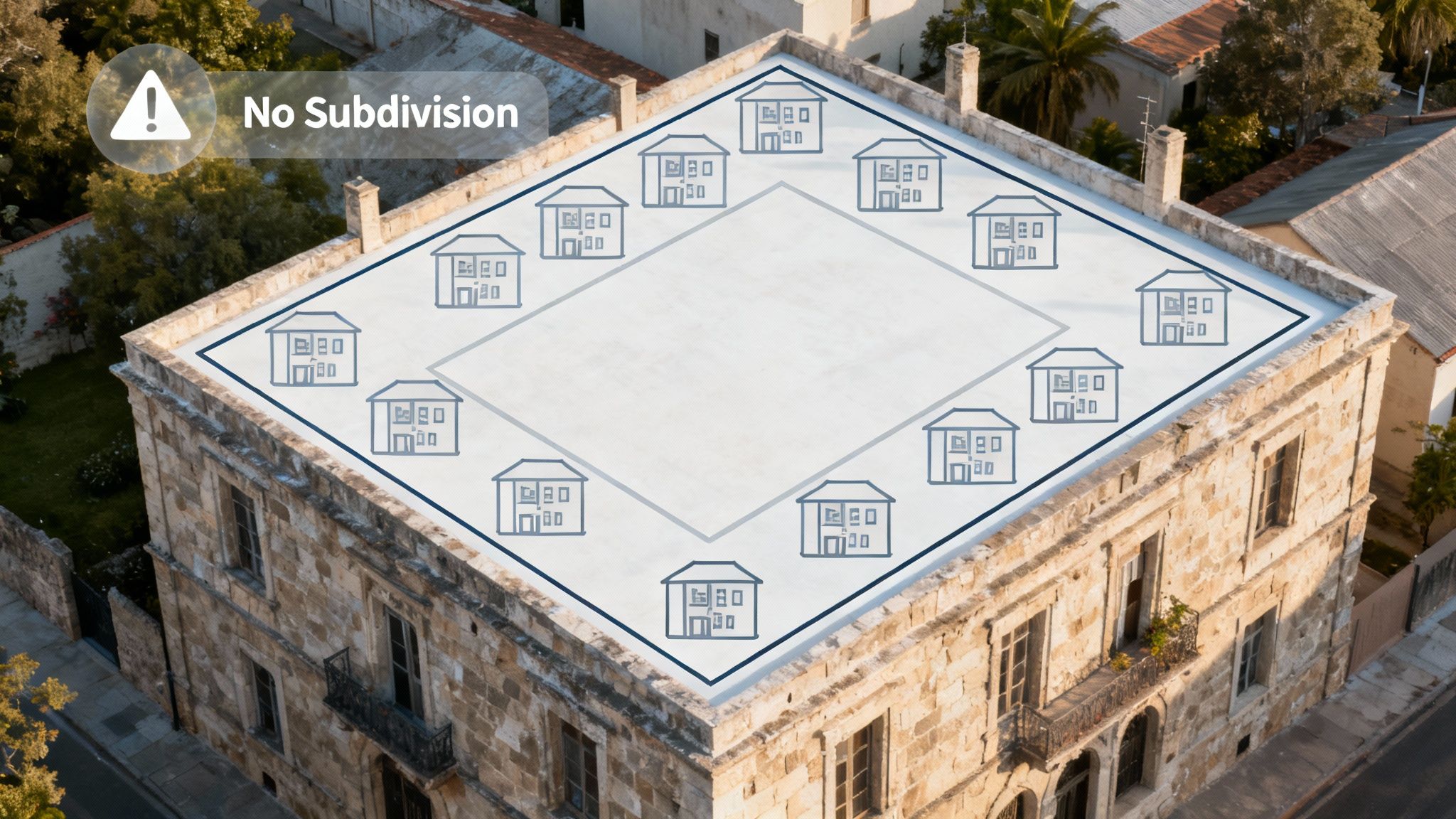
Investing in Israel’s older, historic real estate offers unique character and prime locations, but these properties can harbor a significant legal complication known as parcellation. The core problem is that many of these buildings were constructed on a single large land parcel (Helka) and were never legally subdivided into distinct, individual units. For any corporate investor, this is a critical red flag demanding immediate and sophisticated legal intervention.
When a property lacks proper parcellation, one is not acquiring a clear title to a specific apartment or office. Instead, the purchase is for a fractional, undivided share of the entire building. This arrangement creates a minefield of legal and financial risks that can completely undermine an otherwise promising investment.
The Hazards of Undivided Ownership
The absence of a registered sub-parcel (Tat Helka) for your unit renders the investment highly vulnerable. Ownership boundaries are ill-defined, making it nearly impossible to delineate your specific asset. This ambiguity is a fertile ground for disputes with co-owners over common area rights, maintenance costs, and future renovations.
Without parcellation, you legally own a percentage of the whole, not a defined space. This structure is a deal-breaker for financing, as most banks refuse to issue a mortgage against an asset with such a tangled and shared title.
Furthermore, any attempt to sell or leverage the property becomes a logistical and legal nightmare. Potential buyers and lenders will encounter the same convoluted ownership structure, rendering the asset illiquid and severely diminishing its market value. What appeared to be a prime piece of real estate is, in legal terms, a chaotic web of shared rights.
The Strategic Fix: Forging a Clear Title
Fortunately, parcellation issues are solvable through a meticulous legal process that transforms a high-risk liability into a secure, marketable asset. The objective is to legally create individual sub-parcels in the Tabu, providing each owner with a distinct, unencumbered title to their specific unit.
The process commences with a comprehensive survey and architectural plan, which precisely maps out every individual unit and all common areas. This technical blueprint serves as the foundation for the entire legal application.
Next, a formal agreement must be secured from all the building’s co-owners. This “parcellation agreement” is the instrument through which all parties consent to the subdivision of the property according to the new plans. Achieving this consensus can be a delicate negotiation, particularly in buildings with numerous owners or a history of discord.
Finalizing the Registration in the Tabu
Once the survey is complete and the parcellation agreement is executed by all co-owners, the final step is to submit the comprehensive package to the Land Registry Inspector. This application must include:
- The detailed architectural plans, known as a Tashrit Bayit Meshutaf.
- The fully signed parcellation agreement.
- All necessary municipal approvals and other supporting documentation.
The Inspector reviews the submission to ensure compliance with all legal and planning regulations. Upon approval, the building is officially registered as a “condominium” (Bayit Meshutaf), and each unit is assigned its own unique sub-parcel number in the Tabu. This final act of Tabu Israel registration provides every owner with a clean, state-guaranteed title, resolving the ownership ambiguity and unlocking the property’s true market value.
The Foreign Corporation’s Playbook for Tabu Registration
When a foreign corporation acquires property in Israel, the Tabu Israel registration process is a mission-critical operation demanding strategic precision. It is not a matter of generic checklists but of flawless execution, from deep due diligence to airtight documentation, ensuring the investment is secure from day one.

The first action is always a rigorous title search. Legal counsel must obtain an up-to-the-minute Nesach Tabu (title extract) directly from the land registry. This is not merely to confirm ownership but to uncover any latent encumbrances, such as mortgages, liens, or third-party rights. Crucially, we search for any previously filed Hearat Azhara (Cautionary Note)—a red flag that could halt a transaction.
Building Your Corporate Dossier
With a clean title verified, the next stage is compiling the corporate documentation. International companies often encounter challenges here. Unlike an individual buyer, a foreign corporation must present a specific, authenticated set of documents proving its legal existence and its authority to execute the purchase. Even minor errors can lead to significant and costly delays.
Your corporate dossier must include these core documents:
- Certificate of Incorporation: An apostilled copy, serving as official proof of the company’s existence in its home jurisdiction.
- Articles of Association: A certified copy, paired with an official, notarized Hebrew translation.
- Corporate Resolution: A formal, apostilled resolution from the board of directors that explicitly authorizes the purchase of the specific property and names the individuals empowered to sign all related documents on the company’s behalf.
Expert Tip: A vaguely worded corporate resolution is a common point of failure. The language must be precise, detailing the property and naming the authorized signatories without ambiguity to preempt any challenges from Land Registry officials.
Perfecting this documentation is fundamental. Israeli authorities require undeniable proof that the transaction is legitimate and has been formally approved by the foreign company’s governing body.
The Gauntlet of Tax and Municipal Clearances
Once the corporate file is in order, the next phase is securing clearances from various Israeli authorities. This is where transactions can become mired in bureaucracy. Before the Tabu will consider the application, the seller must provide proof that all property-related taxes and municipal debts have been settled.
This requires the seller to obtain official clearance certificates for:
- Capital Gains Tax (Mas Shevach): A document from the Israel Tax Authority confirming the seller has settled their capital gains tax obligations.
- Municipal Taxes (Arnona): Proof from the local municipality that all property taxes are paid up to the transfer date.
- Betterment Levy (Hetel Hashbacha): A certificate verifying that any levies for increased property value due to zoning changes or new permits have been fully paid.
For the foreign buyer, this stage is about proactive management. Your legal team’s role is to diligently engage with the seller’s representatives and the authorities to expedite the issuance of these clearances. This is also where intelligent corporate structuring proves advantageous. Foreign businesses often need to register with the Registrar of Companies first, a process with its own set of forms and translation requirements. For more information on the initial steps, the guide on starting a business in Israel is a valuable resource.
Why Going It Alone in the Tabu Is a Risk You Can’t Afford
Attempting to navigate the Israeli Land Registry—the Tabu—without specialized legal counsel is an unacceptable corporate risk. This is not simple administration; it involves complex legal doctrines like constructive notice, the critical timing of filing cautionary notes (he’arat azhara), and the ever-present threat of unresolved parcellation issues.
A single misstep in these areas can jeopardize an entire real estate investment. Treating this process as an in-house administrative task is a classic false economy. Israeli property law demands strategic foresight. An experienced legal team does not merely solve problems; we anticipate and neutralize them before they can derail your transaction.
Turning a Minefield into a Strategic Advantage
With the right counsel, the Tabu registration process transforms from a potential liability into a competitive edge, particularly for international companies entering the Israeli legal environment for the first time.
The Tabu is the operational bedrock for over 700,000 active businesses in Israel. While digitization has streamlined the process, properties entangled in unregistered rights or disputes can stall an estimated 60% of related M&A deals. This is where cross-border experience becomes critical. Navigating disputes requires a deep, precedent-based understanding of the system. You can discover more insights about Israel’s business landscape.
In Israeli real estate, expert legal counsel is not a cost. It is the single most important risk mitigation strategy you can deploy to secure your asset, guarantee compliance, and deliver the certainty that high-value corporate investments demand.
Ultimately, the objective is to secure your real estate assets in Israel with complete confidence. The value of seasoned legal guidance lies not just in procedural correctness but in the strategic peace of mind that comes from knowing your investment is unequivocally protected by the full force of Israeli law.
Common Questions About Tabu Registration
When foreign companies and investors first encounter Israel’s property registration system, a few key questions almost always arise. Here are answers to some of the most common inquiries to demystify the practical aspects of securing your real estate assets in the Tabu.
How Long Does the Whole Process Actually Take?
While every transaction is unique, a straightforward registration typically concludes within 30 to 90 days from closing. This is the general timeframe to receive the final, registered deed—the Nesach Tabu—in your company’s name.
However, your legal protection begins almost immediately. A Hearat Azhara (Cautionary Note) is filed within one or two business days of signing the purchase agreement. This action secures your claim and legally prevents the seller from entering into conflicting transactions.
Delays are often caused by waiting for the seller to provide necessary tax clearances or by the need to resolve pre-existing liens or complex parcellation issues in older buildings. Experienced legal counsel can anticipate these potential roadblocks and proactively manage them to keep the process on track.
Can My Foreign Company Own Israeli Property Directly?
Yes, absolutely. There is no legal requirement for a foreign corporation to establish a local Israeli entity to hold real estate. A foreign company can own property directly and have it registered in its name in the Tabu.
To do so, the company must provide a specific package of authenticated corporate documents, including its certificate of incorporation, articles of association (with a certified Hebrew translation), and a formal corporate resolution authorizing the purchase. It is crucial to work with legal experts to determine the optimal ownership structure for your specific tax and liability profile.
What if a Property Isn’t in the Tabu?
It is not uncommon to find properties that are not registered in the Tabu but are instead recorded with other bodies, such as the Israel Land Authority (Minhal) or a housing company (Hevra Meshakenet). It is critical to understand that these alternative registries do not provide the same state-guaranteed title as the Tabu.
For these properties, transferring ownership is more complex, obtaining bank financing is significantly more difficult, and the asset remains more vulnerable to competing third-party claims.
Migrating a property’s registration from the Minhal or a housing company into the Tabu is a specialized legal undertaking. Completing this final registration is the only way to secure the property’s long-term value, ensure its marketability, and establish an indisputable legal standing.
Navigating the complexities of Tabu Israel registration demands strategic legal expertise to protect your investments. Contact us to safeguard your corporate real estate assets in Israel.
This article does not constitute legal advice and is not a substitute for consulting with a qualified attorney. Do not rely on the contents of this article for taking or refraining from taking any action.