

Gifting property in Israel represents far more than a simple family gesture. When executed with strategic foresight, it becomes a powerful instrument for wealth management and estate planning, capable of delivering significant tax optimization. Successfully navigating this process requires a sophisticated understanding of Israeli law, which operates under a distinct framework compared to most Western jurisdictions.
Why Gifting Israeli Property is a Strategic Move
For corporate entities, international investors, and high-net-worth individuals, the decision to gift Israeli real estate transcends personal sentiment—it is a strategic imperative. This calculated maneuver facilitates the seamless transition of high-value assets to the next generation or within a corporate structure, often unlocking considerable financial advantages. Consequently, a simple gift evolves into a pivotal component of a comprehensive asset protection and wealth preservation strategy.

Unlike many nations that impose substantial taxes on asset transfers, Israel’s legal system provides a distinct advantage. A meticulously structured gift transfer can yield substantial savings and circumvent otherwise formidable complexities and costs. This efficacy is rooted in two central pillars of Israeli real estate tax law.
A Uniquely Favorable Tax Environment
Israel’s tax landscape for property gifts is exceptionally favorable on a global scale. The country does not impose estate, inheritance, or broad gift taxes on most assets, including real estate gifted to Israeli tax residents. This policy avoids the significant financial attrition common in Western markets, such as the 40% federal estate tax in the United States on estates exceeding $13.61 million or rates ascending to 45% in the United Kingdom.
For foreign corporations and individuals seeking to transfer assets into Israel, this framework is transformative. It permits nearly frictionless property transfers via gift, sidestepping the cross-border tax traps that ensnare many investors. Further details on Israeli private wealth regulations are available from sources like Chambers and Partners.
This environment is the cornerstone of intelligent cross-border financial planning. It allows for the transfer of significant wealth without erosion by taxation, making a gift transfer property Israel an exceptionally attractive proposition.
Key Concepts for Strategic Tax Planning
To fully leverage these benefits, a command of specific legal mechanics is essential. Two concepts, in particular, are critical for any party contemplating this course of action:
- 1/3 Purchase Tax Rule: For qualifying relatives—a definition that is strictly delineated—the standard purchase tax is reduced to just one-third of the normal rate. This translates into immediate and substantial savings for the recipient.
- The “Cooling-Off Period” (Tkufat Tzinun): This is a mandatory holding period that dictates the duration for which the recipient must own the property before they can sell it without incurring capital gains tax. It is an indispensable detail for any long-term tax planning.
By mastering these rules, a gift transfer ceases to be a mere transaction and becomes a proactive financial instrument. This is how capital is preserved and how family or corporate assets are managed with maximum efficiency and foresight.
Navigating these regulations requires deep expertise in both Israeli property law and international tax codes. In the subsequent sections, we will deconstruct these concepts in detail, providing the clarity necessary for confident decision-making and asset security.
Understanding the One-Third Purchase Tax Rule
The primary financial incentive for a gift transfer of property in Israel is the dramatic reduction in Purchase Tax, or Mas Rechisha. For international investors and corporate entities accustomed to high acquisition costs, this rule is a direct and potent tool for achieving tax efficiency. It is the bedrock of strategic asset transfers within families, converting a potentially heavy tax burden into a significant financial advantage.
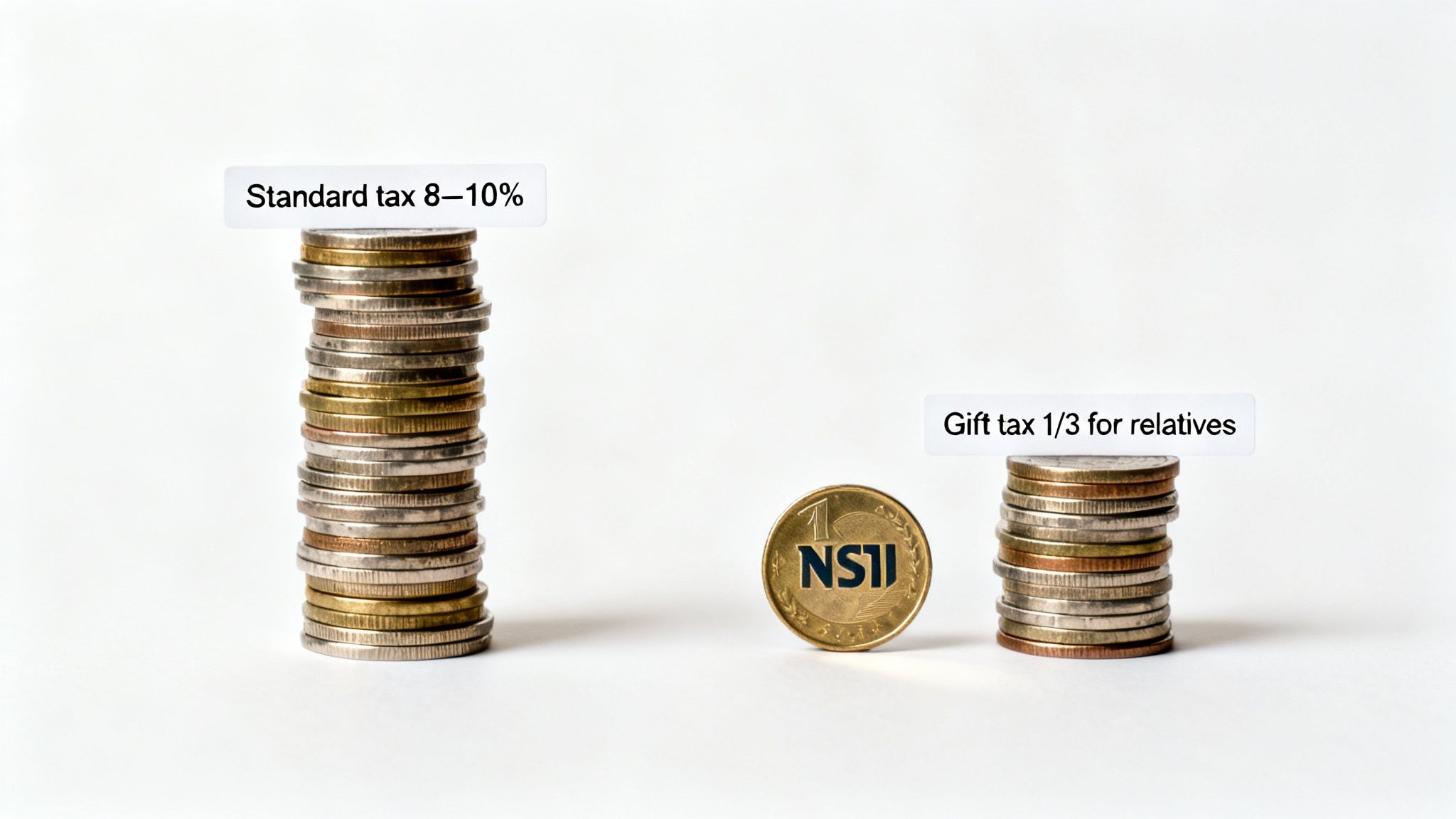
This is not a minor discount; it is a fundamental alteration of your tax liability. Instead of paying the full purchase tax, a qualifying relative who receives property as a gift pays only one-third of the standard rate. This simple provision creates an immediate and tangible financial benefit, positioning it as a central element of any serious wealth and succession planning strategy.
Qualifying as a “Relative” Under Israeli Law
To access this powerful tax concession, the relationship between the donor and recipient must conform to a strict legal definition of a “relative.” Israeli tax law is precise on this point, and erroneous assumptions about eligibility can lead to costly consequences.
Generally, the following relationships qualify for the one-third purchase tax rule:
- Spouse: Transfers between spouses, including those conducted as part of a divorce settlement, are typically exempt from purchase tax altogether.
- Parent and Child: This applies reciprocally—from a parent to a child and from a child to a parent.
- Descendants: Grandchildren and great-grandchildren, along with their respective spouses, also fall within this category.
- Siblings: This category includes a specific condition. A gift between siblings is eligible for the reduced tax rate only if the property was originally gifted or bequeathed to the donor by a parent or grandparent.
Correctly identifying these relationships is paramount. A gift to a nephew, uncle, or cousin, for instance, would be treated as a standard market sale, triggering the full purchase tax and potentially exposing the donor to a capital gains tax liability. Verifying the familial relationship with legal counsel is a non-negotiable preliminary step.
The Financial Impact: A Real-World Scenario
To fully appreciate the financial implications, consider a practical example. For foreign investors, the standard purchase tax is a substantial 8% on the first NIS 6.055 million and rises to 10% on any amount above that (as of 2025). A family gift, however, slashes this burden to just one-third of that rate. The difference is stark. You can find more insights on this from legal experts who frequently discuss family property transfers in Israel.
The following table provides a clear comparison, based on a property valued at NIS 7 million.
Purchase Tax Comparison: Standard Purchase vs. Family Gift Transfer
| Transaction Type | Property Value (NIS) | Applicable Tax Rate | Total Tax Payable (NIS) |
|---|---|---|---|
| Standard Purchase (Foreign Investor) | 7,000,000 | 8% on first 6.055M; 10% on remainder | 580,900 |
| Gift Transfer (Qualifying Relative) | 7,000,000 | 1/3 of the standard rate | 193,633 |
In this scenario, the gift transfer results in a direct tax saving of NIS 387,267. This is not a tax deferral but an absolute, immediate reduction in the acquisition cost, freeing up significant capital.
This powerful mechanism illustrates why a gift transfer is far more than a personal gesture—it is a calculated financial maneuver. Proper execution demands meticulous attention to detail to ensure the Israel Tax Authority approves the reduced rate. For both corporate and private clients, the guidance of a firm skilled in cross-border transactions is vital to navigate these nuances and secure the full financial advantage.
The “Cooling-Off Period”: Why Patience Pays Off for a Tax-Free Sale
Having successfully navigated the gift transfer and secured the substantial one-third purchase tax discount, the next critical phase begins: timing. Israeli law incorporates a safeguard known as the Tkufat Tzinun, or “Cooling-Off Period.” A thorough understanding of this rule is the difference between a tax-free sale and a significant tax liability.
This is not mere bureaucracy. The rule is specifically designed to prevent the use of family gifts as a loophole for rapid property flipping. For genuine family wealth transfers, it is a straightforward—but non-negotiable—component of the strategy.

In simple terms, the recipient of the property must hold it for a prescribed period before they can sell it and claim an exemption from capital gains tax. A premature sale can nullify the financial benefits of the gift, triggering a tax liability that could have been entirely avoided through patience and sound legal counsel.
Know Your Timeline: 3 Years or 4?
The length of this cooling-off period is not uniform. It is determined by a single question: does the recipient reside in the property? This factor establishes two distinct timelines that every investor, whether a family or a corporation, must integrate into their financial planning.
The breakdown is as follows:
- Three Years with Residency: If the recipient occupies the gifted property as their primary residence, the cooling-off period is three years from the date of acquiring ownership.
- Four Years without Residency: If the property is an investment, a rental unit, or a secondary home in which the recipient does not reside, the mandatory holding period extends to four years.
This distinction is fundamental. The intended use of the property directly dictates the timeline for when the asset can be liquidated without surrendering a significant portion of its value to the tax authority.
The Tkufat Tzinun should be viewed not as a penalty, but as a strategic timeline. Adherence preserves the asset’s full value. Disregarding it results in forfeiting a substantial portion of the gains to avoidable taxes.
The High Cost of Impatience: A Real-World Scenario
Let’s quantify what is at stake.
Imagine a parent gifts their Tel Aviv apartment, originally purchased for NIS 2 million, to their adult child. The property is now worth NIS 5 million. The child completes the transfer, pays the reduced purchase tax, and assumes ownership.
Scenario A: Selling Prematurely
Two years later, the child receives a compelling offer and sells the apartment for NIS 5.5 million. Because the sale occurs before the cooling-off period has elapsed, they are not exempt from capital gains tax. The tax is calculated not on their profit but on the entire appreciation since the parent’s original purchase.
- Original Purchase Price (Parent’s cost): NIS 2,000,000
- Sale Price: NIS 5,500,000
- Taxable Capital Gain: NIS 3,500,000
- Approximate Tax Bill (at 25%): NIS 875,000
This staggering tax liability, a direct result of impatience, instantly erodes a significant portion of the family’s wealth.
Scenario B: Strategic Patience
Now, consider an alternative. The child receives astute legal advice and waits. As they do not live in the apartment, they hold it for the required four years before selling it for the same NIS 5.5 million.
- Taxable Capital Gain: NIS 3,500,000
- Capital Gains Tax Due: NIS 0
By simply respecting the mandatory holding period, the child retains an additional NIS 875,000.
This example underscores a critical point: the gift transfer process is not complete upon the signing of the deed. Its full financial power is unlocked only through disciplined, long-term planning that encompasses the entire lifecycle of the asset—from initial transfer to eventual tax-free sale. Such foresight is the cornerstone of any sophisticated wealth management strategy.
Sealing the Deal: Executing the Transfer with Ironclad Legal Affidavits
Once the strategic elements, including the cooling-off period, are mapped out, the focus shifts from planning to execution. A gift transfer of property in Israel is not finalized on intent alone; it is cemented with meticulously drafted legal documents that leave no room for ambiguity. The cornerstone of this process is the set of written affidavits, or Tatzhirim, from both the donor and the recipient.
These are not mere formalities. They are sworn legal declarations that constitute the bedrock of the transaction and serve as primary evidence for the Israel Tax Authority that a genuine gift has occurred. The precision of these affidavits is non-negotiable for securing the gift’s legal recognition and qualifying for the associated tax exemptions.

The Anatomy of a Defensible Affidavit
For an affidavit to be considered legally sound, it must contain specific, unequivocal statements. Vague language is the primary reason tax authorities challenge or reject a gift transfer, leading to costly delays and potential financial penalties.
A robust, defensible affidavit must explicitly include:
- An Unconditional Declaration: The document must state in absolute terms that the property is being given as an unconditional gift, free of any hidden terms, payments, or future considerations.
- A Statement of Good Faith: Both parties must affirm that the transfer is genuine and not a disguised sale designed to evade taxes.
- Confirmation of Relationship: The affidavit must clearly articulate the legal relationship between the donor and recipient to substantiate eligibility for tax exemptions.
Any ambiguity—language that even hints at a loan or conditional arrangement—is a significant red flag for regulators. This is where expert legal counsel demonstrates its value, transforming a standard document into a bulwark against future challenges.
The Formalization Process
Once drafted, the affidavits must be formally executed through a precise process designed to ensure full legal validity.
Both the donor and the recipient are required to sign their respective affidavits in the presence of a qualified Israeli attorney. The attorney then verifies their signatures, thereby authenticating the documents for official submission to the relevant authorities.
This signing is the critical juncture. It is the moment where intent becomes a legally binding action, prepared for the scrutiny of governmental bodies.
Following their execution and verification, these affidavits, along with the gift deed, become the centerpiece of the submission package presented to both the Israel Tax Authority and the Land Registry Office (Tabu). A flawlessly prepared package conveys transparency and compliance, dramatically streamlining the approval process.
It is also crucial to consider the broader tax implications. Gifting property in Israel to close relatives (such as a spouse, parent, or child) does not trigger capital gains tax for the donor. This powerful exemption, codified in Israeli tax law, permits the tax-free transfer of appreciated assets. The recipient effectively inherits the original purchase date and cost basis for future tax calculations. However, this process demands exceptional diligence. For instance, an unregistered title from a previous gift can severely complicate or even derail the current transaction. Additional insights can be found by exploring gifting property to family members in Israel.
Ultimately, the strength of your legal affidavits dictates the security of the entire transfer. Meticulous drafting and flawless execution are not merely “best practices”—they are the essential pillars that ensure your gift transfer is defensible, secure, and successfully achieves your financial objectives.
When a Gift Crosses Borders
The complexity of a property gift transfer escalates significantly when either the donor or the recipient is not an Israeli resident. The transaction then falls under the purview of multiple legal and tax jurisdictions, requiring a multi-dimensional strategy to protect the asset without incurring unforeseen tax liabilities. For non-residents or international corporations, understanding this landscape is critical to avoid costly errors that could nullify the financial benefits of the gift.
A successful international gift transfer hinges on integrated legal advice that harmonizes the tax regulations of every relevant country. Without this holistic perspective, a transaction that appears tax-efficient in Israel could inadvertently trigger a substantial tax obligation in one’s home country, completely defeating the strategic purpose of the gift.
Proving Identity and Residency
One of the initial hurdles is establishing the official residency status of all parties involved. This is not a simple administrative task; it is a critical determinant of tax obligations in both Israel and abroad. The Israel Tax Authority requires official documentation, and the tax agency in your home country will have its own stringent verification requirements.
For dual citizens, the situation demands even more careful navigation, as holding two passports often entails tax obligations in both nations, creating a complex web of compliance requirements.
- Israeli Requirements: To approve any tax exemptions or reductions, Israeli authorities will need to verify the familial relationship and residency status through official documents such as passports, visas, or residency permits.
- Home Country Requirements: These rules vary significantly by jurisdiction. A U.S. citizen, for example, is subject to taxation on their worldwide assets. Gifting an apartment in Tel Aviv necessitates the filing of a U.S. gift tax return (Form 709), even if no tax is immediately due. This filing reports the gift against their lifetime exemption.
Attempting to manage this dual verification process without expert legal guidance is a recipe for delays, denied tax benefits, and unexpected financial penalties.
The Tax Consequences in Every Jurisdiction
The core challenge lies in managing the tax implications across multiple legal systems. While Israel offers a highly favorable environment with no general gift or estate tax, your home country may not be as accommodating. A gift that is entirely tax-free in Israel can easily constitute a taxable event elsewhere.
A proactive, multi-jurisdictional tax analysis before any action is taken is the only viable approach. One must understand how the transaction will be viewed not only by the Israel Tax Authority but also by the IRS, HMRC, or the relevant governing tax body. This is a non-negotiable step for protecting global assets.
Consider a classic scenario: a parent residing in the United States gifts an apartment in Tel Aviv to their child, who lives in Israel.
- Israel’s Perspective: This is a highly efficient transfer. The U.S.-based parent (the donor) is exempt from capital gains tax. The Israeli-resident child (the recipient) benefits from a significant reduction in purchase tax, paying only one-third of the standard rate.
- The United States’ Perspective: The American parent has a mandatory reporting obligation. They must report the gift to the IRS. While the multi-million-dollar lifetime gift tax exemption likely means no tax will be paid, failure to file the correct forms can trigger severe penalties.
This single example illustrates the necessity of a legal partner with deep experience in international transactions. A firm with cross-border expertise can protect clients’ global interests, transforming a process fraught with potential pitfalls into a seamless, strategically sound transfer of wealth. By anticipating and resolving multi-jurisdictional issues before they arise, we ensure your assets are secure, compliant, and positioned for future growth.
Your Checklist for a Successful Property Gift Transfer
Gifting property in Israel is not merely a transaction; it is a strategic exercise that demands precision. While the benefits are substantial, the process is a multi-stage undertaking where every detail is critical. A single misstep can compromise the entire plan.
This checklist serves as an operational blueprint, providing a clear, actionable roadmap from initial conception to final registration at the Land Registry. Each step builds upon the last, ensuring the transfer is both compliant with Israeli law and perfectly aligned with your financial and familial objectives.
Phase 1: Strategy and Documentation
The integrity of any property transfer is determined by its foundation. This initial phase is dedicated to establishing a solid groundwork with airtight legal documentation. Here, the terms are defined, and a legal framework is constructed to withstand the scrutiny of the Israel Tax Authority.
- Strategic Tax Consultation: Initiate the process with a comprehensive consultation to map out all tax implications, both in Israel and in any other relevant jurisdiction. This is the stage to confirm eligibility for the one-third purchase tax reduction and to strategically plan for the mandatory cooling-off period.
- Official Property Valuation: Secure an official valuation of the property. This figure is the basis upon which the Israel Tax Authority will calculate the reduced purchase tax payable by the recipient. Accuracy is paramount.
- Drafting Legal Affidavits: Engage expert legal counsel to draft the sworn affidavits (Tatzhirim) for both the donor and the recipient. These documents must be ironclad, declaring unequivocally that the transfer is a genuine, unconditional gift made in good faith, leaving no room for ambiguity.
Phase 2: Regulatory Submission and Finalization
With the foundational documents meticulously prepared and reviewed, the next step is to engage with Israeli authorities. If the preceding work has been thorough, this phase should proceed smoothly, translating your careful planning into a legally recognized transfer of title.
- Signing and Submission: Both parties must sign the affidavits and gift deed in the presence of a qualified attorney. The documents are then submitted to the Israel Tax Authority to formally declare the transaction and claim the necessary tax exemptions.
- Payment of Reduced Purchase Tax: Upon receiving the assessment from the Tax Authority, the recipient must promptly pay the calculated one-third purchase tax. This payment is required to obtain the tax clearance certificate, which is essential for proceeding.
- Final Registration at the Tabu: With all tax clearances secured, the final step is to file the complete set of transfer documents at the Land Registry Office (Tabu). This act officially records the recipient as the new legal owner, successfully concluding the process.
The following table summarizes the entire workflow, distilling the key actions and critical notes for each phase to help maintain focus and ensure completeness from start to finish.
Actionable Checklist for Gifting Property in Israel
| Phase | Key Action | Critical Note |
|---|---|---|
| 1. Preparation | Conduct a cross-border tax consultation. | Essential for understanding liabilities in Israel and your home country. Confirm eligibility for tax reductions early. |
| 1. Preparation | Obtain an official property valuation (Shuma). | This value is non-negotiable for tax calculations. An inaccurate valuation can cause major delays. |
| 1. Preparation | Draft and review legal affidavits (Tatzhirim). | Must be professionally drafted to prove the “good faith” nature of the gift and leave no room for misinterpretation. |
| 2. Execution | Sign documents before a qualified Israeli attorney. | Both the giver and receiver must sign. The attorney verifies the identities and witnesses the signatures. |
| 2. Execution | Submit all documents to the Israel Tax Authority. | This officially declares the gift transaction and begins the tax assessment process. Accuracy is key. |
| 2. Execution | Pay the reduced purchase tax promptly. | Upon receiving the tax voucher, the recipient must pay to get the final clearance needed for the Tabu. |
| 3. Finalization | File for registration at the Land Registry (Tabu). | This is the final step that makes the transfer of ownership legally binding and officially recorded. |
This table provides a high-level overview, but the success of the transaction lies in the details. Navigating Israeli property law, especially with international elements, demands a level of expertise that transcends a simple checklist.
While this checklist provides a clear operational sequence, it is not a substitute for professional guidance. Navigating the nuances of Israeli property law, especially in a cross-border context, requires the sophisticated counsel of a firm with proven expertise in international transactions.
Expert counsel ensures every stage of your gift transfer is executed with strategic foresight, safeguarding your assets and ensuring your objectives are met with precision and complete legal compliance.
This article does not constitute legal advice and is not a substitute for consulting with a qualified attorney. Do not rely on the contents of this article for taking or refraining from taking any action.