

For any corporate entity or legal team operating on the global stage, obtaining evidence from Israel for foreign proceedings can feel like navigating a complex maze. The primary roadmap for this journey, particularly for court cases in the United States or the United Kingdom, is the Hague Convention on the Taking of Evidence Abroad. This pivotal international treaty establishes a predictable, official channel for gathering evidence, allowing you to bypass slower, more cumbersome diplomatic routes and secure the international support you need.
Navigating Cross-Border Evidence Gathering in Israel
In high-stakes international litigation, securing evidence from another country is not merely a procedural step—it is a critical strategic maneuver. When a commercial dispute hinges on testimony or documents held by individuals or companies in Israel, foreign legal teams must operate within a framework shaped by Israeli sovereignty, its distinct legal traditions, and binding international agreements. The primary instrument for this is the Hague Evidence Convention.
Think of the Convention as a pre-approved, standardized protocol that enables courts in different nations to assist one another. It replaces the archaic and often painfully slow process of sending requests through diplomatic channels with a direct, court-to-court communication line. This ensures that a request for evidence from a court in London or New York is received, understood, and acted upon within the Israeli judicial system in an orderly and efficient manner.

The Foundation of International Judicial Cooperation
The treaty’s full name is the Convention on the Taking of Evidence Abroad in Civil or Commercial Matters. Signed on March 18, 1970, and entering into force in 1972, it has become a cornerstone of cross-border litigation. As of 2023, its 66 signatories underscore its vital importance for multinational corporations and investors embroiled in commercial disputes. You can explore the treaty’s history and list of member states here.
This widespread adoption is a tremendous advantage for businesses. It creates a common language and a shared set of rules for judicial assistance, smoothing the friction that naturally arises when disparate legal systems must cooperate. If your company is involved in a dispute that crosses borders, leveraging the Hague Convention is not just an option; it is essential for maintaining momentum and controlling costs.
The true value of the Hague Convention lies in its predictability. It transforms what could be a vague diplomatic plea into a formal legal request that Israeli courts are treaty-bound to process, providing foreign litigants with a clear roadmap.
Why This Framework Matters for Your Business
Without this treaty, you would be relegated to the traditional and frankly archaic method of “Letters Rogatory.” That process involves a formal request crawling its way through diplomatic channels, a journey that can easily consume many months, if not years, before yielding a result.
The Hague Convention provides the shortcut. It offers a far more direct and efficient path that aligns with the pace of modern business. For any company with operations, partners, or assets in Israel, understanding how to use this tool effectively is fundamental to protecting your interests and achieving a favorable outcome. This guide will illuminate the way.
Understanding the Hague Convention Framework
Let’s cut through the legalese. The Hague Evidence Convention is a treaty designed to prevent international litigation from grinding to a halt. Before its existence, obtaining evidence from another country was akin to navigating a diplomatic labyrinth, fraught with dead ends and confusing protocols. The Convention created a standardized, predictable system—a clear roadmap for gathering evidence across borders.
This is not an abstract legal theory; it has profound real-world implications for your business. The Convention specifically covers civil or commercial matters, a broad umbrella that includes everything from breach of contract lawsuits to complex intellectual property disputes. Therefore, when your lawsuit in New York or London requires a key piece of evidence from a witness or a document located in Israel, there is a recognized and reliable mechanism to obtain it.
The Central Authority: The System’s Linchpin
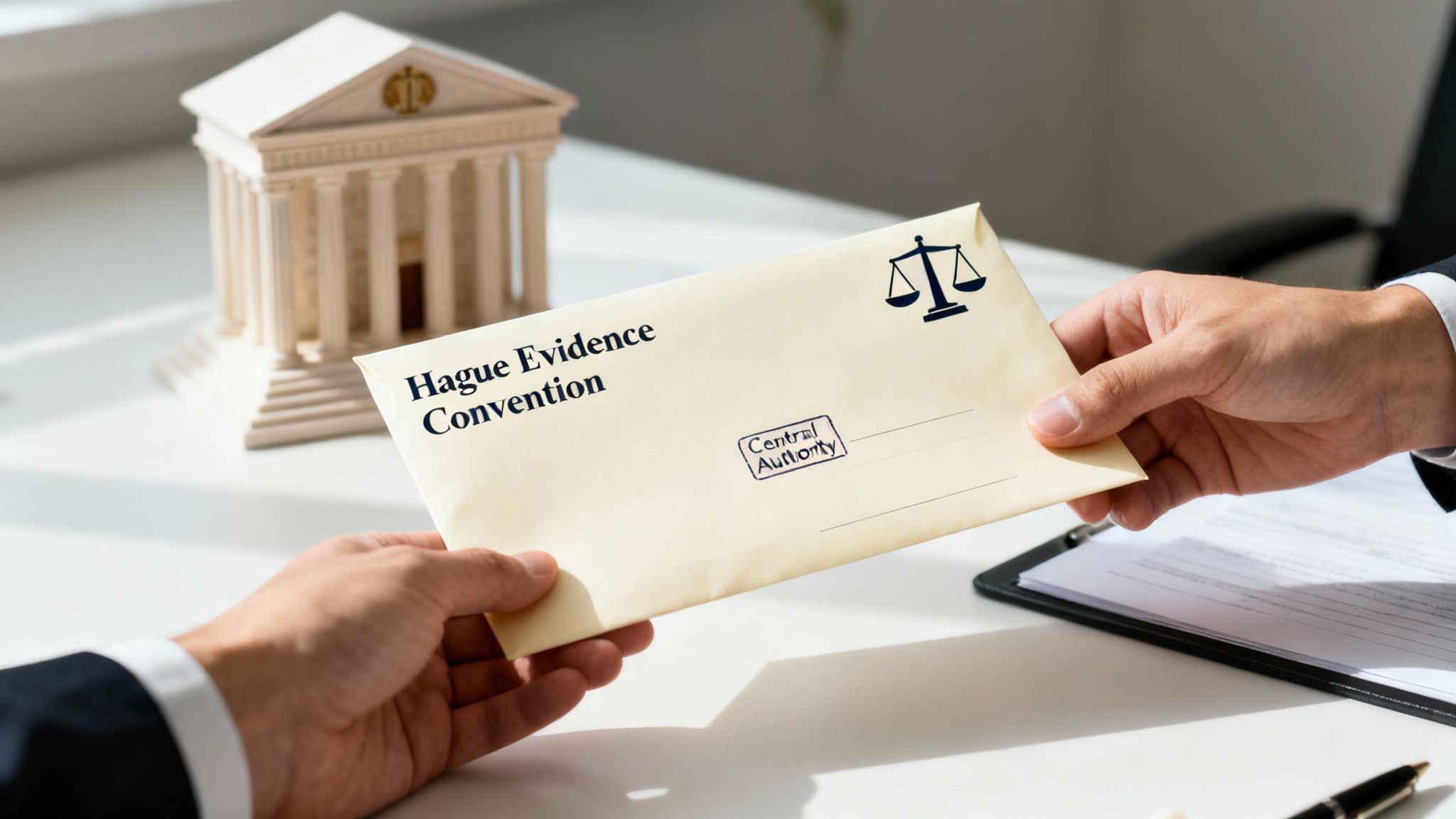
One of the Convention’s most intelligent features is the Central Authority. Each member state designates one, creating an official, single point of contact for all incoming evidence requests—a specialized international mailbox managed by the judicial system itself. This ensures your request lands on the correct desk and is not lost in a bureaucratic shuffle.
In Israel, the Central Authority is the Directorate of Courts. This is a crucial detail, as it means your request from a foreign court goes directly to the administrative heart of the Israeli judiciary. This direct line is a game-changer, guaranteeing your request is reviewed by officials who speak the language of law and procedure, not diplomacy.
The Central Authority’s function is clear:
- Receive and review the Letter of Request to ensure it meets all formal requirements.
- Forward the request to the appropriate Israeli court for execution.
- Monitor the process, ensuring compliance with both the Convention’s rules and local Israeli law.
This system provides a level of predictability that was simply unattainable with older, less efficient methods.
The Decisive Edge Over Letters Rogatory (Chikur Din)
To fully appreciate the Convention’s importance, one must understand what it replaced: the painstakingly slow process of Letters Rogatory, known in Israel as Chikur Din. This was the only available method before the Convention and remains the fallback for countries that have not signed the treaty.
The Hague Convention transforms evidence-gathering from a slow-motion diplomatic plea into a direct judicial action. While Letters Rogatory get tangled in the red tape of foreign ministries, the Convention creates an express lane between court systems.
With Letters Rogatory, a request from a U.S. court would embark on an agonizing journey: first to the U.S. State Department, then to the U.S. Embassy in Israel, then to the Israeli Ministry of Foreign Affairs, and finally to the Ministry of Justice before—at long last—reaching a court. Each step is a potential chokepoint for delays and misunderstandings. A simple request could easily devolve into a year-long saga.
The Hague Evidence Convention eliminates these intermediaries. The Letter of Request goes directly from the court in your country to Israel’s Central Authority. This direct, judge-to-judge channel not only accelerates the process but also dramatically increases the likelihood of success, making it the only logical choice for modern cross-border disputes.
Deposing Witnesses in Israel for US and UK Proceedings
For any high-stakes international litigation originating in the United States or the United Kingdom, securing witness testimony from Israel is often a pivotal moment. While the Hague Evidence Convention provides the official rulebook, successful execution depends on mastering the unwritten rules—the procedural nuances and judicial expectations unique to the Israeli system. The entire process hinges on a meticulously prepared Letter of Request, which is more than a legal form; it is a diplomatic appeal that must persuade an Israeli court to compel a local witness to testify.
This is not a rubber-stamp exercise. A successful request demands surgical precision. It must clearly articulate the case’s context, explain why this specific witness is relevant, and detail the information sought. Israeli courts are notably wary of what they perceive as “fishing expeditions”—the broad discovery tactics common in U.S. litigation. If your request is not tightly focused and fails to demonstrate a direct, legitimate need for the testimony, it is likely to be rejected. This is precisely where expert cross-border counsel becomes indispensable, ensuring the request is drafted to meet these stringent local standards from the outset.

The Israeli Court’s Role in Compelling Testimony
Once Israel’s Central Authority approves the Letter of Request, it is passed to the competent local court, which assumes responsibility for its execution. The court then summons the witness and oversees the deposition. This judicial supervision is a defining feature of the process in Israel. This is not an informal meeting in a conference room; it is a formal legal proceeding conducted under the direct authority of an Israeli judge or a specially appointed commissioner.
The court’s role is to ensure the request is executed according to Israeli law while accommodating the procedural needs of the foreign court. This creates a hybrid legal environment where complex questions about legal privilege and the appropriate scope of questioning inevitably arise. Navigating this intersection of legal cultures requires a deft hand and on-the-ground experience.
Key Logistical and Procedural Considerations
Attempting to depose a witness in Israel for a U.S. or UK case raises several critical questions. Answering them correctly before you begin is essential to prevent costly delays and frustrating complications.
- Can Foreign Counsel Lead the Questioning? In short, yes. Israeli courts are generally accommodating and will permit U.S. or UK attorneys to conduct direct and cross-examinations. However, they must do so under the supervision of the Israeli court and adhere to local procedural rules, which may feel more restrictive than those in their home jurisdiction.
- Which Country’s Rules on Privilege Apply? This can be complex. A witness in Israel can almost always invoke privileges available under Israeli law, such as attorney-client privilege or the right against self-incrimination. They might also be able to claim a privilege recognized by the law of the requesting state (the U.S. or UK). It is crucial to anticipate these potential conflicts and be prepared to argue your position before the supervising Israeli judge.
A deposition in Israel operates at the crossroads of two legal systems. The goal is to obtain testimony admissible in your home court while fully complying with the procedural mandates of the Israeli court supervising the process.
The entire legal landscape in the United States regarding the Hague Convention was shaped by a landmark Supreme Court case. In 1987, the unanimous decision in Société Nationale Industrielle Aérospatiale v. U.S. District Court clarified that while the Convention is not the exclusive method for gathering evidence from abroad, it should be treated as the “first resort” out of respect for international comity. This ruling addresses the tension between America’s broad discovery rules and the sovereignty of foreign nations like Israel, reinforcing why using the treaty’s channels is so important. You can find more in-depth analysis of this pivotal case and its lasting impact on cross-border litigation.
The Rise of Video Conference Testimony
In a strategic shift accelerated by the realities of modern global business, Israeli courts have become increasingly receptive to witness testimony via video conference. This approach can be a game-changer, offering substantial savings in time and money by eliminating the need for international travel. However, remote depositions are subject to specific rules designed to protect the integrity of the proceeding.
Israeli courts will mandate strict protocols for remote testimony, including:
- Secure Identity Verification: Ironclad proof that the person on camera is the correct witness.
- A Neutral Location: The witness must testify from a neutral setting, free from outside influence or coaching.
- Proper Oaths: The oath must be administered in a manner that is legally binding and recognized by the court.
- Exhibit Management: A clear, pre-approved protocol must be in place for presenting and handling documents and other exhibits in a digital format.
Setting up a successful remote deposition requires meticulous planning and tight coordination with the Israeli court. This is where having a local legal partner becomes indispensable. They manage the technical and procedural hurdles on the ground to ensure the testimony you obtain is both valid and admissible in your U.S. or UK case, providing a significant strategic and financial edge.
Choosing Between the Convention and Letters Rogatory
When you need evidence from Israel for foreign litigation, you face a choice between two paths: the modern highway or the old scenic route. The highway is the Hague Evidence Convention, and the scenic route is the traditional diplomatic channel known as Letters Rogatory, or Chikur Din (חקור דין) in Hebrew.
This is not merely a technical choice; it is a critical strategic decision. The path you take will directly impact your timeline, budget, and ultimately, the success of your case. For any legal team or corporate executive, the objective is efficiency and predictability. The Hague Convention was specifically engineered to cut through the bureaucratic fog and glacial pace of the old diplomatic process.
However, Letters Rogatory are not obsolete. They remain a necessary, if far less appealing, tool in certain situations.
When Are Letters Rogatory Your Only Option?
For signatory countries like Israel, the U.S., and the UK, the Hague Convention is the default and vastly superior choice. However, a couple of scenarios will force you onto the more cumbersome Letters Rogatory path.
This traditional method is unavoidable when:
- Dealing with a Non-Signatory Nation: If your case involves a country that has not signed the Hague Evidence Convention, the diplomatic channel of Letters Rogatory is your only way forward.
- Your Request Falls Outside the Convention’s Scope: The Convention is strictly for “civil or commercial matters.” If you need evidence for a criminal, administrative, or tax-related case, it falls outside the treaty’s mandate, and you must use Letters Rogatory.
The real difference lies in the journey the request takes. A Hague Convention request is like a direct flight, moving efficiently from a foreign court to Israel’s Central Authority and then to the designated Israeli court. A Letter Rogatory is a journey with multiple layovers, traveling from the requesting state’s foreign ministry to its embassy in Israel, then to the Israeli Ministry of Foreign Affairs, before finally landing with the judiciary. Each handover is another point of potential—and probable—delay.
A Clear Strategic Comparison
To make the right decision, you must see the practical differences side-by-side. This choice has a very real impact on your case management, client expectations, and the overall litigation budget.
Here’s a concise breakdown of how these two methods compare.
Hague Convention vs. Letters Rogatory (Chikur Din): A Comparison
| Feature | Hague Evidence Convention | Letters Rogatory (Chikur Din) |
|---|---|---|
| Process | Direct judicial channel via designated Central Authorities. | Slow, multi-stage diplomatic channel via ministries and embassies. |
| Legal Basis | International treaty with binding obligations on member states. | Based on principles of international comity and reciprocity. |
| Typical Timeline | Generally 3 to 6 months from submission to execution. | Often 12 to 18 months, and sometimes significantly longer. |
| Predictability | High. The process is standardized with clear requirements. | Low. The process is opaque, with frequent delays and less feedback. |
| Cost-Effectiveness | More cost-effective due to shorter timelines and fewer steps. | Higher costs resulting from prolonged delays and greater complexity. |
As the table illustrates, the Hague Convention provides a structured, legally binding framework that brings clarity and speed to the process. In sharp contrast, Letters Rogatory depend on diplomatic goodwill, making the entire affair inherently slower and far less predictable.
For virtually all commercial disputes requiring evidence from Israel, the Hague Convention is the winning strategy. Its framework is built for the speed of modern business litigation.
This ensures that gathering cross-border evidence supports your legal goals instead of derailing them. Expert counsel in mastering the Convention’s nuances will help you obtain timely, effective results and steer clear of the procedural quicksand of the diplomatic route. Choosing the right path from the start is foundational to winning your case.
Using Video Testimony in Israeli Legal Proceedings
In a world where business is borderless, the logistics of international litigation can impose significant costs and delays. Fortunately, Israeli courts have embraced technology, making witness testimony via video conference a viable and increasingly common tool, especially within the Hague convention evidence framework.
This is not about cutting corners; it is a strategic move away from traditional in-person depositions that saves the immense burden of international travel. It streamlines the evidence-gathering process, but only if executed correctly. Success hinges on a deep understanding of the procedural safeguards Israeli courts demand to protect the integrity of the testimony. Think of it less like a casual video call and more like a formal, court-supervised event that must follow a strict script.

The Legal Framework for Remote Depositions
The ability to use video testimony is grounded in Israeli law, which allows for remote participation as long as the core principles of a fair hearing are upheld. When a foreign court sends a request for testimony via video link under the Hague Evidence Convention, the Israeli supervising court’s primary priority is ensuring the sanctity of the process.
This means that while the technology is modern, the legal standards are traditional and rigorous. The court requires absolute certainty that the remote setting will not compromise the witness’s ability to testify freely or prevent counsel from conducting a proper examination. This is where specialized cross-border expertise becomes critical. We know how to structure the application and demonstrate that a proposed remote deposition will meet every legal threshold the court demands.
Procedural Safeguards You Must Follow
To obtain judicial approval for a video deposition, your legal team must present a rock-solid plan addressing several key procedural requirements. Israeli courts are meticulous and expect you to have anticipated every measure to prevent witness tampering, coaching, or any other procedural misstep.
Your protocol must include specific, detailed measures for:
- Identity Verification: A foolproof method for confirming the witness’s identity at the start of the session, often involving a court-appointed official checking official ID on camera.
- Sterile Environment: The witness must be in a neutral location—such as a law office or dedicated facility—completely free from unauthorized persons or materials. Courts often require a 360-degree camera view of the room to ensure no one is off-screen.
- Secure Exhibit Handling: A pre-agreed digital protocol for presenting, reviewing, and marking exhibits is necessary to create a clear and unambiguous record.
- Proper Administration of the Oath: The witness must be sworn in under oath in a way that is legally binding in Israel, typically handled by an Israeli judge or commissioner.
Conducting a remote deposition is like building a virtual courtroom. Every element—from identity verification to exhibit management—must be meticulously planned to replicate the integrity of an in-person proceeding and ensure the final testimony is admissible.
Successfully managing these logistics requires sharp, on-the-ground coordination and a deep familiarity with Israeli judicial expectations. Failure to meet these standards can result in the court deeming the testimony inadmissible, wasting valuable time and resources. Partnering with a firm experienced in these procedures ensures your remote deposition is not just technologically feasible but legally bulletproof.
Strategic Steps for a Successful Evidence Request
Turning legal theory into a winning litigation strategy requires a precise, actionable plan. When you need evidence from Israel under the Hague Convention, success is the direct result of meticulous preparation and a clear understanding of local judicial expectations. A successful request is not merely filed—it is engineered to sidestep common pitfalls from the ground up.
It all begins with drafting a Letter of Request that is both complete and laser-focused. This document is your case’s first impression on the Israeli Central Authority and, ultimately, the supervising court. It must be clear, concise, and compelling, providing the Israeli judge with enough context to grasp the litigation without being overwhelmed by extraneous detail. Most importantly, it must demonstrate a direct, legitimate need for the specific evidence sought.
Avoiding Common Grounds for Refusal
Israeli courts are protective of their jurisdiction and the rights of local individuals and companies. They will not hesitate to reject a request that appears overreaching. The single greatest red flag that leads to rejection is the perception of a “fishing expedition.”
Unlike the broad pre-trial discovery common in U.S. litigation, Israeli legal culture demands specificity. A vague request for “any and all documents related to the merger” is almost guaranteed to be dismissed. Your request must identify specific documents, communications, or narrowly defined categories of information with surgical precision.
To ensure your Hague Convention evidence request is approved, steer clear of these classic mistakes:
- Overly Broad Language: Using vague, all-encompassing terms will be seen as an attempt to improperly circumvent Israeli discovery rules.
- Lack of Relevance: You must clearly connect the requested evidence to the core issues of your case abroad.
- Infringing on Sovereignty: The request cannot be framed in a manner that could be perceived as prejudicial to Israeli public policy or national security.
A successful Hague Convention request is a masterclass in legal precision. It persuades the Israeli court that its assistance is not merely a procedural formality but a vital component for achieving justice in a foreign courtroom.
Managing Timelines and Client Expectations
A critical part of any international litigation strategy is managing the clock and the budget. While the Hague Convention is significantly faster than the Letters Rogatory process, it is not instantaneous. Setting realistic expectations for your clients and your team is essential for maintaining confidence and staying on track.
Based on extensive data, the process typically takes anywhere from two to six months. A comprehensive study revealed that 53.1% of requests were completed in two to four months, and another 18.8% were handled within four to six months, demonstrating the system’s general efficiency. You can review these findings on Convention timelines for a deeper analysis.
By anticipating these timelines and potential costs, your legal team can budget effectively and synchronize the evidence-gathering phase with the broader litigation schedule. This strategic foresight transforms the request from a reactive task into a proactive tool for achieving your commercial objectives. Expert counsel ensures your request is optimized for speed and success from day one.
Burning Questions About Evidence Gathering in Israel
When dealing with international litigation, theory is one thing, but practical, on-the-ground questions are what truly matter. Corporate clients and their foreign counsel often share the same core concerns. Here are direct answers to the questions we encounter most frequently.
Your Key Procedural Questions Answered
Can a lawyer from the U.S. or UK directly question a witness in Israel during a deposition?
Yes, absolutely. While the deposition is officially overseen by an Israeli court or a court-appointed commissioner, common practice is to permit foreign lawyers to take the lead and conduct the examination directly.
However, the entire process must adhere to Israeli law. This is particularly true for rules of privilege and the scope of questioning, which is typically much narrower and more focused than what is customary in broad U.S.-style discovery.
What is the primary reason a request for evidence is rejected in Israel?
By far, the most common reason for rejection is excessive breadth. Israeli courts have very little patience for what they perceive as a “fishing expedition.” Unlike the sprawling pre-trial discovery common in the United States, Israeli procedure demands precision.
A request for “any and all documents” related to a subject is almost guaranteed to be denied. Specificity is not just a good practice—it is everything.
Think of your Letter of Request as a surgical instrument, not a dragnet. Crafting it with care demonstrates respect for the court’s time and for Israeli sovereignty, dramatically boosting your chances of swift approval.
Realistically, how long does the Hague Convention process take in Israel?
While every case is unique, a well-prepared request for Hague convention evidence in Israel will typically run its course in 3 to 6 months. This timeframe covers the period from submission to the actual taking of evidence.
Although this may seem like a considerable period, it is a significant improvement over the traditional Letters Rogatory channel, which could easily extend for a year or more. For any commercial dispute where time is money, the Convention is clearly the smarter, more efficient choice.
This article does not constitute legal advice and is not a substitute for consulting with a qualified attorney. Do not rely on the contents of this article for taking or refraining from taking any action.