

For corporate entities and international investors engaging with the Israeli real estate market, executing transactions from abroad presents a significant logistical challenge. The critical legal instrument that facilitates these cross-border deals is the Power of Attorney for real estate. This document empowers a trusted representative in Israel—invariably your legal counsel—to execute binding agreements and navigate regulatory requirements on your behalf. Therefore, it ensures seamless and secure closings without the need for physical presence.
Executing Israeli Real Estate Deals from Anywhere in the World
The necessity for principals to be physically present in Israel to finalize a property transaction is a relic of the past. The Israeli legal framework is robustly designed to accommodate foreign nationals and corporate bodies. It offers established and secure methodologies for authenticating documents signed abroad. This operational flexibility is paramount for participating in Israel’s dynamic property market. Without it, one would incur the substantial costs and delays associated with international travel.

The entire process hinges on a specialized legal document: the Irrevocable Power of Attorney (in Hebrew, Yipui Koach Bilti Chozer). This is not a standard, revocable POA. It is a purpose-built, binding instrument engineered to secure the transaction and protect the interests of all stakeholders—the buyer, the seller, and any financing institution. Its primary function is to create transactional certainty, rendering it an indispensable component of any significant property acquisition in Israel.
The Two Paths to Authentication
To ensure this document is legally enforceable in Israel, it must undergo a stringent authentication process. This validation is how the Israeli Land Registry and other authorities confirm the signatory’s identity and the legitimacy of their signature.
Two primary logistical pathways exist:
- Consular Signing: This is the most direct method. The principal schedules an appointment at an official Israeli Consulate or Embassy and executes the Power of Attorney in the physical presence of the consul. The consul acts as an official witness, verifying the signatory’s passport and signature, thereby immediately validating the document for use in Israel.
- Apostille Certification: This is the more prevalent route, particularly when access to a consulate is impractical. It is a standardized, multi-step process available in countries signatory to the 1961 Hague Convention. First, the principal signs the document before a local notary public, who verifies their identity. Subsequently, a designated state authority certifies the notary’s signature by affixing an official stamp known as an Apostille.
The selection of the appropriate method is a technical decision based on the principal’s geographic location, the transaction’s timeline, and the availability of diplomatic services. While both pathways yield a fully authenticated document recognized under Israeli law, their logistical requirements differ substantially. Consequently, precise execution is critical to maintaining the transaction’s security and momentum.
This article does not constitute legal advice and is not a substitute for consulting with a qualified attorney. Do not rely on the contents of this article for taking or refraining from taking any action.
Why an Irrevocable Power of Attorney Is Non-Negotiable
In the high-stakes environment of commercial real estate, transactional certainty is the most valuable asset. The risk of a counterparty withdrawing after months of complex negotiations is a material threat that can lead to catastrophic deal collapse. This scenario is precisely what an Irrevocable Power of Attorney (Yipui Koach Bilti Chozer) is engineered to prevent. It is the legal linchpin of virtually every real estate transaction in Israel.
A standard power of attorney is a tool of agency, revocable at the will of the grantor. An irrevocable POA operates on a different legal principle. Its fundamental purpose is not merely to delegate authority, but to secure the vested rights of a third party—typically the purchaser or the mortgage lender. Because of this distinction, the document is elevated from a simple instrument of convenience to a binding commitment that locks in the transaction.
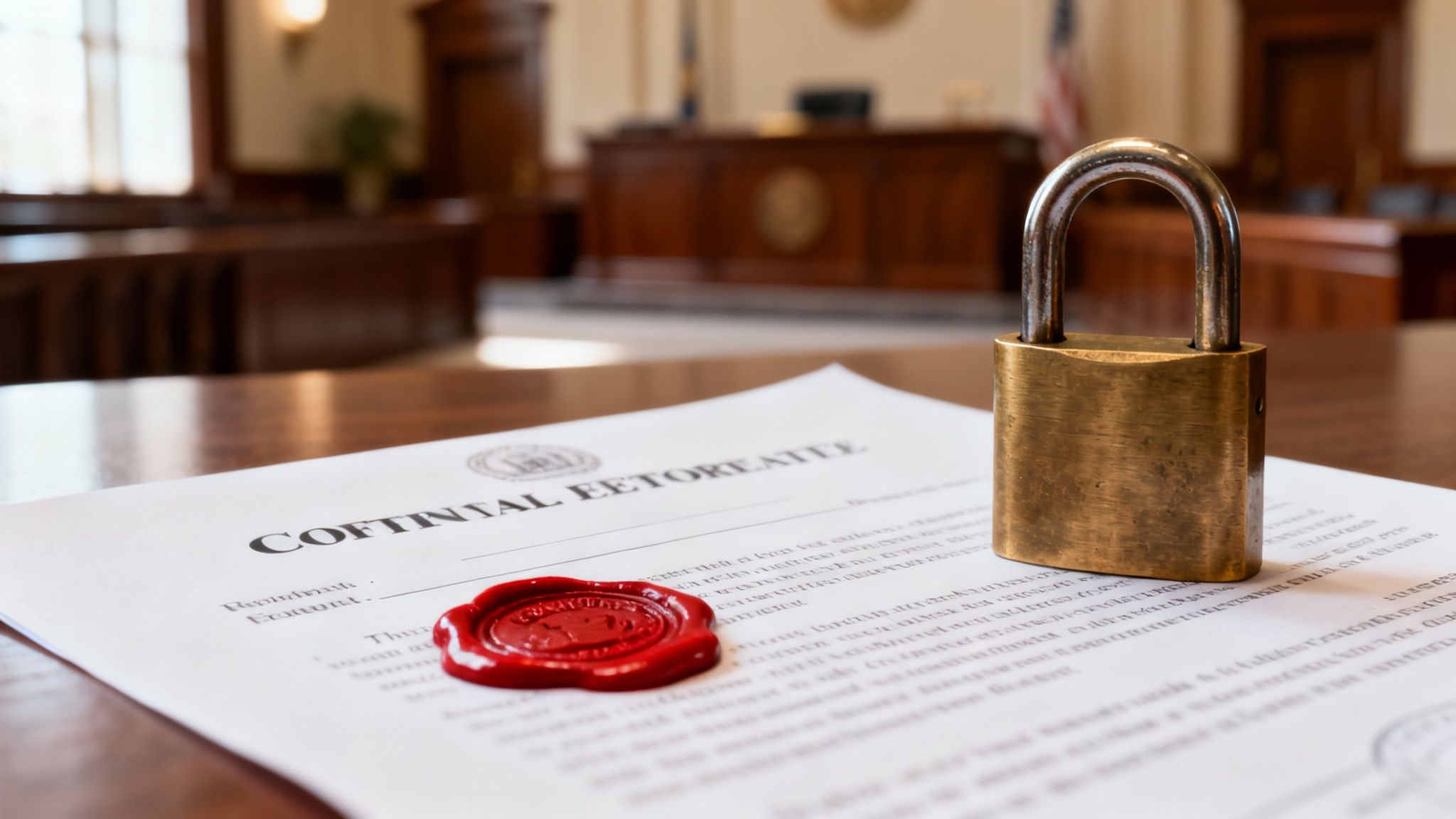
The Lock and Key for Transactional Security
In practice, once a seller executes an irrevocable POA, they grant the buyer’s attorney the authority to perform specific, pre-agreed actions required to finalize the transfer of title. This authority remains effective even if the seller becomes uncooperative, incapacitated, or is otherwise unavailable. It is the mechanism that guarantees the integrity of the closing process.
For international investors and corporate entities, this provides a powerful layer of risk mitigation. It effectively neutralizes the threat of “seller’s remorse” or post-agreement disputes derailing a cross-border acquisition. As a result, the irrevocable POA functions as a legal deadbolt, securing the parties’ intent and ensuring a clear path to closing.
Think of an Irrevocable Power of Attorney for real estate as a legal guarantee. It ensures contractual promises are kept by empowering a neutral agent—the attorney—to execute the final, critical steps of the title transfer, no matter what.
This legal framework is more critical than ever as global investment accelerates. The global real estate legal services market was recently valued at around US$ 141.1 billion, with significant growth on the horizon fueled by cross-border deals. This trend, highlighted in market analysis by Grand View Research, underscores just how vital sophisticated tools like the irrevocable POA have become for facilitating seamless international transactions.
A Mandatory Step at the Land Registry
The use of an irrevocable POA is not merely a best practice; it is a statutory requirement for several key procedures in Israel. The most critical is the registration of a “cautionary note” (He’arat Azhara) at the Israeli Land Registry (Tabu).
A cautionary note is a formal encumbrance placed on the property’s title immediately following the execution of the purchase agreement. It serves two crucial functions:
- Public Notice: The note publicly establishes that the property is under contract, preventing the seller from legally entering into a conflicting transaction with another party.
- Priority of Claim: It secures the buyer’s contractual rights against subsequent liens, attachments, or claims filed against the seller.
To register this vital protection, the seller must provide the buyer’s attorney with an irrevocable POA. The Land Registry will not accept the filing without it. This would leave the buyer’s substantial down payment entirely exposed and their claim to the property unsecured. It is, quite simply, the non-negotiable key that unlocks the full protection of the Israeli legal system for your investment.
This article does not constitute legal advice and is not a substitute for consulting with a qualified attorney. Do not rely on the contents of this article for taking or refraining from taking any action.
Choosing Your Path: Consular Signing vs. Apostille Certification
Once your irrevocable power of attorney is drafted, it requires official authentication to be recognized by Israeli authorities. This is not a procedural formality; it is the critical step that transforms a private document into a legally binding instrument within Israel’s jurisdiction.
For international clients, two primary pathways exist for this authentication: direct signing at an Israeli Consulate or certification via the Apostille process. This is a strategic logistical choice, dictated by geography, timelines, and available resources. One route involves direct validation by an Israeli official, while the other leverages an international treaty to achieve the same legal standing. Understanding the technical distinctions is essential for avoiding costly delays. It also ensures the smooth progression of your real estate transaction.
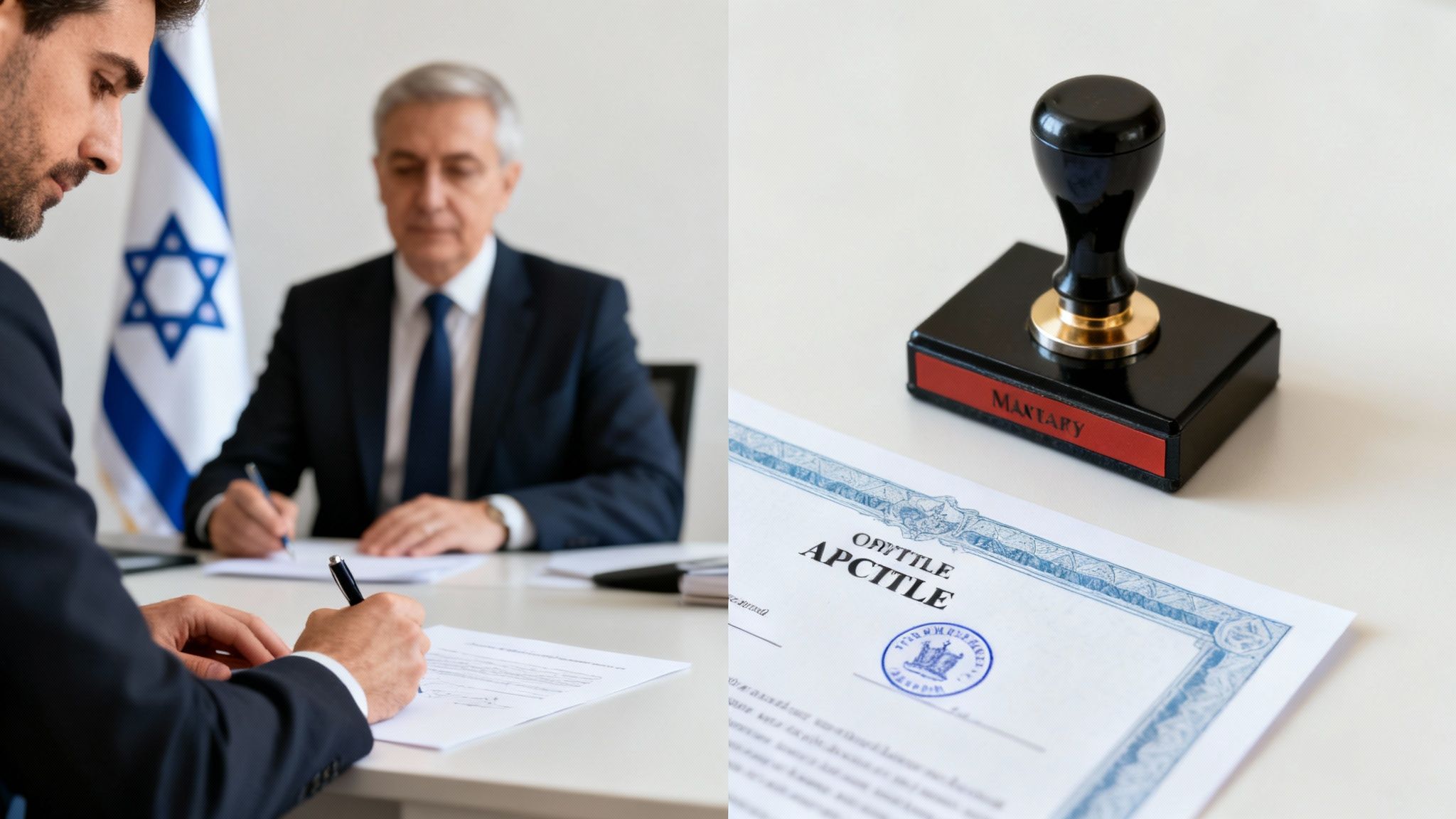
The Direct Route: Consular Signing
Executing a power of attorney at an Israeli Consulate or Embassy is the most direct authentication method. The principal appears in person before an authorized Israeli consular official, who verifies their identity against a valid passport and witnesses the signature. This single act of consular verification renders the POA immediately valid within the Israeli legal system. No further steps are required.
The primary advantage of this method is its simplicity. Once the consul’s seal is affixed, the document is ready for use in Israel. The main constraint, however, is accessibility. Israeli consulates are located only in major international cities, and securing an appointment can involve significant lead times, potentially disrupting a tight transaction schedule.
The International Standard: The Apostille Process
The second, and more frequently utilized, pathway is obtaining an Apostille certificate. An Apostille is a standardized authentication certificate established by the Hague Convention of 1961. It serves to certify the authenticity of the signature on the document. This process is recognized in over 120 member nations, including key jurisdictions for investors such as the United States, the United Kingdom, and France.
The Apostille process involves a two-step sequence:
- Notarization: First, the principal signs the power of attorney in the presence of a local Notary Public in their country of residence. The notary verifies the signatory’s identity and affixes their official seal and signature.
- Apostille Certification: The notarized document is then submitted to a designated government authority (e.g., the Secretary of State in a U.S. state or the Foreign, Commonwealth & Development Office in the UK). This body verifies the notary’s credentials and attaches the official Apostille certificate.
Despite involving an additional step, this route offers superior flexibility due to the widespread availability of notaries. For most international clients, it represents the most practical and efficient method.
Choosing the authentication method is a critical logistical decision. The Consular path offers direct, one-step validation, while the Apostille provides broader accessibility through a two-step verification process recognized by international treaty.
While the final POA requires physical authentication, understanding how to use a secure digital signature for PDF documents can improve efficiency for ancillary paperwork in the preliminary stages of a transaction.
Head-to-Head Comparison
To facilitate an informed decision, the following table outlines the practical differences between authenticating your power of attorney for real estate via the consulate versus the Apostille process.
Comparison of POA Authentication Methods for Use in Israel
| Attribute | Consular Signing | Apostille Certification |
|---|---|---|
| Process Simplicity | Single Step: Sign directly before the consul. | Multi-Step: Requires both a local notary and a higher government authority. |
| Accessibility | Limited: Only available at Israeli consulates in select cities. | High: Local notaries are widely available in most areas. |
| Speed & Timeline | Dependent on consulate appointment availability, which can vary greatly. | Dependent on the processing time of the designated government authority. |
| Cost | Typically involves a set consular fee. | Involves fees for both the notary and the Apostille-issuing authority. |
| Geographic Scope | Available in any country with an Israeli diplomatic mission. | Only available in countries that are signatories to the Hague Convention. |
| Final Recognition | Immediately recognized in Israel without further validation. | Universally recognized in Israel and other Hague Convention countries. |
If proximity to an Israeli consulate and favorable appointment availability align, the direct signing route is highly efficient. For the majority of clients, however, the Apostille process provides a more pragmatic and accessible solution for authenticating a power of attorney for an Israeli real estate transaction.
This article does not constitute legal advice and is not a substitute for consulting with a qualified attorney. Do not rely on the contents of this article for taking or refraining from taking any action.
Country-Specific Protocols for the US, UK, and France
Navigating international administrative law requires absolute precision. When executing a power of attorney for an Israeli real estate transaction from abroad, a thorough understanding of the specific authentication protocols in your country of residence is paramount. While the United States, United Kingdom, and France are all signatories to the Hague Convention, each maintains a distinct procedural pathway for obtaining an Apostille. That is why adherence to these technical requirements is a strategic imperative to prevent errors that could jeopardize the transaction.
United States: State-Level Apostille Procedure
In the United States, the authority to issue an Apostille is decentralized and managed at the state level. The process is therefore contingent on the state where the document is notarized, though the fundamental two-step sequence remains consistent nationwide.
Notarization by a Notary Public: The principal must first sign the Power of Attorney in the presence of a commissioned Notary Public. The notary’s function is to verify the identity of the signatory and witness the signature, subsequently affixing their official stamp or seal. It is critical that the notary’s commission is active and that they adhere strictly to their state’s notarial regulations.
Certification by the Secretary of State: The notarized document is then submitted to the office of the Secretary of State for the state in which the notary is commissioned. This office verifies the notary’s signature and commission against its official records. Upon successful verification, the office attaches the formal Apostille certificate, which completes the authentication process and renders the document legally valid for use in Israel.
For broader compliance in US-related matters, understanding the distinctions between an authorized representative and a Power of Attorney is also valuable, as these roles carry different legal scopes.
United Kingdom: Centralized Legalisation Process
In the United Kingdom, the process is termed “legalisation.” While it follows a two-stage model, the procedure is centralized through a single government department, ensuring uniformity across England, Wales, Scotland, and Northern Ireland.
Notarization by a Notary Public: The Power of Attorney must be signed in the presence of a UK Notary Public. Unlike their US counterparts, UK Notaries are qualified lawyers holding a senior office, often specializing in international legal documents. Their verification carries substantial legal weight.
Certification by the FCDO: Following notarization, the document is submitted to the Foreign, Commonwealth & Development Office (FCDO). The FCDO’s Legalisation Office is the sole UK authority empowered to issue an Apostille. It verifies the signature and seal of the Notary Public before affixing the Apostille certificate, thereby making it legally effective for the Israeli real estate transaction.
A common pitfall for UK clients is underestimating FCDO processing times. Initiating this process well in advance is crucial to accommodate potential administrative backlogs and avoid jeopardizing closing deadlines.
France: Judicial Apostille de la Haye Protocol
In France, the issuance of an Apostille (Apostille de la Haye) is managed through the judicial system. The procedure is meticulous and requires engagement with specific legal professionals and courts.
Execution before a Notaire: The Power of Attorney must be signed before a French Notaire. A Notaire is a public officer and highly trained legal professional with far greater authority than common-law notaries. They typically draft or review the document, verify the principal’s identity, and affix their official seal.
Certification by the Cour d’Appel: The document executed by the Notaire must then be presented to the Cour d’Appel (Court of Appeal) with jurisdiction over that Notaire. The court’s dedicated Apostille service verifies the Notaire‘s signature and authority. Once confirmed, the court affixes the Apostille de la Haye, completing the authentication required for its use in Israel.
This article does not constitute legal advice and is not a substitute for consulting with a qualified attorney. Do not rely on the contents of this article for taking or refraining from taking any action.
Managing Risk and Ensuring Full Legal Compliance
Granting a power of attorney is a significant delegation of authority that demands robust legal and strategic safeguards. Beyond the mechanical steps of notarization and apostille, effective risk management is paramount. For any investor, particularly international corporate bodies, the primary objectives are fraud prevention and preclusion of authority abuse. It is also essential to ensure strict compliance with the exacting standards of the Israeli Land Registry.
Proactive risk mitigation is achieved by embedding legal protections directly into the Power of Attorney document itself. A precisely drafted POA is the first and most effective line of defense, establishing a secure legal framework for the transaction from its inception.

Defining the Scope of Authority
The most critical safeguard is the precise and narrow definition of the agent’s powers. A power of attorney for a real estate transaction must never grant broad, discretionary authority. It should be drafted not as a master key, but as a single-use instrument programmed for a specific, limited purpose.
The document must explicitly delineate every permissible action. For instance:
- Signing the purchase or sale agreement for a single, specific property, identified by its full address and block/parcel number (Gush/Helka).
- Executing registration documents as required by the Israel Land Authority (Tabu).
- Engaging with municipal and tax authorities solely for the purpose of obtaining clearances related to the transaction.
- Operating a designated escrow or client account opened exclusively for the transaction’s funds.
By strictly circumscribing the agent’s authority, ambiguity is eliminated, and the potential for unauthorized actions is foreclosed. Any deviation from these defined parameters constitutes an immediate breach of fiduciary duty, providing a clear legal basis for recourse. This level of detail transforms the POA from a simple grant of permission into a tightly controlled mandate.
The Lawyer as Agent: The Gold Standard for Security
While it is legally permissible to appoint any trusted individual as your agent, the undisputed industry standard in Israel is to appoint your Israeli legal counsel. This practice is not a matter of custom but a calculated risk mitigation strategy.
Appointing your attorney provides multiple layers of protection. An attorney is bound by a strict code of professional ethics and a fiduciary duty to act exclusively in your best interest. Crucially, licensed attorneys carry professional liability insurance (malpractice insurance), which offers a financial backstop against negligence or errors. This framework of professional accountability is a powerful deterrent against misconduct. It provides a level of security that an unregulated agent cannot match.
Appointing your Israeli attorney to act under a power of attorney for real estate aligns the agent’s professional duty with your financial interests, creating a secure framework built on legal ethics and insured accountability.
The real estate litigation landscape is complex, making expert oversight a necessity. Recent data shows a 9% annual increase in lawsuits against agents and brokerages, with foreclosure actions also presenting significant legal challenges. These statistics, detailed in research on real estate legal trends on Lawfirm.com, underscore the non-negotiable value of having experienced legal counsel managing your transaction. At RNC Group, our expertise in cross-border commercial law is designed to navigate these complexities. We shield your interests at every turn.
Ultimately, a meticulously crafted power of attorney is a strategic instrument. By severely limiting the agent’s scope and entrusting that authority to qualified legal counsel, you establish a secure and defensible framework to execute your Israeli real estate investment with confidence.
This article does not constitute legal advice and is not a substitute for consulting with a qualified attorney. Do not rely on the contents of this article for taking or refraining from taking any action.
Your Foundation for a Secure Israeli Real Estate Investment
Properly executing a power of attorney from abroad is the foundational step for any secure international real estate transaction in Israel. As this guide has detailed, the process is technical but entirely manageable with expert guidance.
By understanding the critical function of an Irrevocable POA and selecting the correct logistical authentication path for your jurisdiction—whether Consular or Apostille—you can proceed with your investment with a high degree of confidence. The ultimate key to success, however, lies in partnering with a legal team that possesses deep, practical experience in cross-border transactions.
An investment’s success isn’t just about the property you choose. It hangs on the flawless execution of the legal paperwork that secures it.
This is where our firm’s integrated expertise in commercial law, litigation, and crisis management provides distinct value. We ensure your transaction is not merely compliant, but strategically fortified against potential risks. An expertly managed power of attorney for real estate serves as the concrete foundation upon which your entire investment is built.
For the security and peace of mind that comes from meticulous execution, contact RNC Group to schedule a consultation.
This article does not constitute legal advice and is not a substitute for consulting with a qualified attorney. Do not rely on the contents of this article for taking or refraining from taking any action.
Questions We Often Hear
Managing a real estate transaction from a different continent naturally gives rise to technical questions. Below are concise answers to the inquiries most frequently posed by our corporate and business clients regarding the use of a power of attorney for real estate in Israel.
Can I Just Use a POA Drafted in My Home Country?
No, this is a critical error. A power of attorney intended for use with the Israeli Land Registry is a highly specialized legal instrument that must be drafted by an Israeli lawyer. It requires precise, legally mandated irrevocability clauses (Bilti Chozer) and must be in Hebrew or accompanied by a certified Hebrew translation prepared by a notary. If you submit a generic foreign POA, Israeli authorities will reject it, causing significant and costly delays to the transaction.
How Long Does the Whole Authentication Process Take?
The timeline is variable and requires proactive planning. Securing an appointment at an Israeli consulate can range from a few days to several weeks, depending on the specific location’s demand and staffing. The Apostille process is similarly unpredictable, contingent upon the processing times of the designated state authority, which can vary from a few business days to over a month. We counsel all clients to integrate these potential delays into the transaction timeline from the outset as a critical risk management step.
By design, an Irrevocable Power of Attorney is exceptionally difficult to cancel. It exists to guarantee the rights of a third party, such as the buyer or a mortgage bank. This stability is the cornerstone of transactional security in Israeli real estate.
Is It Really Possible to Revoke an Irrevocable Power of Attorney?
Revocation is exceedingly difficult by design. The document is structured to be ironclad to protect the interests of third parties (e.g., the buyer or a mortgage bank) who rely on its validity to proceed with the transaction. A simple change of mind by the grantor is insufficient grounds for revocation. It could potentially be cancelled only in exceptional circumstances, such as a fundamental breach of the underlying contract by the other party, and would almost certainly require a court order. This is precisely why obtaining expert legal counsel before execution is non-negotiable.
Does the Person I Appoint Have to Be a Lawyer?
While not legally mandated, appointing your Israeli attorney as the agent is the undisputed professional standard for any significant real estate transaction. Your lawyer is bound by a strict code of ethics, carries professional liability (malpractice) insurance, and possesses the specialized knowledge to navigate Israel’s complex regulatory landscape. Appointing a non-lawyer introduces substantial and avoidable risks into a high-value transaction where financial security and legal compliance are paramount.
This article does not constitute legal advice and is not a substitute for consulting with a qualified attorney. Do not rely on the contents of this article for taking or refraining from taking any action.
A Final Word of Caution
This guide is intended for informational purposes only. It provides a general overview and practical insights but is not a substitute for professional legal advice tailored to your specific transaction and circumstances. Every real estate deal possesses unique complexities, and no action or inaction should be taken based solely on the contents herein.
Navigating Israeli real estate from abroad requires more than just capital; it demands expert legal strategy. To ensure your investments are secure and your interests are protected, a professional touch is essential.
For strategic guidance on your cross-border property transactions, connect with the RNC Group. Schedule your consultation today at https://rnc.co.il.