
By 2026, the global data privacy landscape has fundamentally changed. A dense, interconnected web of new laws now exists. Consequently, this poses a direct threat to market access and corporate value.
The New Era for Global Data Privacy in 2026

Is your compliance strategy truly built for the reality of 2026? A seismic shift in global data privacy is currently underway. The legal landscape has morphed into a full-blown minefield.
These new regulations are not just stricter; they are smarter. Indeed, the era of GDPR as the single dominant standard is over. International firms now face a complex legal framework.
Understanding the Evolving Legal Landscape
The heart of this change is a new global consensus. Data protection is a fundamental right with strong enforcement. As a result, a regulatory update in California can trigger a domino effect.
A deep understanding of core concepts is therefore your first step. For instance, knowing what regulators classify as sensitive data is fundamental. This knowledge forms the bedrock of any solid compliance strategy.
A recommended strategic path is to treat compliance as a dynamic function. This requires continuous monitoring of legislative changes. It also demands proactive adaptation of internal controls.
The High Stakes of Non-Compliance
A compliance misstep once resulted in manageable fines. Those days are gone. Now, consequences are severe enough to cripple a business.
The stakes now include:
- Market Access Denial: Failing to meet new standards can lock a company out of entire economic blocs.
- M&A Devaluation: Sloppy privacy practices are now a massive red flag in any due diligence process.
- Reputational Collapse: A public data breach or major compliance failure can instantly destroy customer trust.
Implementing a robust framework for adaptation is no longer a best practice. It is the only way to ensure a business remains resilient. Therefore, proactive risk management is essential for thriving.
Decoding the US Privacy Law Patchwork

How does a business manage compliance in a country with changing rules? The United States lacks a single federal privacy law. Instead, companies face a complex patchwork of state-level regulations.
This decentralized approach creates serious operational hurdles for businesses. Data practices legal in one state can be a violation in the next. Consequently, navigating this fragmented landscape requires constant vigilance.
The Legislative Surge and Its Strategic Implications
Between 2018 and 2024, nineteen U.S. states passed their own privacy laws. Although 2025 saw a pause, legislative momentum is now resuming. You can see a full analysis of these trends in this 2025 year-in-review of U.S. data privacy developments.
In 2026, new laws will activate in several states. At the same time, major updates strengthen rules in others. This ongoing privacy law update signals a fundamental shift in regulatory focus.
A business operating across all fifty states is subject to dozens of obligations. The only sound strategy is to build a compliance program based on the strictest requirements. This applies across all jurisdictions of operation.
The table below summarizes key changes effective in 2026. It offers a snapshot of compliance challenges for businesses.
Key US State Privacy Law Updates Effective in 2026
| State | Key Provision Highlight | Effective Date | Primary Business Impact |
|---|---|---|---|
| Indiana | Introduces a 30-day “right to cure” violations before enforcement action. | Jan 1, 2026 | Provides a grace period, but requires rapid response capabilities for potential violations. |
| Kentucky | Broadens “sensitive data” to include info from automatic content recognition (ACR). | Jan 1, 2026 | Requires explicit consent for processing data from smart TVs and similar devices. |
| Rhode Island | Requires recognition of universal opt-out mechanisms for data sales and targeted ads. | Jan 1, 2026 | Mandates technical integration to honor browser-level opt-out signals automatically. |
| Arkansas | Unique definition of “sale” includes sharing data for “other valuable consideration.” | Jul 24, 2026 | Expands the scope of data transfers that trigger consumer opt-out rights. |
These updates demonstrate a clear trend toward more granular regulations. Consequently, businesses must adopt more sophisticated data governance.
The Real-World Impact on Business Operations
These state-level rules have a long reach and significant effects. An international company with customers in multiple states must adhere to different regulations. This reality impacts everything from website banners to data architecture.
Consider a marketing analytics firm using geolocation data. New, stricter rules force a complete re-evaluation of its business model. The firm can no longer apply a one-size-fits-all approach.
To stay ahead, businesses must take several concrete actions. First, conduct a thorough data mapping exercise to identify which state laws apply. Second, update privacy notices to meet highly prescriptive requirements. Finally, reconfigure consent management platforms to handle new signals.
The Global Focus on Minors’ Data

The global privacy law update has put minors’ data in the spotlight. This is not just a compliance headache. It is a high-stakes arena where one misstep triggers massive penalties.
Regulators are aggressively enforcing new rules for children’s and teens’ data. This shift reflects a powerful societal demand. Consequently, it is changing how companies must design their products.
The New Definition of High-Risk Data
Information previously considered low-risk is now reclassified as highly sensitive. Additionally, the legal definition of a “minor” varies from age 13 to 18. This legal recategorization forces a complete rethink of data strategy.
Simply asking for parental consent is no longer sufficient. The only defensible path is building “privacy by design” into your architecture. This involves specific safeguards designed from the ground up.
Overlooking these nuanced rules is a strategic blunder. It can lead to devastating reputational damage. It can also lock you out of key international markets.
This trend is particularly powerful in the United States. Individual states are creating influential precedents. See the updated state comprehensive privacy law landscape for more details.
US States Set Aggressive Precedents
In 2025, U.S. state privacy laws sharpened their focus on minors. For example, California’s CCPA updates treat all data from users under 16 as sensitive. This change works with the looming 2027 Digital Age Assurance Act.
Other states went even further. Utah imposed social media curfews for teenagers. Meanwhile, Florida introduced fines starting at a staggering $50,000 per violation.
These rules create a daunting compliance puzzle. They demand a way to navigate dozens of state-specific age verification mandates. It also requires managing data processing bans.
Actionable Steps for Mitigating Risk
Navigating this terrain requires a proactive, systematic approach. A reactive strategy is no longer a defensible position. Therefore, your focus must be on concrete risk mitigation.
The recommended strategic path is:
- Implement Age-Gating and Verification: This is the first line of defense. It means using clear age-gating mechanisms or age estimation technologies.
- Adopt the Strictest Standard: The most robust strategy is aligning policies with the strictest global rules.
- Disable Profiling and Targeted Ads: For any user identified as a minor, this is the safest path.
- Conduct Youth-Focused Data Assessments: Your assessments must now include specific risk analyses for minors.
Understanding how to protect children’s privacy online is now essential for corporate teams. This knowledge is fundamental to building a defensible compliance program.
Navigating Cross-Border Data and AI Governance
Could your AI tools illegally transfer data out of the EU in 2026? Moving data across borders has become a highly scrutinized process. Every country now has its own complex and conflicting data requirements.
The growth of artificial intelligence has added another complication. A significant privacy law update now ties international data transfers to AI governance. This creates immense operational headaches for multinational corporations.
Mastering Cross-Border Data Transfers
The legal justification for transferring data has become more complex. Regulators now demand comprehensive documentation. This requires an operational overhaul of your data handling practices.
A critical change is the mandatory use of updated Standard Contractual Clauses (SCCs). These are not templates to sign and forget. They place an ongoing duty to monitor and validate protections.
This brings us to Transfer Impact Assessments (TIAs). A TIA is a formal risk analysis you must document. It forces you to answer a tough question about the recipient country’s laws.
Failing to properly document a TIA creates an immediate compliance gap. It is a gap that regulators are actively hunting for. This assessment is the cornerstone of any modern strategy.
The New Rules for AI Governance
The rise of AI has added another incredibly complex layer. New laws now grant individuals unprecedented rights. This is critical for any business using AI in hiring or marketing.
The core principles of this new AI governance are non-negotiable:
- Transparency in Algorithmic Decisions: You must explain how your AI models reached a conclusion.
- Right to Human Review: Individuals can contest an automated decision and demand a human review.
- Prohibition of Unfair Profiling: AI cannot be used to create profiles that result in discriminatory treatment.
For example, a company using an AI tool to screen job applicants must ensure the model is not biased. It must also be prepared to give rejected candidates a meaningful explanation.
Actionable Steps for Compliance
The recommended strategic path is to integrate data transfer and AI governance. This approach ensures your data practices are compliant from end to end. It also builds a resilient foundation for adaptation.
Here are the critical steps for risk mitigation:
- Update All Data Transfer Agreements: You must replace outdated clauses with the latest, regulator-approved SCCs.
- Systematize Transfer Impact Assessments: Create a standardized, repeatable process for conducting and documenting them.
- Audit Your AI and Automated Systems: Conduct a full inventory of all AI and automated decision-making tools.
- Implement “Privacy by Design” for AI: Ensure new AI projects are developed with privacy controls baked in.
This proactive stance transforms compliance from a burden into a strategic advantage. It builds trust with customers and partners. Ultimately, it ensures your business can operate with confidence.
Your Actionable Risk Mitigation Roadmap
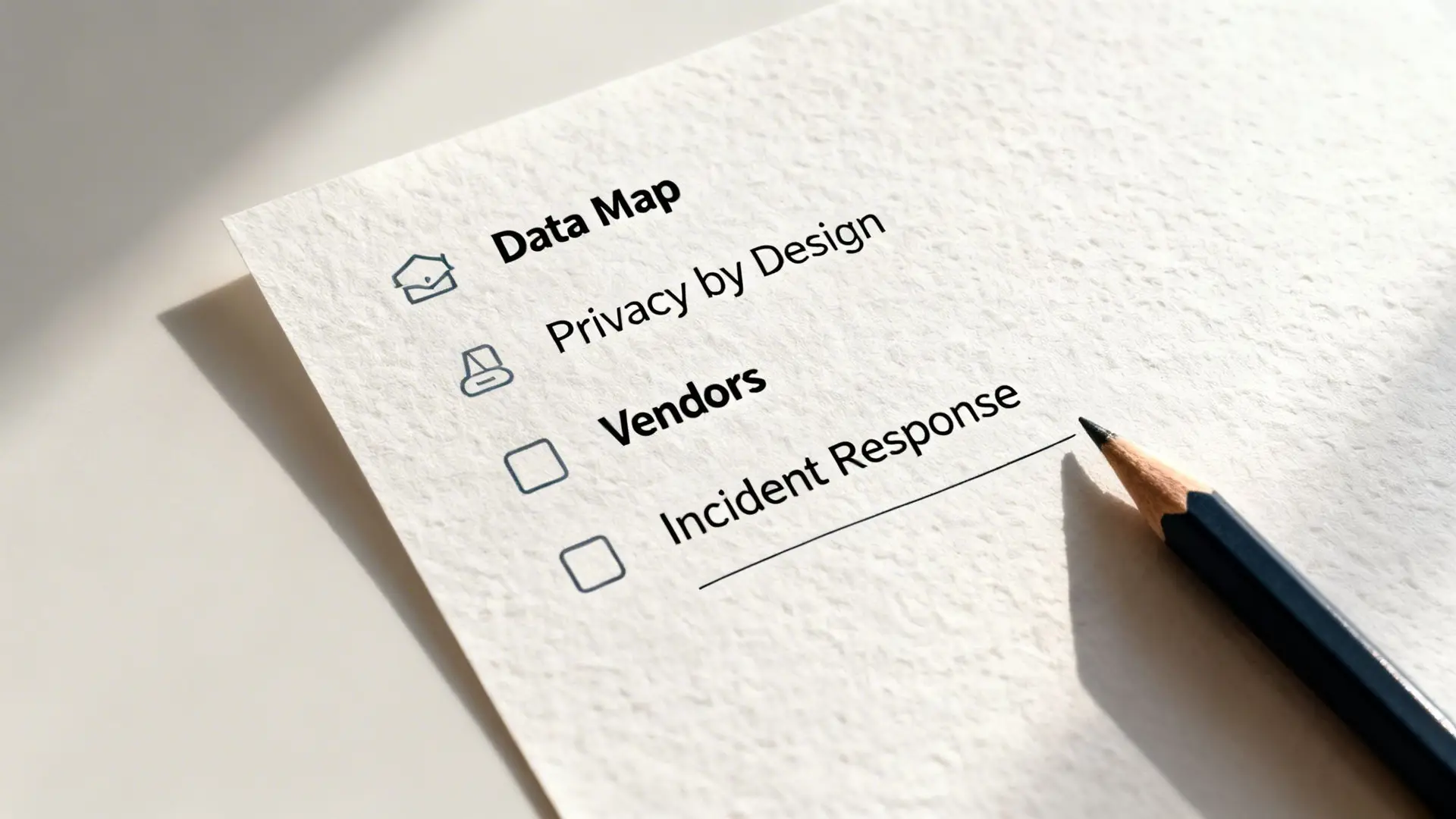
Moving from theory to practice is the only way to manage this risk. This is about building a proactive roadmap for compliance. The goal is to dismantle risks before they become costly liabilities.
Conduct a Dynamic Data Mapping Exercise
First, a static data inventory from last year is already obsolete. You need a dynamic data mapping exercise. This process must account for new definitions of sensitive data.
Your job is to trace the entire lifecycle of this information. Think of it as creating a live GPS for your company’s data. This map becomes the foundational tool for risk mitigation.
Update Privacy Policies for New AI Rights
Next, your public-facing privacy policies need a ground-up overhaul. These documents must clearly articulate new consumer rights. This is especially true for those related to AI-driven profiling.
Vague language is a red flag for regulators. For example, your policy must plainly explain the process for human review. Find a detailed analysis of U.S. data privacy laws for reference.
The goal is to transform your privacy policy into a transparent user guide. It should empower consumers by explaining their rights in simple terms. This is about building trust.
Implement Privacy by Design Protocols
Next, you must shift compliance to a proactive development principle. This means implementing a strict ‘privacy by design’ protocol. Simply put, data protection must be baked into every new product.
This approach requires your engineering and legal teams to collaborate. They must assess and mitigate potential privacy risks from day one. This protocol must include several mandatory steps.
The recommended strategic path involves these actions:
- Data Minimization: Only collect the absolute minimum data necessary for a specific purpose.
- Purpose Limitation: Ensure data is never repurposed without obtaining new, explicit consent.
- Default Privacy Settings: Configure all systems to be maximally private by default.
Establish a Robust Vendor Management Program
Your privacy obligations extend to your third-party vendors. A robust vendor management program is therefore non-negotiable. This involves rigorous due diligence and ongoing monitoring.
Finally, a detailed incident response plan must be prepared and drilled. The timelines for notifying regulators and individuals are shrinking dramatically. Consequently, a battle-tested plan is the only way to meet these deadlines.
Is Your Data Privacy Setup Ready for 2026?
A dense web of new privacy laws now threatens market access and company value – compliance gaps surface in deals and audits.
We review privacy compliance for companies operating across jurisdictions. Describe your data flows and we will mark the gaps.
Disclaimer: The information provided in this post is for informational purposes only and does not constitute professional legal, accounting, or financial advice. It should not be relied upon as a substitute for qualified legal counsel on specific issues. RNC Group is not liable for any damages, losses, or costs incurred from the use of this information. Legislative and regulatory changes may occur, and as such, it is recommended to consult with qualified professionals before making business decisions.