
A cross-border contract can look balanced on signing day and still become a strategic trap when a dispute starts. That risk has sharpened, not eased, as companies enter 2026 with more counterparties, more jurisdictions, and less tolerance for slow enforcement.
Many executives still assume litigation is the default safety net. In practice, international commercial arbitration often gives the stronger business answer, especially when a dispute touches Israel, multiple legal systems, or assets spread across borders.
Your 2026 International Contract Is a Liability Magnet
A standard court clause often fails at the exact moment a company needs certainty. The problem isn’t only delay. The primary problem is loss of control over forum, language, procedure, and enforcement.
For non-Israeli companies dealing with Israeli partners, distributors, founders, franchisees, or acquisition targets, dispute planning now belongs inside enterprise risk management. A contract that ignores dispute architecture leaves value exposed when payment stops, a supply chain freezes, confidential know-how leaks, or a shareholder fight spills into multiple countries.
Why litigation often stops working across borders
National courts operate by national instincts. That creates predictable friction in international business. One side worries about home-court advantage. Both sides face procedural rules they didn’t choose. Then each side discovers that winning a judgment and collecting on it are different problems.
Arbitration exists to solve that commercial reality. It gives parties a private mechanism to resolve international business disputes before decision-makers they choose, under rules they select, in a place they designate in advance.
Cross-border disputes punish improvisation. The side that planned forum, seat, language, and interim relief before signing usually keeps the commercial initiative.
That matters in higher-value transactions, but it also matters in ordinary operational disputes. A distributor termination, a licensing default, or a founders’ deadlock can threaten market access just as quickly as a headline M&A claim.
Why arbitration is a control tool, not only a dispute tool
Savvy companies don’t treat arbitration as a last resort. They use it as a pressure-management device. A well-built clause can narrow tactical gamesmanship, reduce jurisdiction fights, and create a credible enforcement path if negotiations fail.
That approach fits broader crisis planning. Disputes rarely stay isolated. They can overlap with payment failures, reputational pressure, supply interruption, document demands, and emergency asset concerns. Businesses that build arbitration into the contract structure preserve options when the relationship deteriorates.
A practical contract review should therefore test at least these points:
- Neutrality: Does the clause avoid either party’s home court?
- Enforcement: Will the final outcome travel where the counterparty’s assets sit?
- Speed tools: Can the company seek urgent interim protection if the dispute escalates?
- Operational fit: Does the process match the deal type, such as licensing, franchising, or shareholder arrangements?
International commercial arbitration ceases to be a mere textbook inquiry. It transforms into a board-level question concerning control, influence, and recoverability.
Defining International Commercial Arbitration
International commercial arbitration is a contract-based dispute mechanism that lets businesses move a cross-border fight out of national court and into a private process ending in a binding award. For non-Israeli companies dealing with an Israeli counterparty, that is often a risk-allocation decision long before any claim is filed. It can preserve neutrality, limit forum battles, and protect enforcement options if the relationship breaks down under pressure.

The basic structure is straightforward. The parties agree that one or more arbitrators, rather than a state judge, will decide defined disputes. The tribunal issues an award that is intended to be final and enforceable. The process is private in the sense that it does not run through ordinary public court litigation, although court support can still matter for interim relief, jurisdictional objections, and enforcement.
Under the UNCITRAL Model Law, arbitration is generally “international” when the parties have places of business in different states, or when other elements of the transaction point across borders, such as the place of performance or the agreed arbitral seat. “Commercial” is interpreted broadly. It captures the disputes that matter to actual business operations, including distribution, supply, technology, joint venture, shareholder, construction, services, and post-acquisition claims.
For foreign companies with Israeli-facing contracts, that definition matters because the crucial question is not academic classification. Instead, the question concerns control. If a payment default, exclusivity breach, IP misuse, or shareholder dispute hits at the same time as operational disruption, arbitration can give the company a preselected forum, a defined procedure, and a better chance of keeping the dispute from turning into a multi-front court fight.
What parties usually control through the clause is highly practical:
- Who decides the case: a sole arbitrator or a three-member tribunal
- Which rules apply: institutional rules such as ICC or LCIA, or ad hoc rules such as UNCITRAL
- Where the arbitration is legally based: the seat
- What language the case proceeds in: often English in Israel-related cross-border contracts
- How much administrative support the process has: full institution management or a lighter ad hoc structure
Those choices affect cost, speed, confidentiality, procedural pressure points, and settlement dynamics. They also affect how much tactical room the other side has to delay.
In high-value Israel-related disputes, I do not treat arbitration as boilerplate. I treat it as part of the company’s crisis architecture. A well-drafted clause will not eliminate conflict, but it can keep a business dispute from becoming a jurisdictional mess at the worst possible moment.
The Legal Framework Anchoring Your Dispute
A weak arbitration framework gives the other side room to fight about process before anyone reaches the actual dispute. For a non Israeli company facing an Israeli counterparty, that is a risk issue, not a drafting detail. Delay can freeze receivables, disrupt supply, pressure lenders, and force management into a procedural fight in multiple jurisdictions.
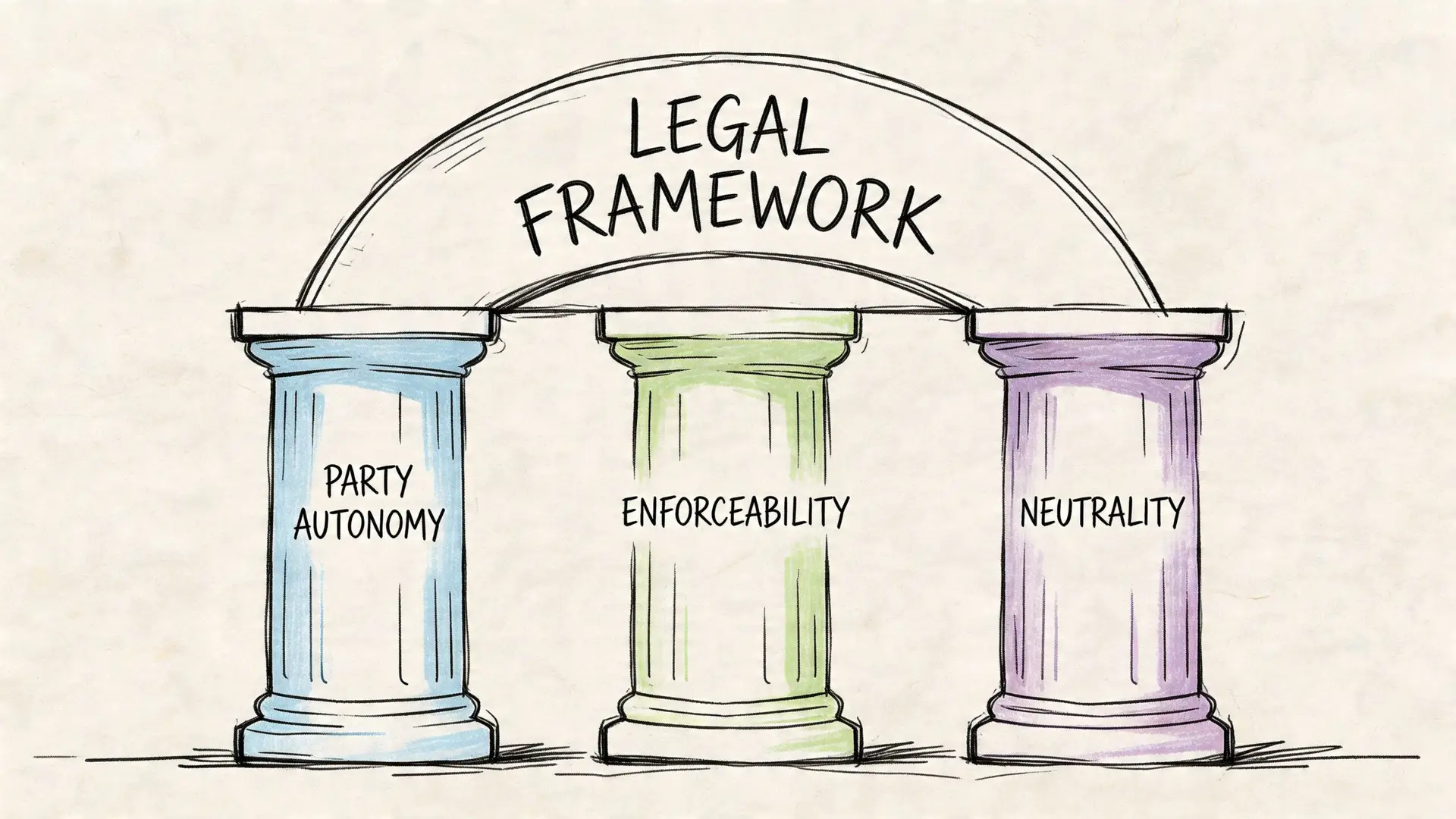
Three choices usually determine whether the process holds under pressure. The arbitration agreement decides whether the tribunal can act. The seat determines which courts supervise the case and what procedural law applies. The governing law controls how the contract is interpreted and which remedies are available. If those choices are misaligned, the dispute starts with avoidable uncertainty.
The arbitration agreement
The arbitration agreement is the operating instruction for the dispute. If it is vague, the first fight is often about whether there is a valid agreement, whether the clause reaches the claim, or whether the named institution can administer the case at all.
That problem appears often in practice. Ambiguous clauses create satellite disputes over jurisdiction, scope, notice, and appointment mechanics. In a high value contract, that usually means extra months, higher legal spend, and immediate settlement pressure before the merits are properly tested.
A clause worth signing should state the institution or procedural rules, the number of arbitrators, the language, and the seat. It also needs to fit the rest of the contract. Notice provisions, escalation steps, confidentiality terms, interim relief rights, and service mechanics should point in the same direction. If they do not, the other side will use the inconsistency.
For Israeli related disputes, I would add one practical point. If the commercial relationship could deteriorate quickly because of sanctions concerns, export issues, shareholder conflict, or payment stress, the clause should be drafted for speed and control from day one. That includes clear appointment language and a realistic path to urgent interim relief.
The seat of arbitration
The seat is the legal home of the arbitration. It is not just the place where a hearing room is booked.
That distinction matters because the courts at the seat can support the process, hear set aside applications, and decide certain threshold issues. A well chosen seat improves predictability. A poorly chosen one can invite procedural interference, tactical court applications, and uncertainty at the enforcement stage.
Foreign companies dealing with Israeli counterparties usually benefit from treating the seat as a control mechanism. A neutral seat such as London, Paris, Geneva, or Singapore can reduce arguments about home court advantage and improve the award’s credibility when enforcement becomes necessary. That is often the smarter course where the relationship has political sensitivity, reputational exposure, or a serious imbalance in local familiarity.
Governing law is a separate decision
The governing law answers the merits. It tells the tribunal how to read the contract, assess breach, calculate damages, apply limitation rules, and evaluate defenses. The seat addresses procedure. Those are different choices and they do not need to match.
A contract may adopt English law because the drafting and financing package were built around it, while selecting a neutral seat outside both parties’ home jurisdictions. That split is common and often sensible. It lets the business choose a familiar substantive law while keeping procedural supervision in a forum with experienced arbitration courts.
The mistake is assuming one choice solves both problems. It does not.
Evidence planning starts before the dispute
Cross border cases are often won or lost on document discipline, internal communications, and early evidence preservation. Israeli related disputes can raise added pressure because negotiations move quickly, decision making is decentralized, and relevant material may sit across several jurisdictions with different disclosure, privacy, and recording rules.
Management teams should set evidence protocols before tensions rise. That includes document retention, messaging practices, call notes, and approval chains. It also includes checking local rules before anyone records calls or online meetings. For teams assessing that exposure, the legality of recording calls is a useful operational reference. A recording obtained badly can create a second legal problem alongside the first.
What usually works, and what usually fails
The best clauses are precise and boring. They leave little room for argument.
Common failure points include:
- Conflicting dispute language: the contract refers to arbitration in one clause and court jurisdiction in another
- No legal seat: the clause names a hearing venue but never identifies the seat
- No language clause: the parties assume English, Hebrew, or another language without stating it
- No urgency planning: the contract ignores interim measures even though assets, data, or inventory could move quickly
- Broken contract mechanics: notice, escalation, and service provisions do not match the arbitration clause
For non Israeli companies, the strategic objective is straightforward. Build a framework that contains the dispute early, limits procedural ambushes, and keeps control in a neutral forum if the commercial relationship breaks down. Arbitration does that well only when the legal architecture is drafted with enforcement, urgency, and cross border pressure in mind.
Major Institutions and Procedural Rules
Arbitration institutions are operating systems for disputes. They don’t decide every case themselves, but they provide rules, administrative support, appointment mechanisms, scrutiny procedures, and practical discipline when parties start fighting about process.
For high-value cross-border business, the choice of institution affects credibility almost as much as the choice of seat. Some forums are better suited to complex international disputes, while others fit regional trade patterns or more customized procedures.
Why the ICC remains the benchmark
The International Chamber of Commerce remains the clearest global benchmark for major commercial cases. It has administered more than 29,000 arbitrations since 1923, and in 2024 it registered 831 new cases involving 2,392 parties from 136 jurisdictions, with a pending caseload value of US$354 billion, according to the ICC’s 2024 dispute resolution statistics.
Those numbers matter because they show institutional depth. A forum handling disputes from under US$10,000 to US$53 billion has seen almost every drafting problem, urgency application, and tribunal-constitution fight that a multinational can expect. In 2024, the ICC also approved 577 draft awards in 11 languages, and by year-end 1,789 cases were pending. That scale gives parties confidence that the institution can manage both complexity and diversity.
China and Asia’s expanding influence
Asian institutions now play a major role in international trade disputes, especially where the underlying business touches manufacturing, technology, infrastructure, or supply chains. According to this review of 2024 statistics from major PRC institutions, the Shenzhen Court of International Arbitration filed 14,518 commercial arbitrations in 2024, while CIETAC handled 6,013 new cases involving RMB 189 billion (US$26.1 billion) in disputes.
The same review reports that the Beijing Arbitration Commission handled 14,060 cases, while HKIAC managed 503 cases worth US$13.6 billion and SIAC handled 625 cases worth US$11.9 billion. For companies trading with Asian counterparties, institution choice has become a strategic issue, not a regional footnote.
Comparison of major arbitration rules
The label on the clause matters less than the mechanics behind it. The table below captures the practical differences businesses usually care about first.
| Feature | ICC Rules | LCIA Rules | UNCITRAL Rules |
|---|---|---|---|
| Administrative model | Full institutional administration | Institutional administration | Often used ad hoc, though parties can pair them with an administering body |
| Typical use case | High-value, cross-border disputes needing strong administrative supervision | Complex international disputes where parties want a leading institutional framework | Flexible disputes where parties want more procedural autonomy |
| Tribunal appointment support | Strong institutional role if parties can’t agree | Strong institutional role | Depends on party agreement and any appointing authority |
| Award scrutiny | Institutional scrutiny is a major feature | Different administrative approach | No built-in institutional scrutiny unless parties add administration |
| Flexibility level | Structured | Structured, often seen as efficient | Highly flexible |
| Best fit | Multinationals prioritizing predictability and global recognition | Parties seeking a premier alternative to ICC | Parties comfortable managing more process design themselves |
LCIA is often selected when parties want a top-tier institutional framework but prefer a different administrative style from ICC. UNCITRAL rules suit parties that value flexibility and are prepared to draft with discipline. They work well, but only if the contract answers the practical questions the rules leave open.
Businesses don’t choose rules in the abstract. They choose how much structure they want when cooperation disappears.
What clients often get wrong
Many contracts choose an institution by reputation alone. That isn’t enough. The actual choice turns on the dispute profile.
A licensing dispute may need decision-makers with technical expertise. A shareholders’ conflict may require strong interim powers. A long-term supply dispute may benefit from a process that can handle multilingual documents and emergency applications without procedural drift.
What works is matching the institution and rules to the transaction’s failure mode. What doesn’t work is copying yesterday’s clause into a very different deal.
The Arbitration Lifecycle From Claim to Award
Arbitration feels less mysterious once the sequence is clear. The process usually begins with a formal claim, moves through tribunal formation and procedural design, then reaches document exchange, hearings, and a final award.
That sequence matters because business advantage rises and falls at specific points. The early procedural decisions often shape the outcome as much as the legal arguments do.

Stage one begins before filing
The formal process starts with a request for arbitration or a notice under the chosen rules. Good counsel starts earlier. They map the claims, preserve evidence, test jurisdiction, and decide whether immediate interim protection is needed.
That early work is where commercial discipline matters most. A rushed filing can lock a party into avoidable procedural fights. A measured filing can frame the dispute around the strongest issues and preserve room for parallel settlement pressure.
Tribunal formation is a strategic event
The tribunal may consist of one arbitrator or three. In a technical dispute, parties often want someone who understands the industry. In a shareholders’ fight, they may prioritize someone experienced in governance and valuation disputes.
This stage has enormous tactical importance because arbitrators manage timetable, evidence, hearings, and procedural fairness. The right tribunal won’t decide a case for a party, but it can prevent the process from drifting into cost-heavy inefficiency.
Procedure should be designed, not inherited
Once the tribunal is constituted, the parties and tribunal set the procedural roadmap. They address pleadings, document production, witness evidence, hearing format, confidentiality handling, and deadlines.
Arbitration’s flexibility is one of its strongest commercial advantages. According to the Federal Judicial Center material cited here, arbitration can reduce dispute resolution time by 40% compared with national court litigation, and a 2021 Queen Mary survey found a median international arbitration duration of 26 months. The same source notes that emergency arbitrator provisions can cut escalation phases by 50%, which is why the Federal Judicial Center’s discussion of arbitral procedure remains useful for practical planning.
Emergency and interim relief can change the dispute
Not every case can wait for a final award. Funds may move. Data may be deleted. Contract performance may collapse before the tribunal reaches the merits.
That is why urgent tools matter:
- Emergency arbitrator applications: Useful when a party needs rapid protective relief before the full tribunal is in place.
- Interim measures from the tribunal: These can preserve assets, evidence, or status quo obligations.
- Court support where appropriate: In some seats, courts can assist without taking over the merits dispute.
Operational priority: If assets can disappear faster than the tribunal can form, the dispute plan must include emergency relief from day one.
Hearings and the final award
Some cases resolve on documents. Others require live hearings with fact witnesses and experts. Hearing design matters because remote, hybrid, and in-person formats create different cost and credibility dynamics.
The final award is binding, subject only to limited challenge rights under the law of the seat. By that point, the side that managed procedure well usually has already improved its settlement position, preserved key evidence, and reduced unnecessary friction.
What works in arbitration is disciplined front-loading. What doesn’t work is importing court habits into a process designed for sharper procedural control.
Arbitration vs Litigation A Strategic Comparison
The core comparison isn’t abstract fairness. It is commercial utility. When a dispute crosses borders, the winning strategy usually favors the forum that produces an enforceable result without handing either side home-field advantage.
Enforceability changes the whole analysis
Arbitration’s strongest advantage is enforceability. The 1958 New York Convention requires recognition of foreign arbitral awards across over 170 states, while court judgments succeed in only about 40% of cross-border enforcement scenarios and arbitral awards are refused enforcement in less than 5% of cases, as described in the earlier UNCITRAL-based source.
That gap is decisive. A judgment that cannot travel is often a paper victory. An arbitral award usually has a far better chance of reaching the counterparty’s assets.
Where arbitration clearly outperforms
For international business, arbitration usually offers four strategic advantages:
- Neutral forum: Neither side needs to litigate in the other’s home courts.
- Confidentiality: Sensitive commercial facts stay out of public court files in many cases.
- Expert decision-makers: Parties can select arbitrators with sector knowledge.
- Procedural customization: The process can be shaped around urgency, document scope, and hearing design.
That combination is especially valuable in M&A, technology licensing, distribution, construction, and shareholder disputes. In those matters, speed and discretion often matter almost as much as legal correctness.
The trade-offs that deserve candor
Arbitration isn’t perfect. Costs can be substantial, especially with a three-member tribunal and aggressive document battles. Appeal rights are limited, which means a weak case presentation can be hard to repair later.
Still, those trade-offs are often manageable. In cross-border disputes, the alternative is frequently slower, more public, and harder to enforce. Businesses usually benefit more from a neutral and enforceable first result than from a wider appeal path that delays collection.
Litigation can feel familiar. Familiarity is not the same as strategic fit.
The strongest approach is to choose arbitration where the transaction is international and the downside of enforcement failure is serious. Court litigation may still suit some local matters. But once assets, counterparties, and performance spread across borders, arbitration usually offers the more defensible risk position.
Strategic Arbitration Guidance for Non-Israeli Companies
Non-Israeli companies entering Israeli-linked transactions shouldn’t ask only whether arbitration is available. They should ask whether the clause gives enough control if the relationship fails under stress.
That question changes drafting, negotiation, document handling, and crisis response. Arbitration works best when the contract treats dispute design as part of the business model.
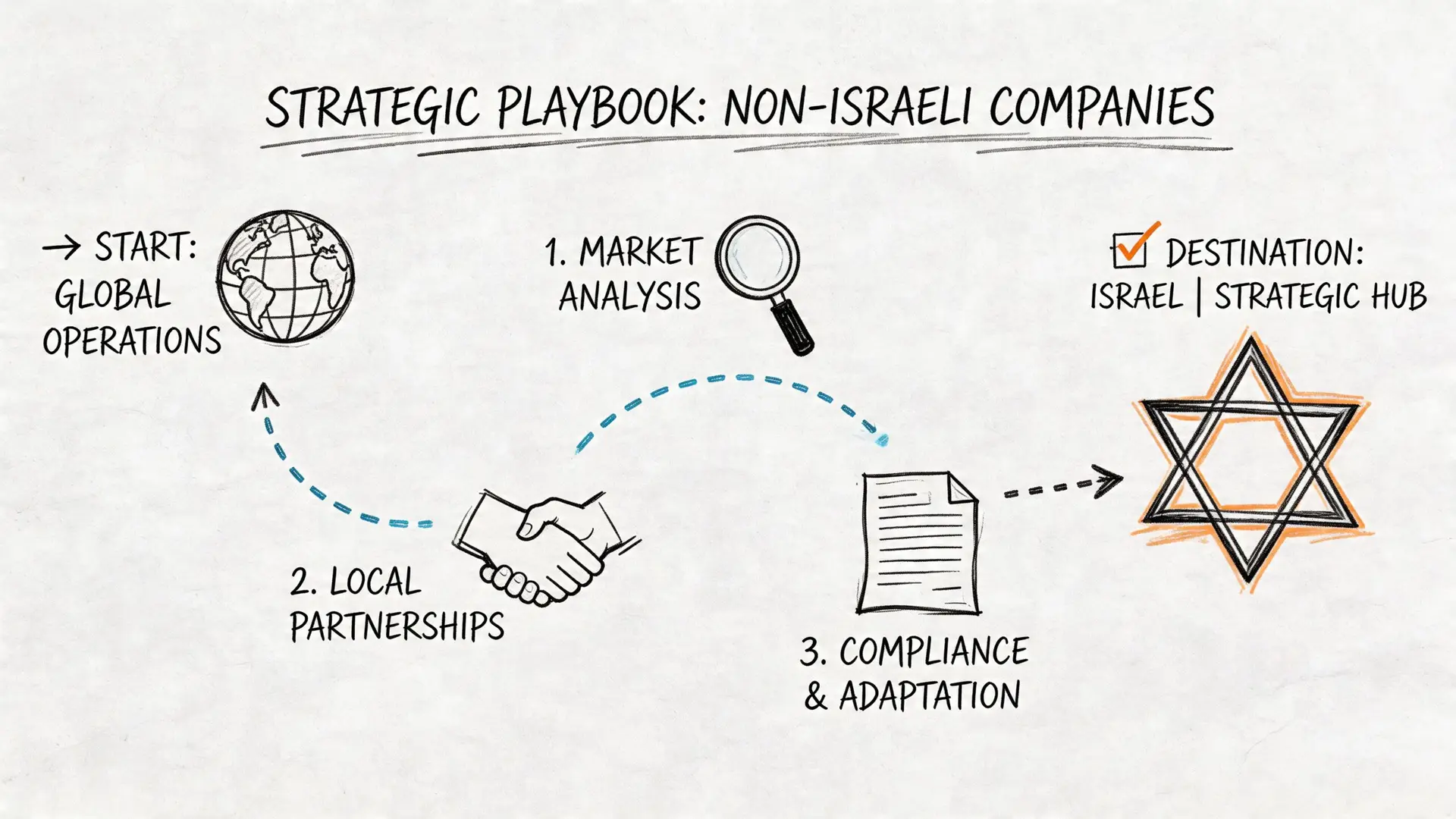
Draft for neutrality, not courtesy
The recommended strategic path is a neutral seat, clear institutional rules, and a language choice that reflects actual deal operations. In many Israeli-related cross-border contracts, parties prefer seats such as London, Geneva, Paris, or Singapore because they reduce any perception of local advantage.
The clause should state the seat, language, institution, and tribunal size in plain terms. It should also fit the transaction. A founders’ dispute clause shouldn’t look identical to a franchise or licensing clause.
A simple model often looks like this:
Any dispute arising out of or in connection with this agreement shall be finally resolved by arbitration under the ICC Rules. The seat of arbitration shall be [neutral city]. The language of the arbitration shall be English. The tribunal shall consist of [one or three] arbitrator(s). The governing law of this agreement shall be [chosen law].
That isn’t universal wording. It is a disciplined starting point. The right draft depends on the business, likely remedies, and where enforcement may be needed.
Language is a strategy issue, not a clerical issue
Language choice affects witness quality, written advocacy, hearing dynamics, and tribunal perception. English dominates many international proceedings. It was used in 80% of ICC awards and 78.7% of 2021 HKIAC arbitrations, according to this analysis of accent and language bias in arbitration.
That same analysis highlights a harder point. Linguistic homogeneity can create unconscious bias against non-native speakers, including Israeli participants. For non-Israeli companies, the recommended strategic path is to align language planning with counsel selection, witness preparation, and translation quality from the start.
Build arbitration into crisis control
An arbitration clause should not stand alone. It should connect with the company’s broader dispute-readiness system. That includes escalation planning, internal document retention, payment controls, executive communication, and rapid-response measures if a commercial conflict spills into operations.
For Israeli-related matters, this often intersects with broader risk planning around crisis management strategy, bank account blockages, and the quality of commercial contracts and agreements. In some disputes, early legal correspondence also shapes the arbitration record, which is why strategic legal correspondence and demand letters belong in the same planning framework.
Use technology carefully, not blindly
Document review, chronology building, and multilingual issue spotting now move faster with legal technology. For in-house teams evaluating tools, this overview of best AI legal assistants is a useful starting point.
Technology helps with scale, but it doesn’t replace judgment. Arbitration strategy still turns on clause design, witness credibility, remedy selection, and enforcement planning. Those are legal and commercial decisions, not software settings.
What non-Israeli companies should do now
The recommended strategic path is immediate and practical:
- Audit existing contracts: Identify clauses with no seat, no language, or mixed forum wording.
- Match clause to deal type: Use different dispute architecture for M&A, licensing, franchising, and shareholder arrangements.
- Plan evidence early: Set rules for internal communications, document retention, and privileged escalation.
- Stress-test enforcement: Ask where the counterparty’s assets sit before choosing rules and seat.
- Prepare for urgency: Include emergency relief options where assets, data, or market position can shift quickly.
The companies that handle Israeli-linked disputes best rarely start with a claim. They start with a contract that already limits chaos.
Conclusion Avoid Costly Mistakes and Secure Your Position
International commercial arbitration is a control mechanism. For non-Israeli companies facing an Israeli-linked dispute, that distinction matters. The right clause, seat, rules, and enforcement plan can contain pressure early, preserve commercial options, and prevent the dispute from dictating the timetable, forum, and settlement dynamic.
Strong companies treat arbitration as part of crisis management before any notice of dispute is sent. They do not wait for a filing to discover that the clause is vague, interim relief is unavailable, or the eventual award will be hard to enforce against assets in the wrong jurisdiction. By then, cost rises and room to maneuver shrinks.
A fundamental mistake is reactive thinking.
Review contracts before the relationship deteriorates. Test whether the dispute architecture matches the transaction, the counterparty, and the asset map. If the matter already shows signs of stress, assess escalation paths immediately and decide what pressure should be applied, when, and in which forum. That is how businesses protect position instead of defending it late.
For specific guidance on Israeli-linked cross-border disputes, contact RNC Group through its contact page.
This article provides general information only and doesn’t constitute legal advice, legal opinion, or a substitute for case-specific analysis. Any reliance on it without obtaining professional advice on the relevant facts, contracts, jurisdictions, and procedural posture is at the reader’s own risk.