
If your acquisition closes on schedule but opens the door to an Israeli lawsuit, did due diligence work?
Most buyers still treat acquisition due diligence as a closing ritual. That approach is expensive. It confuses document collection with risk control, and it leaves the hardest issues untouched until the purchase agreement is already moving toward signature.
For non-Israeli investors, the problem gets sharper in Israel. Standard M&A workstreams often identify headline issues, yet they miss how local contracts, banking conduct, employment exposure, and litigation behavior can alter post-closing influence. The core objective is not to produce a thick report. The objective is to verify value, control downside, and prevent the deal from mutating into a post-acquisition dispute.
The True Cost of Inadequate Due Diligence
A failed deal rarely fails because the buyer missed one obvious item. It fails because the buyer accepted untested assumptions.
That is why acquisition due diligence must be treated as a risk-management function, not an administrative checkpoint. The EBSCO due diligence summary states that 25% to 30% of acquisitions and mergers end in failure, and some research places the figure even higher. Buyers who skip rigorous verification of financial statements, liabilities, ownership, and legal exposure aren’t saving time. They are importing uncertainty into the purchase price.
What buyers usually underestimate
The purchase price draws attention. Hidden liabilities destroy value.
A target can present stable revenue, clean management presentations, and a persuasive growth story. Yet leases, debt, warranties, employment commitments, pending disputes, and weak ownership records can reshape the economics of the transaction after signing. By then, the balance of power has already shifted.
Practical rule: If a diligence finding cannot change price, structure, or closing conditions, the review probably isn’t asking the right question.
In practice, inadequate diligence creates three immediate consequences:
- Valuation distortion: Buyers pay for projected performance that the operating model can’t support.
- Contractual weakness: The acquisition agreement contains generic protections instead of targeted indemnities and conditions.
- Integration instability: The buyer inherits legal and operational friction that surfaces only after control changes.
Why checklists alone fail
A checklist has value. A checklist without judgment does not.
The strongest deal teams use diligence to test the investment thesis itself. If the buyer claims the deal will expand market access, secure technology, or add a new Israeli operating platform, each of those claims must be tested against documents, management answers, and legal reality. That requires skepticism. It also requires speed, because a risk found too late has limited negotiating value.
| Weak approach | Strong approach |
|---|---|
| Collect documents | Form risk hypotheses first |
| Review headline numbers | Reconcile numbers to contracts and cash |
| Wait for a final report | Update deal terms as issues emerge |
| Focus on signing | Focus on post-close survivability |
The cost of weak diligence is not abstract. It appears in price overpayment, trapped cash, disputed earn-outs, integration failures, and litigation that could have been prevented before closing.
Defining Your Diligence Scope and Timeline
A disciplined process starts before the first request list goes out. Scope drives outcome.

Modern acquisition due diligence is more structured and more data-heavy than many buyers expect. The YouSign guide on business acquisition due diligence says the process typically takes 6 to 12 weeks, while complex cases may run for months. That timeline matters because it forces prioritization. Buyers need an early view of what must be answered before signing, what can be handled through conditions, and what belongs in post-close integration planning.
Scope follows the deal thesis
A buyer acquiring a software company for IP and talent needs a different diligence scope than a buyer entering Israel through a regulated operating business. The workstream list may look similar on paper. The weight assigned to each stream should not.
Start with four scoping questions:
- What is being bought? Shares, assets, technology, market access, customer contracts, or management capability.
- What makes the valuation work? Margin expansion, customer retention, product cross-sell, or regulatory positioning.
- What could break that thesis? Contract transfer limits, tax leakage, employee departures, banking friction, or compliance failures.
- What must be true on day one after closing? Payroll continuity, supplier performance, license validity, and account access.
Buyers lose control when they let the seller’s data room define the agenda.
Build a gated workflow
The process works best when each phase has an owner, a deadline, and an escalation trigger. Without that structure, teams drown in documents and miss the issues that deserve executive attention.
A practical workflow usually includes:
- Confidentiality and scoping: Lock down NDAs, define materiality thresholds, and map the thesis.
- Request list issuance: Ask for documents that answer specific risk questions, not every file the target has ever created.
- Management Q&A: Use interviews to test consistency, not to replace hard evidence.
- Review and specialist workstreams: Legal, financial, tax, HR, IT, compliance, and commercial teams work in parallel.
- Risk synthesis: Convert findings into decision points for price, structure, and closing protections.
Keep the data room under control
Virtual data rooms help. They also create false comfort.
A full folder tree can look organized while key items are missing, outdated, unsigned, or internally inconsistent. Buyers should maintain a live issues list that tracks each open point, the requested evidence, the responsible reviewer, and the proposed commercial consequence. That document often becomes more useful than the room itself.
For cross-border buyers, timeline discipline matters even more. Israeli deals can move quickly at the commercial level while local legal issues take longer to surface. The buyer that scopes early and escalates fast usually negotiates from a stronger position.
The Core Diligence Workstreams A Checklist
The right checklist doesn’t ask for more paper. It asks better questions.
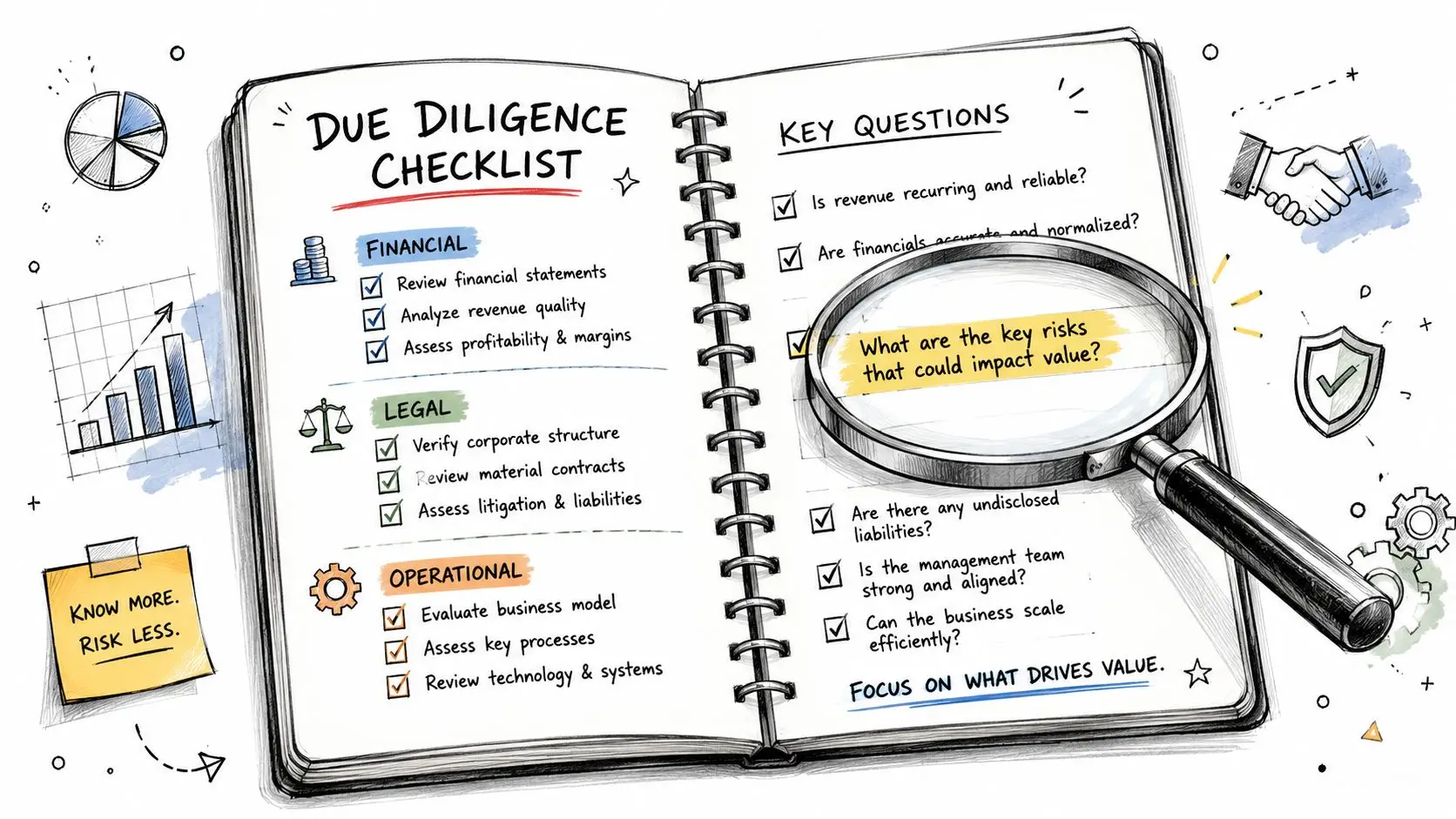
Financial diligence should not stop at historical performance. The Axiom due diligence checklist guide notes that best-practice review validates 3 to 5 years of audited financial statements, tax records, and revenue-source mapping, and then stress-tests those inputs against the business plan. That is the only way to judge whether the valuation rests on a credible operating model.
Financial workstream
Financial review should answer one question. Can this business produce the cash flow the buyer is paying for?
Key checks include:
- Quality of earnings: Reconcile EBITDA to actual cash generation. Test whether adjustments are recurring or cosmetic.
- Revenue mapping: Tie revenue to contracts, renewal mechanics, concentration, and customer durability.
- Working capital pressure: Check whether the business needs cash support to sustain current operations.
- Forecast logic: Compare management projections with historical performance and visible market constraints.
- Tax posture: Review filings, exposures, and the risk that tax assumptions overstate normalized earnings.
A seller forecast can be useful. It is not evidence by itself.
For a seller-side perspective that helps buyers understand how well-prepared targets present themselves, the due diligence for selling a business guide is a useful comparison point. It shows how organized sellers frame their data. Buyers should read that material defensively, because every polished package still needs verification.
Legal workstream
Legal diligence identifies obligations that accounting often doesn’t capture cleanly.
Focus on the documents that can alter control rights, payment obligations, or litigation exposure:
- Corporate records: Confirm ownership, authority, option pools, and approval history.
- Material contracts: Review assignment limits, change-of-control provisions, exclusivity, termination rights, and non-standard liability clauses.
- Debt and security: Trace loans, guarantees, liens, and covenant packages.
- Disputes and threatened claims: Ask for more than filed pleadings. Review demand letters, settlement discussions, and internal issue logs.
- Leases and distribution agreements: These often contain operational dependencies that become visible only after closing.
A clean financial summary can coexist with a weak contract base. Buyers should assume nothing until the paper supports it.
Commercial and operational workstream
Commercial diligence tests whether demand is stable and whether the operating engine can survive ownership change.
A target may appear healthy while key customer relationships depend on founder involvement, informal pricing concessions, or local personal networks. That risk doesn’t sit neatly in audited statements.
Use this short table to frame the review:
| Area | What to test | Why it matters |
|---|---|---|
| Customers | Concentration, churn signals, contract duration | Revenue may not survive transition |
| Suppliers | Dependency, switching limits, pricing exposure | Margin assumptions may fail |
| Operations | Delivery capacity, process bottlenecks, local approvals | Integration may disrupt execution |
| Management | Decision rights, key person reliance, incentive alignment | Control may weaken after closing |
HR, IT, and compliance workstream
These areas often receive the shortest memos. They can produce the longest disputes.
Look closely at:
- Employment terms: Compensation structures, retention risk, bonus obligations, and restrictive covenants.
- IT environment: System dependence, software rights, vendor lock-in, and migration risk.
- Data and compliance: Internal controls, policies, reporting discipline, and known breaches or remedial gaps.
- Regulated activity: Licenses, notices, sector-specific approvals, and local reporting obligations.
Weak diligence usually treats these streams as annexes. Strong diligence links them back to valuation, continuity, and post-close control.
Strategic Analysis Israeli Post-Acquisition Litigation
Will the acquisition survive Israeli legal reality once the signing ceremony ends?

Many buyers run a competent international diligence process and still misread Israeli post-close risk. The problem is not usually the absence of documents. The problem is the absence of local interpretation. A contract that seems commercially ordinary in one jurisdiction can create a different litigation profile in Israel once performance falters, management changes, or payment timing shifts.
The litigation risk increases further in cross-border deals. The Clinx overview of acquisition due diligence issues notes that integration issues, cultural friction, and overestimated synergies remain among the most common reasons value is destroyed after closing, and that this gap is magnified where governance, incentives, and language differ. For non-Israeli acquirers, that warning is not theoretical. It is a drafting and diligence problem.
Where standard diligence misses Israeli exposure
Three categories deserve special attention.
First, local commercial contracts often contain operational assumptions that foreign buyers underestimate. A buyer may review revenue and renewal data yet fail to analyze the legal mechanics of the target’s commercial lease agreements. That omission can trigger occupancy disputes, consent problems, or liabilities tied to use, fit-out, or termination.
Second, banking conduct can become a live business continuity issue. Israeli operating companies can face acute disruption if a bank account is frozen, restricted, or subjected to internal scrutiny. A buyer that doesn’t examine prior banking friction, compliance history, and account dependence may discover too late that post-close operations are vulnerable to bank account blockages.
Third, crisis escalation in Israel often moves across legal, banking, and reputational channels at the same time. An acquisition that inherits contractual conflict, employee unrest, or payment disputes may require structured crisis management long before a court reaches the merits.
Why local counsel changes the risk map
Non-Israeli investors often ask for a clean issue list. They need something else first. They need a local theory of dispute.
That means testing each material issue through Israeli enforcement behavior, commercial practice, and practical influence. A technically correct summary of a contract isn’t enough if it doesn’t answer the core question: how will this issue behave after control changes?
RNC Group publishes practical material on acquisition review, including a due diligence checklist and technical diligence guidance, which can help frame Israeli risk categories during transaction planning. That kind of localized review is useful when the buyer needs to connect commercial assumptions with likely post-close dispute patterns under Israeli law.
In Israeli deals, the legal issue isn’t only whether a claim exists. The issue is who gains leverage first when performance becomes contested.
What non-Israeli buyers should do
The recommended strategic path is direct:
- Review contracts locally: Don’t rely only on translated summaries. Check enforceability, consent mechanics, and termination triggers under Israeli practice.
- Investigate banking stability: Map core accounts, operational dependence, and any history of restrictions or compliance friction.
- Audit employment exposure: Test compensation promises, managerial authority, and local workforce assumptions before integration plans are locked.
- Run a cultural fit review: Examine decision-making norms, reporting lines, and language dependencies, especially where the deal thesis assumes rapid integration.
Standard diligence helps identify risk. Localized diligence decides whether that risk will become litigation.
From Red Flags to Remediation Strategies
A red flag is valuable only if the buyer converts it into protection.
That requires triage. Not every problem should kill the deal. Some should reprice it. Others should move into conditions, indemnities, escrow, or post-close covenants. The buyer that treats every issue as equally urgent usually gets none of them solved properly.
The better approach is a gated process that links findings to remedies as they arise. The Sun Acquisitions buyer-side guidance describes a structured workflow and recommends updating the purchase agreement and closing conditions in real time rather than waiting for a final report. That is the correct discipline, because legal, financial, HR, tax, IT, and commercial risks rarely appear in one place.
A simple remediation framework
Use three categories.
Deal-breakers
These are risks that undermine the investment case itself.
Examples include broken ownership, non-transferable core rights, severe regulatory exposure, or facts that make the target’s core revenue unreliable. If the issue cannot be fixed before signing or neutralized through structure, the buyer should pause or walk away.
Price-chippers
These are issues that don’t destroy the deal but do change its value.
Typical examples include customer concentration, unresolved tax positions, weak margin quality, unusual working-capital pressure, or contracts that are less durable than management claims. These findings support a purchase price adjustment, an earn-out, or a more conservative completion accounts mechanism.
Manageable issues
These are real risks with controllable solutions.
A manageable issue may call for a specific indemnity, a short-term covenant, escrow support, a holdback, or a condition precedent tied to document cleanup. Buyers should resist the temptation to bury these points in general representations. Specific risk deserves specific drafting.
The strongest diligence memo is not the longest one. It is the one that tells the deal team exactly what to change in the papers tonight.
Match the remedy to the problem
A targeted response often looks like this:
| Finding | Better remedy | Weak remedy |
|---|---|---|
| Uncertain forecast delivery | Earn-out tied to verified performance | Generic seller optimism clause |
| Known legal exposure | Specific indemnity and escrow | Broad indemnity with no security |
| Contract transfer risk | Closing condition and third-party consent plan | Promise to sort it out after closing |
| Key employee dependence | Retention package and transition obligations | Verbal comfort from management |
Buyers acquire bargaining power during this stage. A discovered issue becomes commercially useful only when it changes the deal structure.
Keep integration tied to the legal file
Too many teams separate diligence from integration planning. That split creates avoidable disputes.
If a contract requires notice, if a manager controls customer retention informally, or if banking access depends on specific signatory arrangements, integration steps must reflect those realities before closing. The acquisition agreement should mirror the operational transition plan. Otherwise, the buyer signs a legal package that assumes a business handover the documents do not support.
Adopting a Diligence Mindset for 2026
The most effective buyers in 2026 won’t win because they have longer checklists. They’ll win because they think like investigators.
That mindset starts with skepticism and ends with control. Buyers should test the business plan against the documents, treat integration as a diligence topic, and translate findings into legal and commercial advantage before the seller sets the pace. That is especially important in Israeli transactions, where local enforcement patterns, banking behavior, and contract practice can reshape post-close risk quickly.
A useful cross-check comes from investor-side thinking in venture transactions. The PressBeat overview of VC due diligence insights is worth reading because it reflects the same core discipline. Investors who survive bad markets don’t rely on narratives. They verify assumptions, pressure-test governance, and plan for downside before money moves.
Acquisition due diligence is not a report. It is a decision system.
Buyers who adopt that system enter negotiations with sharper pricing logic, stronger drafting positions, and a more realistic integration plan. Buyers who don’t may still close on time, but they often discover that the hardest part of the deal starts after ownership changes.
Avoid costly mistakes before they become disputes. For strategic guidance on Israeli acquisition due diligence, post-deal risk allocation, and cross-border commercial exposure, contact RNC Group now through the firm’s contact page.
Disclaimer: The articles and information provided in this publication are for informational and educational purposes only and do not constitute legal advice. Reading this article does not create an attorney-client relationship. Readers should consult a qualified attorney for advice on any specific legal matter.