
A cross-border contract rarely fails because the commercial terms were unclear. It usually fails because the dispute clause left the parties fighting about process before they could address the problem.
That risk is sharper in 2026. Non-Israeli companies doing business with Israeli counterparties face pressure from faster deal cycles, more scrutiny on governance, and tighter demands for operational continuity. In that setting, mediation vs arbitration isn’t a theoretical comparison. It’s a board-level allocation of control, influence, timing, and enforcement risk.
Many companies still treat the dispute clause as back-page boilerplate. That approach works until payment stops, supply breaks, intellectual property is misused, or a joint venture turns hostile. Then the clause becomes the contract’s most expensive sentence.
Choosing Your Forum A Critical 2026 Contract Decision
A useful starting question is simple. Will the dispute clause defuse a commercial conflict, or will it trap both sides in a private procedural war?
For cross-border contracts involving Israel, that question deserves the same attention as pricing, exclusivity, and termination. The clause determines whether the parties must negotiate first, whether a neutral can impose an outcome, which language governs the process, and where the balance of power shifts once relations deteriorate.
Why boilerplate fails in cross-border deals
Standard templates often import a dispute mechanism that doesn’t match the transaction. A licensing deal, a founders’ agreement, a distribution network, and a supply agreement don’t carry the same dispute profile. Yet many contracts use the same generic arbitration sentence, or worse, no escalation path at all.
That creates predictable problems:
- Mismatch of remedy and risk: A business that needs a quick negotiated fix may get forced into an adjudicative process.
- Procedural ambiguity: The parties argue over seat, language, or scope before they address liability.
- Commercial paralysis: Senior management loses time to process design after the dispute has already escalated.
- Relationship damage: A solvable business conflict hardens into an adversarial record.
Even parties using free consulting contract resources should treat them as drafting aids, not finished cross-border risk architecture. Templates can help identify standard clause headings. They can’t decide whether actual exposure lies in enforceability, confidentiality, speed, or preserving a strategic relationship.
Practical rule: If the contract crosses borders, the dispute clause should never be the least negotiated term.
The decision sits upstream of the dispute
The strongest contracts decide process before tempers rise. That doesn’t mean every deal needs a long clause. It means every deal needs an intentional one.
A well-structured clause answers a few hard questions early. Does the business want a binding decision if negotiations fail? Is a commercial settlement more valuable than a legal win? Will the counterparty comply voluntarily, or will enforcement matter more than flexibility?
Those questions matter even more where Israeli operations, assets, executives, or counterparties are involved. A clause that fits the commercial reality can contain damage quickly. A clause copied from an old deal often does the opposite.
Understanding the Fundamental Differences
The core distinction is not style. It’s decision-making authority.
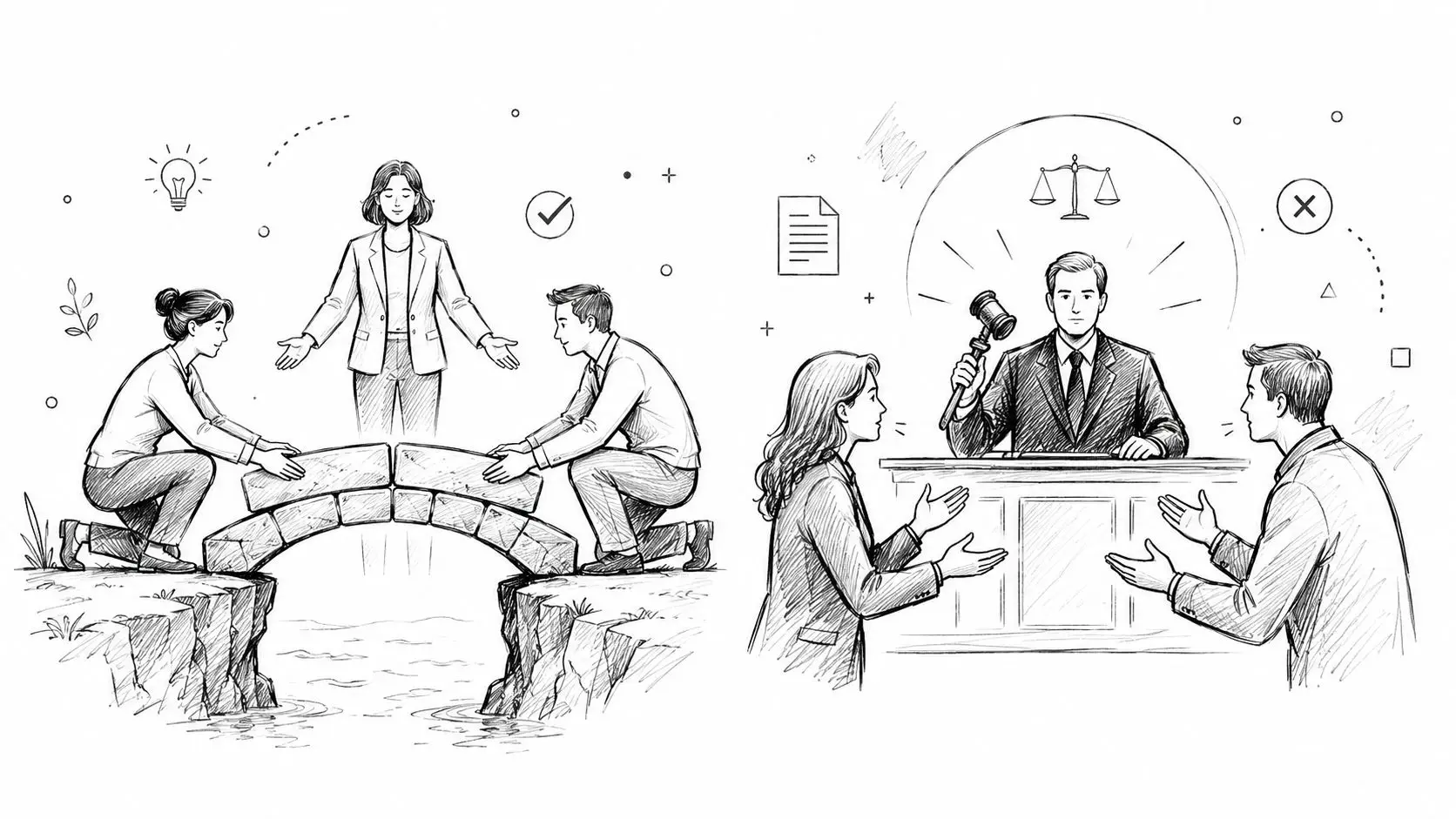
Mediation keeps control with the parties
In mediation, the mediator manages negotiation. The mediator can test positions, challenge assumptions, and help structure settlement options. However, the mediator can’t impose a result.
That means the parties retain control over outcome, scope, timing, and trade-offs. A mediated deal can include business terms that a tribunal would never order, such as revised supply obligations, new milestones, future credits, or territory adjustments.
Arbitration transfers control to the tribunal
Arbitration works differently. The arbitrator or panel hears the case and issues an award. That award is binding if the clause and governing framework support binding arbitration.
This difference is the technical line that matters most. As explained in this guide to investment dispute resolution, businesses often confuse private procedure with informal outcome. Arbitration may be private, but it still functions like adjudication. By contrast, mediation remains a negotiated process unless the parties sign a settlement.
The legal distinction is also direct. The mediator facilitates and cannot impose a result, while the arbitrator issues a binding award that the parties must follow, which makes arbitration better for disputes needing definitive resolution and mediation better for flexibility and relationship preservation, as summarized by ZMAT Law’s explanation of mediation and arbitration.
When a client needs certainty, arbitration answers a different problem than mediation. One seeks closure by decision. The other seeks resolution by agreement.
What that means in practice
A cross-border payment dispute may fit mediation if the parties still need each other. A shareholder deadlock over control rights may require arbitration if neither side will yield. A technology dispute involving licensing misuse may start in mediation, but it often needs an arbitration backstop if future conduct must be definitively ruled on.
The mistake isn’t choosing one process over the other. The mistake is choosing without identifying who should hold the final power to decide.
Comparing Process Timelines and Financial Exposure
When executives ask about mediation vs arbitration, they usually mean two things. How long will this take, and how much disruption will it create?
The answer depends on clause design, party conduct, and case complexity. Still, the two processes behave differently enough that the comparison is practical from the outset.
Mediation vs. Arbitration At a Glance
| Attribute | Mediation | Arbitration |
|---|---|---|
| Decision maker | Neutral facilitator | Neutral adjudicator |
| Outcome control | Parties keep control | Arbitrator controls the final decision |
| Binding effect | Only if parties sign a settlement | Award is binding |
| Procedure style | Flexible and negotiated | Structured and adjudicative |
| Best use case | Commercial compromise and business continuity | Definitive determination of rights and obligations |
| Relationship impact | Often more preservative | Often more adversarial |
| Cost profile | Generally lighter in process burden | Usually heavier because procedure expands |
| Timing profile | Often earlier and faster | Often longer because it resembles private litigation |
What the verified data shows
For companies deciding whether to insert a mandatory mediation stage, the best verified benchmark is straightforward. FINRA reports that more than 80% of mediations result in a settlement, and that mediation is generally faster and less costly than arbitration. FINRA also notes that mediation can begin before arbitration or during arbitration, which makes it useful as an early settlement window without abandoning a later adjudicative option, as stated in FINRA’s overview of arbitration versus mediation.
That flexibility matters in contract drafting. It allows counsel to build a sequence rather than force a binary choice.
Financial exposure doesn’t come only from legal fees
Companies often underestimate the internal cost of arbitration. The process may require document collection, witness preparation, factual submissions, expert coordination, hearing planning, and management time. Even where arbitration is efficient by adjudicative standards, it still pulls senior personnel into a formal contest.
Mediation usually creates a different burden. The pressure sits in preparation quality, decision-maker availability, and settlement authority. If the right executives attend with a realistic mandate, mediation can solve a dispute before the record hardens.
Consider the contrast:
- Mediation front-loads business judgment. Parties prepare commercial options and authority lines.
- Arbitration front-loads proof. Parties build evidentiary positions and legal theories.
- Mediation can narrow exposure early. Even partial settlements can reduce later issues.
- Arbitration tends to carry disputes through to determination. That’s useful when compromise isn’t realistic.
A failed mediation isn’t wasted if it narrows issues, tests assumptions, or exposes the real settlement range.
How to use the timing difference in drafting
The most effective clauses don’t ask the contract to predict every future dispute. They assign the right process to the right stage.
A commercial contract can require short-form executive negotiation first, then mediation, then arbitration if no settlement is signed. That sequence can contain routine conflicts while preserving a binding route for serious deadlocks. For cross-border deals, that combination often protects both efficiency and bargaining strength.
Making the Decision Stick Across Borders
A dispute mechanism has little value if the result can’t be enforced where the other side holds assets, operations, or decision-makers.
That is where cross-border drafting becomes more technical. The difference between mediation and arbitration doesn’t end with process. It extends to the legal machinery available after the dispute closes.

Arbitration starts with enforceability in mind
Arbitration has long been favored in international contracts because it is built around a binding award. In U.S. law, that distinction is formalized because arbitral awards are typically enforceable in court under the Federal Arbitration Act, 9 U.S.C. § 9, while mediation doesn’t impose an outcome unless the parties sign a settlement agreement, as discussed in this analysis of the legal authority behind arbitration and mediation.
That point matters beyond the United States. In practice, businesses choose arbitration for cross-border disputes because they want a final adjudicative result that can travel more easily across jurisdictions.
Mediation needs enforceable settlement architecture
Mediation can absolutely resolve international disputes. But the legal force comes from the settlement agreement, not from the mediator. That means drafting quality becomes critical.
Counsel should address at least four issues in any mediated settlement involving a cross-border Israeli matter:
- Signature authority: The people signing must bind the relevant entities.
- Payment mechanics: Settlement terms should define timing, currency, and conditions clearly.
- Default consequences: The agreement should state what happens if one side doesn’t perform.
- Jurisdictional pathway: The parties should identify how enforcement will work if compliance fails.
Treaty awareness changes clause strategy
International businesses often compare arbitration’s traditional enforcement strength under the New York Convention with the evolving framework for mediated settlements under the Singapore Convention. The strategic takeaway isn’t that one process is universally superior. It’s that enforceability planning must match the likely dispute pattern and the counterparty’s jurisdictional footprint.
If the other side is likely to resist performance, arbitration often gives cleaner finality. If both sides mainly need a face-saving and commercially workable settlement, mediation may offer a better route, provided the settlement is drafted for enforcement and not just for celebration.
Cross-border settlement documents should be written as if enforcement may be needed. Optimism is not a drafting method.
For Israel-related transactions, that means checking where assets sit, where performance occurs, and where any final instrument may need recognition. The clause should reflect that reality before the contract is signed.
Drafting Effective Dispute Resolution Clauses
The strongest dispute clauses don’t pick sides in the abstract. They assign each process a job.
For most cross-border commercial contracts involving Israel, a multi-tier clause gives the best balance. It can require management negotiation first, then mediation, and then arbitration if the dispute survives. That structure reduces the chance that a manageable disagreement becomes a full private trial before the parties have explored a business solution.
A strong clause uses sequence, not slogans
A short clause that says “any dispute shall be referred to arbitration” may look decisive. In practice, it can create avoidable cost if the dispute was commercially solvable. A clause that says only “parties shall attempt amicable resolution” can be equally poor because it lacks a timetable, trigger, and end point.
A better structure usually answers these questions:
- Who negotiates first? Name business representatives with authority.
- How long does that stage last? Use a defined period.
- Is mediation mandatory before arbitration? If yes, define commencement mechanics.
- What happens if mediation fails? State that arbitration begins or resumes automatically.
- Can urgent court relief still be sought? Preserve that right if injunctions may be needed.
The seat, rules, and language are not technical footnotes
In arbitration, the seat determines the legal home of the process. That can affect court supervision, interim measures, and procedural challenges. International companies often focus on the hearing venue and forget the seat. That is a drafting error.
The clause should also specify:
- Institutional rules: ICC, LCIA, or another chosen framework.
- Language: One language avoids satellite disputes over translation and record management.
- Number of arbitrators: The choice should reflect likely dispute value and complexity.
- Scope: Cover contractual, non-contractual, and related claims if that is the intention.
- Confidentiality terms: Don’t assume the institution’s default language will cover every concern.
For contracts touching Israel, counsel should also align the clause with the broader commercial framework. That is especially true in Israeli commercial contracts, where a poorly integrated dispute mechanism can conflict with notice provisions, governing law, payment triggers, or termination rights.
Clause drafting should support crisis control
Disputes rarely arrive in neat legal categories. A supply breach may trigger public messaging issues. A shareholder conflict may freeze access to key accounts. A licensing dispute may threaten customer continuity.
That is why dispute clauses belong inside wider crisis management planning, not outside it. The process should support the business objective. It shouldn’t create a second crisis.
A practical clause often includes a ladder like this:
- Executive negotiation first. This forces a final commercial review before formal escalation.
- Mediation second. The parties get one structured chance to preserve value.
- Arbitration third. If compromise fails, the adjudicative path is already agreed.
- Interim relief carve-out. Courts remain available for urgent protective orders.
- Parallel performance language. Critical obligations continue where possible during the dispute.
International disputes need an integrated roadmap
Cross-border drafting works best when dispute resolution aligns with enforcement planning, asset location, and operational reality. That is the logic behind a serious international dispute resolution strategy.
A clause should not merely answer where the fight happens. It should answer how the business survives while the fight is happening.
Protecting Information and Preserving Partnerships
Many executives compare mediation vs arbitration on speed and enforceability alone. That misses two issues that often matter more in real transactions. The first is who learns sensitive information. The second is whether the parties can still work together after the dispute ends.

Privacy isn’t the same as low damage
Arbitration is private compared with public court litigation. Yet privacy doesn’t remove adversarial pressure. The process still pushes parties to define fault, challenge credibility, and build records that make future cooperation harder.
Mediation operates on a different business logic. It allows parties to discuss settlement structures without asking a neutral to decide who wins on the merits. That often makes it more suitable when the contract sits inside a continuing relationship, such as distribution, franchising, technology licensing, manufacturing, or joint development.
The right question isn’t whether the parties are angry. It’s whether they still need each other after the documents are exchanged.
Confidentiality should be drafted, not assumed
Neither process should rely on optimism about discretion. Counsel should define confidentiality expressly in the contract and, where appropriate, again in the mediation or arbitration protocol.
Drafting should address:
- Protected materials: Settlement communications, technical data, customer lists, and pricing terms.
- Permitted disclosures: Auditors, insurers, lenders, regulators, and essential internal personnel.
- Use restrictions: Information disclosed for settlement shouldn’t migrate into competitive use.
- Remedies for breach: The contract should identify consequences for misuse of confidential material.
Relationship value can outweigh legal position
A party may have a strong legal claim and still choose mediation first because the commercial relationship is worth more than the immediate dispute. That is common in sectors where replacement cost is high, transition risk is serious, or reputational fallout can spread to customers and lenders.
Arbitration remains vital when rights need definitive determination. But where continuity, supply, brand alignment, or investor confidence matters, mediation often creates outcomes that law alone can’t order. A tribunal can issue an award. It can’t rebuild trust through a new operating framework unless the parties choose to do so themselves.
A Checklist for Counsel and Contract Drafters
Dispute clauses improve when counsel stops asking which process is better in general and starts asking which process fits the transaction. The checklist below works best before signature, but it is still useful when reviewing legacy contracts.
Contract review checklist
- Define the primary goal: Is the business seeking a fast settlement window, or does it need a binding ruling if a serious dispute arises?
- Assess the relationship value: If the parties must keep working together, mediation should usually appear somewhere in the escalation path.
- Map likely disputes: Payment defaults, control fights, technical defects, exclusivity breaches, and IP misuse don’t require the same process design.
- Choose the arbitration seat carefully: The seat affects legal supervision and procedure. It shouldn’t be chosen for convenience alone.
- Fix the language in advance: Cross-border disputes become slower and riskier when the contract leaves language open.
- Check signatory authority: Settlement and escalation mechanics fail when the wrong people are named or authorized.
- Protect urgent remedies: Preserve the right to seek interim court relief if assets, confidential information, or operational continuity may be threatened.
- Draft confidentiality expressly: Privacy expectations should be contractual, not implied.
- Coordinate the records plan: In complex disputes, document handling and hearing records matter. Teams reviewing process design may find this resource on everything about legal transcription useful when planning hearing logistics and internal documentation workflows.
- Test enforceability before signing: Consider where assets, counterparties, and performance sit, and draft the mechanism with enforcement in mind.
Two final drafting disciplines
First, avoid hybrid language that sounds overly complex but creates uncertainty. If mediation is mandatory, say how it starts, who administers it, and when it ends. If arbitration is binding, say so clearly.
Second, align the dispute clause with the rest of the contract. Notice provisions, limitation clauses, governing law, confidentiality obligations, and termination mechanics should all point in the same direction.
A dispute clause isn’t a ceremonial ending. It’s the operating manual for commercial failure.
Cross-border contracts involving Israel can tolerate hard commercial bargaining. They usually can’t tolerate vague dispute architecture. To avoid costly mistakes and pressure-test an existing clause or a new transaction structure, contact RNC Group through its contact page.
This article provides general information only and doesn’t constitute legal advice, legal opinion, or a substitute for a fact-specific review of any contract, dispute, jurisdiction, or enforcement strategy. Reliance on this material without specific legal analysis may expose the reader to avoidable risk.