
A foreign award can win the merits and still fail commercially. The New York Convention has been adopted by more than 140 countries, yet enforcement remains a separate legal stage, not an automatic consequence of victory (ICCA research on cross-border enforcement). For Israeli companies and foreign corporations operating in Israel, the decisive question in international dispute resolution therefore isn’t merely who is right. It is whether the contract, forum, interim strategy, and asset plan work together from signature through collection.
Why Your Choice of Mechanism Will Decide the Outcome
A dispute clause determines far more than the forum. It affects who decides the case, which courts can supervise it, whether proceedings stay private, and how a successful party can reach assets abroad. That chain begins when the contract is signed and ends only when money or another remedy is collected.
The commercial consequences appear before filing. An unclear clause can produce jurisdictional challenges, parallel proceedings, emergency applications, and objections to recognition. A carefully drafted clause reduces those risks, although no wording removes every obstacle created by local law, unavailable assets, or an uncooperative counterparty.
ICC dispute-resolution statistics show how international arbitration operates across legal systems. The ICC administered more than 30,000 arbitrations since 1923, while its 2025 caseload involved 2,531 parties from 147 jurisdictions. Cross-border cases may involve several governing laws, currencies, corporate entities, and asset locations.
The clause controls the crisis
A general counsel should answer four connected questions:
- Authority: Which institution or court will decide the dispute?
- Supervision: Which jurisdiction will hear procedural challenges and provide interim support?
- Recognition: Where must the decision receive legal effect?
- Collection: Which assets can satisfy it, and what local rules apply?
The answers expose a frequent drafting error. Parties choose arbitration for neutrality, then leave the seat, governing law, language, and emergency-relief provisions vague. The result is an arbitration clause without a dependable path from filing to enforcement.
Practical rule: Select the mechanism by working backward from the assets, not forward from the preferred institution.
One decision chain, not four silos
Negotiation, mediation, arbitration, and litigation should form a coordinated sequence rather than four isolated choices. A tiered clause can preserve commercial dialogue while protecting access to urgent relief. Mediation may resolve a relationship-sensitive dispute, while arbitration supplies a binding outcome that can be presented for recognition abroad.
The trigger should determine the first move. A continuing supply relationship may support negotiation or mediation. A threatened asset transfer may call for immediate court relief. A high-value dispute involving assets in several Convention states may favor arbitration, provided counsel has checked the seat and enforcement route.
Israeli parties should not assume arbitration always produces the better result under 2026 Israeli law. Local litigation may offer stronger coercive tools when the defendant, witnesses, documents, and assets are in Israel. The sound approach is to compare the complete chain, including interim relief and collection, before accepting the counterparty’s clause. A choice that looks neutral at signature can become expensive if the selected forum cannot support the remedy or reach the assets that matter.
Arbitration, Litigation, Mediation, and Negotiation Compared
The mechanism should follow the recovery plan, not the other way around. Claim value, the parties’ relationship, privacy, urgency, and the location of recoverable assets all affect the correct choice. Under 2026 Israeli law and the New York Convention, the decision runs from the contract clause through interim relief, merits proceedings, recognition, and collection.
| Mechanism | Typical Timeline | Enforceability Abroad | Confidentiality | Best Trigger |
|---|---|---|---|---|
| Arbitration | Institution and tribunal dependent | Strong where the New York Convention applies | Usually private, subject to rules and law | Cross-border enforcement, neutrality, or privacy |
| Litigation | Court and jurisdiction dependent | Depends on local recognition rules and arrangements | Usually public | Local assets, coercive court powers, or non-arbitrable claims |
| Mediation | Often flexible and negotiated | Depends on settlement form and applicable framework | Private by design | Preserving a valuable commercial relationship |
| Negotiation | Parties control the pace | Contractual settlement requires performance or enforcement | Private | Early containment and commercially manageable disputes |
Arbitration offers a neutral process and a tribunal selected for the dispute. The trade-off is limited appellate review, together with continued reliance on courts for recognition, enforcement, and some interim measures. Institutional fees, tribunal fees, and the cost of managing a cross-border record should be modelled before filing. A carefully drafted arbitration clause can support enforcement in Convention states, but it does not eliminate seat-specific procedural risks.
Litigation gives parties compulsory procedures, public judgments, and direct access to local enforcement machinery. Those advantages matter where the defendant, witnesses, documents, or assets are in Israel. A foreign judgment may nevertheless face a more difficult recognition route than an arbitral award, and public filings can expose commercially sensitive information. The court also controls the decision-maker and procedure.
Match the mechanism to the business problem
Choose arbitration where the counterparty operates abroad, the contract involves substantial value, and assets may be found in several Convention states. Name a viable seat and institution, then confirm that the award can reach the jurisdictions holding those assets.
Choose litigation where Israeli assets dominate recovery, immediate coercive orders are likely, or the subject matter falls outside a valid arbitration agreement. Local courts may also handle necessary parties more effectively.
Choose mediation where the parties still need one another. It can preserve supply, licensing, distribution, or investment relationships that adversarial proceedings could destroy.
Choose negotiation while the dispute remains containable and both sides can provide authority, information, and credible settlement terms. It becomes unsafe when delay permits asset movement or exhausts one party’s resources.
Timing must be budgeted realistically. ICCA-IBA data report that arbitration proceedings average 326 days globally, while recognition and enforcement of foreign awards average 557 days (World Bank timing data). The enforcement stage can therefore outlast the merits phase, making asset mapping and clause design part of dispute resolution from the outset.
Seat, Forum, and Choice of Law Decisions
A contract should separate three decisions that parties often blur together. The seat identifies the arbitration’s legal home. The forum identifies the administering institution or court pathway. The governing law supplies the substantive rules for contractual rights.
Those choices interact, but they aren’t interchangeable. A Tel Aviv seat subjects the arbitration to Israeli supervisory courts. A London seat brings English procedural supervision. A Geneva seat may provide a neutral European setting, but its convenience depends on witnesses, evidence, institutional fit, and enforcement targets.

Separate the legal functions
A sound clause should answer these questions clearly:
- Where is the legal seat? Physical hearings elsewhere won’t necessarily change the seat.
- Which rules apply? Name the institution and incorporate its current rules precisely.
- Which law governs the contract? Avoid leaving substantive law to implication.
- Which language controls? Identify the language for pleadings, evidence, and the award.
- How many arbitrators will serve? State the appointment method and avoid internal contradictions.
The drafting risks are predictable. Parties sometimes name an institution but omit the seat. Others select a city without clarifying whether that city represents the legal seat or only a hearing venue. Some clauses provide different governing laws for related documents without explaining priority.
Israeli law now requires careful classification. Israel adopted the International Commercial Arbitration Law, 2024, which follows the UNCITRAL Model Law framework rather than the domestic Arbitration Law of 1968 (Chambers guidance on Israel). The international statute applies only to international arbitration concerning a commercial matter and displaces the 1968 Arbitration Law for that category (International Commercial Arbitration Law text).
Avoid false neutrality
A neutral seat can reduce concerns about local influence, but neutrality doesn’t guarantee speed or affordability. Tel Aviv may offer practical access to Israeli evidence and assets. London or Geneva may suit a multinational transaction with no meaningful Israeli center of gravity.
The governing law should also align with the commercial documents. Counsel should review the main agreement, guarantees, security instruments, and related shareholder or distribution documents together. Otherwise, the counterparty may argue that the arbitration clause covers one document while the claim arises under another.
Enforcing Judgments and Awards Across Borders
An award has commercial value only when recognition reaches assets. The New York Convention provides the principal framework for foreign arbitral awards, while foreign court judgments usually depend more heavily on applicable arrangements and Israeli recognition rules. That difference should shape the dispute mechanism selected in the contract, not merely the enforcement application filed after the hearing.
The enforcement plan should start before proceedings. Counsel should identify the debtor’s Israeli accounts, real estate, shares, receivables, and operating subsidiaries, then test whether those assets can satisfy an Israeli execution process. The results affect settlement pressure, security demands, and the choice between an arbitral award and a foreign judgment.
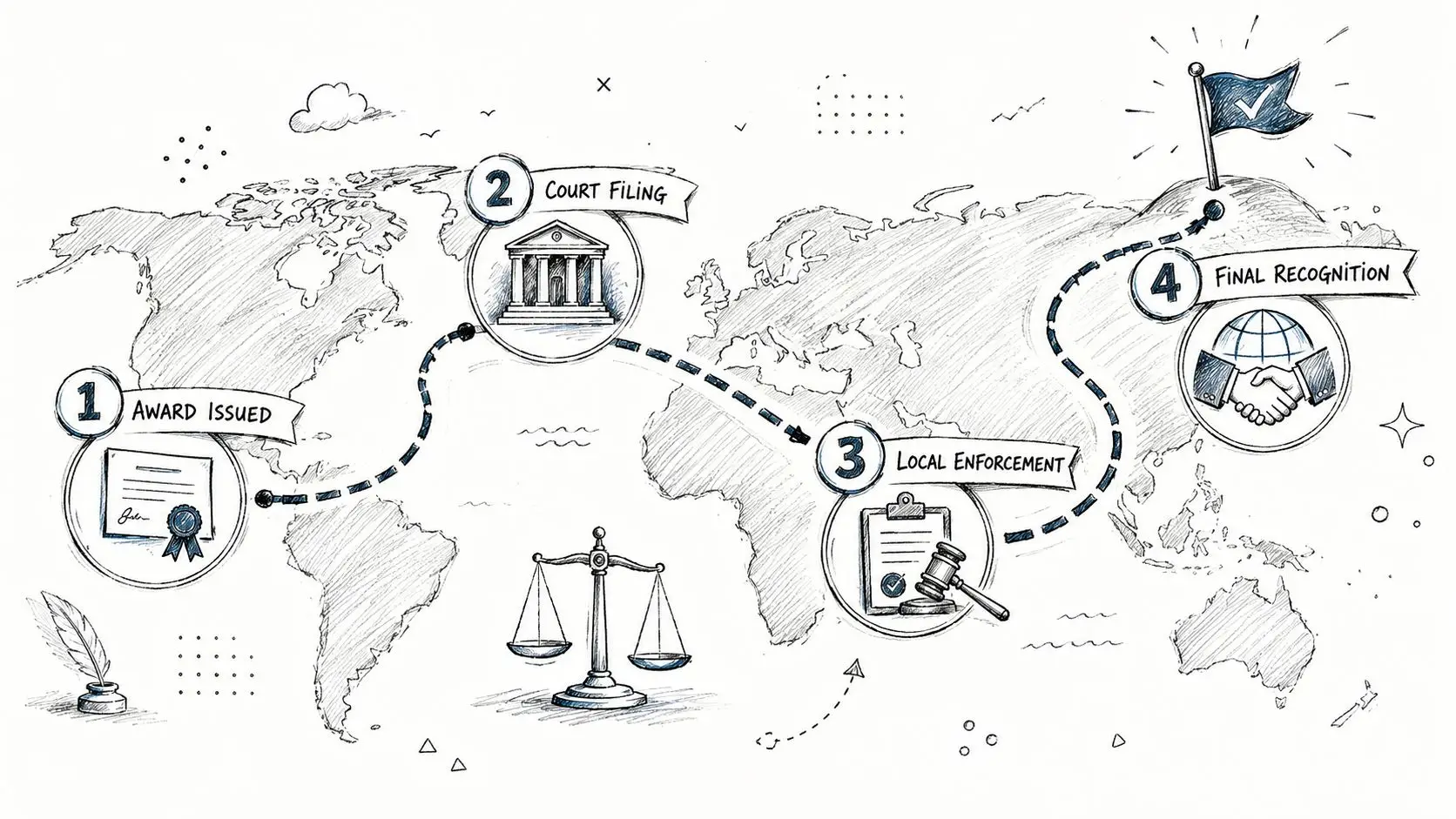
Build the enforcement chain
A practical sequence usually includes:
- Confirm the award: Obtain the authenticated award and any required translations.
- File for recognition: Submit the award to the competent Israeli court with the arbitration agreement and supporting materials.
- Anticipate objections: Address jurisdiction, notice, procedural fairness, excess of mandate, and public-policy arguments.
- Move to execution: After recognition, pursue available measures against identified Israeli assets.
- Coordinate abroad: Instruct local counsel wherever the debtor holds assets outside Israel.
The New York Convention is powerful, but it does not enforce an award automatically. ICCA research reports enforcement of arbitral awards in almost 90% of cases (ICCA enforcement research). The practical conclusion is direct: draft for recognition and collection, not only for success on the merits.
Foreign judgments present a separate risk. Recognition may require a bilateral arrangement or reliance on Israeli domestic principles, followed by disputes over jurisdiction, service, and procedure. Parties should compare that route with arbitration before signing, including the likely asset locations and the courts that can act on them.
Treat public policy carefully
Enforcement courts generally examine the award’s legal and procedural integrity rather than rehearing the dispute. Defects in notice, authority, tribunal composition, or the scope of the submission can nevertheless determine the result. A merits win cannot cure a defective arbitration clause or a process that denied a party a fair opportunity to be heard.
Israel’s International Commercial Arbitration Law, 2024 follows the UNCITRAL Model Law framework for qualifying international commercial arbitrations (Chambers guidance on Israel). Parties should obtain separate advice for investment-treaty awards and state-related disputes. A state-owned counterparty may require a waiver of immunity, and the drafting must distinguish immunity from jurisdiction from immunity from enforcement.
Interim Relief and Crisis-Stage Asset Protection
Interim relief often determines whether enforcement remains meaningful. A tribunal may eventually award damages, but the debtor can defeat recovery by transferring funds, selling property, or moving shares before the award arrives.
Emergency arbitrators under ICC, LCIA, and SIAC rules can provide a rapid procedural route where the arbitration agreement and institutional rules support it. Israeli courts may offer a parallel path when assets or evidence sit locally, particularly where the applicant needs coercive orders against third parties.
Select the forum by the asset
| Relief Type | Forum | Typical Speed | Asset Reach | Ex Parte Available |
|---|---|---|---|---|
| Emergency arbitrator order | Contractual arbitral institution | Rule dependent | Usually directed at parties | Rule and circumstances dependent |
| Preservation order | Israeli court | Urgency dependent | Israeli evidence or assets | Possible where legal requirements are met |
| Worldwide freezing order | Court at a suitable seat | Urgency dependent | Potentially broad, subject to recognition | Possible in appropriate cases |
| Asset tracing | Investigative and court-supported process | Depends on information access | Maps domestic and foreign holdings | Investigation may begin privately |
A Mareva-style order can restrain dissipation, but its effectiveness depends on the issuing court’s jurisdiction and the defendant’s compliance. Foreign parties may ignore an order unless counsel can connect it to local assets, representatives, or enforcement consequences.
The applicant must present credible evidence, explain urgency, and provide the undertaking required by the court. The court may also require disclosure concerning assets, although disclosure orders don’t automatically produce cooperation from an overseas respondent.
Passport surrender and contempt remedies can support compliance in suitable cases. Their practical reach remains limited against parties outside Israel, especially when the order lacks a workable connection to the respondent.
Crisis-stage discipline matters: Preserve evidence and map assets before warning the counterparty if dissipation appears likely.
The recommended strategic path is to coordinate emergency arbitration with Israeli court applications rather than treating them as mutually exclusive. Counsel should avoid duplicative requests, disclose parallel proceedings, and explain precisely which forum can grant which relief.
Contract Clauses and Checklists That Prevent Disputes
A dispute clause should function as an operating system for the crisis. It must tell the parties where to file, how to appoint decision-makers, which language controls, and how the parties can preserve assets before the merits decision.
The core architecture should include:
- Forum selection: Name the court or arbitral institution and state the seat precisely.
- Institutional rules: Consider ICC, LCIA, SIAC, or the Israel Chamber of Commerce rules based on enforcement and administration needs.
- Governing law: Choose substantive law for the agreement and coordinate related guarantees.
- Language: Avoid later disputes over translations, testimony, and evidentiary weight.
- Tribunal composition: Specify the number of arbitrators and appointment process.
- Escalation: Require senior-executive negotiation before formal proceedings, without creating an indefinite condition precedent.
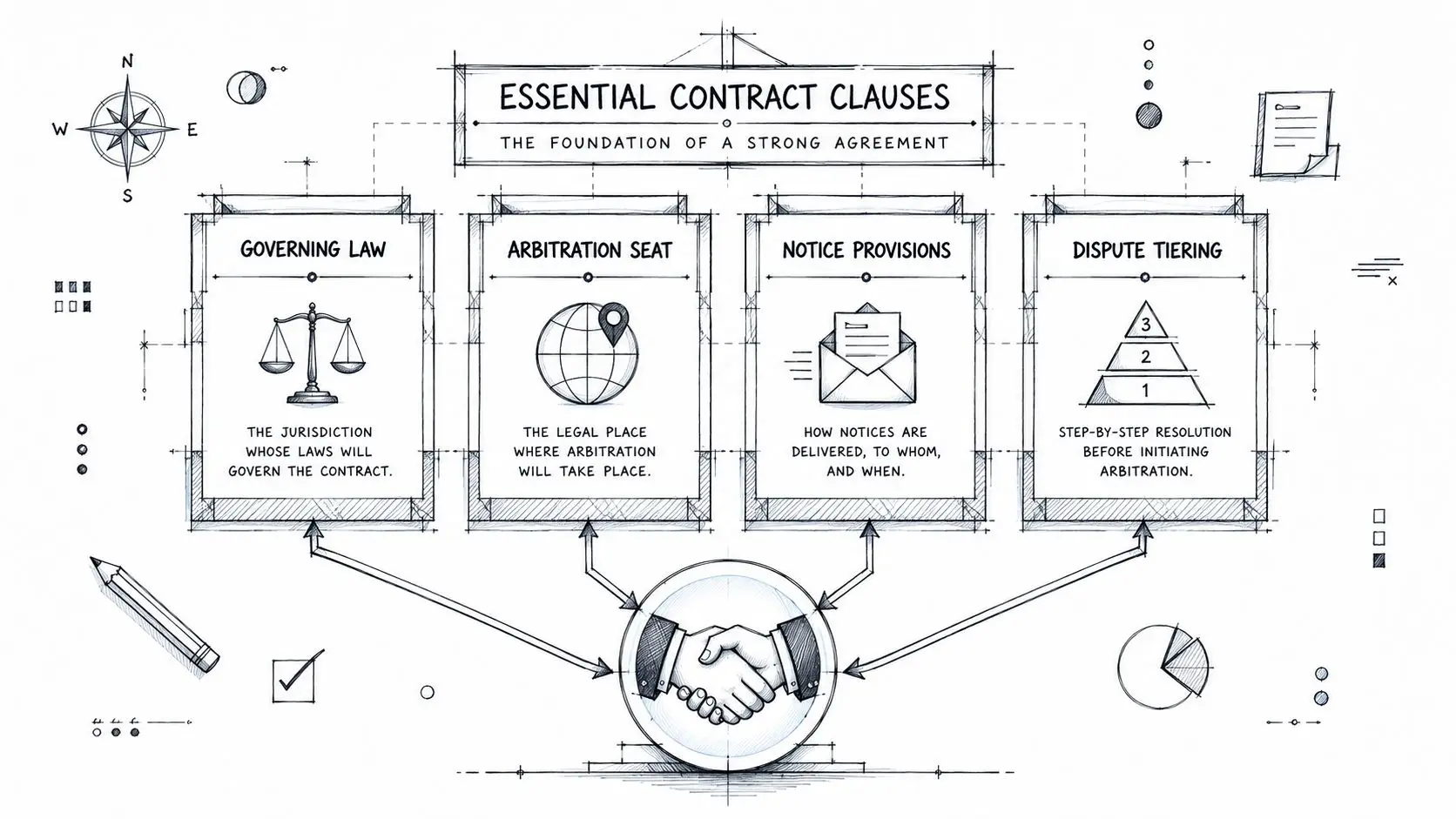
Draft the clauses parties forget
An interim-relief carve-out should preserve access to competent courts. Without it, a party may argue that court applications breach the arbitration promise. The clause should also address emergency arbitrators and the tribunal’s authority to grant protective measures.
State-owned counterparties require a custom immunity waiver. Counsel should cover both jurisdiction and enforcement, then examine whether local law limits the waiver’s effect.
Fee-shifting language deserves equal attention. The parties should understand how the chosen seat treats costs and whether the agreement can alter the default allocation. Notice provisions should survive mergers, assignments, and changes of control, because a valid notice can fail if the contract recognizes only an obsolete address.
A pre-signing checklist for an Israeli company expanding abroad should verify the counterparty, its ownership, and its asset footprint. It should also test sanctions, force majeure, language, and service provisions against the actual jurisdictions involved. RNC Group handles international commercial litigation and cross-border crisis coordination, including matters requiring Israeli and foreign representation.
Phased Escalation and Crisis Management Playbook
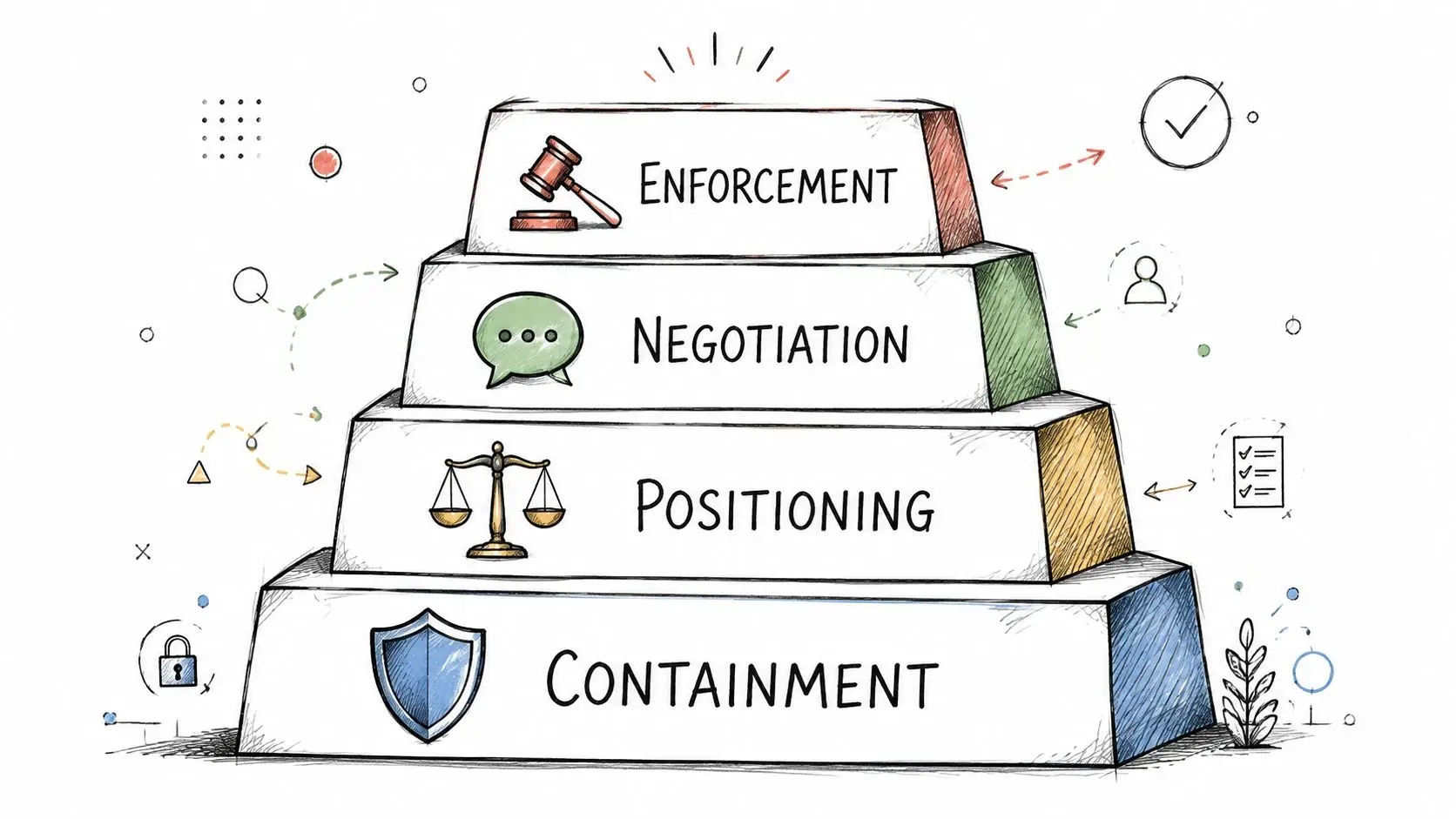
A serious dispute needs sequencing, not instinctive escalation. The recommended model uses four phases, each with a clear trigger for the next decision.
Phase one focuses on operational containment
The company should protect cash, suspend unauthorized performance, preserve communications, and identify personnel with relevant knowledge. Management shouldn’t make admissions in routine emails or allow employees to delete messages after a dispute becomes reasonably foreseeable.
The legal team should then secure the contract set, amendments, invoices, delivery records, board materials, and communications with the counterparty. Counsel should issue a targeted document hold and identify custodians across jurisdictions.
Phase two establishes legal positioning
Counsel should test jurisdiction, limitation periods, notice requirements, security rights, and available interim measures. A calibrated demand should identify the breach, required cure, reservation of rights, and proposed negotiation channel.
The company should also prepare a confidential asset map. If reputational harm threatens revenue, communication planning should run beside legal strategy. Guidance on Press Release Zen brand protection can help counsel coordinate public messaging without compromising privilege or litigation posture.
Phase three creates a controlled negotiation window
Senior executives should negotiate with defined authority, documented concessions, and a deadline. Mediation may suit a relationship that remains commercially valuable. However, negotiation shouldn’t delay urgent relief where the counterparty may dissipate assets.
Phase four pivots toward enforcement
The company should file when the negotiation window closes, evidence deteriorates, or assets move. Counsel should choose between emergency arbitration, Israeli court relief, and merits proceedings based on the location of assets and the authority each forum can exercise.
A practical timetable helps general counsel maintain control:
- First 30 days: Preserve evidence, verify the clause, map entities and assets, and assess urgent relief.
- Next 60 days: Send the demand, conduct executive negotiations, prepare pleadings, and coordinate foreign counsel.
- By 90 days: Decide whether to file, mediate, seek emergency measures, or execute a documented settlement.
The timetable isn’t rigid. It creates accountability and prevents the legal team from confusing activity with progress.
RNC Group offers cross-border representation, international commercial litigation, and crisis management coordination for Israeli and foreign businesses facing disputes involving Israel. Businesses should review their dispute clauses, asset exposure, and enforcement options with RNC Group before a commercial conflict turns into an irreversible loss.
This article provides general information, not legal advice. The applicable outcome depends on the contract, facts, jurisdictions, procedural posture, and current law, so readers shouldn’t rely on this material without obtaining advice regarding their specific circumstances.