
An Israeli exporter launches a connected device in the United States. The design team sits in Tel Aviv, the battery supplier sits in Asia, the distributor sits in New Jersey, and the injury report lands on a general counsel’s desk before sunrise. The first mistake is usually legal framing. The second mistake is operational delay.
Most discussions of product liability cases still treat them as domestic defect disputes. That misses the main pressure point for multinational businesses. In practice, the hardest questions often concern jurisdiction, evidence control, recall discipline, insurance structure, and coordinated crisis management across borders.
Your 2026 Global Supply Chain Under Scrutiny
What happens in 2026 when an Israeli exporter faces an injury complaint in the United States, but the relevant product passed through four countries before sale?
That question matters because product liability isn’t a rare, headline-only event. Filing data cited in an Insurance Canopy analysis of product liability litigation trends shows claims increased from 43,567 in 2018 to 56,041 in 2019, a 28.63% year-over-year rise. The same analysis reports 3,342 product-liability cases in 2013 versus 5,826 in 2022, which reflects roughly 74% growth over that period.
For multinational companies, that trend changes the planning model. The exposure no longer sits only in catastrophic failures, mass recalls, or medical-device litigation. It sits in ordinary product lines, repeated filings, and uneven legal pressure across jurisdictions.
Why exporters misread the risk
Many executives still assume the main question is whether the product was defective. That comes later. A plaintiff’s lawyer first asks where to sue, which entity to name, what evidence exists, and whether internal documents support a warning claim.
A cross-border product claim therefore behaves like a business systems test. It tests distribution contracts, labeling control, customer support logs, engineering change records, insurance wording, and board-level escalation discipline.
Practical rule: In cross-border product liability cases, the company that controls the paper trail usually controls the early narrative.
What a disciplined company does differently
A disciplined exporter treats product risk as part of market entry, not just claims response. That means legal and operational teams align before the first incident.
Key measures include:
- Map the chain of distribution: Identify every manufacturer, assembler, importer, wholesaler, and retailer before a claim appears.
- Control product records: Keep design files, testing records, warnings, manuals, and packaging versions in a retrievable system.
- Pre-plan incident response: Decide who preserves the product, who speaks to regulators, and who handles insurers.
- Localize strategy: A U.S. claim against an Israeli business often turns on American procedural rules, even when the product was built elsewhere.
Understanding the Three Pillars of a Claim
A product claim usually arrives dressed in familiar language, but the legal theory underneath shapes the defense. Three pillars appear repeatedly in product liability cases. They are strict liability, negligence, and breach of warranty.
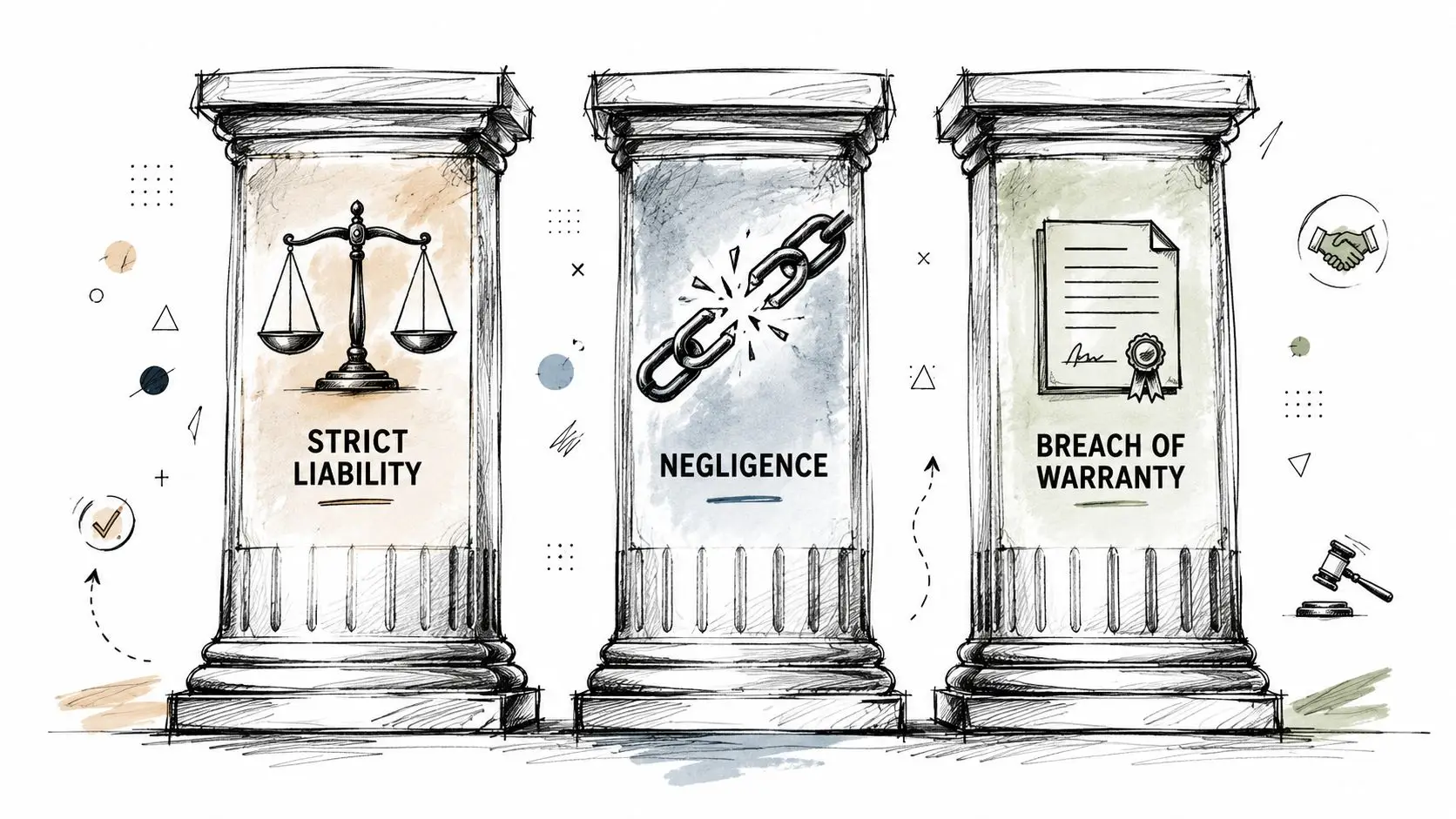
Take a single example. A smart home device overheats and allegedly causes injury. The same event can support three different claims, each with a different proof path.
Strict liability
Strict liability focuses on the condition of the product. The plaintiff argues the device reached the market in a defective state. Intent usually doesn’t drive this theory.
That makes strict liability dangerous for exporters who believe good corporate behavior alone will carry the day. A company may have acted responsibly and still face a hard fight if the product, warning, or manufacturing outcome appears defective.
A strict-liability claim usually pushes the parties into three familiar categories:
- Design defect: The product line itself carries an unsafe feature.
- Manufacturing defect: A particular unit departed from intended specifications.
- Warning defect: The product lacked adequate instructions or warnings.
Negligence
Negligence looks at conduct rather than condition. The plaintiff asks what the company knew, what it should have tested, how it reviewed complaints, and whether it responded reasonably to known risks.
That inquiry often reaches deeper into internal communications. Engineering sign-offs, supplier audits, complaint escalation emails, and launch approvals become central. For that reason, negligence claims often create broader discovery pressure than business teams expect.
A clean engineering process doesn’t guarantee victory. However, a weak engineering process almost guarantees leverage for the other side.
Breach of warranty
Warranty claims turn on promises. Some promises appear in marketing copy, technical specifications, manuals, distributor representations, or packaging language. Others arise by law as implied expectations about merchantability or fitness.
This theory catches companies that let commercial teams overstate performance or safety. A polished sales deck can become litigation evidence if it reads like a guarantee.
A simple comparison
| Theory | Core question | Main business risk |
|---|---|---|
| Strict liability | Was the product defective? | Product condition and warning adequacy |
| Negligence | Did the company act reasonably? | Internal process and decision-making records |
| Breach of warranty | Did the product match the promise? | Marketing, manuals, and contractual language |
Executives don’t need to master doctrinal nuance. They do need to identify which pillar drives the claim, because each one changes document retention, expert strategy, and settlement posture.
The Critical Battlefield of Jurisdiction
In cross-border product liability cases, the first decisive battle often has nothing to do with defect analysis. It concerns forum. Where can the plaintiff sue, and where can the defendant resist?
That issue has become more difficult for international companies. A Baker Sterchi review of product liability developments notes that the U.S. Supreme Court’s Mallory v. Norfolk Southern decision expanded litigation risk by making corporate registration a potential basis for general personal jurisdiction in some states. For companies registered to do business in the United States, that development has intensified venue fights.

Why jurisdiction changes everything
Jurisdiction isn’t a procedural side issue. It affects defense cost, discovery burden, motion practice, jury pool, settlement pressure, and timing. It also affects whether a plaintiff can pull multiple entities into one court, even when manufacturing, design, and sales took place in different countries.
For Israeli exporters, this creates a recurring problem. The business may think of itself as a foreign designer or upstream supplier. The plaintiff may frame it as part of a U.S. distribution system with enough registration, sales activity, or channel integration to justify suit in a preferred forum.
The supply-chain trap
A cross-border claim often involves several actors:
- Original designer in Israel
- Component manufacturer in Asia
- Assembler in another jurisdiction
- Importer or distributor in the United States
- Retail seller or platform operator
Each actor may have a different contract, different indemnity language, and different evidence access. Plaintiffs exploit those seams. They plead broadly, force the defendants to blame one another, and seek a court that tolerates that complexity.
A company that hasn’t mapped those relationships in advance usually loses time at the worst moment. It struggles to identify who controlled warnings, who approved design changes, and who owns complaint data. Jurisdiction fights then become harder because the factual record is fragmented.
The court decides forum before it decides fault. Businesses that ignore that sequence often spend heavily before reaching the merits.
Forum selection and registration strategy
Corporate registration decisions now deserve board-level attention. In some structures, a company registers in multiple states for ordinary business reasons without fully evaluating litigation consequences. That may widen forum exposure.
The analysis should include more than corporate formalities. It should also cover distribution geography, warehousing arrangements, after-sales support, and how the business presents itself online. A website, warranty portal, or replacement program can complicate a clean jurisdictional defense if it shows directed U.S. activity.
A useful internal review asks five questions:
- Which entities are registered in U.S. states, and why?
- Which entity appears on packaging, manuals, and warranties?
- Who receives customer complaints and adverse event reports?
- Where do replacement parts, returns, and service decisions flow?
- Which contracts govern forum, indemnity, and evidence cooperation?
Cross-border evidence and contract friction
Jurisdiction disputes often collide with evidence logistics. The documents may sit in Israel. The component files may sit with a foreign supplier. Testing records may sit with a third-party laboratory. Language barriers then create delay, and delay creates adverse inference risk.
At the same time, supply agreements often fail where they matter most. They may allocate price and delivery with precision, yet say little about litigation cooperation, sample retention, expert access, or coordinated defense obligations.
For that reason, jurisdiction strategy begins long before a lawsuit. It begins in entity planning, contract drafting, and product labeling architecture. By the time the complaint arrives, the strategic room to maneuver may already be narrow.
Navigating the Complex Litigation Process
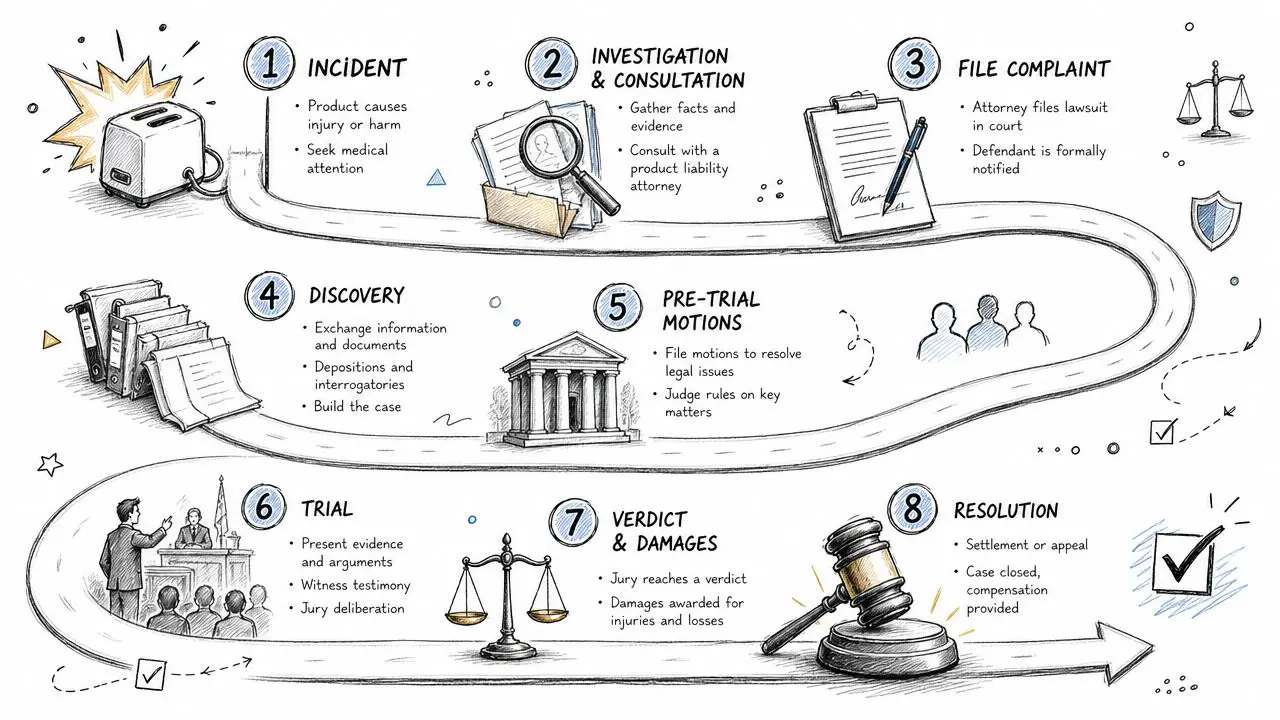
A serious product claim unfolds in stages, but the earliest hours often matter most. The company receives an incident report, demand letter, insurer notice, or regulatory inquiry. Someone then makes a choice that will shape the case. Preserve aggressively, or treat the matter as an ordinary complaint.
That choice carries major financial consequences. A Miller & Zois summary of product liability verdict and settlement data reports a $3,000,000 median compensatory award for transportation product-liability cases and an overall median jury award of $1,531,961 across product-liability cases. The same source notes a $6.01 billion resolution involving 3M earplug claims, which shows how individual allegations can mature into enterprise-level exposure.
The opening phase
The strongest legal teams treat the first incident as an evidence event. They secure the actual product, obtain an exemplar if needed, preserve packaging and manuals, and freeze internal document destruction.
That approach tracks a core litigation reality discussed in an ER Trial Lawyers analysis of assessment and discovery strategy in strict products liability cases. Plaintiffs must separate defect theory from causation, and expert witnesses are commonly required because jurors can’t evaluate engineering, manufacturing, or medical issues without specialized analysis. Once the product is altered, discarded, or mixed with other evidence, proving or disproving the defect mechanism becomes much harder.
A practical timeline
A typical case for an international company often looks like this:
- Incident report arrives: Customer service or distributor flags an injury claim.
- Preservation notice goes out: The company locks down product samples, complaint files, and engineering records.
- Insurers and counterparties receive notice: Coverage and indemnity rights need immediate protection.
- Experts inspect early: Engineers, warnings experts, or medical experts begin reviewing the product and injury pathway.
- Complaint gets filed: Jurisdiction and pleading attacks become the first contested issues.
- Discovery expands: Plaintiffs demand testing files, supplier communications, complaint history, and marketing materials.
- Expert battles intensify: Causation opinions often decide whether the case survives.
- Settlement or trial pressure rises: Trial dates, exclusion motions, and venue realities shape resolution value.
Executives who haven’t lived through this cycle often underestimate the burden of discovery. Cross-border cases add translation, data export, foreign vendor coordination, and internal privilege management. For teams that need a broader comparative perspective on court process, Lighthouse Consultants explain disputes in a way that helps non-litigators understand how procedural choices affect business outcomes.
Preserve first. Explain later. A company can recover from an awkward early email. It rarely recovers from a missing product sample.
What works and what fails
What works is disciplined speed. Counsel identifies the right entity structure, preserves evidence before routine handling destroys it, and engages experts before discovery locks the case into the plaintiff’s narrative.
What fails is scattered internal response. Sales speaks to the customer, engineering runs informal tests, the distributor returns a unit to stock, and no one captures chain of custody. By the time litigation counsel enters, the fact record has already drifted.
Building a Resilient Defense Strategy
The weakest defense starts with a single sentence. “Our product wasn’t defective.” That argument may be right, but it often arrives too late and too narrow.
In many product liability cases, the better defense attacks the claim before the defect debate fully matures. A Cozen O’Connor discussion of defenses in product liability claims highlights three recurring pressure points. They are misuse, post-sale modification, and federal preemption.
Misuse can narrow or end the case
Misuse doesn’t mean the user acted irrationally. It means the product was used in a way the defense can frame as abnormal, unintended, or outside the warning structure. That distinction matters because many plaintiffs will argue the use was still foreseeable.
The practical fight therefore centers on evidence. What did the instructions say, what did the packaging show, what was altered in the field, and what usage pattern occurred? In battery-driven and vaping disputes, that factual sequence often matters more than abstract defect labels.
Modification breaks causation chains
Substantial post-sale modification can be one of the most effective defenses in cross-border claims. Importers, service providers, resellers, or end users may replace components, alter housings, swap chargers, translate labels badly, or remove safety features.
Those changes can transform the causation story. The company no longer argues only that the original product was sound. It argues that the product involved in the incident was no longer the product it sold.
A strong modification defense usually depends on four records:
- Original specifications and approved components
- Chain-of-custody evidence for the incident product
- Service, repair, or retrofit history
- Photographs, packaging, and warning materials from sale and post-sale stages
Preemption can block the claim at the threshold
For heavily regulated products, federal preemption may do more than narrow issues. It may block certain state-law theories entirely. This defense requires technical legal analysis, but the strategic point is simple. If federal law governed warning language, design controls, or approval structure, a state tort claim may not proceed in the form the plaintiff wants.
That makes regulatory records essential. A company can’t invoke preemption credibly if it treated compliance as an afterthought or if it cannot prove the regulatory path it followed.
A disciplined defense asks first which claims should never reach the jury.
Commercial discipline supports litigation defense
These defenses don’t live only in court papers. They start in product governance, channel control, and compliance design. Businesses that police reseller behavior, document approved configurations, and maintain coherent warnings create cleaner defenses later.
That same logic appears in adjacent compliance-heavy sectors. Businesses that safeguard your firearms eCommerce business usually build controls around restricted items, shipping limits, and documented handling rules. Product-risk planning benefits from that same level of operational rigor, even when the product category differs.
The Israeli Exporters Risk Mitigation Playbook
Israeli exporters often enter foreign markets with strong engineering and fast execution. Those strengths help at launch. They don’t, by themselves, control product risk after an incident.
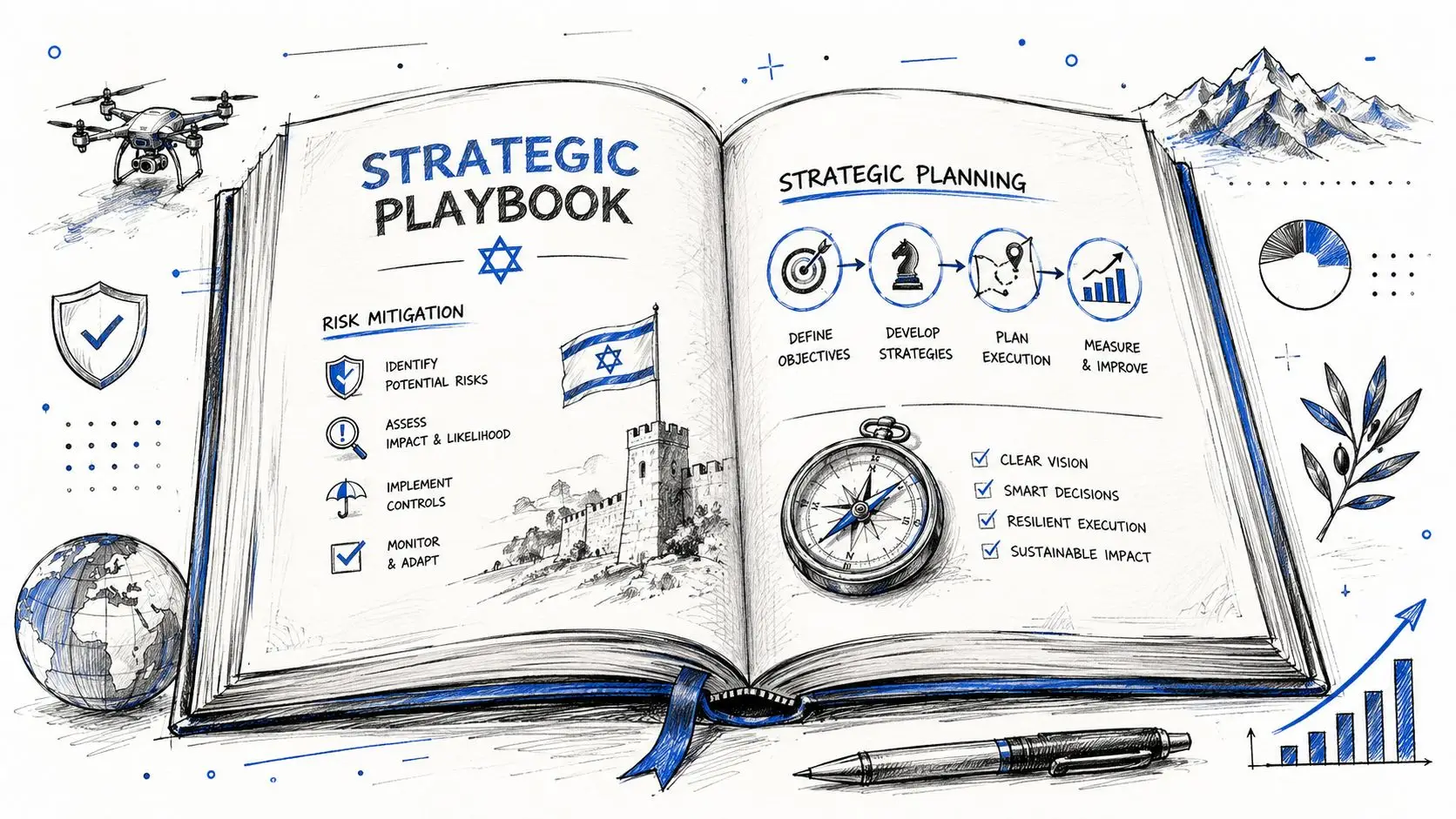
The more reliable approach is a structured playbook that combines legal, operational, insurance, and communications controls. The goal isn’t to eliminate every claim. The goal is to preserve choice when a claim arrives.
Regulatory compliance and documentation
Most cross-border cases get harder because the records don’t travel with the product. Manuals change by market, suppliers revise components unannounced, and complaint logs sit in separate systems.
A strong compliance file should include:
- Version control: Keep dated copies of manuals, packaging, warnings, and technical specifications for each market.
- Supplier discipline: Require notice of component changes, test deviations, and subcontractor shifts.
- Complaint escalation: Route injury allegations, overheating reports, electrical faults, and near misses into one legal review path.
- Language integrity: Review translated warnings and instructions with legal and technical oversight.
For many international companies, contract architecture is where this discipline begins. Market-entry arrangements, distribution terms, and service obligations should fit the product’s risk profile. A careful review of commercial agreements in Israel helps frame how documentation and allocation of responsibility should work before a dispute begins.
Recall readiness and incident control
A recall plan that exists only on paper won’t hold under pressure. Companies need a named decision group, a product quarantine process, draft notice templates, insurer notice triggers, and a tested collection method for affected units.
The first internal checklist should answer these questions:
| Control point | Immediate question |
|---|---|
| Product hold | Who can stop further shipment today? |
| Incident intake | Which team owns incoming injury reports? |
| Evidence handling | Who preserves the product and packaging? |
| Regulator interface | Who approves communications with authorities? |
| Distributor coordination | Which contract forces cooperation and returns? |
Companies also benefit from a wider operational view of risk staging. A practical guide to managing organizational risks can help leadership teams align escalation steps before a crisis forces improvisation.
Insurance and contractual risk transfer
Insurance often disappoints when the placement process ignored cross-border realities. A policy may exist, yet key disputes arise over named insureds, territory, additional insured status, notice timing, vendor endorsements, or recall-related costs.
Contractual indemnities matter just as much. However, many supply contracts use broad language that sounds protective and performs poorly when a lawsuit starts. The better approach is to stress-test indemnity wording against real scenarios, including foreign component failure, warning translation errors, and distributor-side modification.
That review should sit alongside broader structuring work. Companies operating through joint ventures, local subsidiaries, or commercial alliances should also examine corporate and company formation strategy in Israel so the right entity, governance model, and signature authority support the risk plan.
Crisis communications and business continuity
Product incidents rarely stay confined to legal channels. Customers post images online. Distributors call for guidance. Payment providers and banks ask questions. Internal teams circulate incomplete facts.
The communications response should therefore run on two tracks. One track handles legal preservation and privilege. The other handles controlled external messaging.
Recommended actions include:
- Centralize statement approval: No distributor, employee, or reseller should improvise safety language.
- Separate empathy from admission: Acknowledge concern without speculating on defect or blame.
- Protect banking and operations: A serious dispute can trigger commercial disruption, especially if counterparties freeze payments or tighten controls.
- Use formal legal correspondence early: Precise notice letters often shape evidence access and cooperation.
When the commercial side of the crisis spreads, legal process must stay coordinated. That is why businesses facing distributor conflict, blocked funds, or deteriorating counterpart relations often need structured legal correspondence and demand letter strategy in Israel as part of the response. In parallel, companies exposed to payment friction or reputational fallout may also need to understand the operational implications of bank account restrictions in Israel.
Fast communication isn’t the goal. Controlled communication is the goal.
The board-level view
A useful board discussion doesn’t start with abstract liability law. It starts with operational control.
Ask:
- Can the company identify every market-specific warning version?
- Can it retrieve the incident product and preserve chain of custody?
- Can it force supplier cooperation across borders?
- Can it notify insurers without damaging coverage?
- Can it communicate publicly without undermining the defense?
If the answer to any of those questions is uncertain, the company doesn’t have a product liability plan yet. It has a hope.
From Defense to Dominance in Global Markets
By 2026, global product risk will reward disciplined operators and expose loose structures. The decisive companies won’t treat product liability cases as isolated lawsuits. They’ll treat them as stress tests of governance, contract design, supply-chain control, and crisis execution.
That shift matters especially for Israeli exporters and multinationals with Israel-linked operations. Cross-border exposure doesn’t forgive fragmented records, casual registration decisions, weak indemnities, or ad hoc public statements. A company that aligns legal, technical, insurance, and communications functions early retains its advantage when the claim turns hostile.
The recommended strategic path is simple in concept and demanding in practice. Build the file before the incident. Control the forum where possible. Preserve the product immediately. Test defenses that can end the case early. And run the crisis with the same precision used for market entry.
Avoid costly mistakes and contact RNC Group now through its contact page to discuss a cross-border product liability risk strategy specific to your business.
This article provides general information only and doesn’t constitute legal advice. Reliance on this article without obtaining advice on the specific facts, jurisdictions, contracts, and regulatory framework involved may expose the reader to significant legal and commercial risk.