
A judgment doesn’t pay itself. In cross-border disputes, that gap matters more in 2026 than most boards expect.
Many international companies still treat the execution of judgments as a clerical tail-end to litigation. That’s the wrong model. The verdict settles liability. The enforcement phase determines whether the company recovers cash, gains an advantage, or watches the debtor reorganize the asset map before anyone moves.
For non-Israeli businesses with exposure to Israel, this distinction is operational, not academic. A delayed enforcement plan can weaken settlement position, complicate banking relationships, and turn a legal win into an expensive paper asset.
The Post-Verdict Reality for Global Companies
Winning in court answers one question. Can the creditor recover?
That question usually surfaces too late. By the time management asks where the debtor’s money sits, who controls the subsidiaries, or whether key receivables have already moved, the debtor has often gained the initiative. Savvy defendants know the space between judgment and execution is where creditor discipline gets tested.
Why paper victories fail
A judgment is a legal right. It isn’t automatic payment, and it isn’t operational control. The creditor still needs to identify reachable assets, choose the right forum, and apply pressure before the debtor restructures holdings or creates procedural friction.
For global companies, the risk is sharper. Assets may sit in several jurisdictions, ownership may run through layered entities, and the commercial relationship may continue even after the court fight ends. That means enforcement isn’t only about collection. It also affects supply continuity, partner behavior, lender confidence, and negotiation power.
Practical rule: The real contest starts when the debtor understands the creditor is serious about collection, not when the judge signs the order.
Control beats optimism
Boards often assume the strongest judgment wins. In practice, the better enforcement strategy usually wins. A creditor that maps assets early, preserves optionality, and sequences pressure points can change the outcome without waiting for perfect information.
A passive creditor usually does the opposite. It sends demands, waits for voluntary payment, and treats execution as an administrative filing exercise. That approach gives the debtor time, and time is often the debtor’s best asset.
Three habits consistently improve position:
- Move fast on intelligence: Identify bank exposure, commercial counterparties, movable assets, and property interests before warning the debtor through slow correspondence.
- Separate strategic advantage from emotion: A creditor should pursue the asset path that works, not the path that feels most satisfying.
- Treat execution as part of the dispute strategy: Enforcement should align with broader issues such as shareholder conflict, banking pressure, and reputational containment.
This matters in Israel because local enforcement mechanics can be effective, but only if counsel ties procedure to a broader commercial objective. The legal file is one front in a larger conflict.
Understanding the Legal Foundation of Enforcement
Before a creditor can seize anything, it needs an enforceable instrument and a procedure that fits the forum. That sounds basic. It isn’t.
A useful analogy helps. The judgment is the architectural plan. The enforcement mechanism is the machinery that turns that plan into a structure on the ground. Confusing the two leads to delay, defective filings, and wasted motion.
Finality matters before force does
A creditor first needs to know whether the decision is final enough for enforcement in the relevant system. If appeals remain open, stays exist, or the order isn’t yet in executable form, pressure tools may be narrower than expected.
That point becomes critical in cross-border matters. The originating court may regard the dispute as finished, while the enforcing court still asks whether the judgment is conclusive, properly authenticated, and procedurally fit for recognition.
Procedure can be hybrid
International executives often expect one clear national rulebook. Post-judgment enforcement doesn’t always work that way.
In U.S. federal practice, a money judgment is enforced by a writ of execution, but the procedure on execution generally follows the procedure of the state where the court sits unless a federal statute controls, as set out in Federal Rule of Civil Procedure 69. That hybrid structure matters because the federal judgment gives the authority, while state procedure often supplies the mechanics for seizure, discovery, and collection.
A strong judgment with the wrong enforcement procedure can stall just as effectively as a weak judgment.
This is also why compliance teams should distinguish aggressive recovery from unlawful collection conduct. For consumer-facing operations and regulated communication environments, resources on compliance in collections with FDCPA can help frame the boundary between pressure and exposure, even where the immediate dispute sits outside classic consumer debt practice.
Enforcement power comes from process
Executives tend to focus on the amount awarded. Enforcement counsel should focus on reach. Which court can issue executable measures. Which assets can be touched. Which third parties can be compelled to answer. Which objections the debtor can still raise.
Those questions define the practical value of the judgment. Once they’re answered correctly, the creditor can start using execution of judgments as a control tool rather than treating it as a back-office formality.
Domestic Enforcement Mechanisms in Israel
Inside Israel, the available enforcement tools are only useful if the creditor chooses the right one for the debtor’s asset profile. A bank-centric business requires one sequence. A real-estate-heavy debtor requires another. An operating company with active receivables and leased equipment may require both immediate and staged pressure.
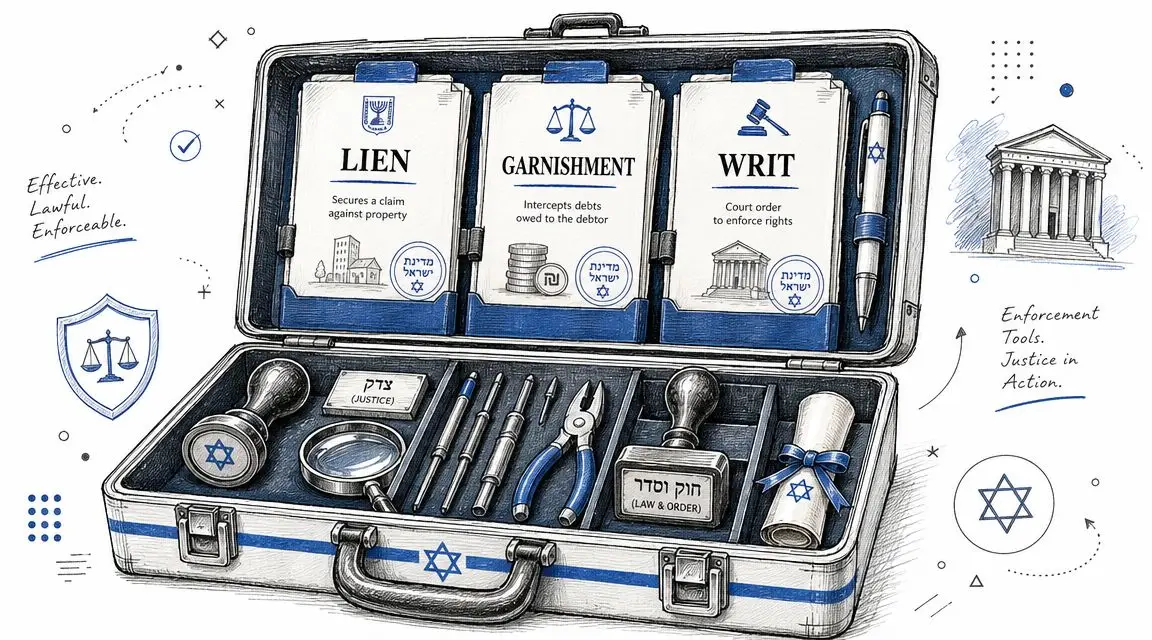
Bank-focused enforcement
If the debtor keeps material liquidity in Israeli accounts, account garnishment is often the fastest pressure point. It can interrupt normal operations immediately and force management attention where demand letters did nothing.
This tool works best when the creditor already has reason to believe the debtor uses identifiable banks and maintains active account balances. It works less well when the debtor operates through multiple entities, foreign payment rails, or nominee arrangements that split cash flow.
A related issue appears when banking restrictions are already part of the broader conflict. In those situations, legal and operational consequences can intersect quickly, especially where bank account blockages affect the debtor’s ability to transact, payroll, or preserve supplier confidence.
Asset seizure and liens
Not every debtor is cash-rich. Some are asset-rich and liquidity-poor. That changes the playbook.
A creditor may target movable assets such as vehicles, inventory, or certain equipment when those assets create business interruption or resale value. Seizing visible operating assets can create immediate pressure, but it may also reduce the debtor’s ability to generate cash for settlement. That trade-off needs active management.
Liens on real property often serve a different purpose. They usually don’t deliver instant recovery, but they can block refinancing, sale activity, and clean title transfers. For debtors who care about long-term asset flexibility, a property-based strategy can be more effective than repeated demands for immediate payment.
Freezing logic and timing
The strongest domestic enforcement campaigns usually combine information with speed. If the creditor waits until after prolonged warning letters, the debtor may have already moved inventory, redirected receivables, or re-papered intercompany claims.
A more effective pattern often includes:
- Immediate asset mapping: Identify which assets are liquid, which are visible, and which matter to the debtor’s business continuity.
- Targeted first strike: Start with the tool most likely to produce either payment or fast negotiation advantage.
- Parallel pressure: Use more than one lawful route when the debtor’s structure suggests easy evasion.
Board-level point: The best enforcement step isn’t always the one that recovers first. It’s often the one that changes the debtor’s incentives fastest.
What usually works and what usually doesn’t
Some methods produce noise but little value. Others create quiet advantage.
| Tool | Often works when | Usually disappoints when |
|---|---|---|
| Bank garnishment | The debtor runs active Israeli banking operations | Cash is already routed elsewhere |
| Seizure of movable assets | Assets are operationally important and visible | Assets are encumbered, low-value, or hard to locate |
| Property lien | The debtor needs financing, sale flexibility, or clean title | The debtor holds no meaningful real property interest |
| Freezing-style relief | The creditor acts before dissipation | The creditor delays and alerts the debtor too early |
The common mistake is procedural literalism. Creditors sometimes ask which remedy exists. The better question is which remedy changes behavior. In execution of judgments, influence often matters before liquidation does.
Enforcing Foreign Judgments in Israeli Courts
A foreign judgment doesn’t walk into Israel with automatic force. It usually needs recognition and enforceability through the Israeli legal system before domestic execution tools become available.
That reality surprises many international companies. They may have already won in New York, London, or another major forum, yet they still face a second legal front in Israel. The issue isn’t relitigating the commercial merits. The issue is whether the Israeli court will treat the foreign judgment as fit for local enforcement.
What Israeli courts typically examine
The court usually looks at core threshold issues. Was the original court competent under the relevant standards. Is the judgment final and enforceable in its home forum. Does enforcement offend Israeli public policy. Were basic procedural fairness requirements met.
Those questions sound formal. They are strategic. A debtor that can’t reverse the underlying result may still attack jurisdiction, service, finality, or public policy to slow recognition and improve settlement terms.
Cross-border planning is therefore essential. If the original proceedings produced a strong liability decision but left procedural vulnerabilities, the creditor may carry those vulnerabilities into Israel. If mishandled, the enforcement dispute can escalate into a broader corporate crisis involving counterparties, lenders, or shareholders.
Scale matters in cross-border enforcement
The broader European experience shows how large and persistent judgment execution can become. The execution of judgments by the European Court of Human Rights became a large-scale supervision process, with 1,379 new judgments forwarded for execution supervision in 2021, a 40% increase from 2020, and 5,533 judgments under supervision at year-end, according to analysis of the Committee of Ministers’ 2021 supervision data.
That example isn’t about Israeli procedure. It does show an important commercial point. Enforcement systems can carry significant volume and still leave creditors dealing with long-running supervision, compliance friction, and staggered implementation.
Foreign Judgment Enforcement in Israel A Snapshot
| Factor | Typical UK Judgment | Typical US (e.g., New York) Judgment |
|---|---|---|
| Starting point | No direct self-executing force in Israel | No direct self-executing force in Israel |
| Core court inquiry | Finality, jurisdiction, fairness, public policy | Finality, jurisdiction, fairness, public policy |
| Typical friction point | Scope of finality and procedural posture | Service, jurisdiction, and record completeness |
| Strategic concern | Fast conversion into Israeli enforcement measures | Managing debtor delay during recognition stage |
Cross-border creditors should treat recognition as an opening move, not a clerical filing.
What international creditors should expect
The practical challenge isn’t only legal doctrine. It’s sequencing. If the creditor files in Israel before it has a coherent asset theory, it may win recognition yet still lose time. If it waits too long for perfect intelligence, the debtor may restructure its Israeli footprint.
The stronger approach usually combines two tracks. One track prepares the Israeli recognition file with careful attention to finality, jurisdiction, and evidentiary completeness. The other track develops a realistic asset map inside Israel so execution can start quickly once the court opens the door.
Strategic Options and Common Pitfalls
Execution of judgments isn’t won by paperwork alone. It’s won by pressure, information, and timing.
That’s especially true when the debtor uses layered ownership, affiliate transfers, offshore holding structures, or politically sensitive assets. In those matters, a passive creditor gives the debtor too many choices. An active creditor narrows them.
The intelligence-led model
The most effective creditors don’t begin with forms. They begin with a theory of recoverability. Which entities hold value. Which assets are protected. Which counterparties can reveal cash movement. Which pressure points matter most to management.
That approach aligns with a key reality identified in discussion of execution against foreign sovereign assets located abroad. Execution success often depends less on the judgment itself and more on asset structure, disclosure advantage, and speed of action. The same discussion notes that U.S. law gives foreign states immunity from execution, yet courts have allowed broad discovery into sovereign assets abroad, creating tension between locating assets and seizing them.
For corporate creditors, the lesson is broader than sovereign immunity. Locating assets and reaching assets are different problems. Good strategy treats them separately.
Common strategic errors
Many enforcement failures come from habits that feel reasonable in-house but weaken legal position.
- Overwarning the debtor: Repeated pre-enforcement threats often encourage asset movement instead of payment.
- Assuming ownership equals accessibility: A shareholding, partnership interest, or LLC position may be harder to execute against than expected.
- Confusing discovery with recovery: Knowing where value sits helps, but some assets remain shielded, encumbered, or procedurally difficult to seize.
- Using one jurisdiction at a time: Resourceful debtors exploit gaps between forums. Creditors should evaluate parallel pressure where lawful and commercially sensible.
Don’t ask only whether the debtor has assets. Ask whether those assets can be reached, restrained, or made commercially inconvenient to ignore.
Leverage often beats liquidation
The strongest move is not always a forced sale. Sometimes it’s an injunction, third-party discovery, or a narrowly targeted execution step that threatens financing, vendor confidence, or pending transactions.
That’s why enforcement should sit next to settlement strategy, not after it. A debtor facing credible account pressure, disclosure exposure, and property interference often negotiates differently from a debtor receiving routine collection notices.
The practical ranking usually looks like this:
- Fast intelligence
- Lawful interim pressure
- Targeted execution
- Negotiated monetization
Creditors who reverse that order often spend more and recover less.
A Creditor’s Workflow for International Execution
A disciplined workflow reduces missed opportunities. It also keeps legal teams, finance teams, and management aligned when pressure increases across jurisdictions.
The value of system matters. In the ECtHR context, a major milestone came in 2017, when pending cases under supervision fell from 9,941 to 7,584 and closed cases rose from 2,066 to 3,691, which amounted to a 23.7% drop in pending inventory and a 78.6% rise in closures, as discussed in the latest statistics on implementation of ECtHR judgments. The business lesson is straightforward. Systematic execution clears backlogs better than ad hoc effort.
Phase one and phase two
Start by verifying the judgment’s executable status. Confirm finality, appeal posture, formal requirements, and the exact debtor identity. A mismatch at this stage can damage every later step.
Next, build the asset picture. Review Israeli touchpoints, banking patterns, commercial receivables, property interests, affiliate relationships, and transaction urgency. In disputes tied to ongoing occupancy, operations, or business premises, issues from commercial lease agreements can also shape where pressure should begin.
Phase three and phase four
Choose the forum before the filing rush starts. The creditor should decide where recognition is needed, where assets are reachable, and whether parallel actions make sense. Sequence matters because one filing can trigger defensive behavior elsewhere.
Then prepare the recognition and enforcement package with commercial precision. Courts need formal sufficiency. Management needs a plan for what happens the day after recognition. Those are different workstreams, and both need ownership.
Phase five
Once enforcement opens, active monitoring becomes essential.
- Track movement: Watch for asset dissipation, corporate changes, and payment diversions.
- Use third-party pressure carefully: Counterparties can become information sources or points of influence.
- Reassess settlement constantly: A payment plan secured against real value may outperform a long technical fight.
A workflow only helps if someone updates it as the debtor reacts.
Conclusion From Judgment to Tangible Recovery
What is a judgment worth if cash, assets, or control never follow?
For a multinational creditor, the answer is simple. A judgment has value only to the extent it changes the debtor’s options and improves your own. The execution of judgments is where legal rights are converted into commercial results, or wasted through delay, poor sequencing, and avoidable jurisdictional mistakes.
That point is sharper for non-Israeli companies. Distance creates friction. Local debtors often know where time can be lost, where procedure can be used defensively, and which assets are hard to reach unless the creditor acts with discipline. The companies that recover well treat enforcement in Israel as part of a wider conflict plan, not as a filing exercise delegated at the end of the case.
Good enforcement strategy is selective. The goal is not to chase every possible measure. The goal is to apply pressure where it affects liquidity, operations, counterparties, or settlement posture fastest, while controlling cost and preserving room for negotiation. Sometimes the right move is immediate execution. Sometimes it is recognition first, asset restraint next, and settlement pressure throughout.
That is how a paper win becomes tangible recovery.
This article provides general information only and does not constitute legal advice. It does not create an attorney-client relationship, and readers should obtain legal advice suited to the facts, jurisdictions, and procedural posture of their specific matter.