
A foreign company rarely loses control of an Israeli commercial lease at the signature page. It loses control much earlier, when executives treat the lease as a property search instead of a legal structure for cash flow, operations, and exit.
That mistake becomes more dangerous in 2026, when businesses are still balancing flexibility, fit-out risk, and banking discipline across jurisdictions. Anyone asking how to lease a commercial property in Israel should start with a harder question. Which clauses decide whether the space supports the business, or traps it?
Is Your 2026 Lease a Gateway or a Trap

Will your 2026 lease in Israel give the business room to operate, or hand the landlord control over your timeline, cash flow, and exit?
For a non-Israeli company, the primary risk usually sits in the clauses that look routine. Governing language. Service of notices. Bank guarantee wording. Landlord consent rights. Israeli dispute forums. Those points decide who has practical control once the deal stops being theoretical and starts affecting payroll, inventory, customer commitments, or a country launch.
Headline rent rarely answers that question.
A lease for office, retail, logistics, or light industrial space in Israel is not just an occupancy document. It is a risk allocation instrument. Foreign tenants often focus on price, fit-out period, and rent-free months, then discover later that the landlord can delay approvals, block assignment, call security aggressively, or force a dispute into a forum the tenant is not ready to handle. By then, the power has shifted.
The first tactical move is to test every draft against three points:
- Operational control: Permitted use, fit-out rights, hours of access, loading rights, data or equipment requirements, and signage permissions must match the business model being imported into Israel.
- Structural flexibility: Renewal options, expansion rights, contraction rights, assignment, subletting, change-of-control restrictions, and consent mechanics decide whether the lease can absorb a reorganization or regional strategy change.
- Enforcement risk: Default triggers, cure periods, security package terms, notice formalities, governing law, and dispute resolution clauses determine how expensive a problem becomes once relations with the landlord deteriorate.
Foreign companies should pay particular attention to control clauses that local tenants sometimes accept with less resistance. A parent-level guarantee may affect banking lines in another jurisdiction. A broad change-of-control restriction can interfere with investment rounds, internal restructuring, or M&A activity. A bank guarantee drafted without clear release mechanics can create friction with compliance teams long after the space is surrendered.
I have seen experienced companies negotiate hard on economics and give away control on process. That is the wrong trade.
Cross-border tenants can still borrow strategy from other markets if they adjust for Israeli drafting and enforcement practice. For example, this guide for Texas commercial tenants correctly treats early termination rights as a bargaining issue, not a fallback clause. The same approach works here. In Israel, however, the surrounding mechanics matter just as much. Notice method, reinstatement of security, landlord mitigation language, and jurisdiction clauses often decide whether an exit right has real value or exists only on paper.
A tenant that defines its core requirements early negotiates from a position of control. A tenant that does not usually starts conceding points one draft at a time.
Laying the Foundation for a Successful Lease
Most bad leases begin with a rushed timeline. Once a move date becomes immovable, the landlord’s position strengthens, internal review shrinks, and expensive compromises start to look acceptable.
Expert guidance says tenants should begin the process 9 to 12 months before the move date if they know the market, and up to 24 months ahead for a first-time tenant or a complex deal because drafting, negotiations, and build-out approvals can compress badly near occupancy deadlines, as noted in this expert leasing timeline guidance. That advice is even more important for a foreign company entering Israel for the first time.
Define the business before reviewing properties
A serious leasing process starts with business needs, not listings. Square footage matters, but it isn’t enough.
The tenant should write an internal operating brief that answers issues brokers often gloss over. How many people need permanent desks. What power load does the business require. Do deliveries need ground access, loading support, or after-hours entry. Will the site hold sensitive equipment, regulated inventory, or client-facing teams.
A budget should also be built around the full occupancy picture, not rent alone. Rent is only one line item. The board or regional management team should model fit-out exposure, security requirements, taxes such as Arnona, service charges, professional fees, and move-in contingencies.
A tenant that doesn’t define operational non-negotiables early usually starts negotiating against itself.
Build the team before market contact
Foreign tenants often hire a broker and wait too long to bring in legal and technical advisors. That sequencing creates avoidable risk. A local commercial broker can identify realistic options, but the lawyer and technical consultant should shape the search criteria from the start.
The basic team usually includes:
- A broker with local market reach: The broker should understand the relevant submarket, landlord behavior, and common concession patterns.
- An Israeli commercial real estate lawyer: The lawyer should review term strategy before paper starts moving, not after the landlord’s form arrives.
- An architect or engineer as needed: This advisor should test whether the premises can support the intended use.
- Finance and operations personnel: Internal stakeholders must validate approval chains, signatory authority, and banking mechanics.
A practical budgeting tool can also help management compare options on a structured basis. For example, SM Elite’s guide to rent value offers a useful framework for thinking about rental value inputs, even though local Israeli costs still require jurisdiction-specific review.
Set negotiation priorities in order
Not every issue deserves equal energy. Strong tenants rank issues before entering the market.
- Operational fit first. If the space can’t support the business, no concession package fixes the problem.
- Flexibility second. The tenant should know whether growth, contraction, or relocation is more likely.
- Economics third. Price matters, but only after the legal and operational framework works.
- Execution risk last, but not least. Signatory authority, internal approvals, and banking arrangements must be ready before final documents circulate.
The Property Search and Initial Due Diligence
A property tour answers only the least important question. It shows what the space looks like today. It doesn’t show whether the site can lawfully and practically support the tenant’s business after signing.

NYC’s official guide describes a practical workflow that starts with space requirements and budget, then moves to market search and property tours, a non-binding LOI, and legal review and drafting. The same guide advises tenants to involve an architect or engineer early and submit alteration plans for permit review before construction begins, as explained in the NYC commercial lease guide. That sequence travels well because it forces technical review before commitment hardens.
What to test during the search
Foreign companies often overvalue location branding and undervalue building function. A smart search asks whether the premises can handle the business on an ordinary Tuesday, not whether the lobby photographs well.
Key diligence points include:
- Permitted use: The intended business activity must align with zoning, building rules, and lease restrictions.
- Physical systems: HVAC, electrical capacity, data connectivity, ventilation, and water supply should be tested against actual operational needs.
- Access patterns: Employees, clients, suppliers, and service providers must be able to enter and use the property without friction.
- Alteration feasibility: The landlord’s approval process should match the tenant’s timetable and fit-out design.
- Building limitations: Shared systems, delivery windows, noise limits, and security protocols can subtly restrict business use.
What foreign tenants often miss
The first missed issue is documentary mismatch. A landlord may market a premises for one type of use while the legal package supports a narrower use. That gap can become expensive after fit-out planning starts.
The second missed issue is technical optimism. Regional management may assume that a landlord’s statement about future works or approvals is enough. It isn’t. If an architect, engineer, or contractor can’t convert that statement into a workable plan, the representation has little business value.
The search phase should eliminate properties. It shouldn’t create emotional attachment to the wrong one.
A disciplined tenant narrows choices only after legal, technical, and operational filters align. That’s how to lease a commercial property without carrying hidden defects into the negotiation phase.
Mastering the Letter of Intent and Negotiation
The Letter of Intent, or LOI, is where one’s bargaining power is greatest and most economical. Once the lease draft starts circulating, the tenant is negotiating inside the landlord’s paper, on the landlord’s assumptions, and often against the clock.
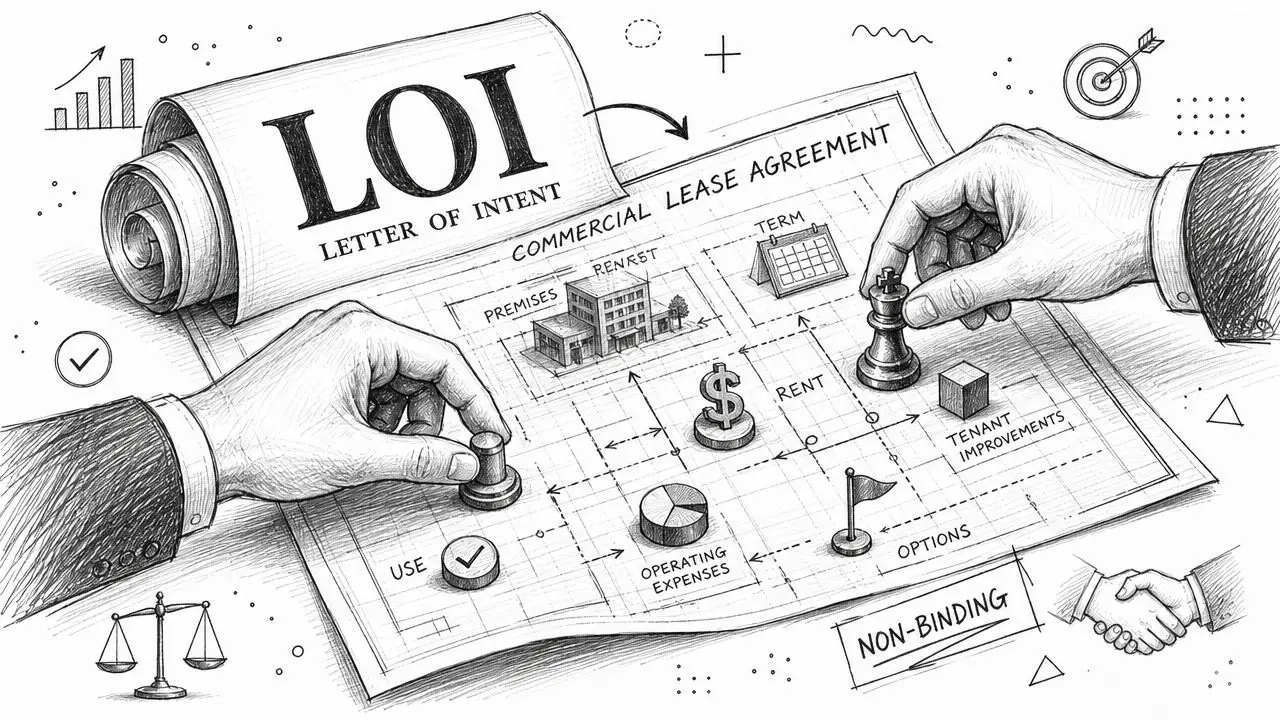
A commercial leasing guide describes the process as a four-step sequence of business readiness, space search, LOI, and final lease or buildout. It also states that the LOI is generally non-binding and “almost always negotiable,” while the lease is a binding legal document, and notes that rents and expenses are commonly assessed on a per-square-foot basis in transactions that often run 3 to 5 years or longer in business practice, as outlined in the Fundamentals of Commercial Leasing guide. That distinction is decisive.
Why the LOI matters more than most tenants think
Many tenants treat the LOI as a summary. Savvy landlords don’t. They use it to anchor the final lease economics and define the business deal before lawyers begin marking up clauses.
If the LOI leaves a point vague, the landlord usually fills that gap later with language favorable to the landlord. Legal review can still improve the position, but it becomes harder and slower. A clean LOI gives counsel a framework to enforce during drafting.
The LOI should settle the major commercial terms with precision. That means the tenant should negotiate business points while both sides still expect movement.
Terms worth pressing hard
A foreign tenant should focus on items that affect control, cash flow, and future optionality:
- Lease term and extension logic: The tenant should decide whether stability or flexibility matters more.
- Tenant improvement package: The LOI should state who performs the work, who approves plans, and what happens if the project runs late.
- Concessions and free-rent periods: If the landlord offers inducements, the timing and conditions should be explicit.
- Expense allocation: Additional charges should be described clearly enough for finance teams to model.
- Expansion or contraction rights: These rights matter more in uncertain headcount environments.
- Deposit and security mechanics: The tenant should know the form of security, release conditions, and any replacement rights.
Negotiating in a softer office environment
In a market with weaker office demand, flexibility becomes a stronger bargaining chip than cosmetic concessions. CBRE reported the U.S. office vacancy rate reached a record 19.7% in Q4 2024, while JLL has noted that occupiers are prioritizing high-quality, flexible space rather than taking more square footage, as discussed in this analysis of commercial lease flexibility and weaker demand conditions. That trend supports a practical negotiation posture.
A tenant should test whether the landlord will trade term certainty for better optionality. Sometimes a shorter term, a break mechanism, or structured expansion rights create more value than a modest rent concession. For a foreign company with uncertain staffing patterns, that trade often makes sense.
Negotiate flexibility when the landlord still wants your signature. Don’t wait until the lease draft hardens.
Strategic Analysis of Israeli Commercial Contracts
Foreign tenants often assume that the risk in an Israeli lease sits in the familiar clauses. Rent. Deposit. Term. Repairs. Those matter, but the sharper risks usually sit in clauses that look technical and ordinary.
In cross-border leasing, hidden costs and control rights can matter more than headline rent. Guidance on commercial leasing risk points to estoppel certificates, sublease and assignment rights, CAM caps, and personal guarantees as core issues, and notes that Fannie Mae treats tenant estoppel certificates as important for underwriting, which shows how directly these documents affect lease value and bankability in practice, as discussed in this analysis of commercial lease control rights. That logic applies with particular force when a foreign company enters Israel through a local subsidiary or branch.
Why Israeli contract analysis must be strategic
Israeli commercial contracts don’t reward passive review. A foreign tenant needs drafting that matches actual decision-making, group structure, and enforcement strategy.
If the tenant is part of an international group, the lease must align with corporate authority, treasury arrangements, and local banking practice. If the business might reorganize later, the document must permit transfer, internal restructuring, or controlled subletting. If disputes arise, the forum clause must support a realistic remedy path.
This is why the strategic center of the deal isn’t only price. It’s control. That point sits at the heart of sound drafting for commercial lease agreements.
Critical Israeli Lease Clauses for Foreign Firms
| Clause | Standard Approach | Strategic Objective for Foreign Tenant |
|---|---|---|
| Permitted use | Narrow definition tied to current activity | Draft a use clause broad enough to cover related operations and business evolution |
| Assignment and sublease | Landlord consent required, often broadly framed | Add objective consent standards and intra-group transfer flexibility |
| Personal guarantee | Broad security demand from landlord | Limit scope, duration, trigger events, and release conditions |
| Estoppel certificate | Treated as technical paperwork | Define timing, content, and cooperation duties to protect financing and transactions |
| Operating expenses and CAM | Broad pass-through language | Narrow categories, exclude landlord capital items where possible, and seek caps where commercially available |
| Alterations | Landlord approval with broad discretion | Separate cosmetic works from structural works and set approval timelines |
| Default and remedies | Fast landlord enforcement rights | Add notice periods, cure rights, and proportional remedies |
| Dispute resolution | Generic jurisdiction wording | Select a forum and procedure that fit the tenant’s cross-border enforcement needs |
The clauses that decide real leverage
Three areas deserve extra attention.
First, transfer rights. A foreign business may need to restructure, bring in an affiliate, or reduce footprint. If assignment and sublease rights are weak, the lease becomes operationally rigid at exactly the wrong moment.
Second, evidence clauses. Estoppel certificates, notices, and documentary acknowledgments look administrative. They aren’t. They shape financing, landlord sales, and later disputes about what each side knew and accepted.
Third, default architecture. Some leases define default too broadly and cure rights too narrowly. That structure gives the landlord pressure points far beyond genuine non-payment issues.
A foreign tenant shouldn’t ask only, “What must we pay?” It should ask, “What can the landlord force if operations change?”
The dispute clause is an operational clause
Many executives read dispute resolution at the end of the draft and assume it’s boilerplate. That’s dangerous. Forum, language, service mechanics, interim relief, and governing law can all alter bargaining power after a conflict starts.
An unclear dispute clause can also produce secondary damage. If a lease conflict disrupts revenue, supplier payments, or internal controls, the problem may spread into broader financial stress. In severe situations, related business friction can sit beside issues such as bank account blockages, especially when local compliance and payment continuity become unstable.
A non-Israeli company therefore needs the lease to function as part of a wider commercial system. The best drafting doesn’t just reduce litigation risk. It preserves room to operate if the relationship deteriorates.
From Signing to Occupancy and Beyond
What happens after signature if your Israeli lease starts to drift away from your internal approvals, banking setup, or operating model?
For a non-Israeli company, that is often where significant risk starts. Signature closes the negotiation. It also triggers a chain of obligations that can affect deposit delivery, fit-out timing, VAT handling, local insurance, contractor access, reporting lines, and the company’s ability to keep paying and performing through an Israeli platform. A lease that looked acceptable on paper can become expensive once those moving parts stop matching each other.
The first post-signing task is implementation, not filing. Build a controlled lease file at once. It should hold the signed lease, guarantees, approved plans, insurance requirements, side letters, handover protocol, notices, and a live calendar for every operative date. If the tenant is foreign, add board approvals, signatory evidence, local tax registrations, and the banking documents needed to move rent, security, and contractor payments without delay.
The handover phase deserves legal attention. In Israel, possession, fit-out access, and commencement of rent do not always line up neatly. A foreign tenant should check exactly when the right to enter begins, what works are allowed before formal delivery, who bears delay risk if permits or landlord approvals stall, and whether rent starts on a fixed date or only after defined conditions are met. Those details decide whether the tenant pays for unusable space.
The first internal checklist should cover five pressure points:
- Security package: confirm the wording, amount, expiry mechanics, and draw conditions for any bank guarantee, cash deposit, or parent support. Foreign groups should also check whether the Israeli bank issuing or receiving the instrument will ask for local compliance documents that were never discussed during negotiation.
- Fit-out control: match the lease to the architect’s plans, contractor scope, landlord approval procedure, building rules, and utility connection timetable.
- Permit record: keep written evidence of municipal submissions, revisions, landlord comments, and approval dates.
- Insurance placement: put the required policies in force before works or occupancy begin. For a practical overview of the categories that often apply, the Professional Insurance Advisors guide is a useful starting point for discussions with the broker.
- Authority matrix: identify who can approve change orders, settlement letters, notices, and site instructions. Cross-border confusion over signing authority creates avoidable default arguments.
Occupancy creates a second category of risk. The lease has to be managed as an operating contract, not stored as a PDF until renewal or dispute.
That matters even more for multinational tenants. Finance may sit outside Israel, operations may sit on the ground, and legal may sit in another jurisdiction altogether. If those functions do not share one control process, the company starts missing notice periods, tolerating undocumented landlord positions, or agreeing to site changes by email that later become binding against it.
Track every date that changes bargaining power. Renewal windows, break rights, rent review notices, reporting obligations, restoration deadlines, guarantee renewal dates, and options tied to corporate structure all belong in one system with a named owner. If the lease restricts assignment, change of control, subletting, or use by affiliates, monitor those clauses against the group’s real business plans. Foreign companies often discover this point too late, during a restructuring, financing round, or internal transfer of operations.
Disputes also need to be prepared for before they exist. If the landlord alleges breach, sends a reservation-of-rights letter, blocks works, or threatens to call a guarantee, the response should run through counsel, local management, and finance together. Informal site-level emails can damage the tenant’s position fast, especially if they contain admissions on delay, condition of the premises, or alleged non-compliance.
Exit planning starts early. Document the state of the premises, preserve approval trails, keep payment evidence, and record every landlord consent or waiver. If the building is sold, refinanced, or brought under new management, that record can decide whether the tenant keeps the deal it thought it signed or spends months proving basic facts.
A company learning how to lease a commercial property in Israel should treat the period after signing as a control exercise. The objective is simple. Keep possession, payment, compliance, and evidence aligned so the lease supports the business instead of becoming a local point of failure.
Disclaimer: The views and opinions expressed in this article are solely those of the author and do not necessarily reflect the official policy or position of any institution or organization. This article is for informational purposes only and does not constitute legal advice.