
A foreign CEO usually asks the wrong first question. They ask whether a royalty audit will damage the relationship, when the sharper question is whether the existing relationship already hides revenue leakage that no one has measured.
That distinction matters in 2026 because cross-border licensing has become operationally dense, not simple. Israeli counterparties often sit inside broader chains of distributors, ERP workflows, e-commerce channels, and sublicensing arrangements. Once reporting moves across those layers, a royalty statement stops being a summary and becomes a legal position.
Most commentary still treats royalty audit procedures as a spreadsheet exercise. That view is incomplete. Commercial risk starts after the discrepancy appears, when parties fight over definitions, evidence, timing, jurisdiction, and collection.
Your Guide to Royalty Audits in 2026
If your royalty stream depends on trust alone, you don’t have a royalty system. You have a revenue exposure.
Published royalty-audit guidance says “almost all audits” produce findings, with an average underreporting range of 15% to 20% in royalty amounts, and it adds that the response process may take 2 to 6 months after findings are reported, according to this royalty audit phase analysis. For a foreign licensor, that means the audit itself isn’t the event. The audit is the opening move in a controlled enforcement process.
A practical executive should treat royalty audit procedures as part of contract governance. They confirm whether the Israeli partner’s reporting process matches the agreement, whether the sales base is complete, and whether deductions reflect what the contract permits.
Why the standard mindset fails
Many executives still view an audit as an accusation. That framing creates delay, and delay usually helps the reporting party.
The more accurate framing is operational. A royalty audit tests whether your contractual economics survived contact with real systems, real invoices, real returns, real exchange-rate handling, and real product classification.
Practical rule: Audit rights exist to preserve control, not to create conflict.
That is why even a preliminary review can affect negotiating power. Once counsel and the audit team map the contract against the reporting workflow, weak points appear quickly. Those weak points usually sit in bundled products, channel exclusions, sublicensing revenue, transfer pricing logic, or manual adjustments that no one documented cleanly.
What a foreign licensor should focus on first
Before sending a notice, management should answer three questions:
- What is being licensed: IP rights, territory, channels, and any carve-outs.
- How is revenue reported: By SKU, by channel, by territory, or through a compressed summary.
- Where is the pressure point: Historic underpayment, current misclassification, or anticipated dispute during renewal or termination.
If the board needs a concise primer on where hidden underpayments usually surface, a useful commercial overview is Mogul’s guide on how to find unpaid royalties. The legal point, however, is narrower. Finding a discrepancy is only valuable if the agreement gives you a clean path to prove it and recover it.
For foreign companies dealing with an Israeli partner, that path must be designed from the start around evidence preservation, contractual advantage, and enforceability. Otherwise, the royalty audit becomes a memo. It doesn’t become money.
The Contractual Blueprint for an Audit
The audit begins long before the notice letter. It begins in the clause.
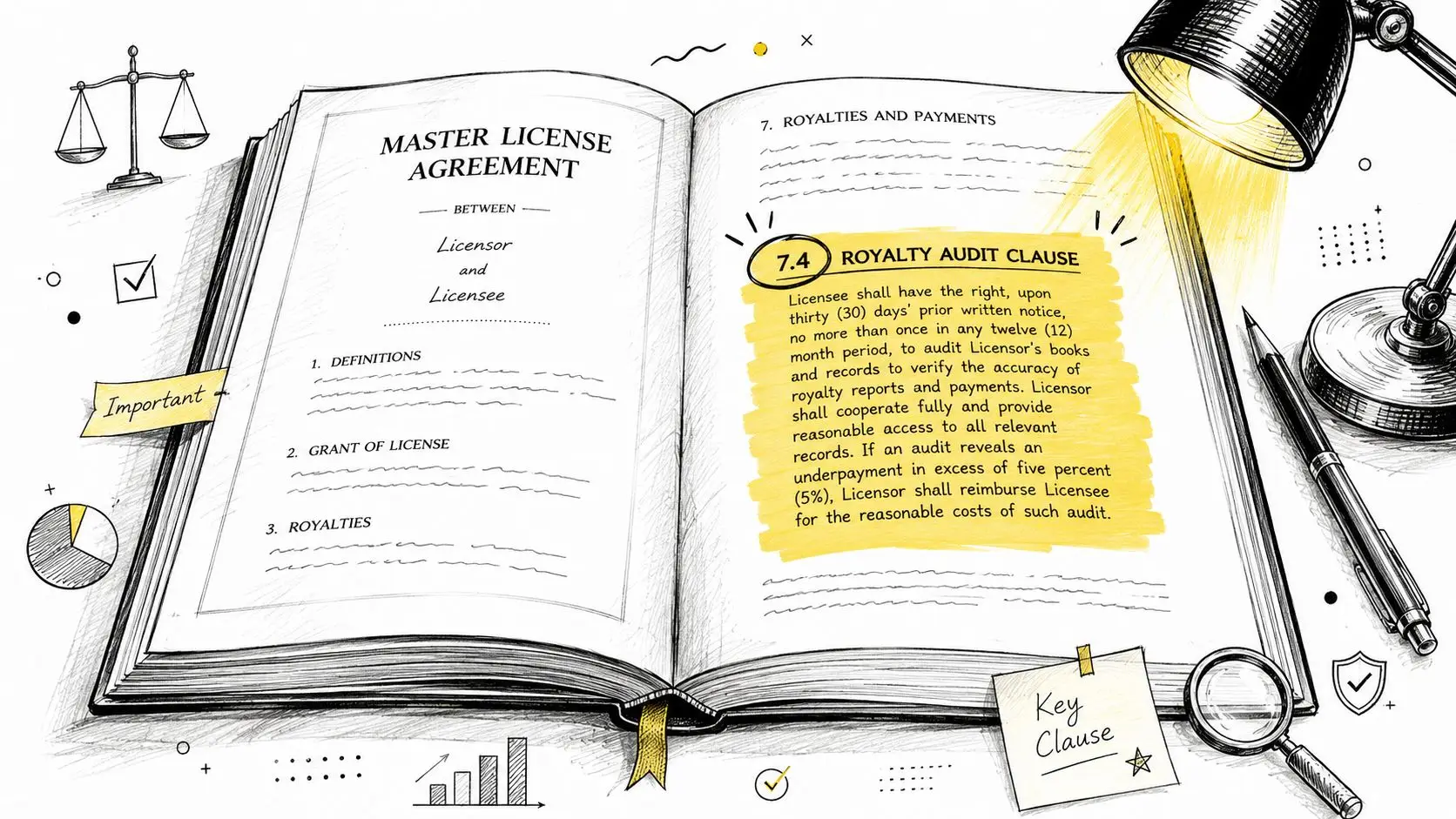
A strong audit clause doesn’t merely permit inspection. It allocates power. In cross-border licensing, especially with an Israeli counterparty that operates through affiliates, distributors, or local service entities, the clause should answer five issues before any disagreement starts.
The five contractual levers that matter
A widely used framework breaks royalty audits into phased control steps, and industry descriptions often use parallel phases of preparation, planning, document review, communication, findings, and follow-up, as discussed in this guide to the five key phases of a royalty audit checklist. The same guidance notes that a commonly cited clause shifts audit costs to the licensee if under-reporting exceeds 2% to 5%. That threshold matters because it turns the clause into a deterrent, not just an inspection right.
The key levers are these:
- Audit trigger: Some clauses allow periodic audits. Others require cause. The former gives more control. The latter invites argument before the audit even starts.
- Scope of books and records: A weak clause says “relevant records.” A stronger clause names sales ledgers, ERP extracts, invoices, inventory records, returns data, sublicensing documents, and supporting accounting reports.
- Affiliate and channel access: If the clause reaches only the signatory entity, value can disappear into distributors, marketplaces, or related companies.
- Confidentiality and auditor restrictions: These terms are legitimate, but they shouldn’t be drafted so tightly that they cripple the review.
- Cost shifting and remedies: Cost shifting and remedies introduce discipline into the relationship.
What works and what doesn’t
The strongest clauses tie the audit directly to the reporting architecture. They don’t rely on abstract rights. They specify data format, timing, retention duties, and the right to inspect supporting source materials.
By contrast, weak clauses often fail in predictable ways:
| Contract issue | What works | What fails |
|---|---|---|
| Record access | Named records and transaction-level support | General reference to “books” |
| Timing | Defined response periods and audit windows | Open-ended timing disputes |
| Cost allocation | Clear underreporting threshold | Silence on who pays |
| Coverage | Affiliates, sublicensees, distributors | Signatory entity only |
A foreign licensor should also review the larger agreement, not just the audit paragraph. Definitions in the royalty section, indemnity language, governing law, jurisdiction, arbitration wording, and survival provisions all affect recovery.
That is why the drafting exercise belongs inside a wider commercial contract review. A practical reference point on that broader framework appears in this overview of commercial contracts in Israel. In practice, the audit clause is only as strong as the definitions and dispute machinery around it.
A royalty audit clause should do two jobs at once. It should allow inspection, and it should discourage sloppy reporting before inspection ever happens.
When advising a foreign CEO, the most important message is simple. If the clause is vague, the first battle won’t concern missing royalties. It will concern access. That is the wrong battlefield.
Launching the Audit and Gathering Evidence
Once the contract supports the exercise, the launch must be disciplined. Casual audit notices create avoidable scope fights.
Industry guidance commonly treats a robust audit as a three-phase process of contract review and initial discovery, fieldwork, and reporting or resolution, with the highest-value work starting by testing contract terms against the licensee’s reporting process, then reconciling sales reports to royalty reports and inspecting source records, as outlined in this discussion of royalty auditing practice. That sequence works because it forces the legal theory and the accounting trail to line up from day one.
The notice should lock the perimeter
An effective audit notice should identify the agreement, the audit period, the contractual basis, the intended auditor or professional team if required, and the record categories requested. It should also reserve rights on additional document requests if the first production reveals new channels or unexplained adjustments.
Desk audits and onsite audits each have value. A desk audit is faster and often sufficient when the licensee maintains structured data exports. An onsite audit remains useful where records are fragmented, manually adjusted, or held by separate teams that don’t produce complete information remotely.
The first document request should be surgical
Poor requests invite delay. Overbroad requests invite performative objections.
A disciplined request list usually includes:
- Royalty statements: Every statement for the review period, including corrected versions.
- Sales support: SKU-level sales records, invoices, credit notes, return logs, and inventory movement reports.
- Accounting tie-outs: Trial balances, P&Ls, and records that reconcile operating data to financial statements.
- Channel evidence: Distributor reports, marketplace exports, e-commerce dashboards, and sublicensing agreements where relevant.
- Adjustment support: Documents for deductions, allowances, credits, write-offs, samples, or internal use.
Ask for the data in native export format where possible. PDF summaries rarely prove the point you need in a contested recovery claim.
In Israeli disputes, process discipline matters early because counterparties often test boundaries through delay, partial production, or narrow readings of the clause. A foreign licensor should therefore preserve a clean chronology from the first notice onward. That means written reservations of rights, clear deadlines, and a record of every refusal or incomplete response.
Two execution errors to avoid
First, don’t let the audit team review numbers without a lawyer mapping them to the contract. A mathematically correct schedule can still fail if it applies the wrong definition of Net Sales or ignores a carve-out.
Second, don’t accept a rolling production without a protocol. If records arrive in fragments, the licensee can later argue that the auditor worked from an incomplete set by choice, not by obstruction.
The goal at this stage isn’t drama. It’s evidentiary control.
Modern Data Analysis and Forensic Techniques
The modern royalty dispute usually isn’t hidden in one ledger. It’s scattered across systems that don’t naturally speak to each other.

Current practice increasingly depends on tracing a complete sales population from the licensee’s accounting system back to financial statements, then using analytics to identify unreported products or royalty-bearing transactions, especially where data is spread across ERP systems, e-commerce channels, and distributors, as explained in this article on what royalty audits are and who gets them. That is the center of gravity in modern royalty audit procedures.
Where hidden value usually sits
Straight recalculation rarely solves a serious case. The better approach follows the data through each reporting handoff.
Auditors and counsel usually look for patterns like these:
- Product misclassification: Royalty-bearing products coded into a non-royalty category.
- Bundled sales: Licensed items packaged with non-licensed items, with revenue allocated in a way that suppresses the royalty base.
- Unreported channels: Marketplace sales, direct website sales, or distributor flows omitted from standard royalty packs.
- Sublicensing gaps: Revenue recognized elsewhere, while the original licensor receives only a partial report.
- Deduction drift: Freight, rebates, marketing support, or internal allocations deducted without contractual support.
Why system tracing matters in Israeli cross-border structures
Israeli businesses often operate efficiently across local and foreign entities. That commercial agility is useful in growth mode, but it complicates audits. Revenue may appear in one entity’s operational system, another entity’s invoices, and a third report prepared for the licensor.
That is why the audit team should test the route from transaction to statement, not just statement to formula. If the transaction population isn’t complete, the recalculation can be perfectly performed and still wrong.
Field insight: In difficult cases, the dispute turns on system integrity before it turns on royalty math.
This is also where outside specialists sometimes matter. Companies that regularly work with cross-system financial records, including teams that find R&D tax incentive consultants for technical documentation-heavy claims, understand a basic truth that also applies here. Recovery work lives or dies on traceability between operational facts and legal entitlement.
The forensic toolkit should match the business model
A licensor with direct-to-consumer sales exposure needs different testing from a franchisor that relies on distributors. A software licensor faces different risks from a consumer product owner.
That is why sophisticated royalty audit procedures should be built around the licensee’s actual revenue architecture. In IP-heavy structures, legal protection also depends on whether the licensed asset and derivative uses are clearly captured inside the contract and compliance record. For that wider protection framework, this guide to intellectual property rights in Israel provides useful context.
The practical lesson is blunt. If the audit only checks arithmetic, it will miss the highest-risk revenue leakage.
Managing Disputes and Enforcing Findings in Israel
An audit report doesn’t end the matter. It starts the actual contest.

The post-audit phase is where foreign licensors often lose momentum. They have a discrepancy memo, but they don’t yet have a claim package that can survive resistance in Israel. That gap is more common than many executives assume. A U.S. government audit report on royalty settlements found that in 9 of 10 reviewed cases there was no documentation for estimated issue values, arguments for reducing them, or reasons for the final negotiated amounts, according to this review of royalty settlement documentation failures. The lesson is universal. Poor settlement governance destroys strong audit work.
The report must become a litigation-grade file
A proper demand after the audit should do more than assert an amount. It should show the chain of reasoning.
That usually includes:
- Issue schedule: Each disputed category separated by product, channel, territory, or deduction type.
- Contract mapping: The exact clauses that support each adjustment.
- Evidence index: Source records, reconciliations, correspondence, and assumptions.
- Calculation record: How each correction was derived, including any credits or counter-adjustments.
- Reservation language: Rights preserved if later productions reveal additional exposure.
This matters in Israel because settlement discussions often move quickly from commercial negotiation to procedural positioning. The counterparty may challenge access rights, interpretation, the auditor’s methodology, confidentiality limits, or the governing forum.
Enforcement choices require strategy, not instinct
The foreign licensor must decide whether to push for negotiated correction, formal demand, arbitration, or court proceedings. That decision depends on the agreement, the evidence quality, the commercial relationship, and the collectability profile of the Israeli party.
A short decision frame helps:
| Situation | Stronger move |
|---|---|
| Ongoing relationship, credible error, cooperative counterparty | Structured negotiation with formal reservation of rights |
| Large dispute over definitions or scope | Pre-action legal position and evidence protocol |
| Repeated non-cooperation or access refusal | Immediate escalation under dispute clause |
| Solvent counterparty but tactical delay | Pressure through forum, timing, and enforcement posture |
Settlement isn’t only about amount. It’s about documenting why the amount changed, who approved it, and what rights survive afterward.
What foreign companies often underestimate in Israel
The legal system rewards parties who arrive with a disciplined record. Sloppy chronology, undocumented concessions, and unclear damage calculations quickly undermine their position.
That is why post-audit correspondence should be drafted as if a judge or arbitrator will later read every line. Internal teams should also avoid informal side conversations with finance staff that soften the claim or create ambiguity about agreed methodology.
Where the dispute escalates, the practical challenge often shifts from accounting to pressure design. Forum, procedure, interim steps, and commercial advantage can shape the outcome as much as the underlying numbers. For broader context on that escalation mindset, this discussion of commercial litigation and crisis management in Israel is relevant.
A foreign CEO should remember one point above all. The audit finds the issue. The recovery depends on how the issue is framed, documented, and enforced.
Drafting Contracts to Prevent Future Royalty Disputes
The best royalty dispute is the one that never becomes a dispute. Prevention starts in drafting, but not in the abstract.

Many agreements contain detailed economics and weak reporting mechanics. That imbalance invites conflict because the parties agree on the headline royalty rate while leaving the payment machinery vague. In cross-border deals involving Israel, that vagueness becomes expensive once products move through local entities, online channels, and mixed distribution structures.
Draft for verification, not just payment
A resilient contract defines not only what is owed, but how the licensor can verify what is owed.
The strongest preventive clauses usually include these elements:
- Clear revenue definitions: Net Sales, gross billings, permitted deductions, returns treatment, bundled products, and internal transfers should be defined with precision.
- Reporting templates: The agreement should require line-item categories, channel breakdowns, territory fields, and identifiable product coding.
- Data retention duties: Records should be kept in usable form for a defined period, with access to source materials and supporting schedules.
- Cooperation language: The licensee should provide reasonable assistance during reviews and procure equivalent cooperation from affiliates or sublicensees.
- Post-termination survival: Audit rights and payment correction duties should survive the commercial relationship.
Draft around recurring failure points
The most useful drafting method is to reverse-engineer prior disputes. If the last audit turned on bundles, define the allocation rule. If it turned on distributor opacity, require pass-through reporting. If it turned on currency handling, specify the conversion method and documentary support.
A simple prevention matrix helps legal and finance teams align:
| Risk point | Better drafting response |
|---|---|
| Bundled products | Pre-agreed allocation methodology |
| Sublicensing revenue | Pass-through reporting and audit access |
| Marketplace sales | Named channel reporting obligations |
| Manual deductions | Closed list of permitted deductions |
| Cross-border entities | Affiliate reporting and record access obligations |
Good drafting reduces argument space. It doesn’t eliminate disagreement, but it narrows the terrain on which disagreement can grow.
What foreign licensors should insist on in 2026
A modern agreement should assume fragmented data, not centralized data. It should also assume that any future audit may need to prove system completeness, not merely recalculate a few statements.
That means legal drafting should be done with finance, operations, and compliance teams in the room. If those teams can’t explain how a number would be tested later, the clause probably isn’t ready.
The practical payoff is substantial, even without promising a specific recovery outcome. Better drafting lowers the chance of scope fights, shortens the path from anomaly to proof, and improves bargaining position if a dispute still arises.
Conclusion
What happens after the audit report lands on the other side of the table?
For foreign licensors dealing with an Israeli counterparty, the harder phase often starts then. The critical contest is about turning findings into payment, preserving pressure without overplaying it, and choosing an enforcement path that fits the contract, the evidence, and the commercial relationship. A royalty audit procedure only creates value if it ends in recovery or a settlement you can enforce.
That requires discipline early and resolve later. Review the agreement before the audit starts. Build the evidentiary record before making accusations. Frame post-audit communications with litigation, arbitration, and collection risk in mind. In cross-border matters, a weak notice letter, an imprecise concession, or a poorly documented methodology can reduce recovery long before a court or tribunal reviews the file.
I have seen this pattern repeatedly. A foreign company proves an underpayment, then loses momentum in the dispute because the contract is vague, the accounting trail is incomplete, or the Israeli partner uses delay to improve its bargaining position. Control comes from preparation, but recovery comes from strategy.
Companies that handle these disputes well do three things. They quantify the claim in a way a decision-maker can defend. They document the breach in a form that can survive challenge in Israel. They plan for enforcement at the same time they discuss settlement.
Avoid costly mistakes by getting a strategic view before the dispute hardens. RNC Group advises international businesses on Israeli commercial risk, cross-border enforcement, and high-stakes royalty and contract disputes. The recommended next step is to contact the firm now and assess the contract, the audit posture, and the recovery path before your position weakens.
This article provides general information for educational purposes only and doesn’t constitute legal advice. Laws and outcomes vary based on the specific facts, contract terms, forum, and evidence. Readers should obtain qualified legal and financial advice before acting, and any reliance on this article is at their own risk.
SEO Title: Royalty Audit Procedures for Cross-Border Israel Disputes
Slug: royalty-audit-procedures-israel
Meta Description: Learn how royalty audit procedures work in cross-border deals involving Israel, from audit clauses and evidence gathering to dispute enforcement and recovery.
Focus Keyphrase: royalty audit procedures
Synonyms: royalty audit process, royalty audit clause, cross-border royalty dispute, royalty enforcement in Israel