
A standard force majeure clause won’t save a cross-border deal in 2026 if the governing law treats disruption differently than your board expects. That gap is especially dangerous in Israeli commercial contracts, where foreign executives often import common law assumptions into a legal system that doesn’t use force majeure in the same way.
Many multinational companies negotiate the event list and stop there. That approach leaves a deeper risk untouched. In Israel, the decisive question often isn’t whether the clause names war, cyber disruption, port closure, or government action. The decisive question is whether the event was contractually and legally framed in a way that survives Israeli scrutiny.
Is Your Contract Ready for a 2026 Disruption
Will your agreement protect performance when a regional shock hits in 2026, or will the clause collapse when you need it most? That question matters because force majeure isn’t a universal safety valve. It works only through exact drafting, exact procedure, and exact alignment with governing law.

Foreign executives often assume that a familiar template from London, New York, or Singapore will function in an Israeli contract with minor edits. That assumption creates false comfort. Under English common law, force majeure isn’t implied at all and exists only if the contract includes it expressly, while courts in the U.S. and U.K. place the burden entirely on the party invoking the clause and require strict proof that the event falls within the clause and directly caused non-performance, as outlined in this analysis of global force majeure divergence.
The 2026 problem isn’t the event list alone
The practical risk for 2026 isn’t just geopolitical volatility. The risk is operational delay inside the contract itself. A broad clause may look protective during negotiation, yet fail in dispute because it doesn’t define trigger events with enough precision, doesn’t separate delay from impossibility, or doesn’t fit the jurisdiction that will interpret it.
A board may read “events beyond reasonable control” and assume resilience. Courts often read that language as an invitation to reject the claim. Astute counterparties know this. They accept vague wording when it benefits them later.
Practical rule: If the clause can’t tell an operations team exactly when to send notice, what evidence to preserve, and what obligations continue, it isn’t controlling risk.
Why Israeli counterparties raise the stakes
Israeli commercial relationships often sit inside active supply chains, licensing structures, services frameworks, franchise systems, and complex collaborations. In those settings, disruption doesn’t stay local. It spreads into payment disputes, inventory risk, missed milestones, lender concerns, and sometimes broader commercial crisis management.
That is why non-Israeli corporations should test the clause before signing, not after a disruption starts. A strong review asks harder questions. Does the clause define the event with operational specificity? Does it match the dispute forum? Does it preserve payment rights? Does it allocate mitigation duties in a way your team can perform?
Those questions determine strategic control. The label “force majeure” does not.
The Four Pillars of a Force Majeure Event
A valid force majeure claim rests on a narrow structure, not on commercial frustration. The doctrine developed around four core requisites. The event must be independent of the debtor’s will, unforeseeable, render performance impossible, and involve no participation by the debtor in the failure. Modern clauses may list over 10 categories such as war, rebellion, natural disasters, epidemics, and strikes, yet force majeure still “means what the contract says it means”, as summarized in this overview of force majeure principles.
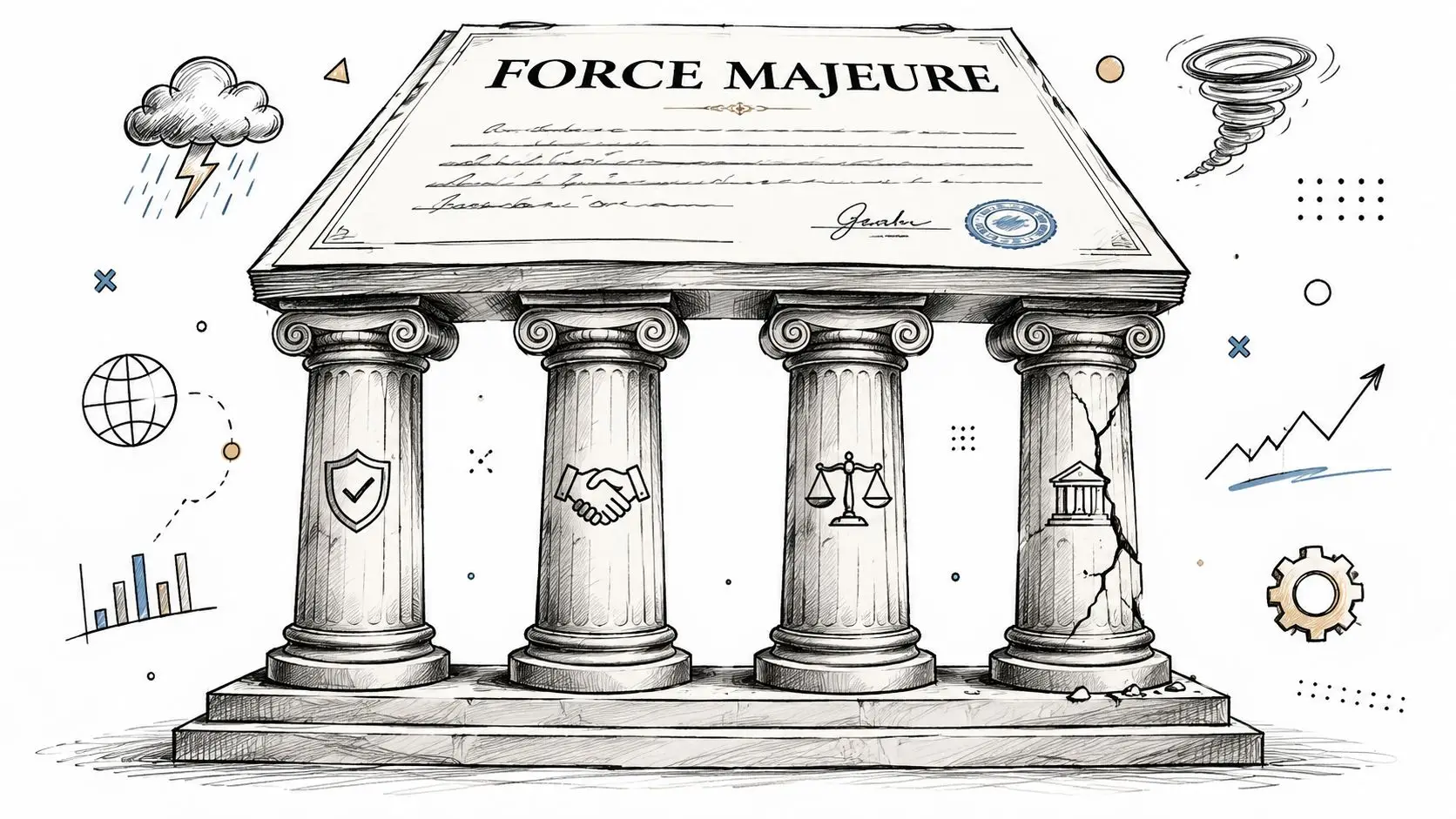
Think of the clause as a locked gate
A useful analogy is a four-key gate. Missing one key keeps the gate shut. Companies usually focus on the event itself, then ignore the other three keys.
The first key is externality. The event must come from outside the invoking party’s control. A supplier’s internal planning failure, staffing issue, or procurement error won’t become force majeure because market conditions turned harsh.
The second key is unforeseeability. If the risk was visible at signing, the contract should have allocated it directly. A party that signs during a known crisis, then claims surprise, starts from a weak position.
Difficulty doesn’t equal impossibility
The third key is the one that executives misjudge most often. Performance must become objectively impossible, not merely slower, more expensive, or commercially unattractive. Courts in major jurisdictions often refuse to treat severe financial pain as force majeure when the work could still be done.
That distinction matters in every cross-border transaction. A sharp freight increase, a shortage of one component, or margin collapse may support renegotiation. It may not excuse performance.
Severe commercial pain may justify a business response. It doesn’t automatically create a legal excuse.
The fourth key is clean hands. The party invoking the clause must show it didn’t help create the non-performance. If poor inventory policy, weak redundancy, or late procurement amplified the failure, the claim weakens quickly.
Why the event list still matters
Although the four pillars drive the analysis, drafting still matters enormously. A clause that lists epidemic, embargo, cyberattack, port closure, change in law, and war risks gives the dispute a clearer frame. A clause that relies on generic language invites argument over every word.
Use the event list to describe real operational threats to the deal. A software rollout agreement faces different disruption patterns than a commercial lease, a manufacturing supply contract, or a distribution appointment. The event list should reflect that reality.
Global Enforcement Versus the Israeli Reality
Foreign expectations often falter. In common law systems, force majeure usually rises or falls on the text. In Israel, the legal analysis moves into a different framework entirely.
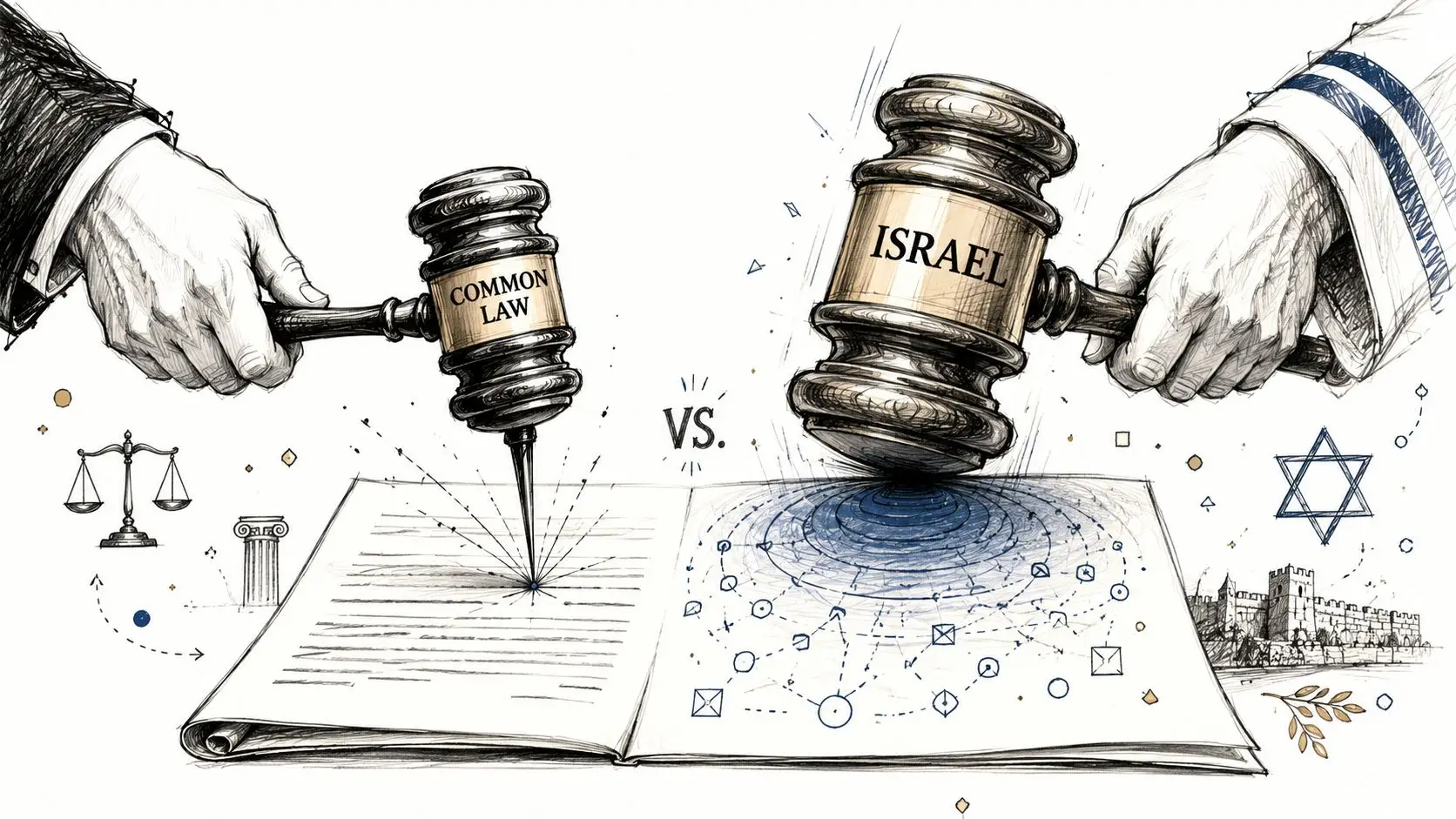
Common law starts with the clause
Under English law, there is no common law concept of force majeure. The clause must exist in the contract, define the covered events, and satisfy its own formalities, including timely notice, as explained in this discussion of contractual implications under English law.
That approach sounds familiar to many international executives because it resembles how advanced contract management already works. Name the event. Show direct causation. Follow the notice mechanics. Prove mitigation. If the clause is tight, the analysis is usually tight as well.
Yet even in common law systems, courts interpret these provisions narrowly. Vague catch-all wording often fails. The invoking party must link the event to the specific non-performance, not merely to general market disruption.
Israel doesn’t use the same doorway
Israeli law doesn’t recognize force majeure as a standalone doctrine in legislation. The closest equivalent is sikkul under Article 18 of the Contract Law 1970. It permits non-liability only if the event was unforeseeable, unavoidable, and rendered performance permanently impossible, as discussed in this review of Israeli contract law and Article 18.
That distinction changes the negotiation strategy from the outset. A foreign party may assume that a war clause creates a broad excuse for delay or suspension. Israeli courts have often rejected defenses based on acts of war or terrorism because they treat those risks as foreseeable for parties doing business in or with Israel.
A non-Israeli executive may see war as extraordinary. An Israeli court may see it as a risk that should have been priced, allocated, and mitigated in the contract.
Why this catches foreign companies off guard
The trap is conceptual. In many boardrooms, “war” feels like the strongest possible force majeure example. In Israeli-related transactions, that intuition can fail because foreseeability carries unusual weight. If the event is considered foreseeable, the party may be expected to address it expressly through pricing, logistics planning, insurance, alternate performance routes, or bespoke remedies.
That creates a sharp trade-off in negotiation. Broad language may help get the deal signed faster, but it leaves major interpretation risk unresolved. Highly specific language takes longer and often triggers tougher commercial discussions, yet it gives the parties actual control.
For that reason, the strategic path in Israeli commercial contracts isn’t to debate whether force majeure is included. It is to decide how the agreement handles foreseeable regional instability, which obligations suspend, which payments continue, what mitigation steps are mandatory, and which forum will decide the dispute.
That same discipline matters in related areas such as commercial lease agreements, where access, premises use, utility interruptions, staffing continuity, and landlord obligations can turn a generic clause into a litigation trigger.
Drafting and Negotiating Bulletproof Clauses
A strong force majeure clause is built, not borrowed. The drafting must tell the parties what counts, what happens next, and what evidence will be required. Anything softer leaves room for tactical dispute.
For enforceability, the invoking party must prove three causal elements: the impediment was beyond its control, unforeseeable at contract formation, and unavoidable despite reasonable mitigation. Failure to provide timely notice, typically within 7 to 14 days, with specific impact details can void the clause, as noted in this force majeure drafting analysis.
What strong drafting does
Start with a precise event list. Generic wording like “any event beyond reasonable control” often creates argument, not protection. By contrast, a better clause identifies concrete triggers tied to the transaction, such as export bans, port closures, government shutdown orders, named epidemics or pandemics, cyber incidents affecting core systems, or interruption of a designated route or facility.
Then define consequence by obligation type. A supply agreement may suspend delivery obligations while preserving payment for goods already accepted. A services agreement may allow temporary reduction in service levels but keep data security duties alive. A franchise or licensing arrangement may need different treatment for royalties, local staffing, and mandatory compliance steps.
Force Majeure Clause Drafting Comparison
| Weak Language (High Risk) | Strong Language (Low Risk) |
|---|---|
| “Events beyond the parties’ control shall excuse performance.” | “Performance is suspended only for the affected obligation if a listed event directly prevents performance.” |
| “War, unrest, or similar matters.” | “Actual armed conflict, government-declared closure, mandatory evacuation order, or closure of the named port or facility.” |
| “Prompt notice shall be given.” | “Written notice must be delivered in the contractually prescribed manner within the stated period, with details of cause, impact, expected duration, and mitigation steps.” |
| “The affected party shall use reasonable efforts.” | “The affected party must document alternative sourcing, rerouting, substitute performance, and other mitigation measures actually attempted.” |
| Silence on payment | “Amounts due for goods delivered or services performed before the event remain payable unless stated otherwise.” |
Drafting test: If two in-house lawyers can read the clause and disagree on what happens on day one of disruption, the wording is still too loose.
Terms that deserve direct negotiation
- Define foreseeability in context: If the deal touches Israel, address known regional risks expressly instead of pretending they are abstract.
- Separate impossibility from hardship: If the parties want relief for cost spikes or shortage, add a hardship or price-adjustment mechanism. Don’t hide that issue inside force majeure.
- Lock in notice mechanics: State the trigger date, delivery method, required content, and who must receive the notice.
- State mitigation duties concretely: Require alternate sourcing, substitute routing, or temporary workaround steps where feasible.
- Clarify long-stop outcomes: Say whether suspension converts into termination after a defined period and what happens to deposits, work in progress, and transition obligations.
Drafting discipline also depends on document control. Cross-border teams often lose their advantage because notice drafts, appendices, and signed versions don’t match. For law departments managing execution trails, structured document tools like PDFWix solutions for attorneys can help standardize signing packets, preserve notice-ready records, and reduce version confusion during a live dispute.
Invoking a Clause and Responding to a Claim
When disruption hits, speed without discipline creates more exposure. A force majeure clause lives or dies through evidence, notice, and conduct after the event.
Upon a force majeure event, performance is typically suspended, not terminated, unless the event persists beyond a defined date, commonly 60 to 90 days. Payment obligations for services rendered or goods delivered before the event remain unaffected in 78% of benchmark agreements, and failure to follow notice and dispute-resolution formalities can remove the clause’s protection, according to this explanation of force majeure consequences and procedure.
If your company needs to invoke the clause
The first move is factual, not rhetorical. Preserve every operational record that shows direct causation. Keep shipping records, government orders, site access restrictions, internal escalation logs, supplier notices, and timeline evidence showing when performance became impossible or prevented.
Next, issue formal notice exactly as the contract requires. Use the stated channel, the stated recipient, and the required content. If the contract requires a particular method, don’t improvise.
Then mitigate aggressively and document every step. Try alternate suppliers, substitute facilities, rerouting options, staged performance, remote delivery, or temporary workforce changes if those options are realistic. A claim supported by mitigation evidence is stronger than a claim supported by conclusions.
If you receive a force majeure notice
Treat the notice as a legal and commercial event. Don’t accept the label at face value. Test the claim against the actual clause, the governing law, and the chronology.
Use a short response checklist:
- Check the event definition: Is the cited event listed or covered by the clause?
- Test causation: Did the event genuinely prevent performance, or did it only make the deal less profitable?
- Review timing: Was the notice sent in the required period and by the required method?
- Demand mitigation proof: Ask what alternatives were attempted and why they failed.
- Reserve rights: Respond in writing and preserve all contractual and damages positions.
The strongest early response often isn’t a rejection. It’s a precise request for evidence that exposes whether the claim has real support.
Why procedure matters as much as substance
Many companies focus only on whether the event was serious. The more decisive issue is often whether the invoking party followed the contract’s operating manual. Missed notice requirements, weak evidence, and undocumented mitigation can convert a disruption defense into a breach case.
That procedural failure can create secondary problems quickly. Once invoices, milestones, or supply obligations are contested, the dispute may spread into financing friction, covenant pressure, and operational restrictions, including issues that can overlap with bank account restrictions when payment disputes intensify.
A Final Checklist for Your Israeli Contracts
Non-Israeli corporations should treat Israeli force majeure drafting as a local risk allocation exercise, not a template exercise. The significant mistake is assuming that familiar common law language will carry the same weight in an Israeli dispute. It often won’t.
The final review should focus on what the contract controls when the pressure starts. In jurisdictions such as Florida and under English law, courts read force majeure clauses narrowly, and a party must notify the other side as soon as it becomes aware of the preventing event or risk dismissal on technical grounds, as explained in this discussion of prompt notice and impracticality. That lesson becomes even more important when an Israeli counterparty and an international supply chain sit inside the same dispute.
The decision checklist that matters
- Assume regional instability is foreseeable: If the transaction touches Israel, address war, security disruption, and civil disturbance with bespoke wording and bespoke remedies.
- Use a specific event list: Replace catch-all phrases with events that map to your actual operation.
- Define notice with precision: State timing, recipients, form, and required evidence.
- Separate hardship from impossibility: If the parties want relief for cost escalation, address it directly.
- Preserve payment rules: Specify what remains payable during suspension.
- Set the long-stop mechanics: Clarify when suspension becomes termination and how exit works.
- Choose forum and law deliberately: Governing law and dispute process shape the outcome as much as the clause text.
A force majeure clause should reduce uncertainty. In Israeli contracts, poorly localized drafting often does the opposite. The recommended strategic path is a line-by-line review by counsel who understands both cross-border deal practice and the Israeli litigation posture that may follow.
Avoid costly mistakes before they become disputes. The prudent next step is to review high-value Israeli contracts with counsel experienced in cross-border commercial risk allocation and crisis strategy. For that purpose, contact RNC Group now.
This article is intended for informational purposes only and does not constitute legal advice. The information provided is not a substitute for professional legal counsel, and no reader should act or refrain from acting based on it without obtaining advice on the specific facts involved. Reliance on this article is solely at the reader’s own risk.