
Will a partner payment, acquisition escrow, or franchise remittance trigger scrutiny in 2026 even if your company isn’t a bank? For multinationals with Israeli exposure, that question now belongs in board-level risk review, not only in compliance files.
Most executives still treat suspicious activity reporting as a back-office banking issue. That view is outdated. In complex commercial litigation, damage often begins earlier, when a bank, counterparty, or regulator decides that a transaction pattern doesn’t make commercial sense.
Your 2026 Guide to Suspicious Activity Reporting

A foreign CEO entering Israel often asks the wrong opening question. The usual question is whether the company itself must file a report. The better question is whether the company’s transaction design, ownership structure, or dispute posture will cause someone else to file one.
That distinction matters because scrutiny has expanded fast. In 2024, SAR filings surged by 51.8% from the 2020 baseline, a change that reflects broader financial crime detection and heightened pressure on businesses through their banking relationships, as noted in the 2024 FinCEN SAR analysis.
Why non-financial companies now sit inside the risk perimeter
A non-Israeli corporation can enter the risk perimeter without touching classic banking conduct. It can happen during a distressed acquisition, a founders’ dispute, a licensing rollout, or a rapid change in payment flows after sanctions screening, investor pressure, or reputational concerns.
Banks see fragments. Litigation counsel sees motives. Regulators compare timelines. When those views collide, suspicious activity reporting becomes a strategic issue.
Practical rule: If a payment path needs a long verbal explanation, the bank may decide that the explanation belongs in a report.
The usual compliance checklist doesn’t solve this problem. It asks whether a transaction fits a policy. A stronger legal strategy asks whether the transaction will still look coherent after a hostile counterparty, a cautious bank, and a regulator review the same facts from different angles.
Why this belongs in complex commercial litigation strategy
In high-stakes disputes, a suspicious activity issue rarely stays isolated. It can affect document preservation, witness preparation, negotiation advantage, account access, and settlement timing. It can also reshape how a court or arbitrator views commercial behavior, even before any formal allegation matures.
For that reason, suspicious activity reporting should be treated like an early-warning system. It signals legal and financial exposure long before a claim is fully framed.
Senior management should focus on three questions:
- Transaction logic: Can the company explain why funds moved in this sequence, through these entities, and on these dates?
- Counterparty integrity: Does the ownership, funding source, or side-letter structure create avoidable suspicion?
- Dispute readiness: If a bank restricts activity tomorrow, can the company preserve operations and legal privilege immediately?
A company that answers those questions early usually contains the problem. A company that waits for a blocked account, urgent regulator inquiry, or leaked accusation is already behind.
Understanding a SAR as Strategic Intelligence

The most costly misunderstanding is simple. Many executives think a SAR means someone has concluded that wrongdoing occurred. That isn’t how the mechanism works.
A Suspicious Activity Report functions as intelligence. It raises a flag. It doesn’t deliver a legal judgment.
What a SAR is and what it isn’t
Business teams often react defensively. They launch long internal fact-finding exercises, involve too many people, and delay escalation until they believe they can prove innocence or prove misconduct. That approach creates delay, weakens control, and often worsens the record.
The sharper view is operational. A SAR means that a transaction, pattern, or explanation didn’t align with expected behavior. It tells authorities that the filer saw enough concern to report, not that the filer completed a prosecution analysis.
Data shows that 68% of financial institutions delay SAR filings because staff mistakenly believe they must prove wrongdoing. FinCEN’s position is the opposite. A SAR is about “raising a flag” and sharing intelligence to build a larger picture, according to this analysis of suspicious activity reporting practice.
A SAR should change the company’s review posture, not trigger panic. Management needs a controlled inquiry, not a theatrical one.
How this changes executive decision-making
Once a CEO understands the intelligence function, several business decisions become clearer.
- Escalate faster: Internal teams shouldn’t wait for certainty before involving legal leadership.
- Limit speculation: Staff should record facts, chronology, and supporting documents, not theories.
- Protect the narrative: Mixed explanations across finance, operations, and local management create avoidable risk.
- Prepare for banking consequences: A report can lead to closer monitoring, delayed transactions, or account friction, even without any accusation against the company.
This is why suspicious activity reporting often intersects with operational fallout such as bank account blockages. The issue isn’t only whether a regulator acts. The issue is whether a bank decides the relationship has become harder to defend.
What works and what fails
The strongest responses share one habit. They separate commercial review from legal judgment. Management gathers facts quickly, counsel protects sensitive analysis, and the company keeps ordinary business activity consistent with documented purpose.
Weak responses usually show the opposite pattern:
- Too many reviewers
- Uncontrolled internal emails
- Late document collection
- Payment explanations that change over time
In cross-border matters involving Israel, that discipline becomes even more important. A local transaction may look routine to the business unit, yet unusual to a foreign bank, investor, or opposing litigant. Strategic intelligence starts with recognizing that mismatch early.
Navigating Cross Border Legal Obligations
A multinational doesn’t need direct reporting duties to feel the force of suspicious activity reporting. Banking relationships, investor requirements, payment intermediaries, and acquisition structures can pull a non-financial company into a regulatory chain very quickly.
For businesses with Israeli exposure, the central problem is jurisdictional overlap. A transaction may be documented under one governing law, executed through another country, funded through a third, and reviewed by a bank that applies a different risk standard from all of them.
Where the pressure actually comes from
In practice, pressure usually appears through private actors first. A bank asks follow-up questions. A payment processor pauses activity. A buyer requests revised source-of-funds materials. A lender delays release conditions. None of those steps looks like enforcement at first. All of them can shape later exposure.
The legal team should map four layers at once:
- Banking layer: Which institution monitors the movement and what risk triggers matter to it?
- Corporate layer: Which entity receives, routes, or explains the funds?
- Dispute layer: Is there a shareholder, founder, distributor, or former partner who may frame the same facts aggressively?
- Evidence layer: Which records show the economic rationale in a clean chronology?
A fragmented response fails because each advisor sees only one layer. The finance team answers the bank. Local counsel handles a shareholder complaint. External litigation counsel sees only the threatened claim. The missing piece is strategy that integrates all three.
Why Israeli exposure requires tighter coordination
Israel often sits inside fast-moving, international deal structures. That creates strength, but it also creates pressure points. Founders may hold interests through several entities. Capital may move under urgent commercial deadlines. Joint ventures may involve changing payment obligations across jurisdictions and currencies.
None of that, on its own, is improper. However, complexity without disciplined documentation invites suspicion.
A prudent legal strategy doesn’t assume that one regulator controls the story. It assumes that different institutions will hold different fragments, and that a fragmented explanation creates risk even when the underlying business is legitimate.
Cross-border risk grows when the company treats each request for information as an isolated event. The safer approach is one master factual record, controlled by counsel, adapted for each audience.
The 2025 change that shifts the review burden
A major update sharpened this regulatory environment. Under revised FinCEN FAQ guidance issued on October 9, 2025, institutions aren’t required to file structuring SARs unless they have specific knowledge or suspicion that a transaction was designed to evade Bank Secrecy Act thresholds. The same guidance moved institutions toward risk-based internal monitoring and away from mandatory manual post-filing review, with WilmerHale’s analysis of the FinCEN clarification noting an estimated 20% to 30% reduction in unnecessary filings in major markets.
For non-financial companies, that doesn’t reduce strategic risk. It changes it. Banks may file fewer low-value reports, but they will focus more attention on cases they consider meaningful. That means a suspicious pattern linked to an acquisition, founder payout, or distressed commercial breakup may attract more deliberate review, not less.
The result is straightforward. Cross-border legal obligations no longer sit only in compliance manuals. They sit inside transaction design, dispute planning, and board oversight.
Identifying Red Flags in Your Operations
The red flags that matter most in suspicious activity reporting often hide inside ordinary commercial behavior. They don’t always look dramatic. They look untidy, inconsistent, rushed, or economically hard to explain.
For multinational groups with Israeli exposure, the danger often appears during growth, conflict, or restructuring. Those are the moments when commercial teams accept workarounds that later look deliberate.
How red flags show up in live transactions
Consider a franchise network collecting entry fees through several entities because local setup isn’t finished. Or an acquisition where milestone payments are split across different dates and accounts after negotiations change. Or a founder exit where funds move through relatives, affiliated companies, or side arrangements because the parties no longer trust one another.
Each scenario may have a legitimate explanation. Yet the legal test in practice isn’t whether management has an explanation. It’s whether the explanation is coherent, documented, and consistent across all records.
Data shows that 42% of SAR filings now relate to structuring transactions, and the issue extends beyond banking into founder agreements, franchise networks, and other commercial arrangements, as reflected in FinCEN’s clarification on suspicious activity reporting requirements.
Common commercial red flags for SARs
| Operational Area | Red Flag Example | Strategic Implication |
|---|---|---|
| M&A transactions | Purchase price components move through multiple affiliated entities without a stable explanation | Investigators may question source of funds and deal purpose |
| Franchise operations | Fees are split, delayed, or rerouted across territories without matching contract terms | The network may look like it is masking true payment flows |
| Partnership disputes | A partner demands payment to a newly introduced third party shortly before termination | The transfer can become evidence in later fraud or asset diversion claims |
| Service agreements | The commercial scope stays narrow, but payment volume rises sharply | Banks may question whether the contract reflects the real economic activity |
| Joint ventures | Last-minute changes to funding source appear after due diligence closes | Counterparties and banks may revisit beneficial ownership concerns |
| Founder exits | Settlement funds are broken into smaller movements with no operational need | The pattern can be framed as structuring rather than convenience |
What experienced counsel looks for first
A useful internal review doesn’t begin with legal labels. It begins with friction points.
- Broken chronology: Dates in contracts, invoices, approvals, and transfers don’t line up.
- Unstable counterparties: The named payee changes late, with weak paper trail.
- Side-letter economics: Actual payment logic sits outside the main agreement.
- Ownership opacity: Beneficial ownership looks harder to verify than it should.
- Narrative inflation: Team members use long explanations for simple transfers.
Those signals often foreshadow disputes. They also sit at the heart of any effective crisis management response, because the same facts can feed a bank review, a fraud allegation, and emergency motion practice at the same time.
Operational test: If a neutral reviewer can’t explain the transaction from the documents alone, the company should expect harder questions.
Fraud risk now includes synthetic evidence
Another red flag deserves more attention. Internal fraud reviews can no longer assume that every voice note, video call clip, or identity artifact is authentic. In contentious commercial settings, manipulated media can distort approval trails, payment instructions, or representations from counterparties. That’s why many legal teams now pair transaction review with resources on preventing enterprise fraud when verifying suspicious communications and escalations.
That step matters most when management receives urgent payment changes, revised banking details, or executive instructions that don’t match established process. A forged instruction can trigger the same banking and litigation consequences as intentional misconduct if the company executes it without controls.
The Reporting Process and Its Aftermath
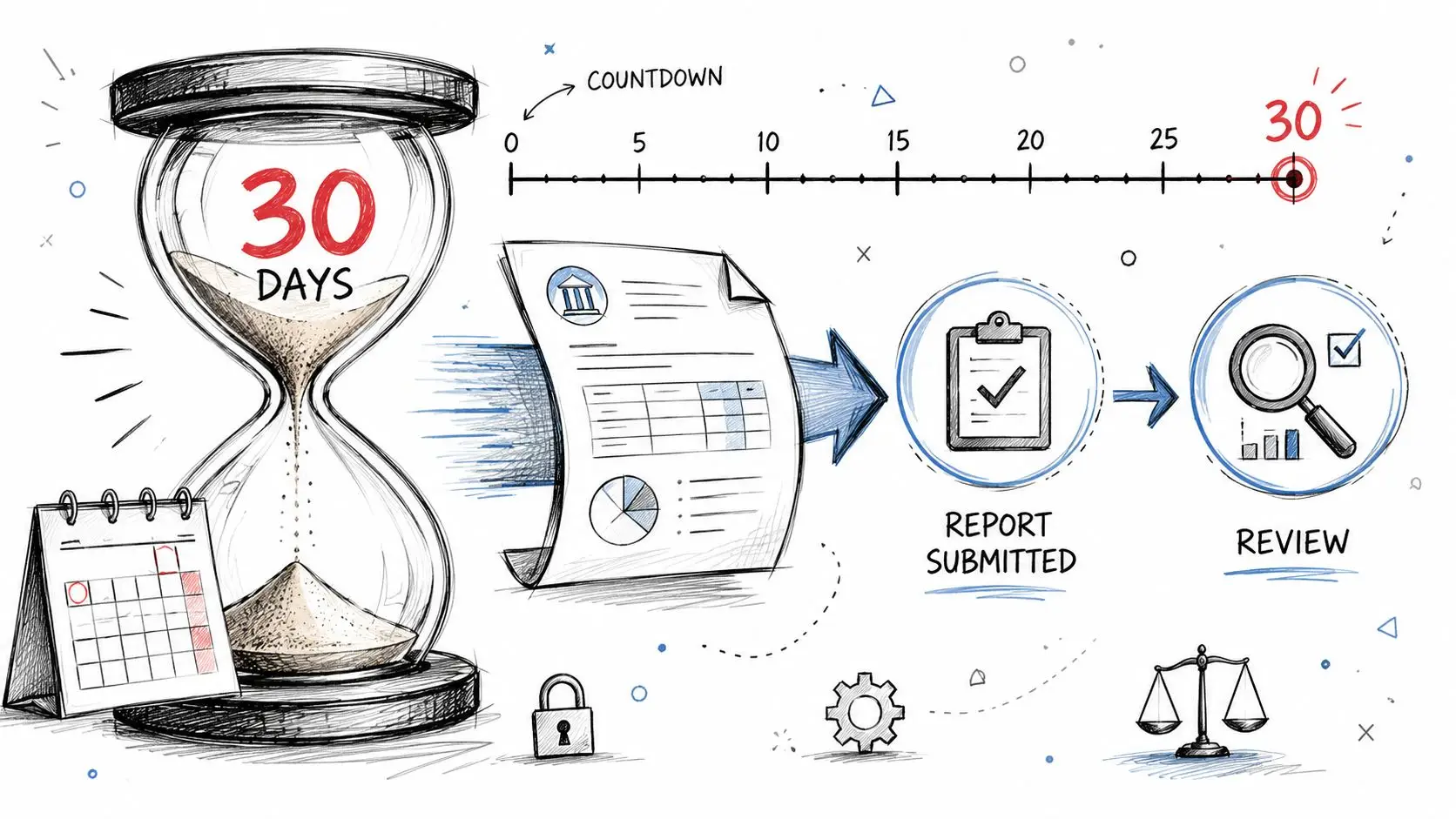
When suspicious activity reporting enters the picture, timing becomes legal risk. Delay creates exposure. Overreaction creates a messy record. The company needs a disciplined response built around facts, privilege, and document control.
The baseline protocol is strict. The standard SAR process requires e-filing within 30 days of detection, with five-year retention of reports and supporting materials, and the report includes five distinct data sections, including a detailed narrative, as summarized in this explanation of SAR filing requirements.
What the formal process requires
The filing framework typically includes these core elements:
- Subject identifiers such as names and identification details.
- Incident timing and activity codes tied to the suspicious conduct.
- Institution details and contact information.
- A narrative explaining what happened and why it looked suspicious.
- A formal declaration of the suspicious nature of the activity.
For executives, the narrative is the most important element. It translates scattered facts into a theory of concern. If the facts around your transaction are incomplete, contradictory, or poorly documented, the narrative may harden those weaknesses into the official record.
What usually happens after filing
A filed report doesn’t guarantee visible enforcement. It does, however, increase the chance of follow-up friction. Banks may seek more information, increase monitoring, reconsider account tolerance, or pause activity while they assess ongoing exposure.
That aftermath creates two parallel tasks for management.
- Preserve business continuity: Keep payroll, supplier payments, and core operations insulated from a single account issue where possible.
- Protect legal position: Centralize communications through counsel where legal assessment begins, and avoid casual internal commentary.
The first internal email after a bank inquiry often matters more than the tenth. It usually sets the tone, the fact pattern, and the list of people who become witnesses later.
Privilege and data governance are not side issues
Cross-border companies often make the same mistake here. They launch a wide internal review through ordinary business channels. Finance sends summaries. Operations adds context. Regional managers forward old messages. Someone drafts a timeline that mixes facts with blame. By the time external counsel reviews the file, the record is already contaminated.
A safer approach looks different:
- One intake point: All bank and regulator communications flow through a designated legal lead.
- One chronology: The company maintains a master timeline supported by primary documents.
- One evidence map: Contracts, invoices, approval trails, KYC files, and payment records are indexed immediately.
- Controlled interviews: Counsel decides who needs to be asked, in what order, and for what purpose.
That discipline doesn’t obstruct cooperation. It improves it. Authorities and financial institutions respond better to a company that can produce a clean chronology, stable explanation, and targeted supporting records.
Building Your Internal Response Playbook
Companies that wait for a bank alert are already operating from a weak position. A stronger posture starts earlier, inside transaction planning, contract drafting, and dispute governance.
An internal playbook should treat suspicious activity reporting as part of enterprise legal risk. It belongs beside data incidents, high-value contract failures, and urgent shareholder disputes.
The core elements of a workable playbook
The first requirement is a clear escalation rule. Finance teams need to know when a transaction pattern stops being routine and starts requiring legal review. That rule should cover unusual routing, unexplained changes in counterparties, payment splitting, funding source shifts, and pressure to bypass standard approvals.
The second requirement is targeted training. Generic AML lectures won’t help a commercial team negotiate a founder settlement or franchise amendment. Training should use the company’s real transaction types, real approval paths, and real cross-border counterparties.
A practical playbook usually includes:
- A named response lead who owns intake and coordination.
- A counsel trigger for situations that may affect privilege, account access, or litigation exposure.
- A document protocol that locks down drafts, approvals, payment records, and messaging history.
- A banking response plan for requests, delays, or restrictions.
- A board notification standard for material cross-border issues.
What boards and CEOs should insist on
Leaders should ask for evidence, not reassurance. “Compliance reviewed it” isn’t enough when the risk sits inside deal structure or dispute conduct.
A board-level review should test whether the business can do three things well:
- explain the commercial purpose of unusual transactions;
- identify who approved each deviation from normal process;
- respond quickly if a bank or counterparty reframes the facts aggressively.
This same discipline also strengthens adjacent risk areas such as disputes over commercial lease agreements, where payment conduct, control failures, and incomplete records can reshape bargaining power unexpectedly.
The recommended strategic path is simple. Build the response system before the crisis, not during it. That approach reduces operational shock, protects legal position, and gives management room to act with precision instead of urgency.
Avoid costly mistakes by getting the legal strategy right before a bank inquiry, partner dispute, or cross-border payment issue escalates. For specific guidance on suspicious activity reporting, Israeli exposure, and complex commercial risk, contact RNC Group now.
This article provides general information only and doesn’t constitute legal advice. It doesn’t replace legal counsel suited for specific facts, jurisdictions, and business objectives, and any reliance on it is solely at the reader’s own risk.