
A standard partnership agreement often fails at the exact moment a foreign investor needs it most. The critical question for 2026 isn’t whether the deal looks balanced on signing day. It’s whether the document can stop a cross-border dispute, protect cash movement, and preserve control when an Israeli venture hits friction.
Many non-Israeli clients enter Israeli partnerships with documents drafted for domestic use elsewhere. That approach creates avoidable exposure. Israeli tax rules, partnership limits, enforcement mechanics, and banking scrutiny can turn a familiar agreement into an operational risk.
A capable Business Partnership Lawyer doesn’t just record commercial terms. Counsel must build a control system. That system has to govern authority, exits, deadlock, and payment channels before the first conflict appears.
Is Your Partnership Ready for 2026 Regulations
Foreign companies still ask the wrong opening question. They ask whether the Israeli partner is trustworthy. They should ask whether the agreement can survive regulatory pressure, internal disagreement, and banking intervention.
That distinction matters because cross-border partnerships fail through process gaps, not only bad faith. A document can look polished and still leave control over signatures, notices, capital calls, and dispute venue dangerously vague.
The hidden risk in a familiar structure
Israel gives business opportunities real speed. However, speed without legal architecture creates exposure. A foreign board may approve a joint venture, appoint a local operator, and assume the standard form used in London, New York, or Berlin will work unchanged in Israel.
It often won’t.
A cross-border arrangement with an Israeli entity has to account for local formation rules, tax registration, practical banking scrutiny, and enforceability abroad. If those pieces don’t fit together, the problem won’t stay inside the contract file. It will show up in frozen funds, delayed launches, blocked approvals, or a deadlock that no one can unwind cleanly.
Board-level rule: If the agreement doesn’t define who controls money, notices, and exits under stress, then the partnership isn’t ready.
Why 2026 thinking starts before signature
Boards preparing for 2026 shouldn’t treat legal drafting as a closing task. They should treat it as a risk sequencing exercise. First, map the revenue path. Next, map control over cash, approvals, and intellectual property. Then, test what happens if one side stops cooperating.
That discipline separates transactional law from strategic law.
The same logic explains why demand for commercial counsel remains strong. As of 2025, the United States had 279,438 business lawyers and attorneys operating in business entities, reflecting a 0.8% increase from the prior year according to IBISWorld data on business lawyers and attorneys. The number matters less than the reason behind it. Commercial structures keep getting more complex, and boards need lawyers who can draft for operational reality.
Non-Israeli companies entering Israeli ventures need that discipline early. They don’t need broad reassurance. They need a document that can withstand conflict.
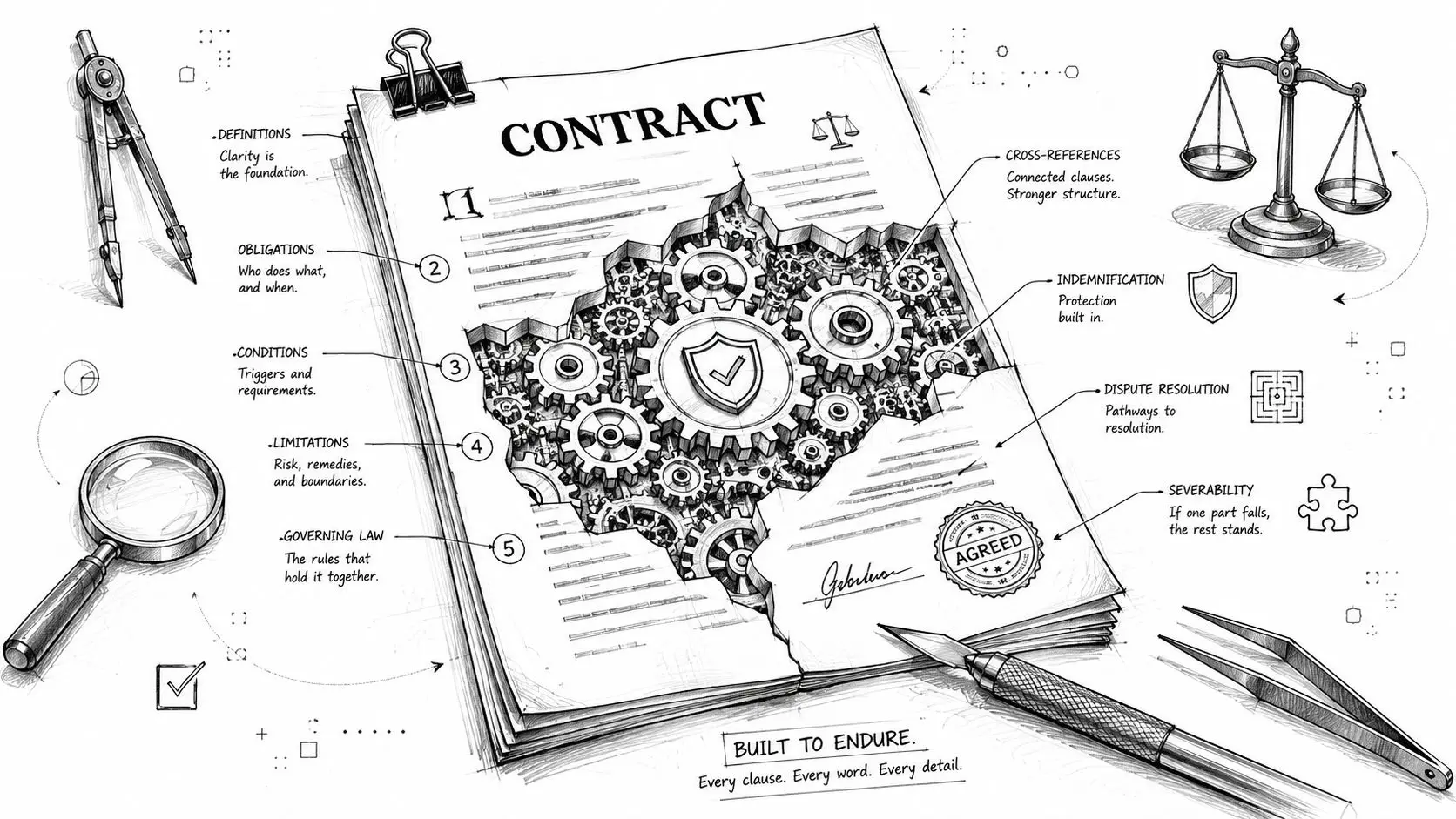
The Anatomy of a Bulletproof Partnership Agreement
A strong agreement doesn’t try to sound complete. It assigns power with precision. Every clause should answer a practical question that will arise under pressure.
Governance must control real behavior
Most failed agreements spend too many pages on economics and too few on decision rights. Profit sharing matters, but control matters first. Who appoints directors. Who can bind the company. Which matters require unanimity. Which decisions move by ordinary majority. What happens when one side refuses to attend a vote.
Those aren’t technicalities. They’re the operating spine of the venture.
A strong drafting process usually addresses:
- Authority to sign: Name the people who can bind the venture, the parent entities, and any financing documents.
- Reserved matters: List approvals for debt, hiring, licensing, dividends, asset sales, and related-party transactions.
- Capital calls: State when extra funding can be demanded, who contributes, and what dilution or default follows non-payment.
- Information rights: Require timely delivery of accounts, tax records, banking notices, and compliance reports.
- Director appointment rights: Tie board seats to ownership, but also define replacement mechanics and emergency appointments.
For comparative planning, founders who also review international formation options often look at EU company setup for global founders to understand how corporate structures differ across jurisdictions. That comparison is useful because it highlights a core truth. Governance language that works in one market may fail badly in another.
The most litigated clauses usually look harmless
The dangerous clauses are often the shortest ones. “Commercial collaboration.” “Best efforts.” “Mutual consent.” Those phrases invite argument because they sound flexible while saying very little.
Exit drafting is where this becomes expensive. In international business partnerships, 68% of cross-border disputes arise from inadequately defined exit clauses and governance mechanisms in founder agreements, with the median cost of resolving such disputes reaching $1.2 million per case when litigation occurs, according to this analysis of international business law disputes. That figure should change how boards read the back half of a partnership agreement.
Vague governance language doesn’t preserve relationships. It transfers bargaining power to the first party willing to create disruption.
Ownership and economic rights must match the deal model
Many disputes begin because the contract bundles unlike rights together. Equity, management power, IP ownership, client ownership, and distribution rights should not sit in one loose paragraph. They should be separated and sequenced.
A business partnership lawyer should isolate at least four ownership buckets:
| Rights Area | What the agreement should define |
|---|---|
| Equity ownership | Percentage, vesting or transfer restrictions, and dilution rules |
| IP ownership | Pre-existing IP, newly created IP, licensing scope, and post-exit use |
| Revenue rights | Dividends, management fees, royalties, reimbursements, and timing |
| Client and data rights | Ownership of leads, CRM records, confidential data, and use after termination |
This discipline is especially important in technology, licensing, and management-service structures. A foreign company may think it owns the product while the Israeli operating entity claims rights over local adaptations, customer data, or source materials.
Boards should also examine the contract architecture used in adjacent commercial deals. A useful professional reference point is commercial contracts in Israel, because strong contract drafting in one commercial channel often reveals what your partnership document still lacks.
Dispute Prevention and Phased Escalation
The best dispute clause doesn’t celebrate litigation. It delays it. A mature commercial structure creates pressure to solve the problem while facts are still manageable and before public filings harden positions.
Litigation-first drafting usually loses control
Many agreements use a one-line dispute clause. It says the parties may sue in a named court or proceed to arbitration. That clause looks efficient. In practice, it often accelerates conflict because it gives the angriest executive the shortest route to escalation.
A phased system works better. The sequence should force senior engagement before formal proceedings begin. That means executive negotiation first, mediation second, and only then arbitration or litigation if the dispute survives.
This isn’t soft drafting. It’s strategic containment.
A board should treat a partnership dispute as a corporate incident, not a private argument between founders.
What a phased clause should actually do
A practical escalation framework should define timing, participants, notice mechanics, confidentiality, and interim operational rules. It should also state what continues during the dispute, including payroll, customer service, bank authorization, and access to records.
A useful sequence often includes:
- Formal notice of dispute with clear issue framing and document exchange.
- Executive conference within a fixed short period, attended by decision-makers only.
- Mediation with a named institution or agreed selection process.
- Interim preservation measures that prevent asset dissipation or unilateral data capture.
- Arbitration or litigation only after the earlier gates are completed, unless urgent injunctive relief is required.
The same containment logic appears in broader crisis work. Boards assessing early-fact development and internal evidence handling may also review external frameworks for corporate investigations, particularly where misconduct allegations overlap with partnership breakdown.
Why staged pressure changes outcomes
A dispute clause should alter behavior before any filing occurs. It should force the parties to speak through identified channels. It should stop side communications with employees, banks, and vendors. It should narrow the factual battlefield early.
That is why structured escalation deserves board attention. The 2024 international dispute study cited earlier also reported that partnerships with phased escalation protocols reduce litigation duration and settlement costs compared with litigation-only agreements, because early mediation and controlled sequencing prevent avoidable escalation. The practical lesson is simple. Process design affects outcome.
For companies dealing with reputational and operational stress, a related professional reference is commercial crisis management in Israel. It reflects the same principle. Controlled escalation preserves options.
Designing Your Partnership Exit Strategy
Most partners postpone exit drafting because they think it signals distrust. The opposite is true. A clear exit framework protects the venture while the relationship is still healthy enough to negotiate rationally.

Exit terms should start with trigger events
An exit clause must answer one operational question. What event forces a transition from partnership to separation. If the agreement doesn’t state that clearly, every serious disagreement becomes a debate about whether the exit machinery even starts.
Typical trigger events include death, disability, insolvency, deadlock, regulatory breach, material default, change of control, or sustained failure to fund agreed obligations. However, naming the event isn’t enough. The contract must also define notice requirements, cure periods, valuation date, and interim management control.
A business partnership lawyer should make each trigger observable. “Loss of confidence” is too vague. “Failure to fund an approved capital call within the agreed cure period” is enforceable.
Buy-sell mechanics need precision, not slogans
Boards often ask for a shotgun clause because it sounds decisive. Sometimes it is. Sometimes it rewards the party with deeper liquidity. Rights of first refusal, put and call options, drag-along rights, tag-along rights, and compulsory transfers each fit different ownership structures.
The right choice depends on advantage and business continuity.
Consider the trade-offs:
- Shotgun clauses: Fast, but they can coerce weaker partners into bad timing.
- Rights of first refusal: Protective, but they can slow a sale and chill third-party buyers.
- Call options on breach: Effective where one side controls key operations.
- Put rights after deadlock: Useful when continuity matters more than preserving equal control.
Practical warning: An exit mechanism without a valuation formula is an invitation to litigation.
Valuation should be agreed before anyone is angry
Valuation fights poison exits because they turn the operating dispute into a pricing war. A strong agreement chooses the method in advance and ties it to a clear process. That may involve a pre-agreed formula, an expert determination, or an appraiser selection method with strict instructions.
The method matters as much as the number. EBITDA-based formulas may suit some trading businesses. Asset-based approaches may fit others. IP-heavy companies, management-service structures, and early-stage ventures may require different logic altogether.
A prudent agreement also states:
- Who appoints the valuer
- What records the valuer may review
- Whether discounts apply
- Whether the determination is final
- How payment is staged after valuation
A foreign investor should also ask what happens if the exiting party still holds local banking authority, key employee relationships, or customer credentials during the transfer period. Exit drafting isn’t only about price. It’s about continuity.
For disputes that have already moved beyond drafting failure, complex commercial litigation in Israel offers a useful reference point on how courts and pressure tactics interact once prevention fails.
Navigating Israeli and International Legal Frameworks
Foreign companies don’t struggle in Israel because the market is inaccessible. They struggle because domestic and cross-border rules intersect in ways that standard offshore drafting doesn’t address.

Israeli partnership rules affect structure from day one
In Israel, a general partnership is formed by two or more persons carrying on a business together for profit under the Partnerships Ordinance, and the number of partners is generally capped at 20 unless a statutory exception applies, as summarized in the Auren Israel guide. That rule alone can affect how a non-Israeli group structures an expansion, especially where multiple investors, operating managers, or professional participants expect direct partnership status.
Foreign boards should also avoid assuming that “joint venture” means a tax-neutral operating label. If the Israeli venture conducts business domestically, VAT treatment becomes immediate and concrete. The Israeli VAT Authority requires an Israeli joint venture company conducting business in Israel to register and charge VAT at the current rate of 17% on taxable supplies, as explained in this guide to a joint venture agreement in Israel. That affects pricing, cash flow, invoicing, and profit assumptions from the outset.
Banking friction is not a side issue
Many foreign companies still treat bank account restrictions as a compliance afterthought. That is a mistake. Banking friction can interrupt payroll, vendor payments, investment tranches, and even basic market entry.
Benchmark data indicates that 74% of Israeli companies expanding internationally face bank account blockages or asset freezes within 18 months, primarily due to jurisdictional conflicts in partnership agreements and unenforced compliance protocols, according to this review of internationally interested business professionals. For a non-Israeli commercial client, that isn’t a niche risk. It’s a core operational threat.
A strong agreement should therefore connect legal drafting to bank-facing practice. That means:
- Neutral dispute venue: Choose arbitration language that banks and counterparties can understand quickly.
- Dual-signature payment controls: Prevent unilateral transfers in sensitive transactions.
- Compliance undertakings: Allocate AML-related responsibilities clearly.
- Document retention rules: Preserve the records needed when a bank asks for commercial justification.
International enforcement must be built in
Cross-border drafting fails when it assumes every later dispute can be solved in one domestic court. It can’t. Enforcement, recognition, and practical advantage matter just as much as substantive rights.
Jurisdictional design holds strategic importance. Clauses that identify a neutral arbitral venue, define the procedural rules, and align with enforceability frameworks can reduce later chaos. The same benchmark review noted that specific clauses, including neutral arbitration arrangements and dual-signature protections for higher-value transactions, reduced freezing incidents in the cases it examined.
For foreign businesses, the primary advantage comes from pairing Israeli legal knowledge with international execution capacity. A firm connected through the ADVOC network can coordinate trusted legal partners and business contacts across over 73 countries, which is especially important when an Israeli dispute spills into offshore assets, foreign affiliates, or parallel proceedings. The legal issue may begin in Israel. The enforcement problem often doesn’t end there.
A related practical reference is bank account restrictions in Israel, because account limitation issues often sit at the center of broader partnership crises.
How to Hire the Right Business Partnership Lawyer
Choosing counsel for an Israeli partnership isn’t a branding exercise. It is a stress test. The board needs to know how the lawyer drafts under uncertainty, how the lawyer thinks about exits, and how the lawyer reacts when a bank, regulator, or counterparty creates pressure.
Start with the lawyer’s operating method
Ask for the lawyer’s drafting philosophy before discussing fees. A serious answer should cover governance, escalation, banking controls, and exit mechanics. A weak answer usually sounds like this: “We use an extensive template and adjust it.”
That isn’t enough for a cross-border Israeli venture.
The better question is whether the lawyer builds documents around likely failure points. Those include deadlock, payment authority, VAT handling, notice mechanics, data access, IP ownership, and cross-border enforcement. If counsel can’t explain how those pieces interact, the document may read well and still fail in a crisis.
Hire the lawyer who can identify how the deal breaks. Not the lawyer who says it probably won’t.
Interview for judgment, not just credentials
Reputation matters. So does technical skill. However, boards often miss the more important issue. Can the lawyer make good strategic choices before facts are complete.
The following checklist exposes that quickly.
| Question Category | Specific Question to Ask |
|---|---|
| Cross-border disputes | How would you draft the dispute clause to protect an overseas investor if the Israeli partner controls local operations? |
| Exit planning | Which exit triggers would you define for this deal, and which ones would you leave out? |
| Banking risk | How would you draft authority and compliance provisions to reduce the risk of payment blocks or account restrictions? |
| Governance | Which decisions should require unanimity, and which should remain with management? |
| Capital calls | What happens if one side refuses to fund an approved capital requirement? |
| IP and data | Who should own local adaptations, customer data, and work product created after closing? |
| Enforcement | If the dispute leaves Israel, how would you improve recognition and enforcement abroad? |
| Crisis handling | What would you do in the first week after a serious founder deadlock? |
A good commercial lawyer should answer with examples of process, not generic confidence. In adjacent sectors, experienced investors often review specialist role definitions before retaining counsel. For example, sponsors exploring pooled real estate structures may learn about syndication attorneys to understand how sector-specific legal risk changes the engagement. The same logic applies here. Partnership work is not interchangeable with general corporate drafting.
Fees should be judged against risk, not comfort
Clients often ask whether hourly billing, a fixed fee, or a retainer is best. The answer depends on the stage of the matter. Fixed fees can work for initial drafting with defined scope. Hourly billing often fits negotiations, restructurings, or active disputes where variables change quickly. A retainer may suit a company entering several linked contracts at once.
Boards should also understand why top-tier partnership and dispute counsel command premium pricing. The average compensation for law firm partners in the United States reached $1.4 million in 2024, representing a 26% increase since 2022, according to the Major, Lindsey and Africa partner compensation survey release. That figure doesn’t tell a client what any specific lawyer should cost. It does show that senior commercial legal judgment carries serious market value.
The right comparison isn’t “What is the cheapest drafting quote?” The right comparison is “What is the cost of a weak agreement if control fails later?”
The final screen before appointment
Before instructing counsel, a non-Israeli client should require three concrete deliverables:
- A risk map identifying the venture’s likely conflict points
- A clause architecture note explaining dispute, banking, governance, and exit design
- A cross-border enforcement view showing how the structure would operate outside Israel
If counsel resists that discipline, move on. A board doesn’t need optimism. It needs a lawyer who can turn uncertainty into controlled options.
Your Recommended Strategic Path
Non-Israeli companies entering partnerships with Israeli entities should reject boilerplate comfort. The strategic path starts with structure. Define authority clearly. Build phased escalation before any disagreement exists. Draft the exit before trust gets tested. Align Israeli legal requirements with international enforcement from the first draft.
A Business Partnership Lawyer adds value only when the document controls real-world pressure. That means banking safeguards, precise governance, enforceable dispute routes, and a practical separation mechanism. It also means anticipating where local law and cross-border execution collide.
The recommended strategic path is simple. Treat the partnership agreement as a crisis-prevention instrument, not a ceremonial closing document. Boards that do that maintain their advantage. Boards that don’t often discover the weakness only after money, control, or market access is already at risk.
Avoid costly mistakes before they become disputes. For a strategic review of an Israeli partnership structure, cross-border risk exposure, or a live commercial crisis, contact RNC Group through the firm’s contact page.
Partnerships do not fail on intent. They fail on what the agreement never said.
Decision rights, exit mechanics and deadlock resolution decide whether a disagreement is a bump or a breakup. A partnership agreement written for the bad day is what protects the good ones.
We draft partnership agreements and resolve partner disputes. Reach us on WhatsApp or by email.
This article provides general information only. It does not constitute legal advice, does not create an attorney-client relationship, and should not be relied on as a substitute for case-specific legal analysis of any Israeli or cross-border commercial matter.