
A 2026 cross-border acquisition can close, transfer the purchase price, and still leave its most expensive risk buried in a note. An Israeli technology buyer may discover a dormant regulatory investigation during the opening-balance audit. The target may call the exposure possible, not probable. The buyer’s auditors may demand fuller contingent liability disclosure before accepting the accounts.
That disagreement can change the deal economics. The parties may contest the indemnification basket, renegotiate the escrow, and delay an earn-out trigger until the teams quantify the exposure. Legal, accounting, and commercial teams often assess the same facts through different default standards.
When a Signed Deal Suddenly Depends on a Footnote
The buyer’s first problem usually appears after signing, when the transaction team no longer controls the target’s historical record. A European subsidiary may hold correspondence about an investigation that never reached formal proceedings. Local counsel may describe the matter as manageable. The group auditor may still view the correspondence as evidence that users need a clearer explanation.
A short note can therefore create a long negotiation. If the disclosure omits the investigation’s nature, potential effect, timing, or uncertainty, the buyer may argue that the target failed to present a complete risk picture. The seller may respond that the available evidence doesn’t support recognition or a reliable estimate.
Practical rule: Recognition and disclosure require separate decisions. A matter can remain off the balance sheet while still requiring meaningful note disclosure.
The dispute becomes commercial when the parties apply the disclosure to the purchase agreement. The buyer may seek a specific indemnity outside the general cap. The seller may resist because the disclosure already appeared in the accounts. The parties may also debate whether an escrow should secure the exposure or whether an earn-out should remain suspended.
Why the accounting note affects the contract
Auditors assess financial statements. Transaction lawyers allocate risk. Those functions overlap because the note often becomes evidence in later arguments about knowledge, materiality, and contractual disclosure.
A buyer’s diligence team should compare the note against legal correspondence, regulatory communications, insurance policies, and board materials. A seller should test whether the note accurately describes the uncertainty without overstating an unproven claim.
IAS 37 created a globally recognized baseline for this process. The standard was originally issued in September 1998 by the International Accounting Standards Committee and later adopted by the IASB in April 2001. It replaced earlier IAS 10 contingency guidance issued in 1978, moving reporting toward a more framework for uncertain obligations. IAS 37 issued standard
The lesson for a cross-border deal is direct. A footnote shouldn’t merely protect the financial statements. It should support a defensible allocation of risk in the SPA.
What Contingent Liability Disclosure Actually Means
A contingent liability is a possible obligation arising from past events. Its existence depends on a future event outside the entity’s control. IAS 37 also treats a present obligation that doesn’t meet the recognition criteria as a contingent liability for disclosure purposes.
That definition separates three ideas that teams often combine:
- A provision represents an obligation that meets the recognition requirements. The entity recognizes it because an outflow is probable and the amount can be estimated reliably.
- A contingent liability remains uncertain enough to avoid balance-sheet recognition. The entity may still need to disclose it in the notes.
- An accrual records an expense or liability when the accounting framework supports recognition. The label doesn’t decide the outcome. The underlying evidence does.
Apply the recognition test first
Start with the obligation. Did a past event create a present duty, or does a future event determine whether any duty exists? Next, assess the likelihood of resource outflow. Finally, determine whether the entity can make a reliable estimate.
If the item fails recognition, stop there only for the balance sheet. The team must then perform a separate disclosure analysis. Under IAS 37, disclosure generally applies unless the possibility of outflow remains remote. The note should describe the contingency, its possible financial effect where practicable, uncertainties about amount or timing, and expected reimbursement. IAS 37 disclosure requirements
Consider a pending warranty claim. Customers allege that a product defect caused losses, but the company has limited evidence about the defect rate and the legal outcome. The company may initially describe the matter as a contingent liability because the outflow remains uncertain.
Later, testing may confirm the defect. Counsel may identify a probable obligation, and finance may establish a reliable estimate. The company may then recognize a provision. However, recognition doesn’t erase disclosure duties. The notes may still need to explain the nature of the claim, estimation uncertainty, timing, and reimbursement.
Build the note around user understanding
A useful question asks whether a reasonable reader could understand the exposure from the note. A statement that merely says “various claims exist” may conceal the difference between a routine warranty dispute and a regulatory matter affecting a key license.
The IFRS for SMEs disclosure module presents the same practical checklist for each class of contingent liability. The entity should provide a brief nature description, an estimated financial effect when practicable, uncertainties about amount or timing, and any reimbursement possibility.
IAS 37 Versus US GAAP in Plain Language
IAS 37 and U.S. GAAP both distinguish recognition from disclosure. They don’t always produce the same note, timing, or estimation outcome. Multinational groups must therefore map the fact pattern before they prepare a consolidated package.
| Issue | IAS 37 | ASC 450 |
|---|---|---|
| Recognition | Recognizes a provision when a present obligation exists, an outflow is probable, and a reliable estimate can be made | Accrues a loss when the loss is probable and reasonably estimable |
| Unrecognized exposure | Discloses a contingent liability unless the possibility of outflow is remote | Discloses a material loss that is reasonably possible, or probable but not estimable |
| Estimation | Provides an estimate of financial effect where practicable, with uncertainty about amount or timing | Discloses the possible loss or range when material and determinable |
| Presentation model | Uses a distinct contingent liability category | Uses an accrual-plus-disclosure model for loss contingencies |
| Reimbursement | Addresses expected reimbursement in the disclosure | Requires separate analysis of recoveries and applicable presentation rules |
The comparison needs careful handling. IAS 37 doesn’t support the simplistic claim that every possible loss requires a gross undiscounted figure. Instead, it requires an estimate of financial effect where practicable, alongside uncertainty about amount or timing. U.S. GAAP similarly focuses on the nature of the contingency and a possible loss or range where the disclosure is material and determinable.
FASB Statement No. 5 standardized U.S. contingent liability disclosure. FASB Interpretation 14, issued in 1976, clarified the use of a range when estimating contingent liabilities, which made quantitative disclosure more useful to investors and creditors. SEC filing example applying U.S. GAAP
The reconciliation problem for Israeli groups
An Israeli dual-reporter may prepare local IFRS information and a U.S. reporting package. A litigation matter may require an IAS 37 note with a best estimate where practicable, while the U.S. analysis may focus on whether the loss is reasonably possible and material.
Remote matters generally don’t require accrual or disclosure under either framework. The hard cases sit between remote and probable. The group needs a documented probability map, a consistent materiality assessment, and an explanation for any different language.
SEC filing practice also shows why teams should preserve the methodology. Some issuers record the low end of a range when that amount represents the best estimate, then disclose the maximum reasonably possible loss separately. SEC contingent loss range example
How Much Uncertainty Can Stay Unsaid
The most difficult question isn’t whether a contingent liability exists. It’s whether silence would mislead a reader who needs to understand the company’s financial exposure.
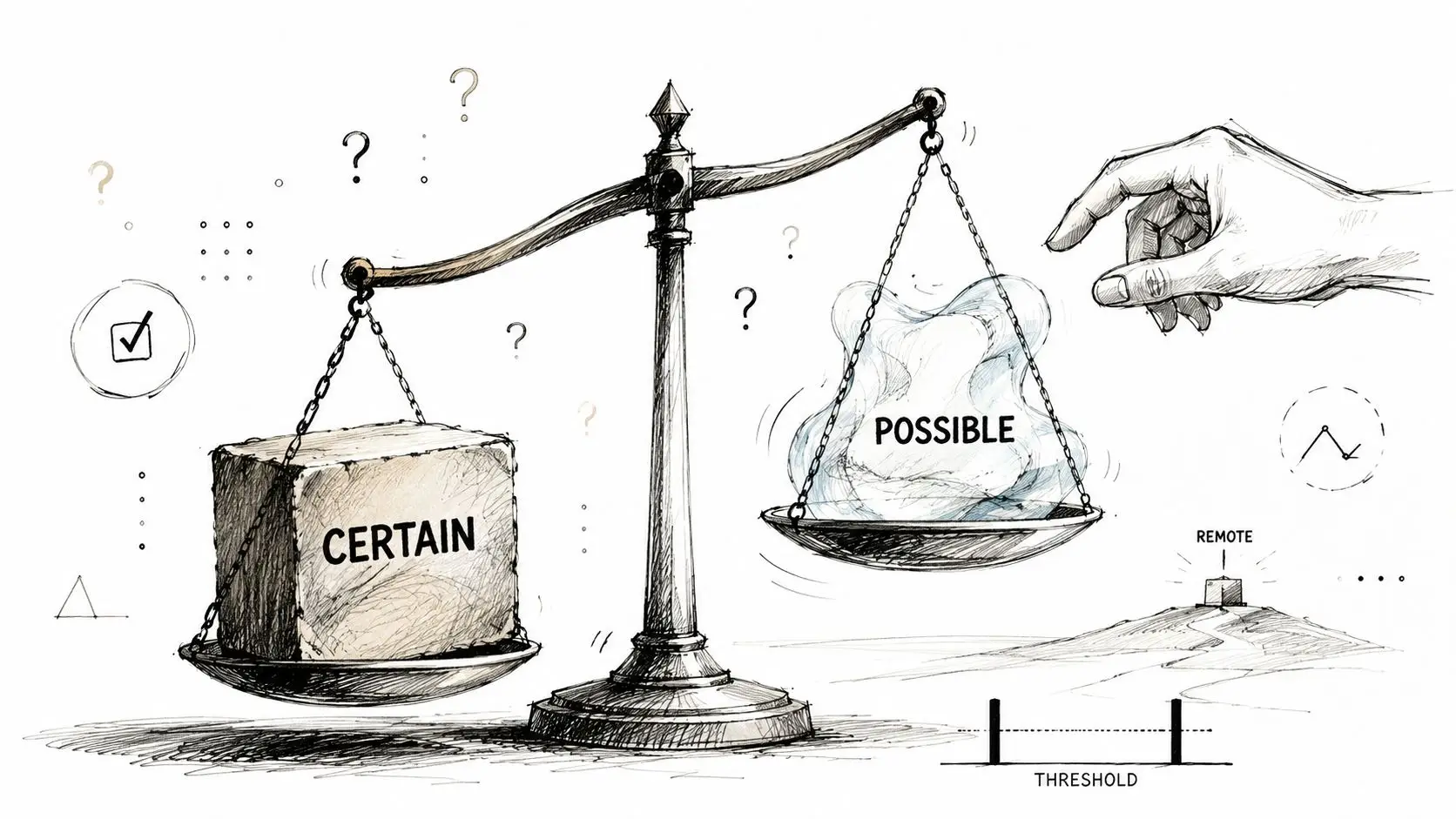
IAS 37 generally requires disclosure unless the possibility of outflow is remote. U.S. GAAP generally addresses exposures that are reasonably possible, or probable but not estimable, when the matter is material. Those phrases create judgment rather than a mechanical answer.
Four variables change the judgment
Materiality: A small isolated claim may not need the same treatment as a claim affecting a major contract, license, covenant, or acquisition valuation. Teams should assess both the amount and the nature of the exposure.
Range methodology: Finance should decide whether a single estimate, an expected value, or a range best represents the evidence. If a range provides the most faithful picture, the note should explain the range and its uncertainty.
Privilege: Legal advice may contain privileged analysis. Privilege doesn’t automatically remove the underlying exposure from the financial statements. Counsel should separate protected legal reasoning from factual descriptions that users need.
Insurance: Expected recovery can affect the analysis, but teams shouldn’t assume coverage without reviewing exclusions, limits, deductibles, notice requirements, and insurer reservations. The note should address expected reimbursement where relevant.
Aggregate disclosure can work when claims share similar characteristics and aggregation doesn’t hide a material issue. Itemized disclosure usually provides better transparency when one dispute carries unusual regulatory, reputational, or deal significance.
Silence becomes risky when the omitted fact could change a reader’s assessment of liquidity, valuation, compliance, or future cash needs.
Board minutes should record the evidence reviewed, the probability conclusion, the materiality reasoning, the range methodology, and the treatment of insurance. The record needn’t reproduce privileged advice. It should show that directors and management considered the recognition and disclosure tests separately.
Drafting Notes That Survive Auditor Scrutiny
Strong contingent liability disclosure uses facts, not conclusions. It identifies the dispute or guarantee, explains the uncertainty, and states the financial effect or range where practicable.
Passive language often fails because it hides responsibility and timing. “A claim has been received” doesn’t tell the reader who faces the claim, what event caused it, or how the company assessed the outcome. “Management believes” can also invite challenge when the sentence provides no evidence or range.
Draft by risk category
| Risk Category | Minimum-Compliant Wording | Best-Practice Wording | Auditor Red Flag |
|---|---|---|---|
| Pending litigation | The company faces a claim arising from a contract dispute. The outcome remains uncertain. | The claimant alleges breach of contract. The company contests liability. Counsel expects the matter to proceed through the applicable process. The company cannot estimate the outcome reliably. The possible financial effect includes legal costs and any award. Insurance recovery remains subject to policy review. | “Management believes the claim is without merit,” without describing the claim, uncertainty, or potential effect |
| Parent guarantees and performance bonds | The parent has issued guarantees for selected obligations of subsidiaries. | The parent guarantees specified payment or performance duties. The guarantees may require payment if the subsidiary defaults. The company assesses the likelihood of an outflow as remote, possible, or probable based on current evidence. Available reimbursement and collateral arrangements remain subject to their terms. | A list of guarantees without beneficiary, purpose, trigger, timing, or recovery information |
| Regulatory or antitrust investigations | A regulator is reviewing the company’s conduct. | The regulator is reviewing specified conduct in a defined market or transaction. The company has responded to requests for information. The investigation may result in penalties, remedial measures, or other consequences. The company cannot reliably estimate the amount or timing at this stage. | “The inquiry is routine,” without explaining scope or potential consequences |
The expanded wording should match the evidence. Counsel shouldn’t disclose a settlement figure that the record cannot support. A defensible range may communicate the exposure while protecting negotiation strategy.
Use a shared drafting checklist
- Separate the tests: Confirm recognition independently from disclosure.
- Align legal letters: Reconcile counsel’s probability language with the controller’s accounting conclusion.
- Describe uncertainty: Explain why the amount or timing remains uncertain.
- Quantify where practicable: Provide a single estimate or range supported by documented assumptions.
- Address recoveries: Identify expected reimbursement without treating uncertain insurance as guaranteed.
- Cross-reference captions: Link the note to any recognized provision, guarantee liability, or related balance-sheet line.
- Check consistency: Compare the note with the SPA, board materials, regulatory correspondence, and public filings.
IAS 37 paragraphs 84 to 92 and SEC Regulation S-K Item 103 require context, not decorative cautionary language. The note should let a reader understand what happened, what may happen, and why the company cannot yet state the final amount.
A Cross-Border Deal Walkthrough
An Israeli target disclosed a pending tax dispute in a short note. The note identified the authority and general subject, but it didn’t describe the exposure band, procedural stage, or potential effect on the transaction.
The buyer’s diligence team treated the omission as a valuation issue. The buyer demanded a specific indemnity, enlarged the escrow from 5% to 12% of the purchase price, and added an earn-out clawback tied to resolution of the dispute. Those percentages come from the anonymized deal scenario, not from published market data.
The negotiation turned on coordination
The seller’s general counsel coordinated Israeli counsel, U.S. M&A counsel, and the IFRS-reporting controller. Each adviser reviewed the probability assessment, the available tax correspondence, the potential range, and expected recovery.
The seller argued that the matter remained possible, not probable. The buyer argued that the note could reasonably be expected to mislead because it omitted information relevant to valuation and allocation of risk. The dispute later supported a price-adjustment claim under the buyer’s interpretation of the disclosure standard and applicable anti-fraud principles.
A separate insurance review also mattered. Cross-border transport, product, and performance exposures can involve different policy triggers, exclusions, and notice duties. Counsel reviewing operational guarantees may find this resource on insurance for cross border hauls useful when mapping recovery assumptions.
The avoidable errors
The parties could have reduced the dispute by taking several steps before signing:
- Obtain legal letters: Request jurisdiction-specific assessments before finalizing the disclosure schedules.
- Prepare exposure bands: Use documented ranges instead of unsupported settlement figures.
- Coordinate standards: Explain differences between the target’s IFRS analysis and the buyer’s U.S. reporting requirements.
- Draft express carve-outs: Exclude the tax dispute from the indemnity cap if the parties intend separate protection.
- Tie the earn-out carefully: Define resolution, payment timing, offsets, and the effect of a partial settlement.
- Preserve evidence: Keep the assumptions supporting the note and the SPA allocation.
A thin note doesn’t necessarily create liability. It does, however, weaken the seller’s ability to argue that the buyer accepted the risk knowingly.
Israeli and Cross-Border Risk Implications
Disclosure quality affects more than the annual report. Buyers and lenders use contingent liability notes to assess covenant headroom, indemnity exposure, escrow size, and earn-out reliability.
An Israeli parent may also face several reporting layers. Directors and shareholders may need information relevant to their decisions under the Companies Law. A public company may need to assess periodic or immediate reporting under the Securities Law. Regulatory or antitrust exposure can create additional urgency when an investigation affects a strategic transaction or operating license.
The exact reporting conclusion depends on the issuer, instrument, facts, and applicable rules. Counsel should therefore avoid treating financial-statement disclosure as a substitute for Israeli corporate and securities analysis.
Keep the reporting package consistent
A group reporting under IFRS and U.S. GAAP should maintain one factual record and separate conclusion sheets. The facts should remain consistent. The probability terminology, estimation approach, and note wording may differ where the standards require different treatment.
| Disclosure Quality | Covenant Impact | Indemnity / Escrow Outcome | Israeli Reporting Risk |
|---|---|---|---|
| Specific, quantified, and internally consistent | Lenders can assess available headroom | Parties can price risk and draft targeted protection | Supports a defensible review of director and issuer duties |
| Accurate but thin | Lenders may request clarification or tighter controls | Buyers may seek broader indemnities or larger escrow | Creates questions about omission and materiality |
| Inconsistent across reports | Covenant calculations may rely on conflicting information | Opposing parties gain leverage in claims | May expose the company and officers to reporting and fiduciary arguments |
| Unsupported reassurance | Reviewers may challenge the accounting conclusion | Buyers may pursue misrepresentation or price claims | Personal-liability arguments may become harder to defend |
Poorly calibrated language can also affect a material adverse change clause. A new investigation may not satisfy the clause by itself. Yet an earlier note that concealed its significance can strengthen the buyer’s argument that the risk was unexpected.
Directors should document why they approved the disclosure. Israeli fiduciary standards require careful decision-making, and a board record should show that directors considered material uncertainty, legal advice, insurance, and stakeholder impact.
Checklist and Common Questions for Counsel and Finance
The closing team should treat contingent liability disclosure as a controlled workstream. It should assign an owner, set a review date, and preserve the evidence behind each conclusion.
Operational checklist
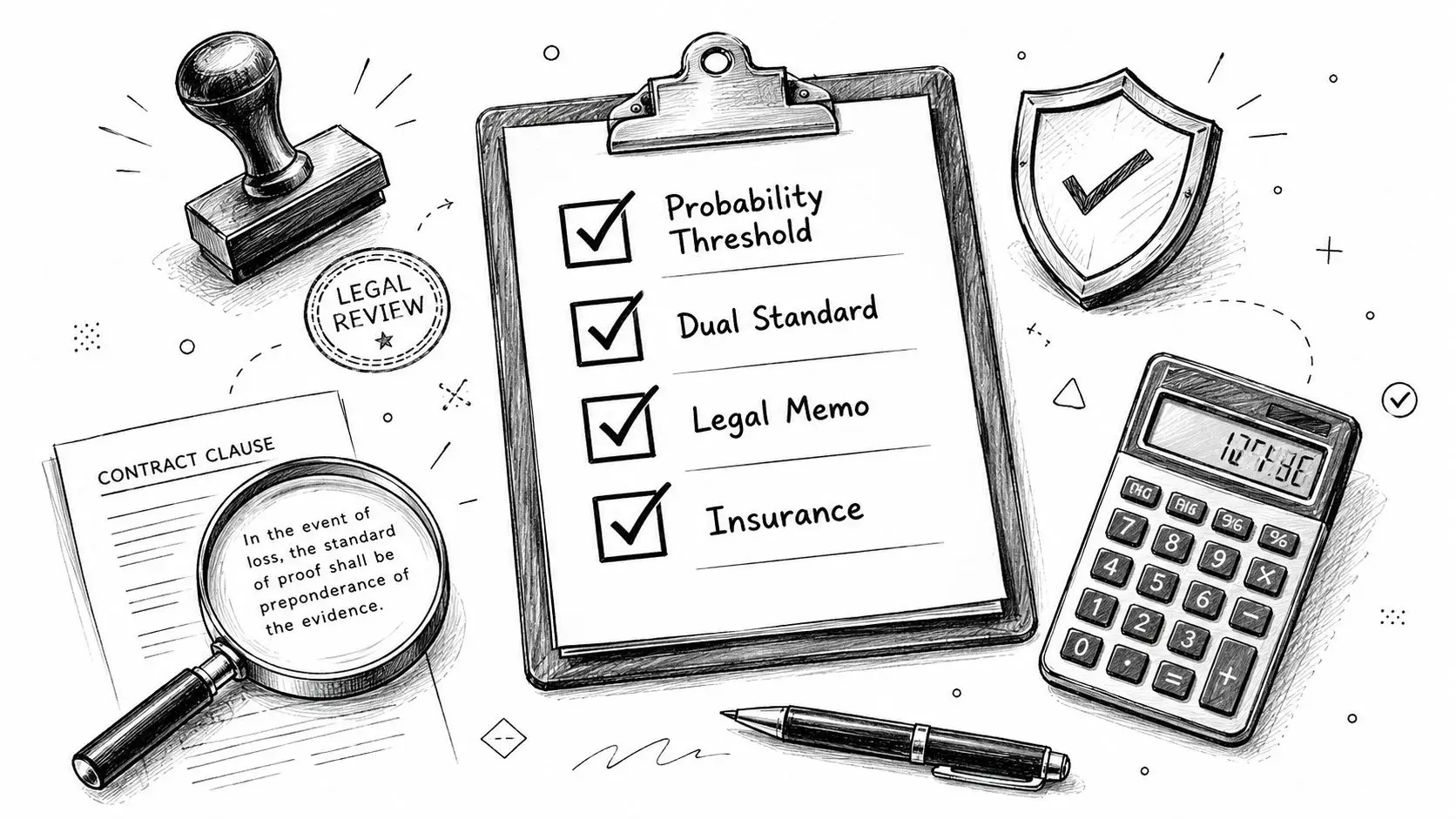
- Map probability language: Translate “possible,” “reasonably possible,” “probable,” and “remote” into a shared factual matrix.
- Reconcile standards: Prepare separate IAS 37 and U.S. GAAP conclusions when the group uses both frameworks.
- Confirm legal advice: Ask counsel to confirm the factual basis without circulating privileged analysis unnecessarily.
- Test recoverability: Review insurance, indemnities, guarantees, and reimbursement rights under their actual terms.
- Review consistency: Compare the note with the SPA, diligence responses, board papers, legal letters, and regulatory communications.
- Approve closing deliverables: Finalize the note, disclosure schedule, indemnity carve-outs, escrow instructions, and earn-out definitions together.
A diligence review should also test for hidden liabilities in acquisitions because accounting notes rarely capture every contractual, regulatory, and operational exposure in equal detail.
Questions that need clear answers
Must a remote threat appear in the note?
Generally, IAS 37 excludes remote outflows from disclosure. U.S. GAAP generally follows a similar approach. The team should still document why the threat qualifies as remote.
Can counsel describe an investigation without waiving privilege?
Yes, if the note states necessary facts and uncertainty without reproducing privileged legal strategy. Counsel should separate factual scope from protected opinion.
Should escrow mirror the disclosed exposure?
Not automatically. Escrow should reflect probability, timing, collectability, insurance, caps, baskets, and the parties’ negotiated risk allocation.
How should Israeli directors approach sensitive reporting?
They should obtain appropriate advice, identify the relevant reporting duties, and record the reasons for the chosen disclosure. Market sensitivity doesn’t justify silence when omission could mislead.
The recommended strategic path is to complete the probability matrix, legal-letter review, recovery analysis, and cross-border consistency check before signing. RNC Group offers international commercial advice covering M&A documentation, risk allocation, multilingual coordination, and Israeli cross-border disputes. Companies facing contingent liability exposure should contact RNC Group before a footnote becomes a valuation dispute.
This article provides general information and doesn’t constitute legal, accounting, tax, or financial advice. Readers shouldn’t rely on it without obtaining advice suited to the relevant facts, jurisdictions, reporting standards, transaction documents, and regulatory requirements.
A contingent liability hidden in diligence becomes your liability after closing.
Pending claims, guarantees and off-balance-sheet obligations decide the real price of the company. Disclosure schedules are where these fights are won or lost.
We run legal diligence and negotiate disclosure in M&A transactions. Reach us on WhatsApp or by email.
This article does not constitute legal advice and is not a substitute for consulting with a qualified attorney. Do not rely on the contents of this article for taking or refraining from taking any action.